Few skin concerns generate as much marketing noise as pores. Search online and you will find products and devices promising to “shrink,” “erase,” or “close” pores, and red light therapy is increasingly part of that conversation. Before you spend time or money chasing poreless skin, it helps to separate what is genuinely supported by evidence from what is wishful marketing. This article explores red light therapy pores research, separating realistic expectations from marketing claims and explaining what current evidence actually supports.
The most important truth comes first: pores are a normal, permanent feature of human skin, and no device can eliminate them. What can sometimes change is how noticeable they appear. That distinction — between removing pores and influencing their appearance — is the key to thinking clearly about this topic.
Understanding Red Light Therapy Pores
A pore is the visible opening of a hair follicle at the skin’s surface. Most pores are connected to a sebaceous gland, which produces sebum, the skin’s natural oil. Sebum travels up through the follicle and onto the skin, helping to keep it lubricated. Pores are essential to this process, which is why they cannot simply be closed or removed without harming normal skin function.
Pore visibility is influenced by several factors largely outside any single product’s control: genetics, skin type, oil production, sun exposure over time, and age. As skin matures and its supporting structures change, pores can look larger because the surrounding skin offers less support. Understanding these underlying causes makes it easier to see why claims of permanent “pore shrinking” deserve skepticism.
Why Red Light Therapy Pores Look Different
Pores tend to appear more prominent when they are filled with oil, dead skin cells, and debris, or when the skin around them is less firm. Several things can make pores look larger than they are, including excess sebum that stretches the opening, buildup that widens it, and a loss of firmness in the surrounding skin. Conversely, clean, well-hydrated, and reasonably firm skin can make the same pores look smaller and smoother.
This is why the realistic goal with any pore-focused routine is to influence appearance — not to physically shrink a fixed anatomical structure. Keeping that framing in mind protects you from disappointment and from overhyped promises.
How Red Light Therapy May Affect Pores
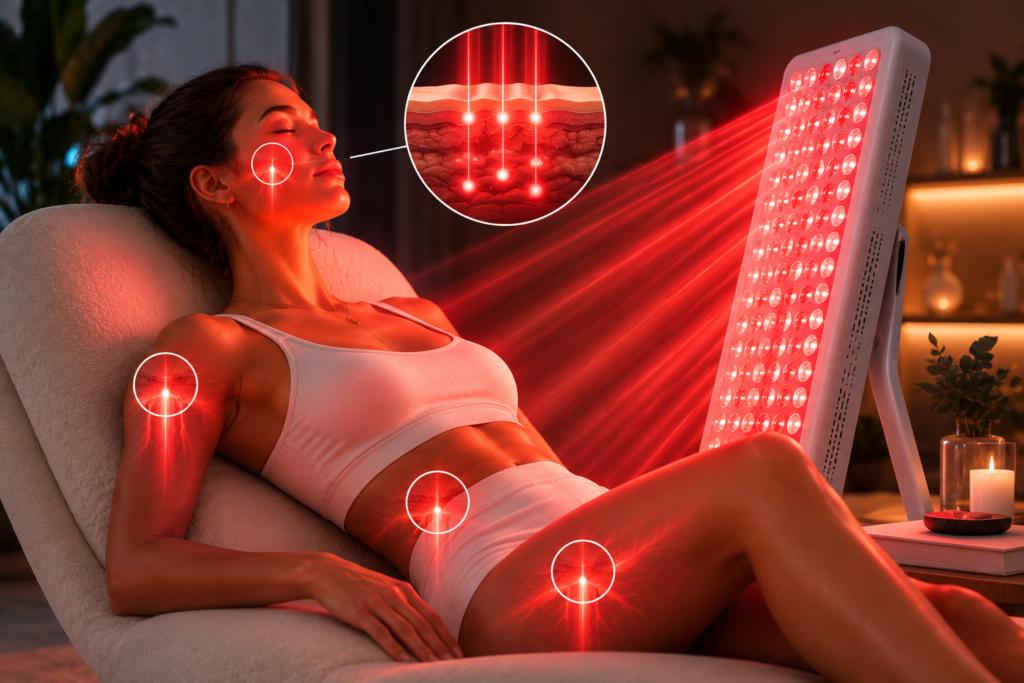
Red light therapy, also called photobiomodulation, delivers red and near-infrared wavelengths to the skin. According to Cleveland Clinic, it uses low levels of light to influence skin cells without the ultraviolet radiation that damages skin. Research on light-emitting diode (LED) phototherapy in dermatology suggests that red light may support certain skin-quality goals, such as the general look of texture and tone, by interacting with skin cells.
If red light contributes to smoother-looking, healthier-appearing skin overall, pores may look somewhat less conspicuous as part of that broader effect. This is an indirect, appearance-level possibility — not evidence that light physically reduces pore size. It is an honest framing supported by the cautious tone of the research rather than by bold claims.
Red Light Therapy Pores and Oily Skin
Because oil production affects how pores look, some people ask whether light therapy can reduce oiliness. The most relevant research here comes from the acne field, where certain light-based approaches are studied for their effects on the factors that contribute to breakouts. The American Academy of Dermatology notes that lasers and lights are studied as options for acne and that results vary, with these approaches often working best alongside other treatments rather than on their own.
It is important not to overextend this. Evidence specifically measuring “pore size” as an outcome is limited, and findings on oil control are mixed and device-dependent. Red light therapy may support clearer-looking skin for some people, but it should not be presented as a reliable way to control oil or shrink pores.
What Red Light Therapy Pores Research Shows
Here is the honest summary. There is reasonable research interest in red light and LED phototherapy for general skin quality, and some studies report improvements in the look of texture and tone. However, high-quality evidence focused specifically on pore size is limited, and many studies are small, use different devices and settings, and report varied results. More rigorous, standardized research is needed before anyone can claim that red light therapy measurably reduces pores.
In practical terms: red light therapy is not a proven pore treatment. It may, for some people, contribute to smoother, healthier-looking skin in which pores appear a little less noticeable. Results vary from person to person, and it is not a replacement for medical or dermatological care when a skin concern needs professional attention.
Realistic Red Light Therapy Pores Expectations
If you decide to try red light therapy as part of a skin routine, approach it the way the evidence suggests: as a possible supportive habit, not a guaranteed fix. Expect gradual, subtle changes at best, and only after weeks of consistent use rather than after a single session. Track how your skin looks over time rather than expecting an overnight transformation, and remember that lighting, hydration, and overall skin health all influence how pores appear on any given day.
Equally important is what red light therapy cannot do. It will not permanently close pores, eliminate them, or override the genetic and age-related factors that shape pore appearance. Anyone promising those outcomes is overstating the case.
Habits That Improve Red Light Therapy Pores Results
While red light therapy may play a modest supporting role, several well-established habits tend to have a more direct influence on how pores look. Gentle, consistent cleansing helps prevent the buildup of oil and dead skin that makes pores look larger. Daily sun protection matters because cumulative sun exposure can weaken the skin’s supporting structures over time, which can make pores more noticeable. Keeping skin hydrated supports a smoother surface, and avoiding harsh, over-aggressive scrubbing prevents irritation that can make pores look worse. These fundamentals are not glamorous, but they are reliable, and red light therapy is best viewed as a possible complement to them rather than a substitute.
Red Light Therapy Pores Safety
For most healthy adults, red light therapy at consumer doses is generally considered low-risk, with reported side effects that tend to be mild and temporary, such as brief warmth or redness. Even so, it is sensible to protect your eyes from bright light and to follow the device’s guidance on distance and session time. If you have a persistent skin concern, very oily or acne-prone skin that troubles you, a condition that makes you sensitive to light, or you take medication that increases light sensitivity, speak with a dermatologist or healthcare professional before starting. Red light therapy is a wellness practice that may support appearance goals, not a medical treatment for skin conditions.
The Bottom Line
Pores are a normal and permanent part of healthy skin, and no device can erase them. Red light therapy is not a proven pore treatment, and evidence focused specifically on pore size is limited. What the research more cautiously suggests is that red light may support smoother, healthier-looking skin in which pores can appear somewhat less noticeable for some people. Approached with realistic expectations, solid skincare basics, and professional guidance when needed, it can be a reasonable part of a routine — just not the pore-eliminating miracle the marketing sometimes implies.
Ready to get your red light therapy device? See our brand and product reviews, and try out our product comparison tool to inform your decision.
Frequently Asked Questions
Can red light therapy shrink or close my pores?
No. Pores are permanent anatomical openings and cannot be shrunk or closed by any device. Red light therapy may, at best, support smoother-looking skin in which pores appear somewhat less noticeable for some people.
Is there strong evidence that red light therapy reduces pore size?
No. Evidence focused specifically on pore size is limited. Some research suggests red light may support general skin quality, but more rigorous, standardized studies are needed before any pore-specific claims can be made.
Will red light therapy control oily skin?
Possibly for some people, but the evidence is mixed and device-dependent. Light-based approaches are studied mainly in the acne field, where results vary, so oil control should not be expected as a reliable outcome.
How long before I might see any change in pore appearance?
If any change occurs, it tends to be gradual and subtle, appearing only after several weeks of consistent use. Results vary, and many people notice little difference in pore appearance specifically.
Should I see a professional about my pores?
If oily or acne-prone skin, or the look of your pores, genuinely bothers you, a dermatologist can offer evidence-based options. Red light therapy is not a replacement for professional skin care.
This article is for general educational purposes only and is not medical advice. Red light therapy is not a substitute for professional care. Talk with a qualified healthcare professional about your individual situation.