OVERALL
4.5
BEST FOR
Travel, Targeted Recovery, Cordless Use
$249.99
WAVELENGTHS
630nm-830nm
IRRADIANCE
~14 mW/cm² at distance of 6 in.
COVERAGE AREA
Targeted (Face, joints, or lower back)
WEIGHT
1-1.5 lbs (0.45-0.68 kg)
Our Review
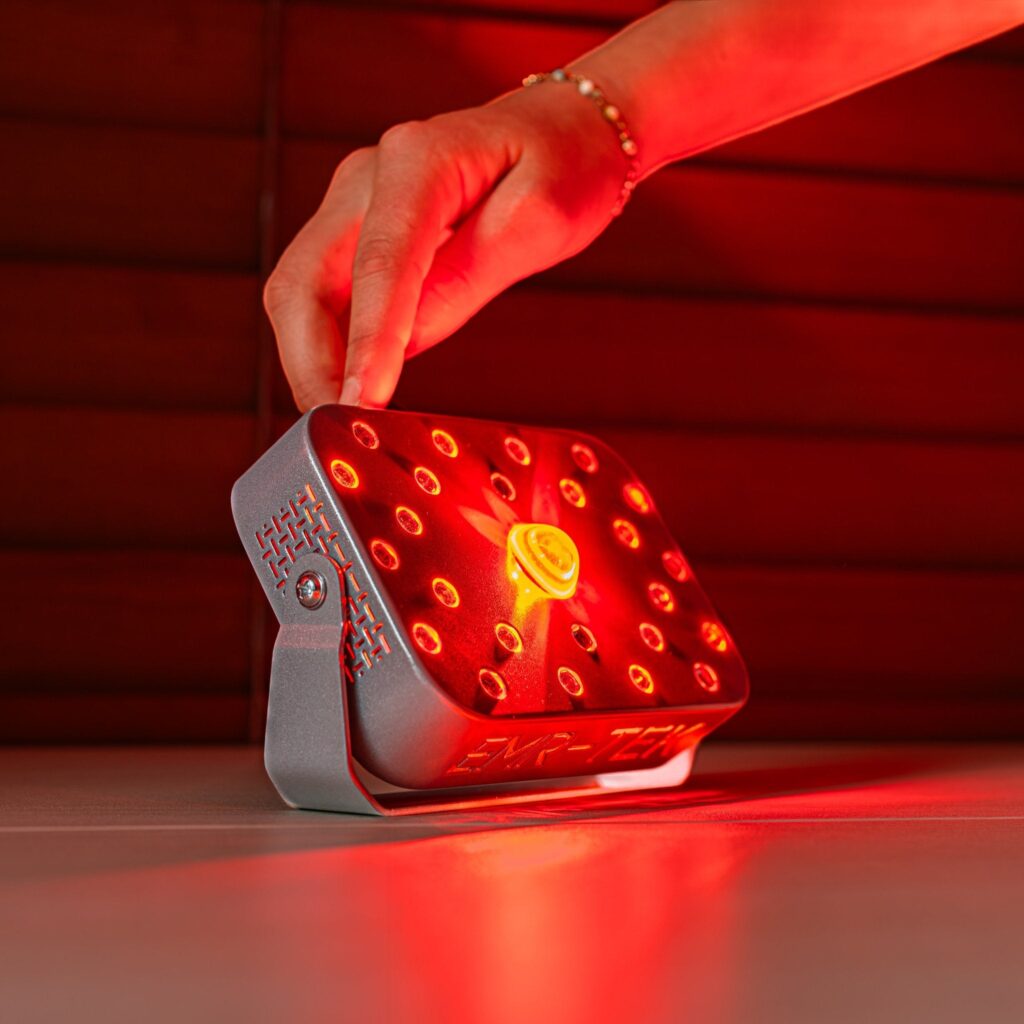
The EMR-TEK Firefly is built for portability. It takes the basic red and near-infrared light experience and puts it into a compact, rechargeable device that can be used at home, at work, or while traveling without staying connected to a wall outlet.
That portability comes with an obvious tradeoff. The Firefly is a targeted device, not a substitute for one of EMR-TEK’s larger panels. It makes much more sense for areas like the face, knee, shoulder, elbow, foot, or an individual muscle than for someone trying to treat most of the back or torso at once.
The Firefly is straightforward to work into a routine because there is very little setup involved. Charge it, position it over the intended area, select the desired light output and treatment time, and begin the session.
Its controls allow the red LED and near-infrared COB output to be selected rather than limiting the device to a basic on-and-off function. Adjustable treatment timing also means there is no need to keep checking the clock throughout a session.
The experience works best on areas that are easy to reach. Positioning the Firefly around a knee, abdomen, shoulder, or foot is relatively simple. Keeping a small device correctly aimed at the middle of the back can be much more awkward without assistance.
The Firefly is designed for localized treatments. Its compact light surface concentrates the output around a specific area rather than spreading it across a large section of the body.
That is useful when a larger panel would simply provide more coverage than necessary. Someone primarily treating one joint or muscle can position the Firefly where it is needed without setting up a permanent red light therapy area.
The limitation becomes more noticeable when several areas need to be treated. Moving the Firefly between the back, legs, shoulders, and other locations would require multiple positions and could use a significant portion of the available battery during one routine.
Someone who regularly wants large-area treatments will get considerably more practical coverage from a conventional panel. The Firefly makes more sense when portability and targeted use take priority.
The current EMR-TEK Firefly uses 630nm and 670nm red light alongside 830nm near-infrared light. This gives it two visible red wavelengths and one near-infrared wavelength in a much smaller format than the company’s conventional panels.
Buyers may come across older or inconsistent EMR-TEK information mentioning 660nm and 850nm, so we would check the specifications of the exact version being purchased rather than relying on older product information.
The Firefly combines 24 conventional LEDs with a COB light source. That allows EMR-TEK to concentrate a meaningful amount of output into a relatively compact device.
Actual power consumption is listed at approximately 21W. Published irradiance is above 57mW/cm² at three inches and above 19mW/cm² at six inches. Those figures are understandably lower than EMR-TEK’s larger panels, but the Firefly is a battery-powered targeted light intended to operate relatively close to the treatment area.
Cordless operation is one of the Firefly’s biggest advantages. Its 5,200mAh rechargeable battery removes the need to stay beside an outlet during a session, which is particularly useful for a device intended to travel.
Charging is handled through USB-C, and EMR-TEK lists approximately 90 minutes of runtime from a full charge. Actual battery life will depend on the settings and length of each session.
Customer experiences suggest several treatments between charges can be realistic, although runtime naturally varies. One owner reported getting roughly two 20-minute sessions plus one or two shorter sessions before needing to recharge.
That is reasonable for a portable device, but frequent users should expect charging to become part of the routine. Someone completing several targeted sessions in one day may go through the battery considerably faster.
Portability is where the Firefly has its clearest advantage over a conventional panel. It measures approximately 15.8cm by 10.4cm by 4.2cm and weighs around 783g, making it compact enough to carry between locations without much difficulty.
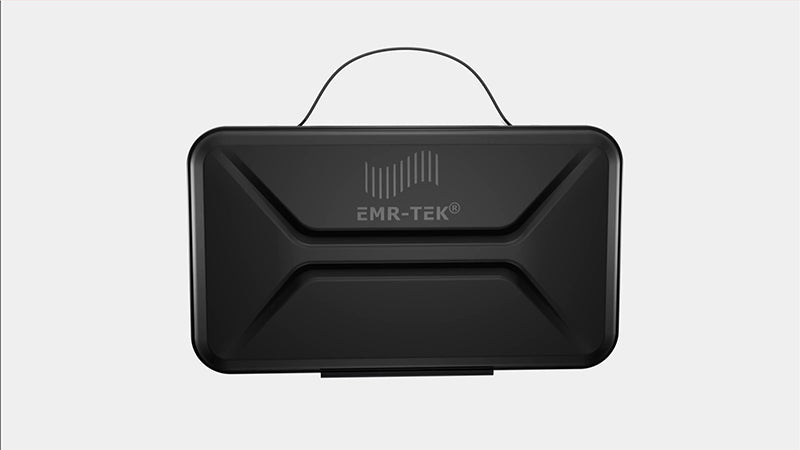
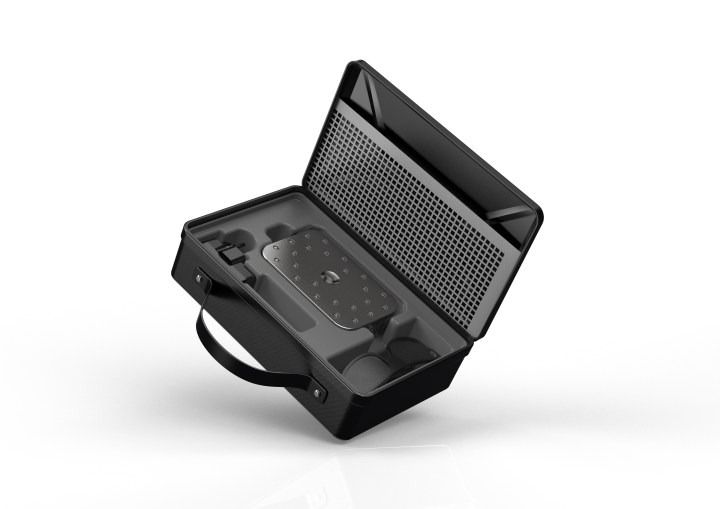
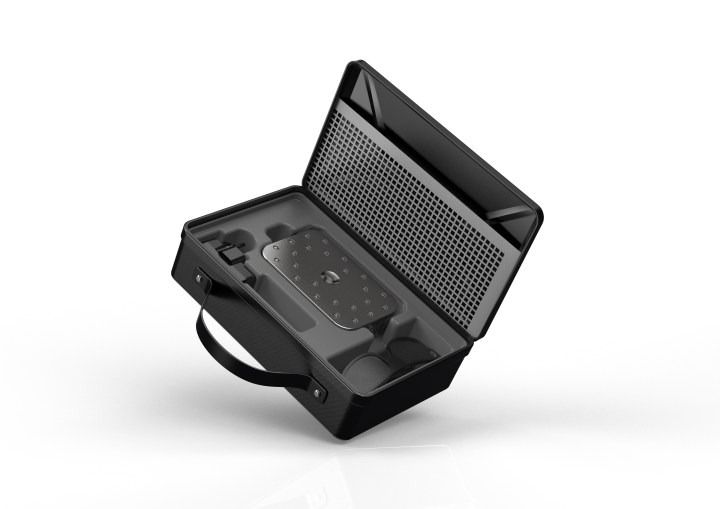
A travel case is also included, which makes more sense for this device than it would for most of EMR-TEK’s lineup. The Firefly can realistically be packed for work or travel instead of being tied to a dedicated treatment area at home.
The metal construction gives it a more substantial feel than a lightweight plastic handheld device. Customer feedback generally describes the Firefly as sturdy and well built.
At close to 800g, though, portable does not necessarily mean exceptionally light. Holding it in the same position throughout a longer session may become less convenient, particularly when treating an awkward area.
Battery operation contributes to two technical characteristics EMR-TEK emphasizes with the Firefly. The company describes the device as zero flicker and zero EMF while operating away from AC power.
Those specifications may appeal to buyers who specifically compare red light therapy devices based on flicker and electromagnetic field measurements.
For everyday ownership, we would still give more weight to factors like coverage, battery life, positioning, wavelengths, and whether the compact design actually makes treatments easier to complete consistently.
The Firefly’s value is tied more closely to portability than treatment area. Buyers are paying for a rechargeable cordless design, COB technology, three wavelengths, USB-C charging, compact metal construction, and the ability to use the light away from an outlet.
Someone who plans to use red light therapy exclusively at home and has room for a permanent setup may be able to get considerably more coverage from a conventional panel for a similar investment.
The Firefly makes more sense when being able to carry the device between locations is genuinely useful. Its smaller treatment area becomes easier to accept when portability is one of the main reasons for buying it.
The Firefly comes with a 30-day return period and a one-year warranty. Those protections are relatively limited compared with red light therapy brands offering longer home trials and two- or three-year warranties.
The shorter warranty is particularly worth considering because the Firefly includes a rechargeable battery in addition to its LEDs, controls, and other electronic components.
We would also check the complete return conditions before beginning regular use rather than assuming the 30-day period operates as an unrestricted home trial.
Product-specific feedback for the Firefly is encouraging but still limited. Owners commonly praise its portability, construction, output for its size, and overall ease of use.
Battery experiences vary somewhat, which is expected with a rechargeable device. Some customers report completing several sessions between charges, while heavier use naturally requires more frequent charging.
Some owners also describe positive personal experiences when using the Firefly around previously injured or uncomfortable areas. Those reports are individual experiences and should not be interpreted as results every buyer will achieve.
Broader customer feedback surrounding EMR-TEK is mixed. Some buyers report positive support experiences, while others describe delayed shipping, damaged deliveries, slow communication, or difficulty resolving order problems.
Those complaints do not specifically indicate a problem with the Firefly, but after-sales service matters with a rechargeable electronic device, particularly when the included warranty lasts only one year.
Portability is easily the Firefly’s biggest strength. Its compact dimensions, rechargeable battery, USB-C charging, and included travel case make it one of the more practical EMR-TEK options for someone who does not want red light therapy confined to one room.
We also like the combination of 630nm and 670nm red light with 830nm near-infrared light. It provides both visible red and NIR exposure without requiring a conventional panel.
The combination of standard LEDs and COB technology helps provide useful output from such a small device, while the treatment timer and selectable light output provide more control than a simple portable light with only an on-and-off switch.
The metal construction is another positive. It gives the Firefly a sturdy feel that better suits its price and intended use as a device that may frequently be transported.
Coverage is the biggest limitation. The Firefly works well for individual areas but becomes inefficient when treating the back, torso, legs, or several locations during the same routine.
Battery life is another consideration. Cordless operation is convenient, but anyone using the Firefly frequently will need to recharge it regularly.
Its size can also make hands-free positioning difficult. A wrap or panel on a stand will be easier to use around areas that are difficult to reach without assistance.
The one-year warranty is shorter than we would like for a rechargeable device at this price, particularly when some competing red light therapy products provide considerably longer protection.
We would also like to see greater consistency in EMR-TEK’s product specifications. Older information mentioning different wavelengths can make researching the exact Firefly configuration more confusing than it needs to be.
The EMR-TEK Firefly gives up the coverage of a conventional panel in exchange for something much easier to carry and use away from home. Its rechargeable battery, 630nm, 670nm, and 830nm wavelengths, combination of LEDs and COB technology, USB-C charging, compact metal construction, and included travel case give it a clear purpose within EMR-TEK’s lineup.
The limitations come directly from that portability. Treatment coverage is small, difficult-to-reach areas can be awkward, frequent use means regular charging, and the one-year warranty provides less long-term protection than we would prefer.
It’s ideal for someone who wants a portable red and near-infrared light for individual joints, muscles, the face, or other targeted areas and expects to use it in more than one location. Someone primarily treating larger sections of the body at home will get considerably more practical value from a conventional panel.
Key Features
Runs from a standard USB-C battery bank rather than mains power, so there is no AC ripple to produce flicker.
EMR-TEK states an hour and thirty minutes of run time from a full charge. Battery capacity is not published.
Separate LED and COB modes, with EMR-TEK advising LED only at 18 to 24 inches for facial use.
Full Specifications
Wavelengths:
Final Verdict
4.5
Tec Specs
Wave Lengths
630nm-830nm
IRRADIANCE:
~14 mW/cm² at distance of 6 in.
Coverage Area:
Targeted (Face, joints, or lower back)
Overall Category Scores
Category
Score
Best Quality
Ease of Use
Features
Value
Support
Staying informed with the latest research and reviews.
10 Minute Read
10 Minute Read
10 Minute Read