Quick Answer
A 2024 study of healthy adults found that one 15-minute session of 670 nm red light, given before a glucose drink, was linked to a smaller rise in blood sugar than placebo. Red light therapy and blood sugar research is promising early science, not a diabetes treatment.
Key Takeaway
Your mitochondria use glucose to make energy, and red light may nudge them to work harder. The best human evidence on red light therapy and blood sugar so far comes from one small healthy-adult study, so treat it as research worth watching, not a medical plan. Talk with your doctor if you take diabetes medication.
If you have been searching for clear answers on red light therapy and blood sugar, you are not alone. A 2024 human study gave the topic a real data point, and many headlines stretched it further than the authors did.
This post walks through that study in plain language, explains the mitochondrial idea behind it, puts nearby research in context, and covers limits plus basic safety. The goal is education, not a treatment plan.
Why Blood Sugar Rises After You Eat
After you eat carbohydrates, your digestive system breaks them into glucose. That glucose enters your bloodstream, which is what people mean by blood sugar. Rising glucose signals the pancreas to release insulin so cells can take glucose in for energy. Extras get stored in muscle and liver. Simple carbs often raise levels faster than complex ones. That matches how MedlinePlus, the NIDDK, and Cleveland Clinic describe the basics.
Researchers sometimes study that rise with an oral glucose tolerance test. Volunteers drink a measured amount of glucose after fasting, then get repeated finger-stick readings for about two hours. That lab setup is where the main paper on red light therapy and blood sugar comes in. It measured the post-drink rise after a single light session, not long-term metabolic health.
How Red Light Interacts With Your Mitochondria
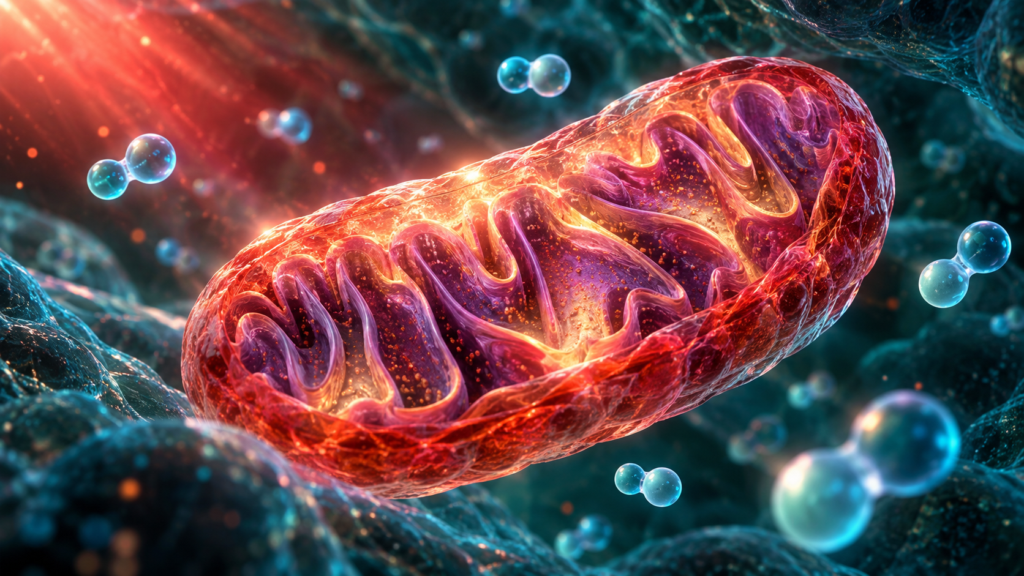
Red and near-infrared light used in photobiomodulation are often discussed as signals for your cells’ mitochondria. Reviews by Hamblin and de Freitas and Hamblin point to cytochrome c oxidase in Complex IV as a primary chromophore.
A leading idea is that red or near-infrared photons can help release inhibitory nitric oxide from that enzyme. Electron transport can then pick up, membrane potential can rise, and ATP production can increase.
Why would that matter for glucose? The 2024 study authors propose that higher mitochondrial activity raises energy demand, so cells pull more glucose out of circulation after a load. That link is a hypothesis. The trial did not measure ATP, cytochrome c oxidase activity, or tissue glucose uptake.
Understanding that pathway helps when you read claims about red light therapy and blood sugar, because mechanism talk is easy to overstate. For a deeper primer, see our science of how red light therapy works post and our mitochondrial redox signaling guide.
Inside the 2024 Study
The core paper is Powner and Jeffery 2024 in the Journal of Biophotonics. Thirty healthy adults with no known metabolic conditions took part, 15 in the 670 nm group and 15 in a no-light placebo group. Each person completed two fasting oral glucose tolerance tests about a week apart. Visit one was a control test. Visit two added the intervention before the drink.
The light session used 670 nm LEDs for 15 minutes at about 40 mW per square centimeter on roughly 800 square centimeters of upper back, including the trapezius, with the array about 400 mm from the skin. Authors reported 28,800 J total energy. Light was delivered 45 minutes before a 75 g oral glucose drink, with capillary glucose checked every 15 minutes for two hours.
Compared with placebo, the post-glucose rise (area under the curve of change from baseline) was about 27.7% smaller (p = 0.0002). Absolute circulating glucose area under the curve was about 7.3% lower (p = 0.0061). Peak glucose was about 12.1% lower versus placebo (10.8 to 9.5 mmol/L, p = 0.0102). Separately, within the 670 nm arm, the paired peak drop was about 7.5% (10.3 to 9.5 mmol/L, p = 0.0054).
What changed after 670 nm red light
Powner and Jeffery 2024 · healthy adults · reductions versus placebo
Reported peak glucose (PBM vs placebo)
Between-group comparison, p = 0.0102. A separate within-670 nm paired peak drop of about 7.5% was also reported.
Source: Powner MB, Jeffery G. J Biophotonics. 2024. Values are reported reductions versus placebo in healthy adults. Not a diabetes treatment finding.
Those numbers are interesting and tightly scoped. The volunteers were healthy. Body mass index was not recorded. It was one session. The authors say plainly that a bridge to diabetes has yet to be made, and that the results cast no light on impact in diabetes.
So when you read about red light therapy and blood sugar online, the careful version is this. In healthy adults, one 15-minute session of 670 nm light on the upper back before a glucose drink was linked to a smaller post-drink rise than placebo. It is not a diabetes treatment claim.
What Other Research Shows
A few nearby papers help fill in mechanism and early clinical context. None of them is a copy of the 2024 design.
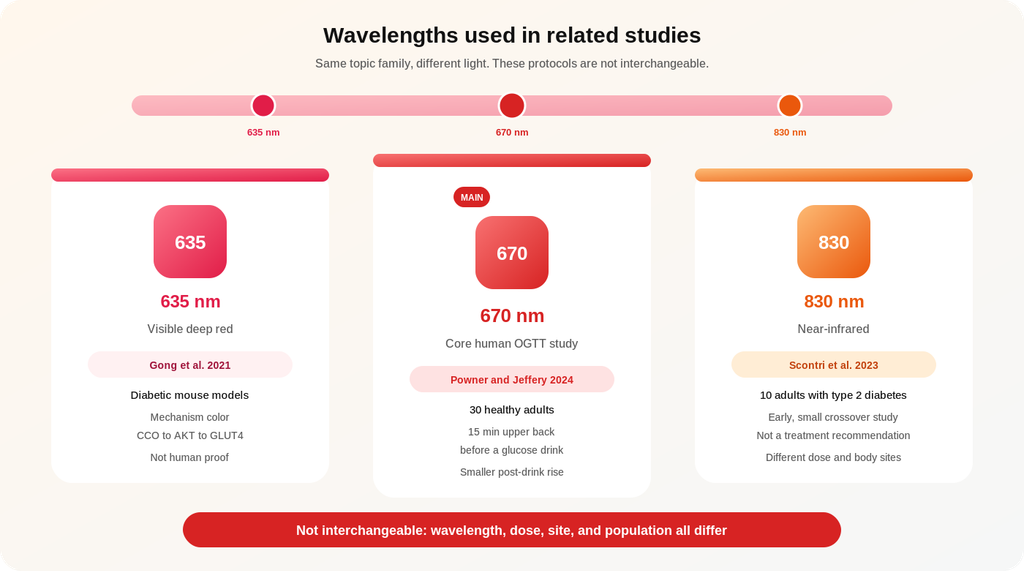
A 2021 mouse study by Gong and colleagues used 635 nm light in diabetic mouse models and linked photobiomodulation to lower glucose and insulin-resistance markers through a cytochrome c oxidase, AKT, and GLUT4 pathway. That is mechanism color, not human proof.
A small 2023 human study by Scontri and colleagues tested 830 nm light in 10 adults with type 2 diabetes. Without usual oral meds, glycemia fell after photobiomodulation, and 100 J per site looked stronger than 240 J. The sample is tiny and acute. It is early research, not a treatment recommendation.
Since 2024, no independent group has repeated the healthy-adult 670 nm upper-back oral glucose test with a matching result. A 2025 review by Nowacka and colleagues summarizes Powner and stresses larger trials. A 2026 Barrett and Jeffery paper cites the finding from the same lab, which is continuity, not independent confirmation. A 2026 Nature news feature also covers the wider red-light conversation.
Together, that stack supports curiosity about red light therapy and blood sugar. It does not support swapping wavelengths or treating the 2024 result as settled clinical guidance.
Why Wavelength, Dose, and Timing Matter
You cannot treat 670 nm, 830 nm, and 635 nm as interchangeable. Body site, dose, and timing versus a meal also differ across papers. See our guides on 660 nm vs 850 nm, irradiance and dosage, and whether you can overdo sessions.
Anyone comparing devices after reading about red light therapy and blood sugar should start with the study wavelength and dose, not with a generic red glow.
| Study | Wavelength | Population | Key setup | Glucose-related takeaway |
| Powner & Jeffery 2024 | 670 nm | 30 healthy adults | 15 min upper back, 45 min before 75 g glucose drink | Smaller post-drink rise vs placebo (~27.7% for AUC of change) |
| Scontri et al. 2023 | 830 nm | 10 adults with type 2 diabetes | Multi-site LEDs; 0, 100, or 240 J; meal challenge | Early, small crossover signals; 100 J looked strongest without meds |
| Gong et al. 2021 | 635 nm | Diabetic mouse models | Multi-week muscle-focused protocols | Mechanism color (CCO to AKT to GLUT4); not human proof |
Photobiomodulation often shows a biphasic dose pattern, so more energy is not always better. Consumer devices also vary in irradiance and coverage, so research protocols do not map one-to-one onto a home panel.
Timing mattered in the 2024 design. Light came 45 minutes before the glucose drink. That detail is easy to miss when people talk about red light therapy and blood sugar in general terms.
What We Don’t Know Yet
- No independent lab has repeated the 2024 oral glucose protocol in healthy adults with a matching result.
- It was one session with 15 people per arm. Capillary glucose was the main readout. Placebo was no light, so blinding was imperfect by design.
- BMI and adiposity were not tracked.
- The ATP-demand explanation is proposed, not measured inside that trial.
- A 2026 study by Aussieker and colleagues found that a multi-wavelength laser protocol did not raise mitochondrial respiration in skin or muscle versus sham. Different device, different wavelengths, and no glucose test. It does not erase the 2024 glucose finding. It does caution against overconfident mechanism copy.
- Long-term HbA1c, insulin-clamp, and hard-outcome data for typical consumer red light use are not there for this endpoint.
If you take diabetes medication or manage a metabolic condition, talk with your doctor before changing light exposure, meals, or monitoring. This article is educational. It is not medical advice.
Questions about red light therapy and blood sugar should stay tied to what was measured. Healthy volunteers. One wavelength. One timing window. Acute readings after a glucose drink.
Safety Basics
Dermatology consensus work summarized by Maghfour and colleagues in 2025 generally views photobiomodulation as low-risk in adults when used appropriately. Practical cautions still matter.
The ICNIRP statement on cosmetic non-ionizing optical exposure notes eye injury risk, advises protective eyewear even for many LED uses, flags people on photosensitizing medications or supplements, and notes a lack of safety data for cosmetic near-infrared procedures in pregnancy. AAO EyeWiki lists photosensitivity disorders, photosensitizing medications, and certain eye conditions among contexts that need clinical judgment. That page is about medical ocular devices, not consumer panels.
Cleveland Clinic explains that some medications and conditions make skin react abnormally to light, which is the plain-English meaning of photosensitivity used here.
Practical takeaways tied to red light therapy and blood sugar curiosity are simple. Do not stare into bright LEDs. Use eye protection as your device guidance recommends. If you are pregnant, photosensitive, or on a photosensitizing medicine, ask your clinician first. See our eye protection research post for more.
Where This Fits in Your Routine
Food quality, movement, sleep, and medical care still do the heavy lifting for metabolic health. A single research protocol does not replace those basics.
If you already use a red light device, the 2024 paper is a reason to stay curious about metabolic endpoints. It is not a reason to skip meal planning, ignore your clinician, or expect a home panel to match a lab array on the upper back for 15 minutes before a 75 g glucose drink.
For a wider look at metabolic claims, see our red light therapy and metabolism overview.
Interest in red light therapy and blood sugar will keep growing as more labs test meals, wavelengths, and longer timelines. Until then, the honest stance is promising early human data in healthy adults, with clear limits.
FAQ
Does red light therapy lower blood sugar?
Careful wording matters. A 2024 study linked one 670 nm session to a smaller rise after a glucose drink in healthy adults versus placebo. That is not the same as calling red light therapy and blood sugar a treatment story. Authors also said their results do not speak to diabetes.
Can people with diabetes use red light therapy?
Talk with your doctor first, especially if you take glucose-lowering medication or have eye or skin conditions that affect light tolerance. Early type 2 diabetes research exists and is very small. It is not a reason to change prescribed care. Questions about red light therapy and blood sugar for diabetes belong in a clinical conversation.
What wavelength was used in the 2024 study?
670 nm LEDs on the upper back for 15 minutes. Other papers used 830 nm or 635 nm. Those wavelengths are not interchangeable.
How long was the session, and when was it timed?
Fifteen minutes of light, delivered 45 minutes before the 75 g glucose drink.
Does red light therapy affect insulin?
The 2024 study focused on circulating glucose after an oral load. It was not an insulin-sensitivity clamp study. Human insulin conclusions for consumer devices remain limited.
Is red light therapy safe?
Photobiomodulation is generally considered low-risk in adults when used appropriately. Protect your eyes, follow device guidance, and check with a clinician if you are pregnant, photosensitive, or on photosensitizing medication. Safety questions sit beside any curiosity about red light therapy and blood sugar.
Soft next step
If you want practical buying criteria rather than a brand pitch, start with our guide to choosing a red light therapy device. To line options up side by side, use the product comparison shopping tool.
Interest in red light therapy and blood sugar should lead you toward detailed research, not shortcuts. Read the methods. Note the population. Keep your clinician in the loop when health conditions are involved.