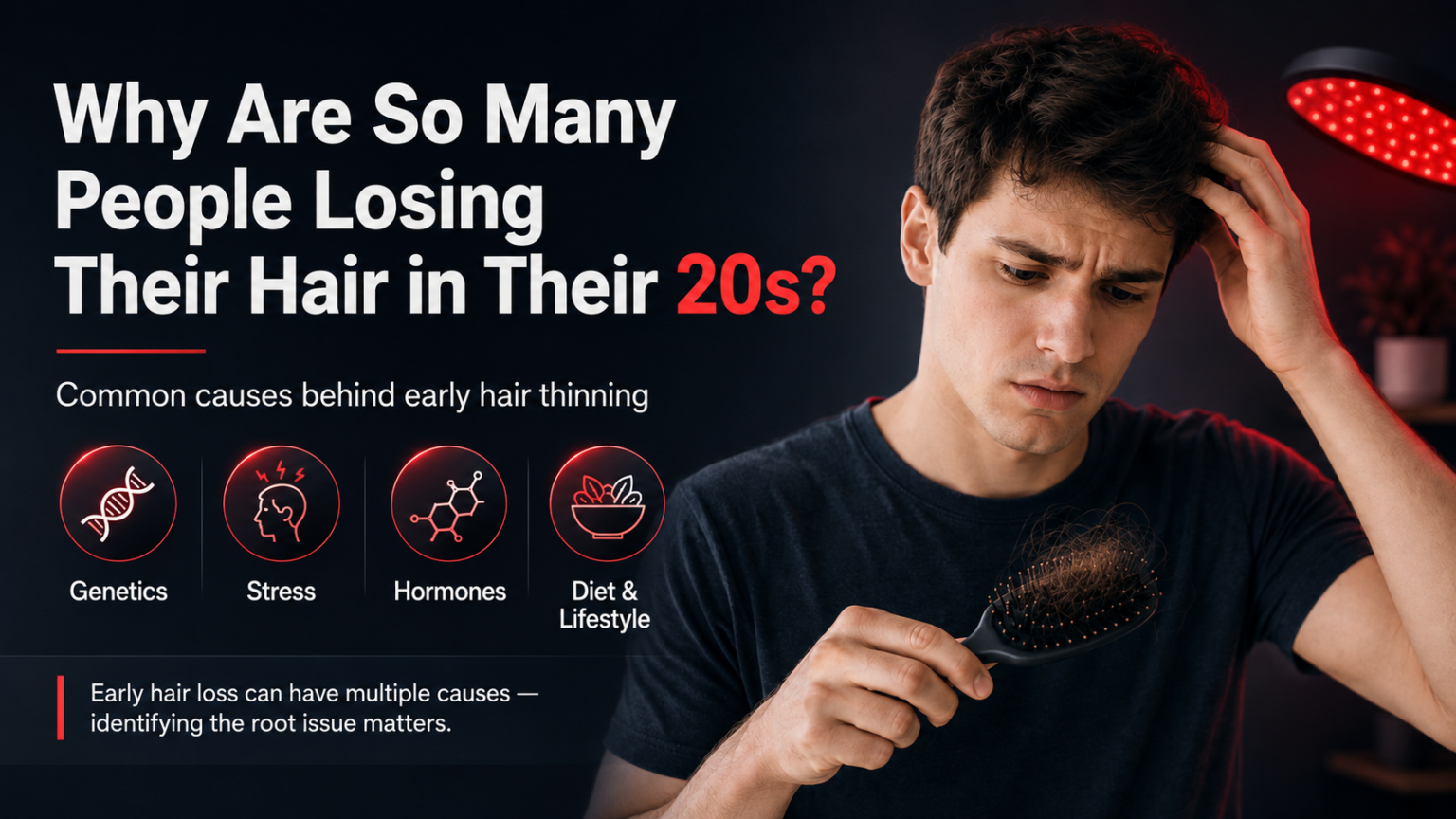
Hair loss in your 20s isn’t something you’d expect to be worried about. You figured you had some time before you had to deal with it.
At least, that’s how it feels until you’re 23 and your temples look a little farther back than they did two years ago. Or you’re 27 and suddenly noticing your scalp under bright bathroom lighting. Maybe it’s not even your hairline. You’re just finding way more hair in the shower than you used to, and now you can’t stop paying attention to it.
The frustrating part is that once you notice it, you start seeing it everywhere.
But losing hair in your 20s isn’t as unusual as you might think. In one study of 1,507 men between 18 and 30, researchers identified early-onset androgenetic alopecia in 19.2% of participants. That doesn’t mean one in five young men everywhere is going bald, since this was one specific population. But it does show that significant hair loss can begin well before middle age.
And there isn’t one explanation for why it happens.
Your genetics can start showing themselves earlier than expected. Your hair can temporarily shed after a stressful event, illness, rapid weight loss, or major dietary change. Hormonal and medical issues can be involved. Even the way you regularly wear your hair can matter.
So before deciding that you’re “going bald,” it’s worth figuring out what your hair is actually doing.
Are You Losing Your Hair, or Are You Shedding More Hair?
These sound like the same thing. They aren’t necessarily.
Everyone sheds hair. The American Academy of Dermatology (AAD) says losing roughly 50 to 100 hairs per day is normal. Those hairs are continually being replaced as follicles move through their normal growth cycles.
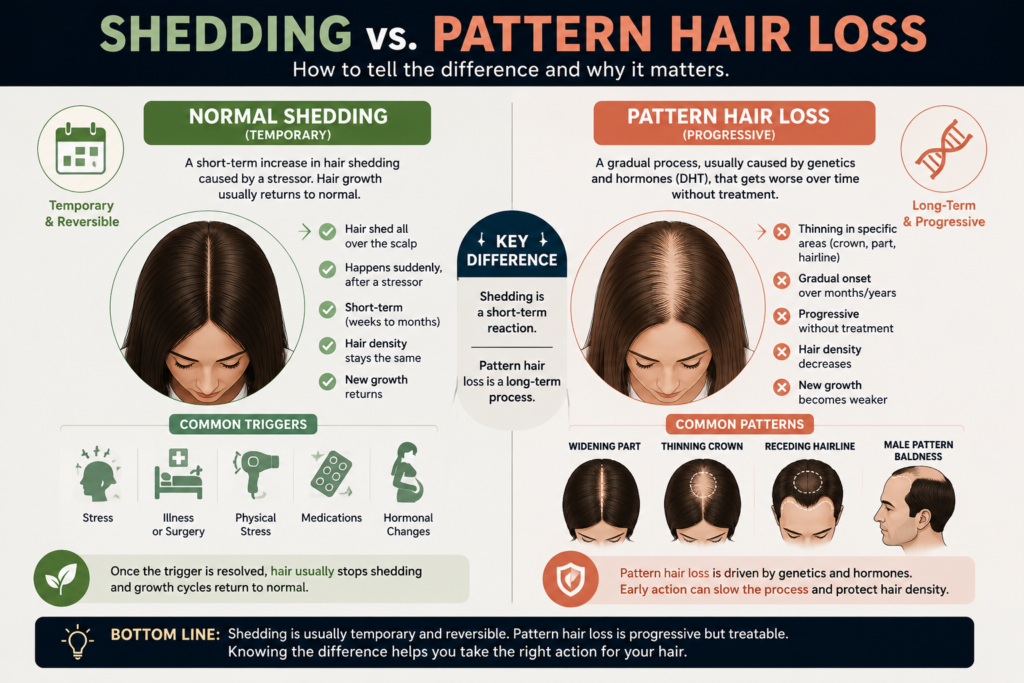
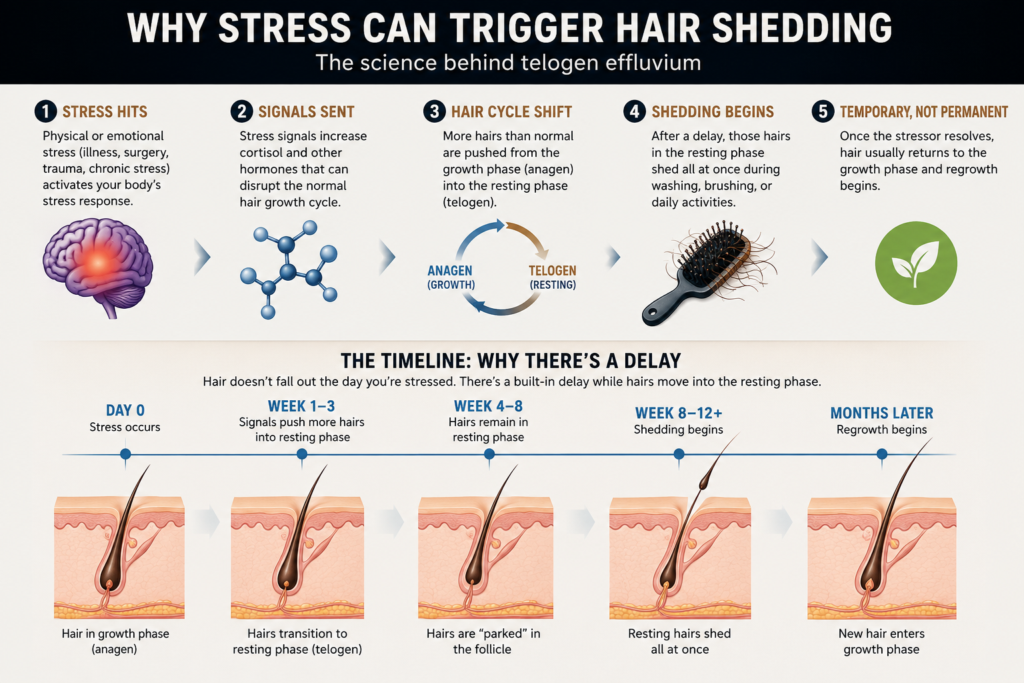
Sometimes, though, far more hairs than usual enter the shedding phase. This is known as telogen effluvium.
It can be alarming because it may seem to happen all at once. There’s more hair between your fingers in the shower. More comes out when you brush it. You start noticing strands on your clothes, pillow, or desk.
That doesn’t automatically mean those follicles are permanently disappearing.
Pattern hair loss, or androgenetic alopecia, usually behaves differently. It tends to progress gradually. A man might notice his temples receding or thinning around his crown. A woman might notice that her part is becoming wider or that her overall density isn’t what it used to be.
That distinction matters because someone experiencing temporary excessive shedding isn’t necessarily dealing with the same problem as someone whose follicles are gradually miniaturizing from androgenetic alopecia.
The symptom may look similar in the mirror.
The reason behind it can be completely different.
Your Genetics Don’t Wait Until You’re 40
If your hairline is gradually changing while you’re still young, it’s natural to wonder whether you’re simply too young for hereditary hair loss in your 20s.
Unfortunately, genetics doesn’t work on that schedule.
Androgenetic alopecia can begin during the teens or 20s. In that study of men ages 18 to 30, researchers found early-onset androgenetic alopecia in 19.2% of participants, and family history was associated with an increased likelihood of developing it.
Pattern hair loss involves genetically susceptible follicles gradually producing thinner, shorter hairs. This process is commonly referred to as follicular miniaturization.
It doesn’t necessarily happen quickly.
That’s why old photographs can suddenly become so interesting. You might not notice a tiny change from one morning to the next, but compare your hair today with a photo from three years ago and the difference can become much easier to see.
For some people, then, losing hair at 25 isn’t evidence that something suddenly went wrong with their lifestyle.
Their genetic predisposition simply began expressing itself early.
But that’s far from the only possibility.
Your Hair Can Be Reacting to Something That Happened Months Ago
This is one of the stranger things about hair loss.
If you’ve suddenly started shedding, don’t just think about what changed this week.
Think back a few months.
The AAD notes that excessive shedding from telogen effluvium can become noticeable a few months after a stressful event. Recognized triggers include substantial weight loss, high fever, surgery, recovering from illness, childbirth, significant psychological stress, and stopping birth-control pills.
That delay can make the cause surprisingly difficult to recognize.
Maybe you got seriously sick, recovered, and moved on with your life. Then months later your hair starts shedding.
Maybe you went through an extremely stressful period that has finally settled down.
Maybe you lost a significant amount of weight and felt better than you had in years.
Then you notice your hair.
The two events can feel completely unrelated because so much time separates them.
So if you’re experiencing hair loss in your 20s, mentally rewind the last few months. Not because you’ll necessarily find the answer yourself, but because that timeline can contain useful clues.
Hair loss in your 20s: Yes, Stress Can Affect Your Hair
“You’re probably just stressed” isn’t a particularly satisfying explanation when you’re staring at a clump of hair in your hand.
But stress really can affect the hair cycle.
Significant physiological or psychological stress can trigger telogen effluvium, causing more hairs than usual to enter the resting and shedding phases.
That doesn’t mean every bad week at work is making you bald.
It also doesn’t mean stress-induced shedding is the same thing as hereditary pattern hair loss.
Think more in terms of substantial or sustained stress on the body.
Your 20s can contain plenty of it. Starting a career, struggling financially, moving, finishing school, changing relationships, losing relationships, sleeping poorly, and generally trying to establish an adult life can overlap in ways that don’t feel particularly gentle.
Physical stress counts too. Surgery, illness, high fever, and major changes to the body can disrupt the hair cycle.
And if the stressor resolves, telogen effluvium frequently improves. The AAD says normal fullness often returns within roughly six to nine months as the body readjusts, although continued stress can prolong excessive shedding.
That’s an important distinction if you’ve already convinced yourself that every hair you lose is gone forever.
It may not be.
Rapid Weight Loss Can Show Up in Your Hair
There’s another factor worth discussing because it has become increasingly relevant: rapid weight loss.
Losing weight can be a positive change for someone who needs or wants to do it. But losing a substantial amount quickly can also place stress on the body.
The AAD lists losing 20 pounds or more as one potential trigger for excessive shedding. Eating too few calories can also contribute to significant hair loss in your 20s.
Researchers studying weight-loss-associated telogen effluvium found that patients in one retrospective study had lost an average of approximately 15% of their body weight at an average rate of about 3.5 kilograms per month.
That doesn’t mean losing 15% of your body weight automatically makes your hair fall out. It was an observation among people who had already developed telogen effluvium, not a threshold everyone crosses.
The more useful takeaway is that the speed and circumstances of weight loss can matter.
That’s relevant in a world of aggressive cutting diets, major body transformations, restrictive eating patterns, and increasingly common GLP-1-assisted weight loss.
If you lost a significant amount of weight and then began shedding hair a few months later, that history is worth mentioning to a healthcare professional.
Before You Buy the Hair Gummies, Look at Your Diet
Once you start researching hair loss in your 20s, supplements find you very quickly.
Biotin gummies. Collagen powders. Hair vitamins. Multivitamins. Proprietary blends with long lists of ingredients promising thicker, stronger-looking hair.
Nutrition absolutely can affect hair.
The AAD identifies insufficient intake of nutrients, including iron, protein, zinc, and biotin, as potential contributors to noticeable hair loss in your 20s. Consuming too few calories can also be a problem.
But there’s an important difference between correcting a deficiency and simply consuming more of something because it’s associated with healthy hair.
If you aren’t deficient in a nutrient, taking increasingly large amounts doesn’t necessarily translate into increasingly thick hair. Some supplements can even cause problems when taken excessively.
If your diet has become highly restrictive, you’ve experienced major weight loss, or you suspect you’re deficient in something, that’s a better reason to investigate your nutritional status than simply assuming a hair supplement will solve the problem.
Your hair needs raw materials to grow.
That doesn’t mean it needs every hair gummy advertised to you.
Sometimes the Problem Is What You’re Doing to Your Hair
Not every cause comes from inside your body.
Repeated tension can damage hair follicles and lead to traction alopecia.
Frequently wearing hairstyles that pull tightly on the hair can be a problem, particularly when that tension repeatedly affects the same areas. Depending on the person and hairstyle, tight ponytails, buns, braids, cornrows, extensions, and other tension-producing styles can contribute.
Early on, changing the hairstyle and removing that repeated tension can make a meaningful difference.
If traction continues long enough to permanently damage follicles, however, some hair loss in your 20s may become permanent.
This is another reason not to lump everything under the word “balding.”
If your hairstyle is physically pulling on your follicles every day, you need to address that.
If you’re experiencing hereditary pattern hair loss, you’re dealing with a different process.
Same visible concern. Different solution.
Hormones and Medical Conditions Can Have An Effect On Your Hair Loss In Your 20s
There are also times when hair loss is a clue rather than the entire problem.
Thyroid disease, hormonal imbalances, polycystic ovary syndrome (PCOS), certain medications, autoimmune conditions, and other health issues can affect hair growth or shedding.
That doesn’t mean you should read a list of conditions online and start diagnosing yourself.
It means unexplained hair loss deserves attention, particularly when it’s sudden, patchy, rapidly progressing, or happening alongside other symptoms.
A dermatologist can examine the pattern of loss, your scalp and hair, your medical history, medications, diet, recent illnesses, family history, and other factors to help determine what’s actually happening.
That’s considerably more useful than choosing a treatment based solely on the fact that you’re “losing hair.”
So, Are People Actually Going Bald Younger?
This is where things get interesting.
Hair loss in your 20s is absolutely real. Early-onset androgenetic alopecia is well documented, and there are plenty of reasons a young adult can experience excessive shedding.
What we can’t confidently say is that today’s 20-somethings are definitively going bald at dramatically higher rates than 20-somethings from previous generations.
Proving that would require good population-level data across generations while accounting for differences in diagnosis, awareness, demographics, lifestyle, and other variables.
So it’s better not to manufacture an epidemic where the evidence doesn’t establish one.
What we can say is that the modern environment gives hair plenty to contend with.
Major weight changes, restrictive diets, stress, illness, hormonal changes, styling practices, and hereditary hair loss can all enter the picture.
We’re also much better at noticing our appearance than previous generations ever had the opportunity to be.
You’re photographed constantly. There are selfies, group pictures, high-resolution phone cameras, video calls, social media, and bathroom lighting that seems specifically engineered to expose every square millimeter of scalp.
Once you notice your hair changing, it’s very hard to unnotice it.
Hair loss in your 20s is real. Whether there’s actually a new epidemic of young people going bald is a much harder claim to prove.
So…Am I Actually Going Bald?
You can’t reliably diagnose yourself from an article, but the way your hair is changing can tell you when it’s time to look closer.
If you suddenly started shedding hair from all over your scalp, think about what was happening several months ago. Illness, surgery, major stress, rapid weight loss, a significant dietary change, childbirth, or hormonal changes could be relevant.
If the change is gradual and follows a recognizable pattern, such as progressively receding temples, crown thinning, a widening part, or declining density, androgenetic alopecia becomes one possibility worth investigating.
And if you’re developing distinct bald patches, losing hair extremely quickly, experiencing scalp pain or inflammation, or noticing other physical symptoms, that’s a good reason to see a dermatologist rather than trying random treatments and hoping something sticks.
There’s another reason to take progressive hair loss in your 20s seriously.
With many types of hair loss, knowing what’s happening earlier gives you more useful options than waiting until the loss becomes advanced.
What Can You Actually Do About Hair Loss in Your 20s?
This is where identifying the cause starts paying off.
If you’re deficient in an important nutrient, correcting the deficiency makes sense.
If repeated tension from a hairstyle is damaging your follicles, removing that tension makes sense.
If an underlying health condition is contributing, treating the condition matters.
If you’re experiencing telogen effluvium after a major physiological stressor, addressing the trigger and giving the hair cycle time to recover may be part of the process.
And if you’re experiencing androgenetic alopecia, there are treatments specifically aimed at pattern hair loss.
Minoxidil is one well-known option. Prescription treatments may be appropriate for some people under medical supervision.
There’s also a noninvasive approach that’s received considerably more research over the past several years: photobiomodulation, commonly called low-level light therapy or red light therapy.
And this is where red light gets interesting, because we’re not talking about a theoretical wellness trend.
There are controlled clinical studies examining its effect on hair growth.
Can Red Light Therapy Actually Help Hair Grow?
The evidence is strongest for androgenetic alopecia, meaning hereditary pattern hair loss.
A 2025 systematic review and meta-analysis evaluated 38 studies involving 3,098 patients. The overwhelming majority, 2,930 participants, had androgenetic alopecia.
The researchers found significant improvements in hair density with low-level laser and LED therapy compared with placebo for androgenetic alopecia.
That’s meaningful evidence.
But there’s an equally important part of the research that deserves to be said out loud.
There were only 17 participants with telogen effluvium across the studies included in that review. There were similarly much smaller populations for alopecia areata, scarring alopecia, and chemotherapy-induced alopecia. Researchers didn’t have sufficient data to perform the same kind of meta-analysis for those conditions.
In other words, evidence that red light therapy can help with pattern hair loss doesn’t mean it has been proven to fix every reason someone might be losing hair.
Remember everything we just covered.
If you’re shedding because your body is severely undernourished, light doesn’t replace adequate nutrition.
If a hairstyle is continually pulling on your follicles, light doesn’t remove that tension.
If an underlying medical condition is affecting your hair, you still need to address the underlying condition.
Red light therapy becomes particularly interesting when you’re talking about the type of hair loss for which it has actually been studied.
What Is Red Light Supposed to Do to a Hair Follicle?
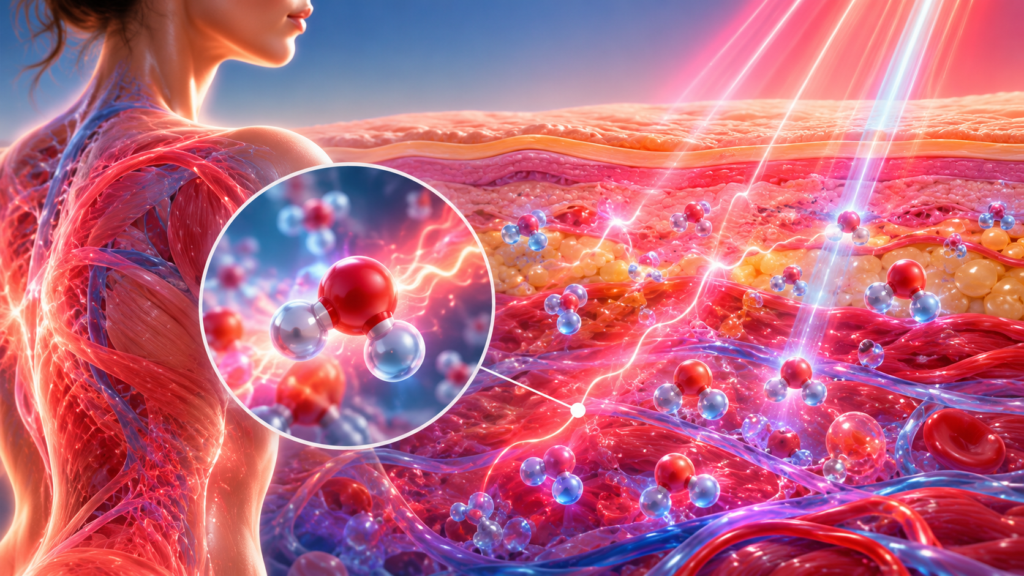
Photobiomodulation uses specific wavelengths of light to influence biological activity in tissue.
The precise mechanisms involved in hair growth are still being investigated, so it’s better to avoid the oversimplified explanation that red light simply “increases circulation and grows hair.”
Researchers have proposed several interconnected mechanisms.
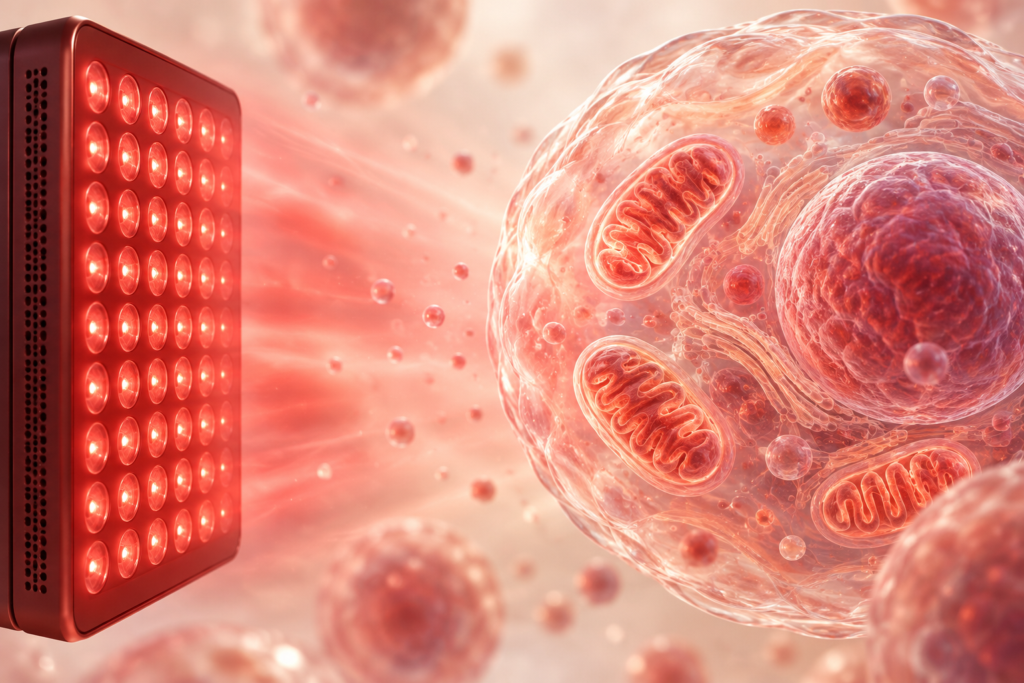
Red and near-infrared light can interact with light-sensitive components within cells, including mitochondrial chromophores. That interaction can influence cellular energy metabolism, nitric oxide, reactive oxygen species, and downstream signaling pathways.
In hair follicles, researchers believe these effects may help create conditions that support follicular activity and influence the hair-growth cycle.
The important distinction is between how scientists think the treatment works and whether clinical studies have actually measured more hair.
We don’t need every piece of the mechanism completely solved before looking at clinical outcomes.
And in androgenetic alopecia, researchers have measured improvements in hair density.
Don’t Judge a Hair-Growth Device by How Many Lights It Has
This is where shopping for a red light hair device can get unnecessarily confusing.
One device has 100 diodes.
Another has 200.
Another proudly advertises 300.
It’s tempting to assume the biggest number wins.
Research doesn’t make that case nearly so simple.
A systematic review examining treatment parameters in photobiomodulation studies found that the number of lasers or LEDs wasn’t significantly associated with changes in hair density.
Other treatment characteristics, including aspects of energy delivery, exposure time, and pulsing, showed associations with outcomes.
That’s important because dose matters in photobiomodulation.
The number of lights on a device doesn’t tell you everything about how much useful light reaches the treatment area, at what wavelength, at what intensity, or for how long.
Research on home-use devices also shows considerable variation between caps, helmets, combs, and headbands. In one meta-analysis of randomized trials, wavelengths clustered around the red spectrum, with a median around 650 nm and a range of approximately 620 to 678 nm among the analyzed devices.
So when evaluating a device, don’t let diode count become the entire conversation.
Coverage, wavelength, output, dose, treatment time, consistency, and the research supporting the approach all matter.
How Long Does Red Light Therapy Take to Work for Hair?
Hair grows slowly.
Any treatment promising a dramatic transformation in a couple of weeks deserves skepticism for that reason alone.
Clinical studies of photobiomodulation for androgenetic alopecia generally evaluate changes over weeks and months, not days. The 2025 systematic review included studies with treatment durations ranging from approximately four to 26 weeks.
That doesn’t mean everyone should expect a specific amount of growth at week 12 or week 26.
People differ. The extent and duration of hair loss differ. Devices and treatment protocols differ. And hair itself operates on a long biological cycle.
What it does mean is that red light therapy isn’t something you use three times, inspect your hairline, and declare a success or failure.
Consistency matters.
So do realistic expectations.
What About Using Red Light Therapy With Minoxidil?
This is a reasonable question because many people with pattern hair loss aren’t looking for one magical treatment. They’re trying to understand which evidence-based approaches can be combined.
There have been studies evaluating low-level light therapy alongside minoxidil, and some individual trials have reported encouraging results.
The overall evidence, however, isn’t clear enough to say that adding red light therapy to minoxidil will automatically produce better results for everyone.
A recent systematic review and meta-analysis comparing minoxidil alone with minoxidil plus low-level light therapy found no statistically significant advantage in hair count or hair diameter from the combination in the included trials.
That doesn’t make either treatment useless.
It means the research doesn’t justify turning “use both” into a universal rule.
If you’re considering combining treatments, particularly prescription treatments or medications with potential side effects, that’s a conversation worth having with a dermatologist.
The Most Important Thing You Can Do Is Figure Out Why You’re Experiencing Hair Loss In Your 20s
When your hair starts changing in your 20s, it’s easy to jump immediately to the end of the story.
I’m going bald.
Maybe you are developing hereditary pattern hair loss in your 20s.
But maybe you’re experiencing temporary shedding after one of the hardest periods your body has been through. Maybe you’ve lost a significant amount of weight. Maybe your diet isn’t giving your body what it needs. Maybe repeated tension is damaging your hair. Maybe there’s a medical or hormonal issue worth investigating.
And sometimes more than one thing can be happening at the same time.
That’s why the best first question isn’t:
“What hair-growth product should I buy?”
It’s:
“Why am I losing my hair?”
Once you have a better answer to that question, the treatment decisions become much clearer.
And if what you’re dealing with is androgenetic alopecia, red light therapy deserves a place in that conversation. It offers a noninvasive approach with controlled trials and systematic reviews supporting improvements in hair density, without pretending to be a universal solution for every strand of hair that ends up in the shower.
Hair loss in your 20s doesn’t mean you’re too young to experience something like this.
But it also doesn’t mean you have to look at a changing hairline, assume the worst, and do nothing about it.
Figure out what’s happening first.
Then you can decide what actually makes sense to do about it.
If you’re experiencing hair loss in your 20s, check out our product and brand reviews to help you decide which device is right for you. You can also use the product comparison tool.