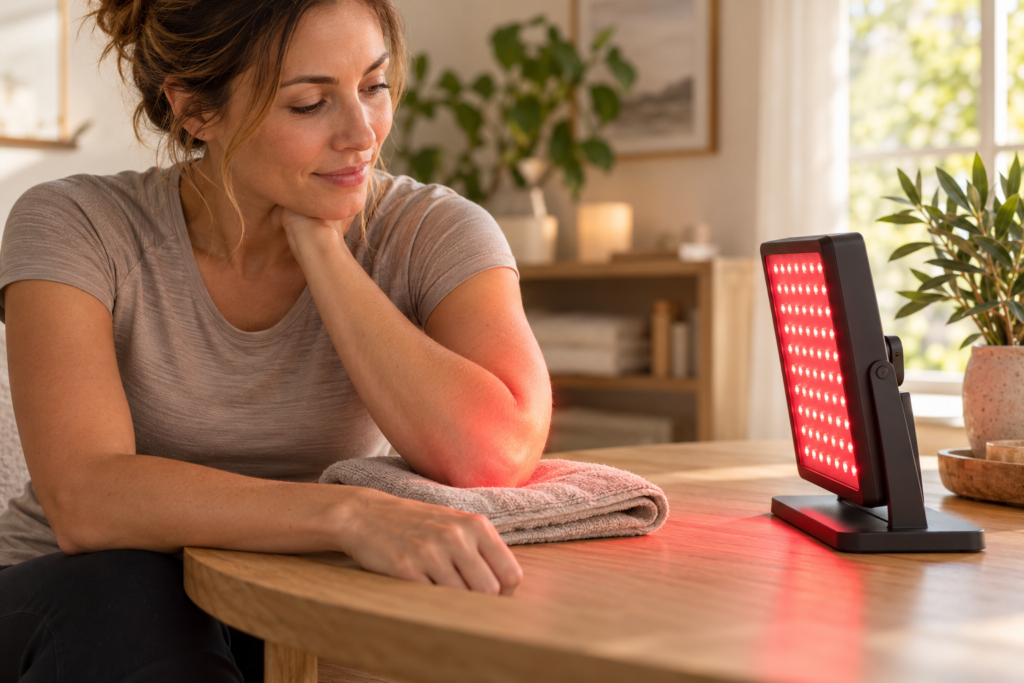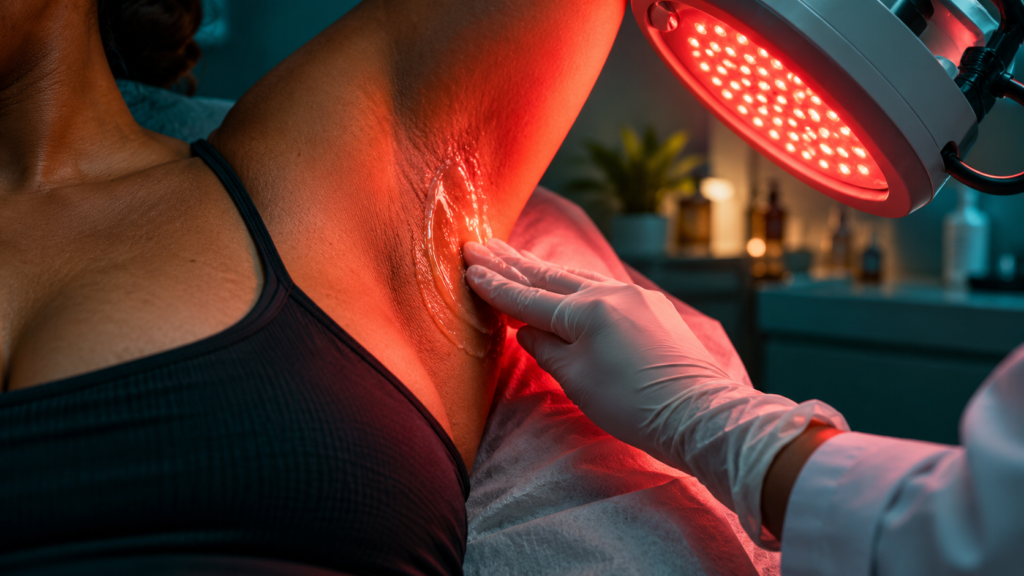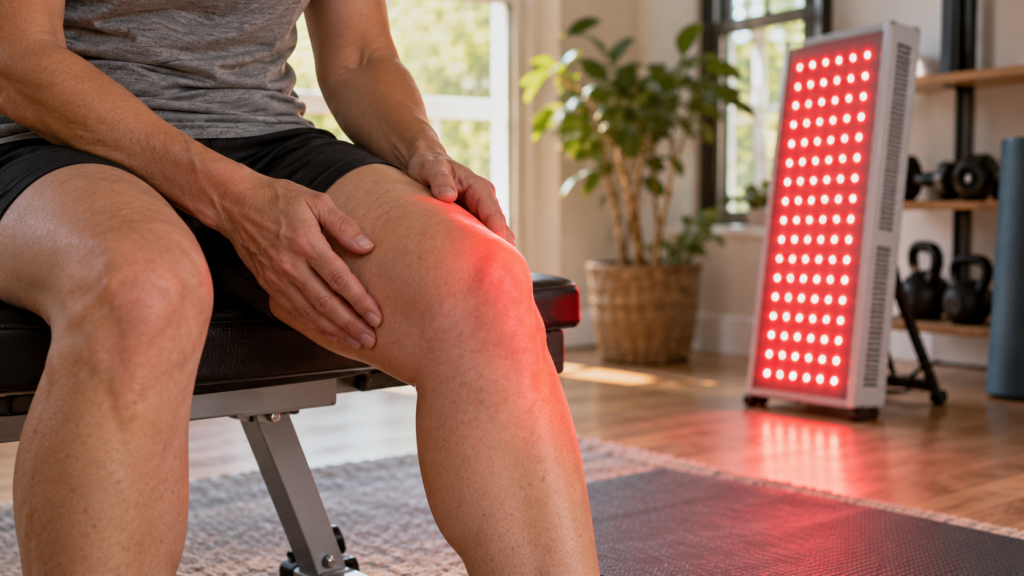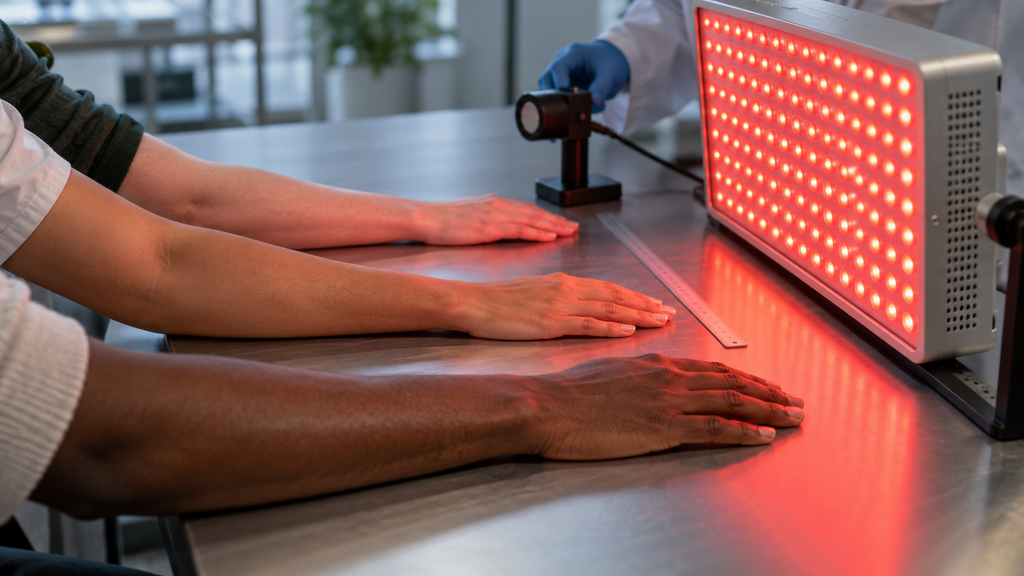
Key Takeaways
- Can you overdo red light therapy? Yes, but there is no single session length that defines excessive exposure for every device.
- Dose-response research shows that more light can produce a smaller response under some studied conditions.
- Minutes alone do not describe your exposure. Light intensity at the treatment area and device positioning also matter.
- A dose measured at the skin’s surface is different from the dose reaching deeper tissue.
- Do not extend sessions, increase frequency, or combine devices simply to chase faster results.
- Follow your device’s instructions, use the required eye protection, and seek advice for persistent or worsening reactions.
You finish a red light therapy session and wonder whether another ten minutes would help. Or you miss a few days and consider doing two sessions to catch up.
The reasoning makes sense: if some light is helpful, more light should be more helpful.
But biology does not always work that way.
So, can you overdo red light therapy? Yes. You can exceed the instructions for your device, and a larger exposure does not necessarily produce a better response.
The useful question is what “too much” actually means. To understand that, you need to look beyond the timer and understand how light intensity, session length, and treatment conditions work together.
Can you overdo red light therapy? Two different issues matter
“Overdoing it” can describe two different situations.
The first is receiving an exposure that does not improve the outcome you want. Under some experimental conditions, increasing light exposure produces a smaller biological response.
The second is experiencing an adverse reaction, such as irritation or pain.
These are different outcomes. A treatment can become less useful without causing an injury. Likewise, discomfort does not tell you exactly where you sit on a biological dose-response curve.
When you ask, “can you overdo red light therapy,” separating effectiveness from safety helps you avoid two mistakes: assuming every extra minute is dangerous, or assuming an exposure is beneficial simply because it does not hurt.
What “dose” means in red light therapy
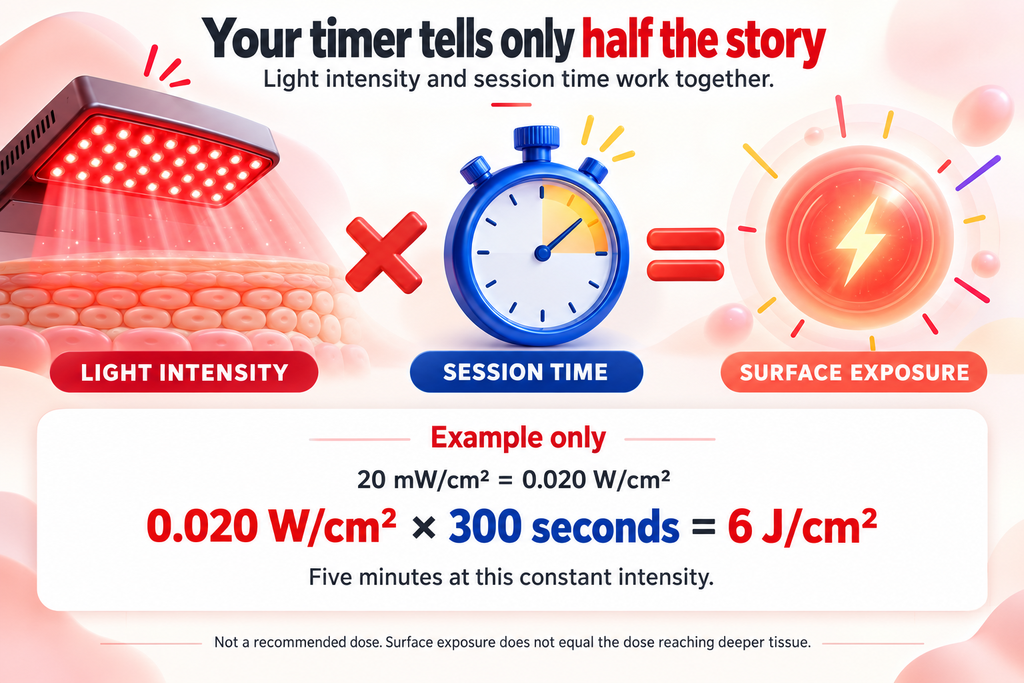
A timer tells you how long your session lasts. It does not tell you how much light reaches the treatment area.
Think about filling a glass. How much water goes into it depends on both the flow rate and how long the tap runs.
Light exposure has a similar mathematical relationship: intensity and time work together.
The terms that help you understand your device
| Term | What it tells you |
|---|---|
| Irradiance | Light power arriving per unit area, often expressed in milliwatts per square centimeter, or mW/cm². |
| Exposure time | How long the area receives light. |
| Radiant exposure, often called fluence | Energy delivered per unit area, commonly expressed in joules per square centimeter, or J/cm². |
| Wavelength | The particular red or near-infrared light being used. |
For a constant exposure, you calculate radiant exposure by multiplying irradiance in watts per square centimeter by time in seconds.
Here is a hypothetical example:
- Irradiance at the treatment surface: 20 mW/cm², or 0.020 W/cm².
- Session duration: five minutes, or 300 seconds.
- Calculated radiant exposure: 0.020 × 300 = 6 J/cm².
This is a math example, not a recommended treatment dose.
It also describes exposure at the measured surface. It does not tell you how much light reaches a tendon, muscle, or another structure below the skin.
When considering “can you overdo red light therapy,” this distinction matters: two people can spend the same number of minutes using different devices and receive different exposures.
Your panel’s wattage is not your treatment dose
A device’s electrical wattage is not the same measurement as irradiance at your skin.
If you want to understand an output specification, look for the measurement distance and operating mode. An irradiance figure without those details gives you an incomplete picture.
That is why “can you overdo red light therapy” cannot be answered by checking the panel’s wattage or timer alone.
Why more light does not always produce more benefit
Photobiomodulation researchers describe a pattern called a biphasic dose response.
In simple terms, some experiments find that a response increases as exposure rises, then decreases when exposure increases further. The strongest measured response occurs somewhere between the lowest and highest exposures tested.
The dose-response research discusses this pattern across different experimental models. It also shows that changing intensity and changing exposure time can affect the result. pmc.ncbi.nlm.nih.gov
What the research curve actually means
Imagine a graph with light exposure along the bottom and a measured biological response up the side.
The line may rise, reach a peak, and then fall.
That illustration can help explain “can you overdo red light therapy,” but it cannot identify your personal ideal dose. The response depends on what researchers measure, the cells or tissue involved, and the treatment conditions.
A curve based on wound healing in an animal model cannot tell you the exact session length for a home facial mask.
A laboratory example makes the concept clearer
A 2024 study of human adipose-derived mesenchymal stem cells tested exposures between 0 and 10 J/cm². The 5 J/cm² group showed higher cell viability and migration than the other tested groups. pubmed.ncbi.nlm.nih.gov
This gives researchers an example of a response that did not keep improving as exposure increased.
However, these were cells studied in a laboratory. They were not people using a panel at home.
The lesson for “can you overdo red light therapy” is that dose matters. The study does not establish 5 J/cm² as the ideal exposure for your face, joints, or muscles.
Why a stronger, shorter session may not equal a weaker, longer one
You might assume that doubling intensity and halving session time gives you an equivalent treatment.
Mathematically, it can give you the same radiant exposure. Biologically, the response may differ.
For example, these hypothetical exposures both equal 6 J/cm²:
| Irradiance | Duration | Calculated radiant exposure |
|---|---|---|
| 20 mW/cm² | 300 seconds | 6 J/cm² |
| 40 mW/cm² | 150 seconds | 6 J/cm² |
The research on intensity and exposure time describes circumstances in which matching total energy does not produce the same biological effect. pmc.ncbi.nlm.nih.gov
For anyone asking “can you overdo red light therapy,” this is a reason to avoid rewriting a manufacturer’s protocol using a simple calculation.
A dose equation helps you understand exposure. It does not replace a tested treatment schedule.
Can you overdo red light therapy by moving closer?
Moving closer to a panel changes the exposure conditions. Depending on the device, it can change the irradiance and distribution of light across your body.
It can also change which areas fall within the illuminated field.
Instead of choosing the closest position you can tolerate, check the instructions for your device and intended use.
If a manufacturer provides measurements at a particular distance, do not assume those measurements apply at every distance.
When asking “can you overdo red light therapy” because you have moved closer, compare your positioning with the actual instructions. Brightness and warmth cannot confirm that your dose is appropriate.
Can you overdo red light therapy if you use it every day?
Daily use describes frequency. It does not describe the complete exposure.
A short daily session with one device is different from a long daily session with another. The operating mode, treatment area, and intended purpose may differ too.
The American Academy of Dermatology’s guidance recommends following the directions supplied with your device rather than using a universal schedule. www.aad.org
If you are asking “can you overdo red light therapy” because your routine is daily, check whether daily use is part of your device’s instructions.
Do not assume that a schedule recommended for a hair-growth cap also applies to a facial mask or a large panel.
What about twice-daily sessions?
Adding a second session increases exposure to the areas treated again.
Whether that schedule is appropriate requires more information than “the device uses red light.” Check whether the manufacturer or your clinician specifically recommends it.
If your instructions call for one session, a second session should not become your default response to slow progress.
There is also no universal recovery interval that applies to every red light therapy device and treatment purpose.
Should you double a session after missing a day?
A missed session does not create a dose debt.
Unless your instructions specifically provide a catch-up schedule, resume the normal routine.
This is a practical answer to “can you overdo red light therapy” after missed sessions: following the established schedule is more useful than improvising a larger exposure.
Can you overdo red light therapy by combining devices?
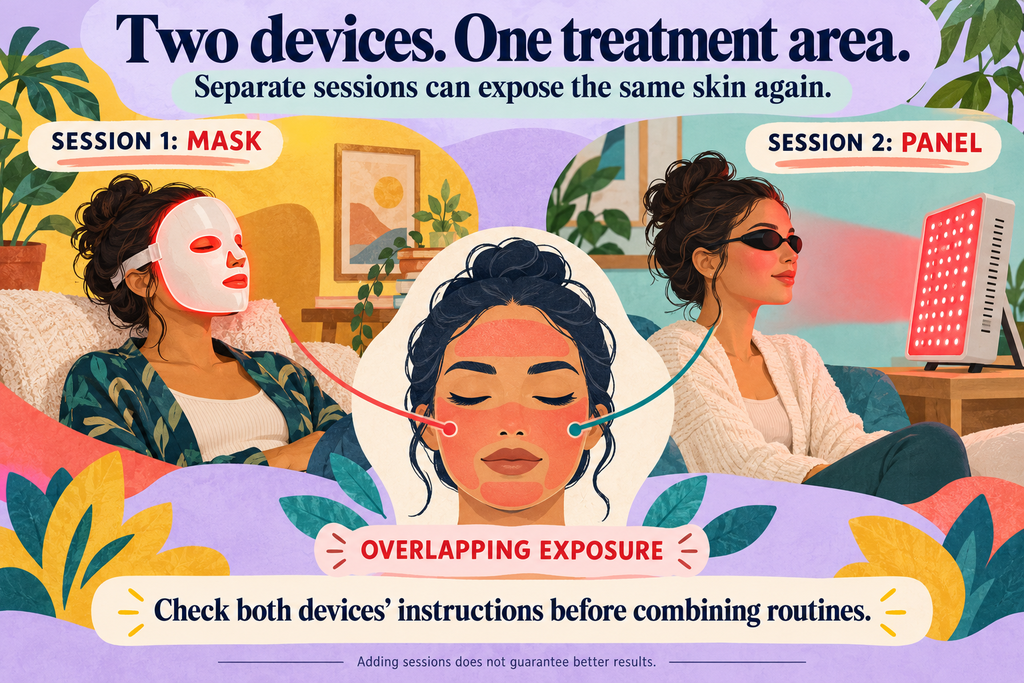
A mask and a panel may both expose the same facial area. Two separate timers do not make those exposures unrelated.
Before combining devices, identify the overlap:
- Are they treating the same area?
- Are you using them close together in time?
- Do their instructions address combination use?
- Are you adding exposure beyond either device’s recommended routine?
You may not have enough reliable output information to calculate the combined exposure accurately. Even a calculation would not establish whether the combination improves results.
The question “can you overdo red light therapy” becomes especially relevant when you stack sessions. Ask for guidance rather than assuming that individually recommended routines remain appropriate when combined.
What reactions should make you stop and reassess?
Pay attention to how your skin and eyes respond.
The American Academy of Dermatology identifies temporary mild pain and irritated skin among reported red light therapy side effects. It also notes that long-term effects require further research. www.aad.org
Stop a session if you experience pain, uncomfortable heat, or irritation. Persistent or worsening symptoms deserve medical advice.
Discomfort is not proof of an effective session
You do not need to push through discomfort to make a session count.
If you are asking “can you overdo red light therapy” because your skin becomes irritated after use, do not treat that reaction as evidence that the light is working harder.
Review your settings, duration, positioning, and instructions. Seek advice before continuing if the reaction persists.
A lack of discomfort does not prove your exposure is ideal
An exposure can feel comfortable without being the most useful exposure for your goal.
You also cannot diagnose excessive dosing from slow results alone. Lack of improvement may reflect an unsuitable treatment, limited effectiveness, unrealistic expectations, or other factors.
For “can you overdo red light therapy,” neither feeling nothing nor seeing no immediate change gives you enough information to decide that more exposure is the answer.
Follow the eye-protection instructions
Use the protection specified for your device. If goggles are required, ordinary sunglasses are not a substitute.
Ask a clinician about suitability if you have a light-sensitive condition or take medication that increases light sensitivity. These precautions are included in the AAD’s home-use recommendations. www.aad.org
Why there is no single perfect dose for everyone
Research includes different wavelengths, devices, treatment areas, schedules, and outcomes.
A study measuring cell migration asks a different question from a trial measuring pain or changes in skin appearance.
A 2025 umbrella review of randomized clinical trials evaluated 35 health endpoints. None had high-certainty evidence, although some outcomes had moderate-certainty support. pmc.ncbi.nlm.nih.gov
That does not mean every application is ineffective. It means conclusions need to remain specific to the outcome and evidence.
A responsible answer to “can you overdo red light therapy” should therefore explain the variables instead of offering one universal maximum time.
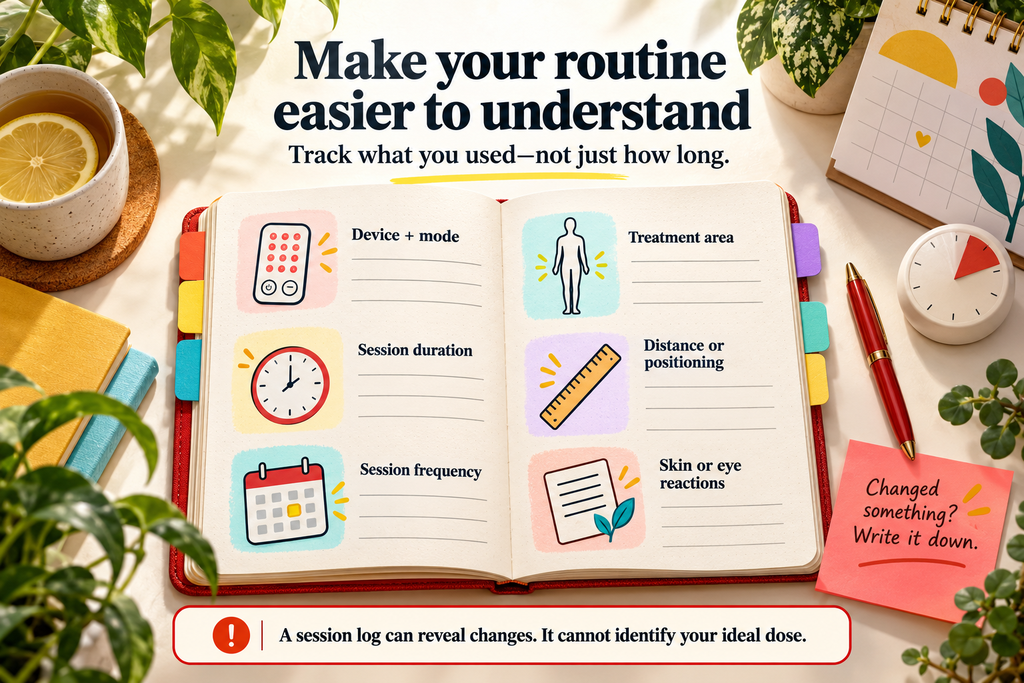
How to make your routine easier to evaluate
Keep a simple session record:
| Record this | Why it helps |
|---|---|
| Device and operating mode | Shows which settings you actually used. |
| Treatment area | Helps identify overlapping exposures. |
| Duration | Makes extended sessions easier to spot. |
| Distance or positioning | Records changes that could affect exposure. |
| Frequency | Shows whether extra sessions are accumulating. |
| Reactions | Helps you describe a problem to the manufacturer or clinician. |
Use a timer and keep the recommended positioning consistent.
If instructions are unclear, ask the manufacturer to clarify the session length, mode, distance, and frequency for your intended use.
This record cannot diagnose an optimal dose. It can make your routine—and any changes to it—much easier to understand.
Frequently asked questions
Can you overdo red light therapy on your face?
Yes, you can exceed a facial device’s instructions. Use its specified duration and frequency, and stop if you develop discomfort or irritation. Do not copy a body-panel routine for your face.
Are longer sessions more effective?
Not necessarily. Dose-response research shows that increasing exposure does not always improve the measured biological response. Longer sessions should not replace the device’s recommended protocol.
Does feeling nothing mean you need more light?
No. Sensation is not a measurement of dose or effectiveness. Check your device’s setup and instructions rather than increasing exposure until you feel something.
Does irritation mean you crossed the optimal dose?
It means you should stop and reassess. Irritation cannot identify your exact position on a dose-response curve.
Will one longer session erase previous progress?
The research discussed here does not establish that one extended session erases earlier benefits. Avoid that assumption, return to the specified routine, and seek advice if you experience a reaction.
The practical takeaway
Red light therapy is not a contest to tolerate the brightest panel or complete the longest session.
Understand the instructions for your device. Keep your positioning and settings consistent. Use a timer, and record reactions instead of continually adding exposure.
That gives you a routine you can evaluate—and a clearer way to recognize when something needs to change.
This article provides general educational information and is not medical advice. It does not establish a treatment dose or claim that any device treats a medical condition. Consult a qualified healthcare professional about using light therapy for a specific health concern.