Some red and near-infrared light can pass through skin and reach tissue beneath it. Near-infrared light generally travels farther under comparable conditions, but the amount reaching a particular muscle or joint structure depends on the wavelength, device, treatment position, and tissue in its path. Research on red light therapy for muscle and joint recovery suggests possible benefits for some knee pain and post-exercise soreness outcomes. It does not show that light repairs joint cartilage or that a home panel will reproduce the results of a clinical laser study.
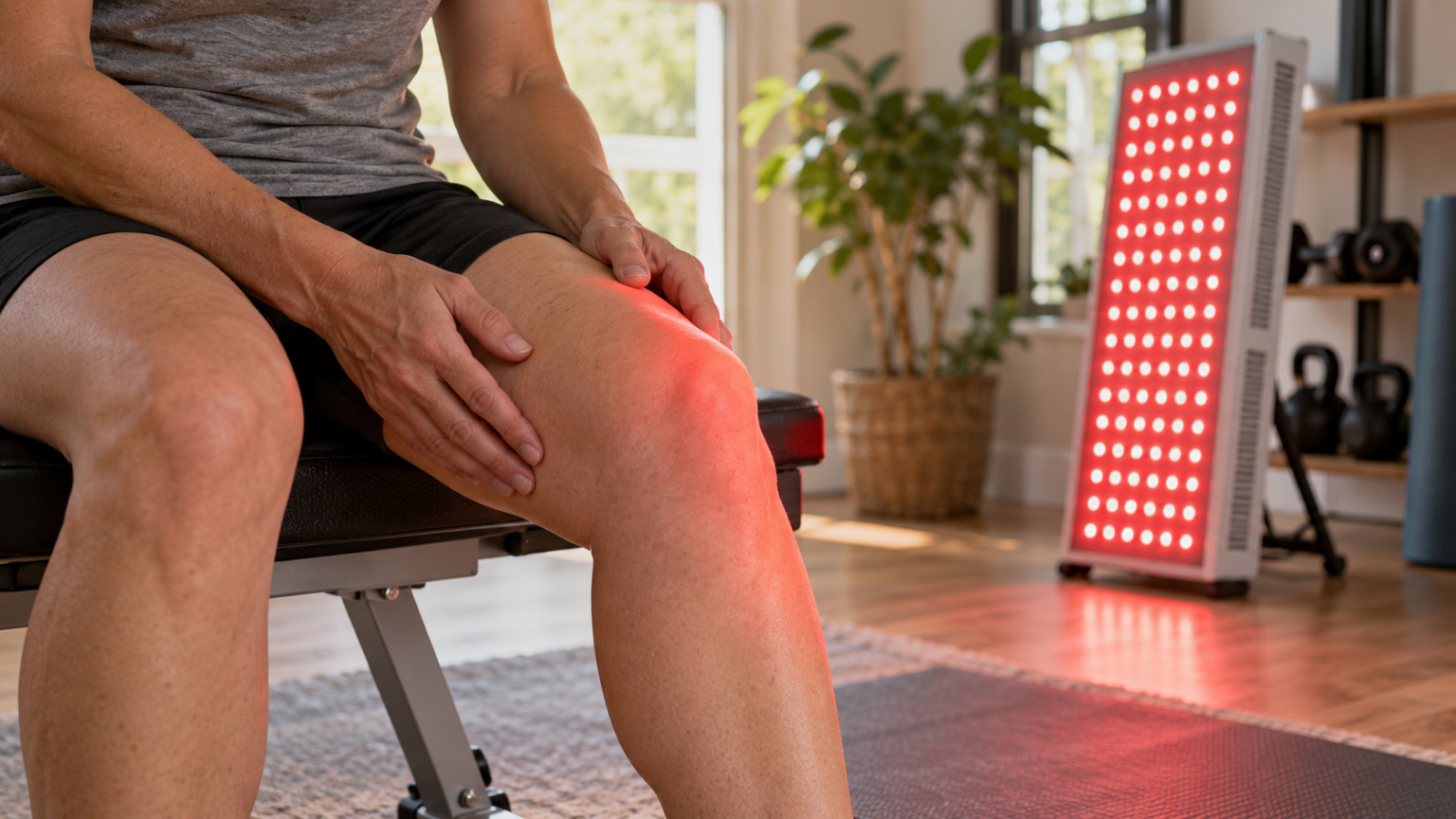
If you aim a red light panel at a sore knee, what happens after the light touches your skin? Can it reach the joint, or does it stop at the surface?
Those questions matter because red light therapy for muscle and joint recovery is often discussed as though shining light on an area and treating the tissues beneath it are the same thing. They are not. Some light travels into the body, but it becomes weaker and more scattered along the way. And even when light reaches a tissue, we still need human studies to tell us whether the treatment makes a meaningful difference.
Here is what researchers have measured, what clinical trials have found, and where the answer remains uncertain.
What happens when red light enters the body?
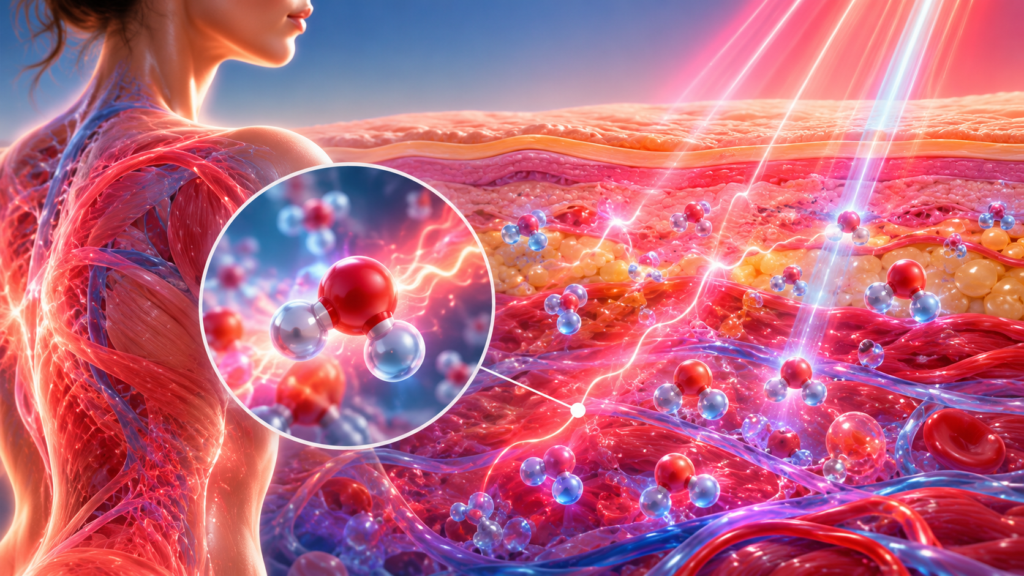
When light hits your skin, three things can happen: some is reflected away, some is absorbed, and some travels farther into the tissue. The light that continues forward does not move through the body in a perfectly straight line. It scatters as it encounters skin, fat, blood, muscle, and other structures.
Imagine shining a flashlight into a glass of cloudy water. The light does not suddenly stop, but it spreads out and becomes weaker with distance. Human tissue is more complicated than cloudy water, yet the comparison helps explain the challenge in red light therapy for muscle and joint recovery: a device can deliver a measurable amount of light to your skin without delivering that same amount to a deeper target.
Researchers call the amount of light arriving at a surface irradiance. It is usually reported in milliwatts per square centimeter (mW/cm²). Irradiance measured at the skin is useful information. It is not a direct measurement of the light reaching knee cartilage, a hip joint, or a muscle several layers below the surface.
Where does the light go?
Choose a wavelength, then tap a tissue layer to follow the light’s path.
At the skin Some incoming light reflects away or is absorbed. The rest can enter underlying tissue.
Conceptual illustration, not a scale drawing or measured penetration depth. More transmission does not prove better pain relief.
Does near-infrared light travel farther than visible red light?
Under many conditions, yes. Visible red and near-infrared wavelengths interact differently with tissue, which is why studies examining deeper targets often investigate near-infrared light.
In one human transmission study, researchers tested 660 nm red light and 830 nm near-infrared light at the elbow and heel tendon. Under the study’s conditions, the 830 nm light showed greater transmission through skin. The researchers also found that transmission varied with tissue characteristics and the equipment used.
This finding helps explain the interest in near-infrared red light therapy for muscle and joint recovery. It does not establish a single depth that 830 nm light always reaches. An elbow, a heel tendon, and a knee have different anatomy. People also differ in tissue thickness and composition. A measurement at one body site cannot tell us precisely how much light reaches another.
What does it mean to “reach a joint”?
A joint is not one uniform target. A knee includes cartilage, a joint lining, ligaments, tendons, and other nearby structures. Pain felt around the knee does not necessarily come from cartilage, and an improvement in pain does not prove that cartilage has changed.
This is an important distinction in red light therapy for muscle and joint recovery. Light might interact with tissues around a joint without delivering a large dose to its deepest structures. Researchers are studying whether those interactions can affect pain and function. They cannot determine what happened inside a person’s joint simply because that person reports feeling better.
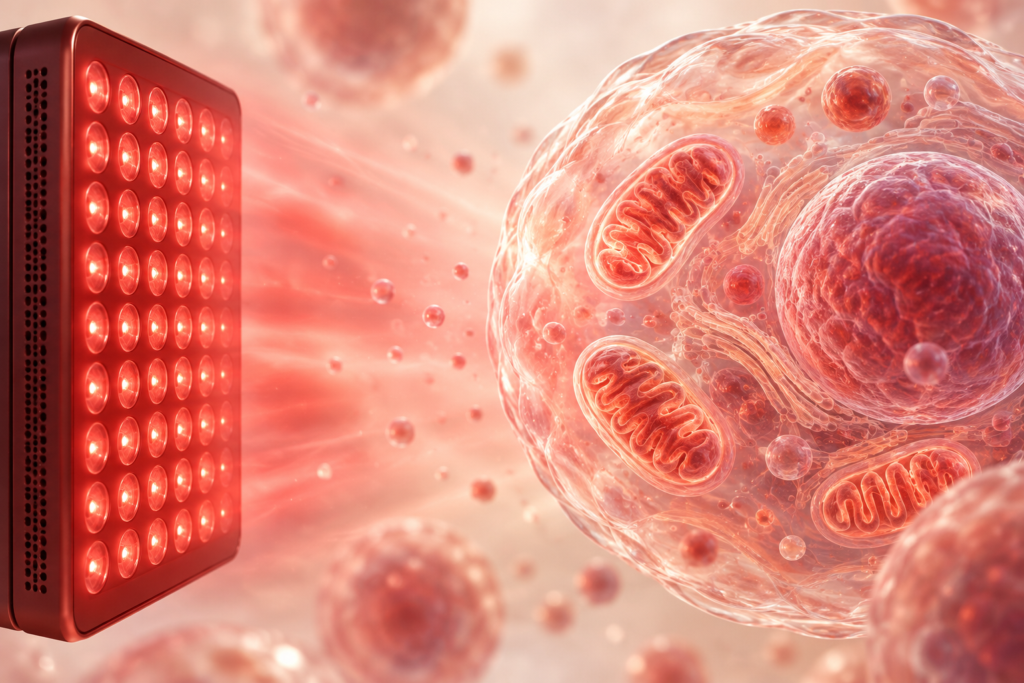
Scientists have proposed several ways absorbed light could influence cells, including changes involving mitochondria, which help cells produce energy, and other cellular signaling pathways. A review of a National Institute on Aging research workshop describes these possibilities and notes that the mechanisms and effective treatment protocols still need further study.
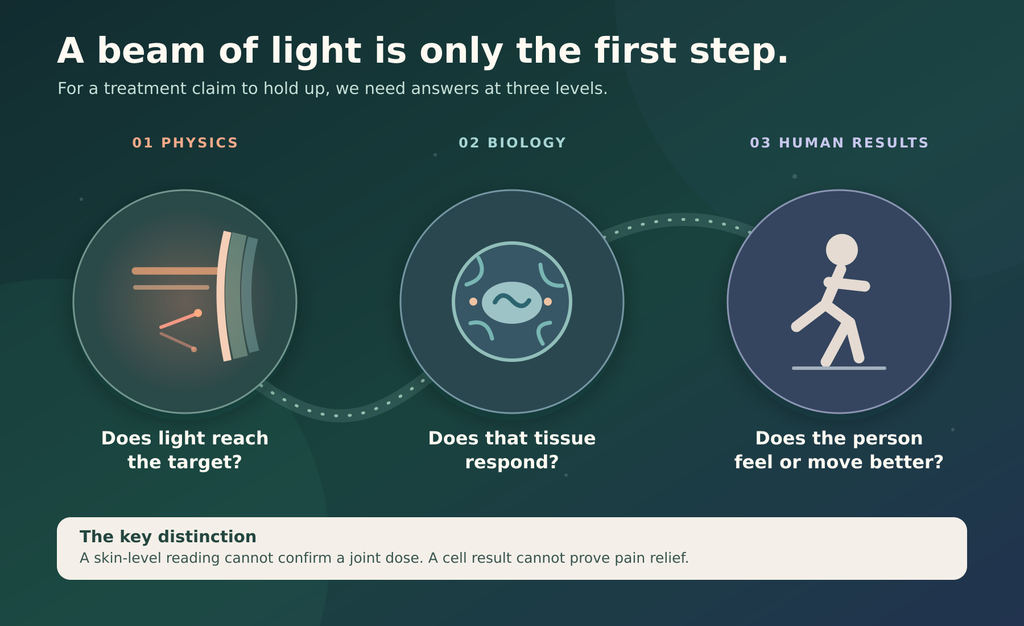
The evidence therefore has to answer three separate questions:
- Did light reach the tissue?
- Did the tissue respond to it?
- Did the person experience a meaningful improvement?
A laboratory finding about cells cannot answer the third question. That requires well-designed studies in people.
What have knee pain studies actually found?
Knee osteoarthritis provides some of the most relevant human research for the joint side of red light therapy for muscle and joint recovery.
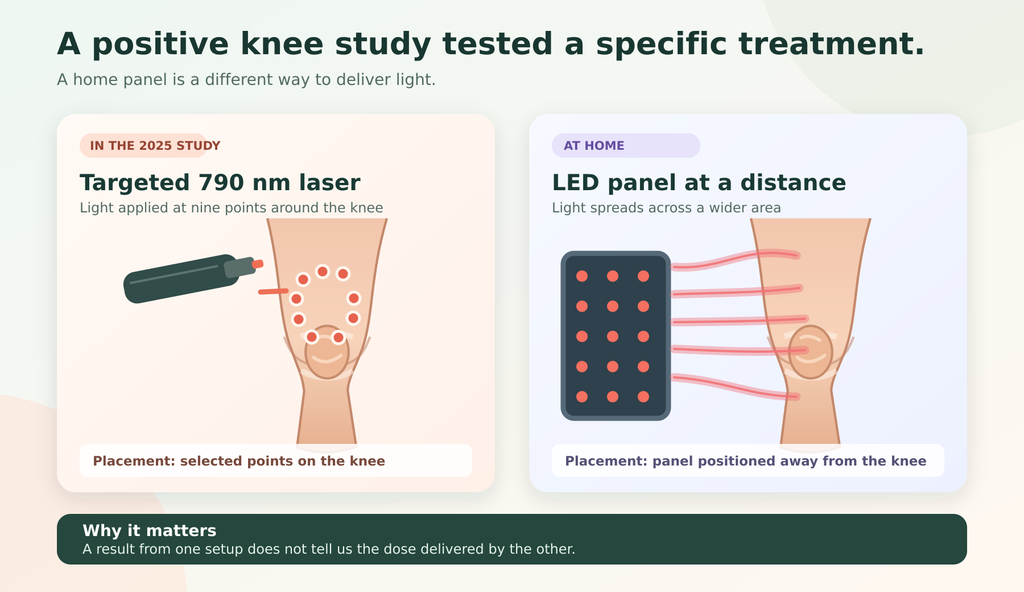
In a 2025 randomized clinical trial, researchers compared active light treatment with a sham treatment and a group receiving no intervention. The active treatment was a 790 nm laser applied to nine specific points around the knee. Participants receiving the active treatment reported greater reductions in pain than those in the comparison groups.
That is a useful result, but one trial cannot establish that every light device will help every painful knee.
A 2024 review of placebo-controlled knee trials found that photobiomodulation reduced pain at rest compared with placebo. The authors rated the certainty of that finding very low, however. They found no significant improvement on the Timed Up and Go test, which measures how long it takes someone to stand, walk a short distance, return, and sit down. They also questioned whether every measured improvement was large enough to matter in daily life.
A broader review of research reviews found moderate-certainty evidence for improvement in knee osteoarthritis disability. That does not cancel out the caution in the 2024 review: the reviews assessed different collections of studies and outcomes. Together, they show why an article about red light therapy for muscle and joint recovery needs to name the outcome rather than simply say that it “works.”
The reasonable reading is that light treatment may help some knee osteoarthritis symptoms under-studied conditions. The evidence does not show that it rebuilds cartilage, reverses osteoarthritis, or treats every cause of joint pain.
Does the research on muscles tell us the same thing?
No. Muscle soreness after exercise and ongoing joint pain are different problems. A treatment that changes one outcome may have no effect on the other.
A 2025 review of randomized trials found low-certainty evidence that photobiomodulation applied before exercise reduced later muscle soreness. That is a potentially useful finding for red light therapy for muscle and joint recovery, but the timing matters. It does not establish that using a panel after every workout will produce the same result.
It also matters what a study calls “recovery.” A person can feel less sore without researchers demonstrating that muscle tissue repaired faster. Studies may measure soreness, strength, exercise performance, or laboratory markers, and those results should not be treated as interchangeable.
The type of device matters too. A review of five whole-body photobiomodulation studies found no benefit for the fatigue markers and exercise performance outcomes those studies tested. That finding does not disprove every localized muscle study. It does show why results from light directed at a particular muscle cannot automatically support claims about standing in front of a full-body panel.
Why a clinical laser study cannot validate every home panel
A device’s wavelength is only one part of a treatment. To understand a study, we also need to know where the light was applied, whether the device touched the skin, how much area it covered, how long each session lasted, and how often treatment was repeated.
Consider the positive knee trial. Researchers applied a laser to nine selected points around the joint. A home LED panel positioned some distance from the knee may illuminate a larger area, but it will not necessarily deliver the same amount of light to those points. It may use a different wavelength and treatment schedule as well.
That does not mean a home panel cannot be useful. It means the trial did not test that home panel. When evaluating a claim about red light therapy for muscle and joint recovery, the honest question is: How closely does this device and its recommended use match what the researchers studied?
You can check for these details:
- Wavelength: Which red or near-infrared wavelengths did the study and device use?
- Device type: Did researchers use a laser, an LED device, or both?
- Placement: Was light applied directly to selected points or delivered from a distance?
- Dose: Where was the output measured: at the device, at the skin, or at another point?
- Schedule: How long and how often was treatment given?
- Outcome: Did participants report less pain, move more easily, feel less sore, or show a change on a laboratory test?
Those questions reveal much more than a large wattage number or a promise of “deep penetration.”
A surface dose is not a joint dose
Here is a simplified example. Suppose a device delivers 40 mW/cm² at the skin for five minutes, with output remaining constant. That would equal a calculated surface exposure of 12 J/cm².
It would not mean that 12 J/cm² reached the center of the knee. Light is reflected, absorbed, and scattered on the way in. The calculation tells us about exposure at the measurement surface, not the dose received by every tissue below it.
This is why more minutes are not automatically the answer for red light therapy for muscle and joint recovery. A longer session increases surface exposure, but it does not remove the tissue between the light and its target. It also does not tell us what dose produces the best outcome. Our guides to irradiance and dosage and panel coverage explain how those measurements are made and why they can vary.
What should someone expect at home?
Start by identifying what you are trying to change. Post-workout soreness, stiffness around a knee, and persistent pain that has never been assessed are different situations. Research on one should not be presented as evidence for all three.
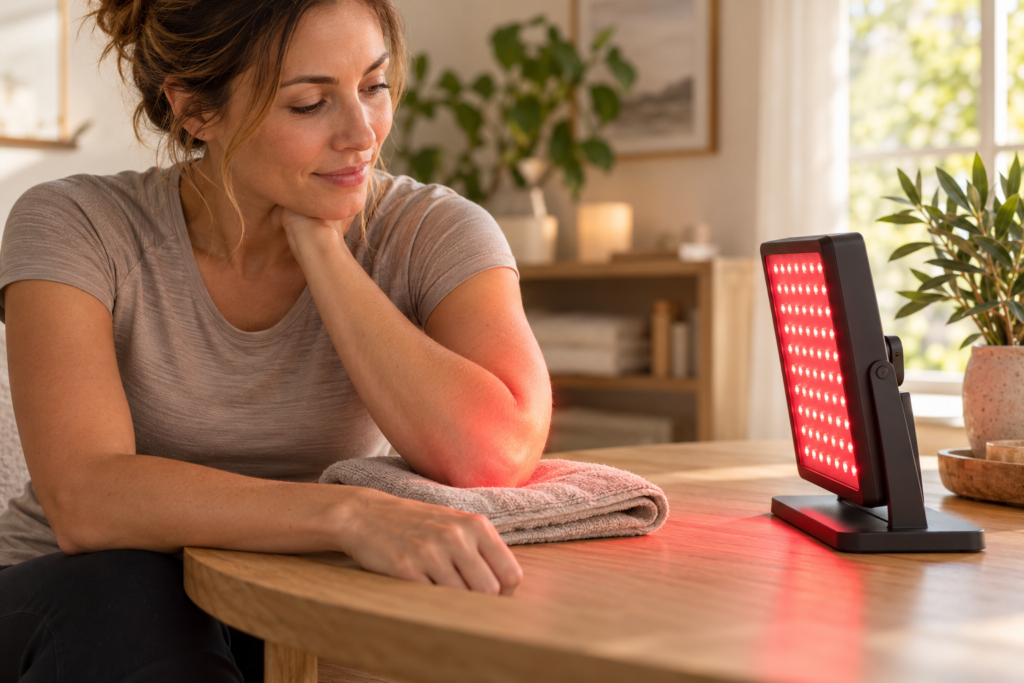
If you use a home device, follow its instructions for distance, session length, and eye protection. When you see a claim about red light therapy for muscle and joint recovery, look at the study behind it. Check the condition studied and whether its device and treatment schedule resemble yours. Be especially cautious when a claim about an LED panel relies on a trial of a targeted clinical laser.
For persistent, worsening, or unexplained joint pain, finding the cause matters more than experimenting with longer light sessions. A healthcare professional can assess the problem and help you decide whether light therapy has a place alongside your existing care.
So, can red light therapy reach your joints?
Some light can travel beneath the skin. Human measurements show that near-infrared light can transmit more readily than visible red light under certain conditions. But the amount that reaches a specific structure varies, and a measurement at the skin cannot tell us whether enough light arrived at the joint to produce a benefit.
Clinical studies offer some encouragement, particularly for certain knee osteoarthritis outcomes and for muscle soreness after specific pre-exercise treatments. They also leave important gaps. Findings from targeted lasers do not automatically apply to home panels, and reduced pain does not demonstrate cartilage repair.
That is where the science of red light therapy for muscle and joint recovery stands: there are measurable physical effects and some promising human results, alongside unanswered questions about who benefits, from which device, and under what conditions.
Frequently asked questions
Can red light therapy reach knee cartilage?
Some light can pass beneath the skin, but we cannot determine how much reaches an individual’s knee cartilage from a panel’s surface output alone. Tissue between the device and cartilage absorbs and scatters light. Studies reporting less knee pain do not, by themselves, show that cartilage received a particular dose or was repaired.
Is near-infrared light better than red light for joints?
Near-infrared light showed greater transmission than visible red light in one study of living human tissue. That makes it relevant to research on targets beneath the skin. It does not mean every near-infrared device will improve joint pain, because wavelength is only one part of a treatment.
Does red light therapy for muscle and joint recovery work better before or after exercise?
The answer depends on the outcome being studied. One review found low-certainty evidence that pre-exercise treatment reduced subsequent muscle soreness. That result should not be presented as proof that post-exercise treatment has the same effect.
Will a full-body panel produce the results seen in knee studies?
We cannot assume so. Some knee studies used lasers placed at specific points around the joint. A full-body LED panel differs in placement, coverage, and potentially the dose delivered to those points. The panel would need its own relevant evidence to support the same claim.
If my knee feels better, does that mean the joint is healing?
Feeling better matters, but it does not tell us which tissue changed or whether structural healing occurred. Pain and function are important outcomes in their own right. Claims that a treatment rebuilds cartilage require separate evidence.