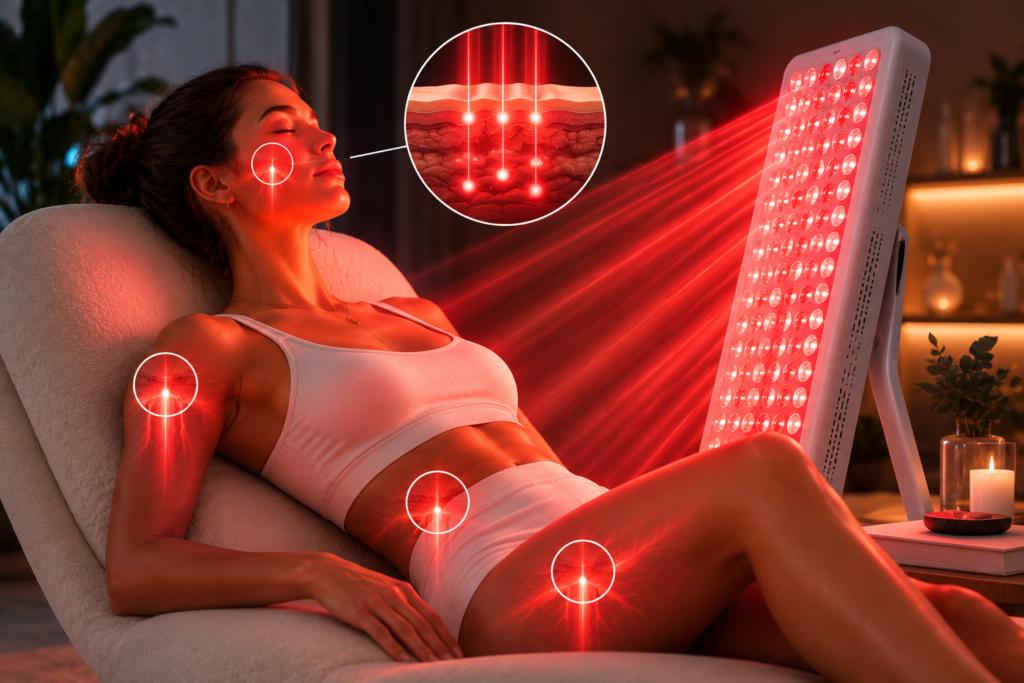
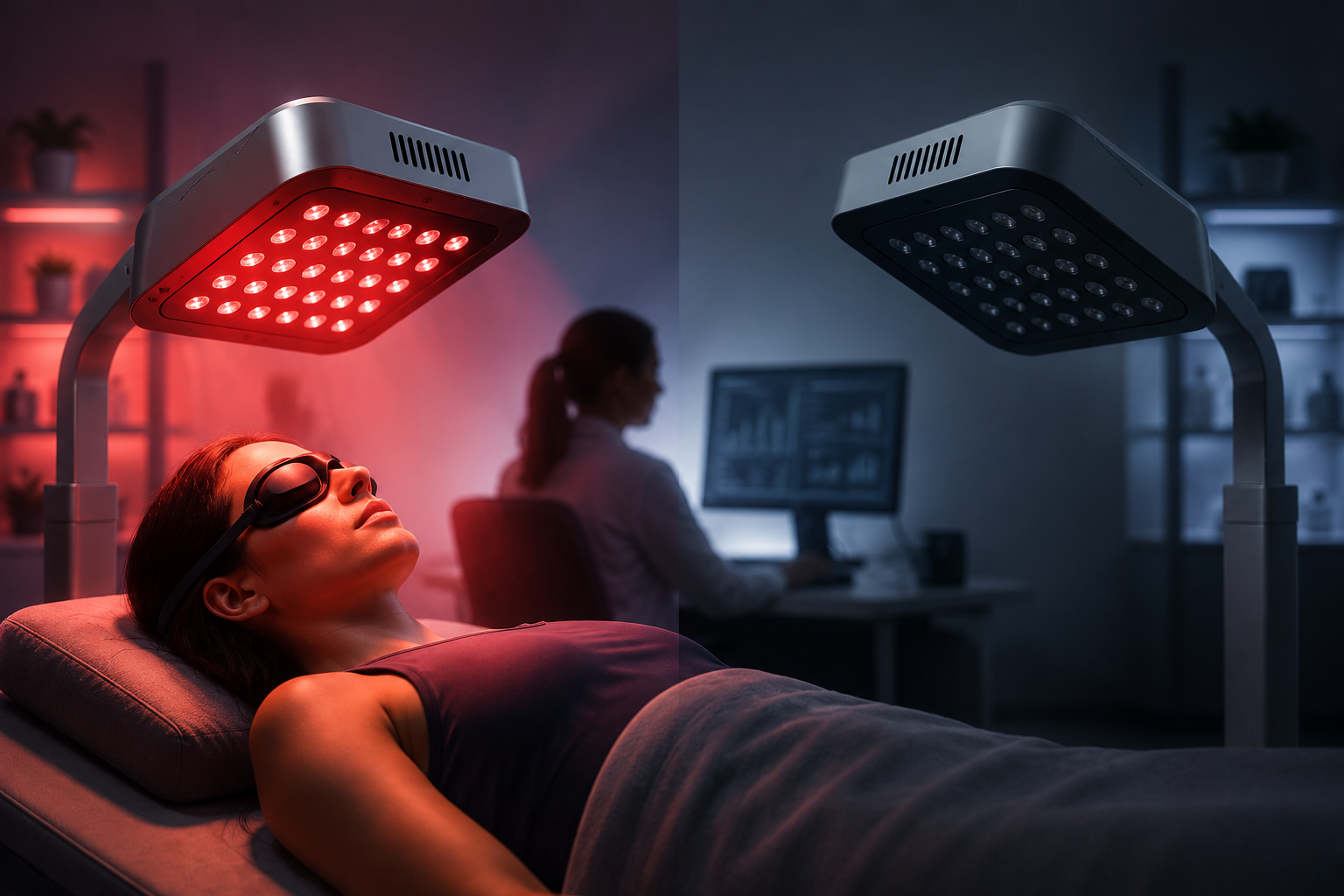
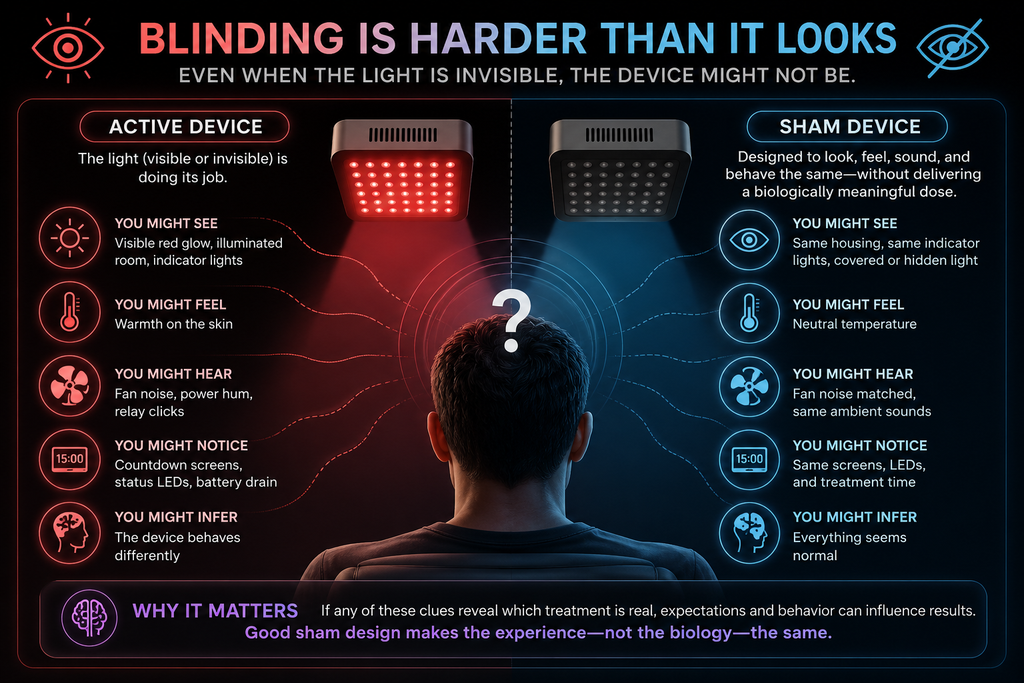
When a photobiomodulation study reports that it was “placebo-controlled” or “double-blind,” those labels can sound reassuring. Yet light-based interventions create masking problems that a drug trial does not. A participant may see a red glow, feel warmth, hear a fan, notice an indicator light, or recognize that a device behaves differently. The clinician operating the equipment may also be able to tell which unit is active. If those clues reveal treatment assignment, expectations and behavior can influence the result.
A well-designed photobiomodulation sham devices is meant to reproduce the experience of treatment without delivering a biologically meaningful dose to the target tissue. That is harder than simply turning the LEDs off. This guide explains what sham controls and blinding are supposed to accomplish, why they are difficult in red and near-infrared light trials, and what readers should check before treating a study’s conclusions as reliable.
Research note: This article discusses clinical-trial methods, not whether photobiomodulation is appropriate for any individual condition. A rigorous design can strengthen confidence in a result, but it does not replace evaluation of dose, population, outcomes, statistics, safety, and independent replication.
What photobiomodulation sham devices need to control
Symptoms such as pain, fatigue, sleep quality, mood, and perceived recovery can change for reasons unrelated to the specific optical effect being tested. People may improve because they expect to improve, because they receive extra attention, because symptoms naturally fluctuate, or because they change other behaviors during a trial. Regression toward the mean can also matter: participants often enroll when symptoms are unusually severe, then improve toward their typical level regardless of treatment.
A sham-controlled trial attempts to keep those nonspecific influences similar between groups. Ideally, both groups attend the same number of sessions, spend the same time with staff, use equipment that looks and sounds identical, receive the same instructions, and believe they could be receiving the active intervention. The intended difference is the relevant light dose.
This does not mean that every change in a sham group is “imaginary.” Natural history, co-interventions, measurement variation, attention, and expectancy are real contributors to observed outcomes. The active-versus-sham comparison asks whether the tested protocol produces an effect beyond that shared background.
Blinding is not one single thing
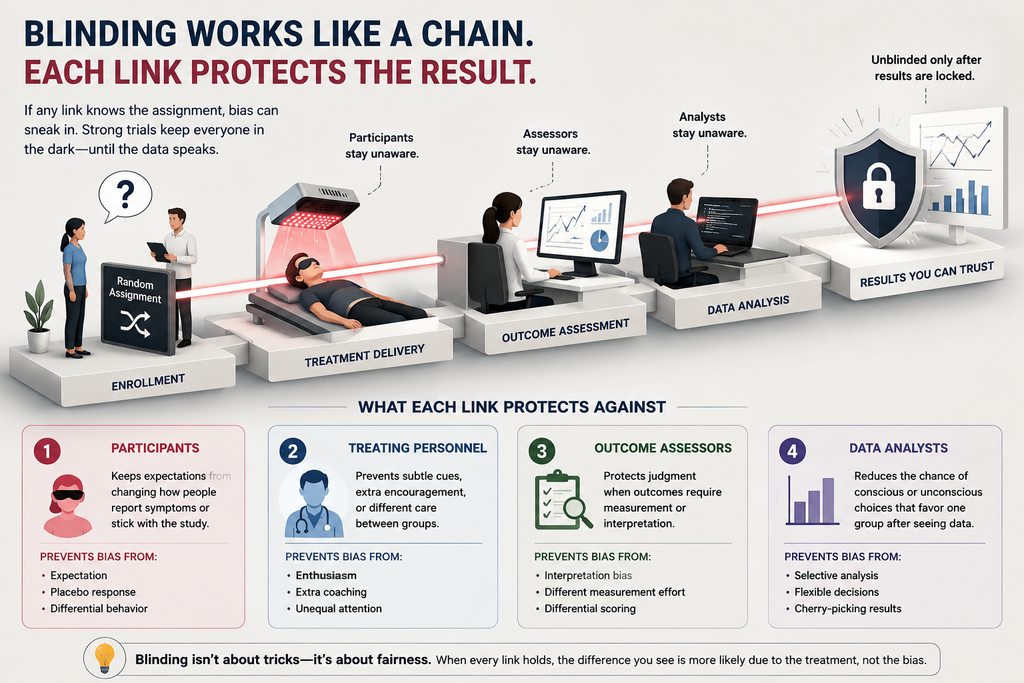
Articles often use “single-blind,” “double-blind,” or “triple-blind,” but those labels are not perfectly standardized. A better report identifies exactly who was unaware of allocation:
- Participants should not know whether they received active or sham treatment.
- Treating personnel should ideally not know which setting or device is active, although this can be difficult when they operate the equipment.
- Outcome assessors should not know allocation when measuring strength, range of motion, wound area, hair counts, cognitive performance, or other endpoints.
- Data analysts can analyze groups under neutral labels until prespecified decisions are complete.
Each layer protects against a different pathway of bias. An unblinded participant may report symptoms differently. An unblinded therapist may communicate enthusiasm, adjust positioning, give extra coaching, or unintentionally treat groups differently. An unblinded assessor may make different judgment calls when an outcome requires interpretation. Blinding an analyst can reduce opportunities to make analysis choices after seeing which group appears to benefit.
Why visible red light can reveal allocation
Red wavelengths are plainly visible. If an active panel illuminates the room and a sham unit stays dark, participants and operators can often infer assignment immediately. That threatens masking even when the devices have identical housings.
Researchers may use opaque or wavelength-blocking goggles, cover the device, operate it outside the participant’s view, or include a harmless visible indicator in both conditions. One randomized, sham-controlled ICU trial reported that patients and therapists wore protective goggles that blocked the light, the sham device followed the same programmed treatment time, and neither device produced a detectable temperature rise. The authors also separated treatment, outcome assessment, and data-analysis roles. Those details are more informative than the phrase “triple-blind” alone.
Near-infrared light is invisible, but the device may not be
Near-infrared output is outside normal human vision, which can make participant masking easier. Nevertheless, active and sham devices can differ in other detectable ways. High-output arrays may create warmth. Cooling fans can turn on or change speed. Power supplies may hum. Status LEDs, countdown screens, relay clicks, or battery drain can reveal operation. Some devices combine invisible near-infrared LEDs with visible red LEDs, restoring the visual problem.
An inactive sham must also be optically inactive
A sham can look convincing yet deliver enough light to have a biological effect. This can happen when researchers reduce power rather than eliminate it, use a supposedly irrelevant wavelength, shorten exposure, increase distance, or add an optical filter without measuring what reaches the treatment surface.
That creates an “active placebo” problem. If the sham receives a small but meaningful dose, the difference between groups may shrink even when both exposures have an effect. A null result could then reflect a weak contrast, not proof that light is ineffective. Conversely, a visible sham light chosen only to preserve masking might have its own physiological or circadian effects.
Good reports describe the sham’s wavelength, irradiance, exposure time, area, and radiant exposure—or clearly state that measured output was zero. Measurement matters because a disabled-looking device can leak light, and a filter’s real transmission may differ across wavelengths. The same attention given to active-device dosimetry should be applied to the control.
Allocation concealment is different from blinding
Allocation concealment protects the randomization process before a participant enters a group. Blinding protects the study after assignment. They solve different problems.
If recruiters can predict the next assignment, they may consciously or unconsciously influence who is enrolled. Proper methods can include centralized randomization, sequentially numbered opaque sealed envelopes prepared independently, or device codes generated by someone not involved in enrollment. Merely saying that participants were “randomly divided” does not show that allocation was concealed.
After assignment, blinding aims to prevent people from learning the group. A trial can conceal allocation correctly yet lose participant blinding during the first illuminated session. It can also use convincing sham equipment while having a weak randomization process. Readers should assess both.
Why subjective and objective outcomes respond differently to failed blinding
Failed participant masking is especially important when the primary outcome is self-reported pain, fatigue, sleep, mood, or quality of life. Expectations can affect ratings, adherence, reporting of adverse events, and decisions to seek other care. If participants know they are receiving sham treatment, disappointment can amplify the apparent difference between groups.
Objective outcomes are not immune. Motivation can affect grip strength, walking tests, reaction time, or exercise performance. Staff encouragement can influence effort. Image interpretation, wound tracing, hair counts, and clinical scoring may involve judgment. This is why blinded outcome assessors and standardized measurement procedures remain valuable even when participants cannot be perfectly blinded.
Credibility checks: did the blind actually work?
Investigators sometimes ask participants and staff to guess which treatment they received and rate their confidence. If guesses are far more accurate than chance, masking may have failed. Researchers can also ask what clues informed the guess: visible glow, heat, lack of sensation, comments from staff, or perceived symptom change.
These checks need careful interpretation. A participant may correctly guess active treatment because symptoms improved, not because the device revealed its setting. Asking only at the end mixes sensory clues with perceived efficacy. Assessing guesses early, before outcomes have had much time to change, can provide a cleaner test of sham credibility. Repeating the question can show whether masking deteriorates.
A trial should not claim successful blinding solely because nobody formally reported unmasking. Evidence is stronger when the authors describe the sham, report any credibility assessment, and explain whether guesses were associated with outcome changes.
Therapist blinding and device coding
Blinding the operator is often the hardest part of a device trial. One approach is to manufacture active and sham units that are externally identical and labeled only with codes. A device can load a concealed program from a card or respond to a participant code, allowing the operator to start a session without knowing the setting.
However, coding works only if active operation cannot be inferred from light, heat, sound, control menus, maintenance screens, or power consumption. The person who holds the code key should not be the person recruiting participants, delivering treatment, or scoring outcomes. Procedures for emergency unblinding should be specified and documented.
When therapist blinding is genuinely impossible, the study should say so plainly and reduce the risk in other ways: scripted interactions, automated timing, fixed positioning, equal contact time, blinded assessors, and outcomes less vulnerable to encouragement or judgment.
Common sham designs and their tradeoffs
Completely inactive device
This gives the cleanest optical contrast when zero output is verified. Its weakness is credibility if active light is visible, warm, or audible.
Inactive emitters plus matching indicators
A separate low-output indicator can imitate the appearance of operation. Researchers must verify that the indicator does not irradiate the target with a potentially active dose or create a different sensory experience.
Blocked or filtered output
A physical barrier or optical filter may let the device operate normally while preventing treatment light from reaching tissue. This can preserve fan noise and display behavior, but the filter must be characterized, secure, and visually concealed.
Very-low-dose or alternate-wavelength control
This may improve credibility but risks biological activity. It is better described as an active comparator if the control exposure could plausibly influence the outcome.
Distance or positioning control
Moving the device farther away or aiming it elsewhere is easy, but participants and staff may notice the difference. Reflections and scatter can also deliver nonzero exposure. This approach requires measurement at the actual sham target location.
How poor reporting affects evidence reviews
Systematic reviewers cannot reliably judge bias when trial reports omit the details. A review of randomized photobiomodulation trials for primary headache evaluated random sequence generation, allocation concealment, blinding of participants and personnel, blinding of outcome assessors, incomplete data, selective reporting, and other bias domains. More recent reviews in other PBM applications have likewise downgraded certainty when allocation, blinding, adherence, or sham procedures were unclear.
“Unclear” does not necessarily mean the researchers used a bad method. It means readers cannot verify what happened. That uncertainty matters when small trials, subjective endpoints, flexible dosing, and incomplete masking appear together. Transparent methods allow later reviewers to distinguish an inadequately reported study from an inadequately conducted one.
A practical checklist for reading a PBM trial
When a paper uses the words sham, placebo, masked, or blinded, look for answers to these questions:
- Who was blinded: participants, therapists, assessors, and analysts?
- How was the random sequence generated, and was allocation concealed?
- Did active and sham devices look, sound, and feel the same?
- Could visible red light, heat, fans, screens, or indicator lights reveal assignment?
- What optical output did the sham deliver at the treatment surface?
- Were active and sham devices measured with appropriate instruments?
- Were session time, positioning, staff interaction, and co-interventions equal?
- Did the researchers test whether participants or staff could guess allocation?
- Were outcome assessors blinded, particularly for subjective or judgment-based measures?
- Was the protocol registered, and were primary outcomes and analyses prespecified?
- Did dropouts, adherence, or accidental unblinding differ between groups?
- Was the study large enough, and has an independent team replicated the result?
What a failed blind does—and does not—mean
Imperfect masking does not automatically make a result false. Some interventions are impossible to conceal fully, and a large effect on a hard objective outcome may remain persuasive. But failed blinding changes how confidently the effect can be attributed to the intended photobiological mechanism, especially when results depend on self-report or investigator judgment.
The right response is not to discard every imperfect trial or to accept “double-blind” at face value. Instead, examine the direction and likely size of bias. Did sensory clues favor the active group? Were staff behaviors standardized? Did blinded assessors measure objective outcomes? Did early credibility checks suggest successful masking? Do results agree across trials using different sham designs?
The bottom line
A credible photobiomodulation sham devices must control more than visible light. It should match the treatment experience while delivering no biologically meaningful exposure to the target, and investigators should verify both conditions at the point of use. Strong trials distinguish allocation concealment from blinding, identify exactly who was blinded, reduce sensory clues, protect outcome assessment, and report whether masking remained credible.
For readers, the practical lesson is simple: treat “placebo-controlled” as the start of the methods review, not the end. The more clearly a study explains its active device, sham output, sensory matching, randomization, and blinding checks, the easier it is to judge whether the observed difference is likely to reflect the light protocol itself.
Last reviewed: August 23, 2026.