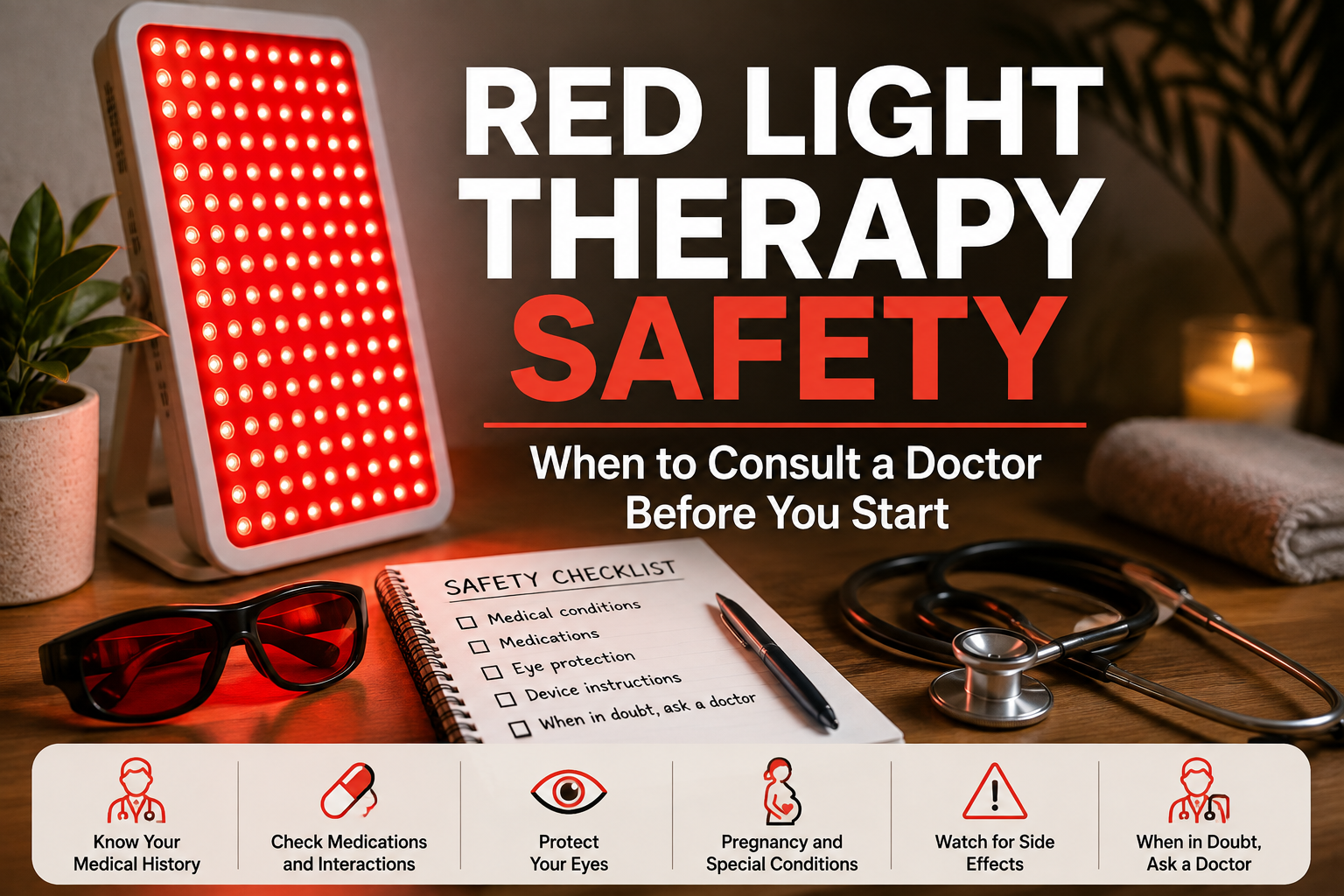
Red light therapy (also known as photobiomodulation, or PBM) has a generally favorable safety profile. It has been praised for its beneficial effects on the skin, joints, muscles, and overall well-being. Still, red light therapy safety isn’t exactly the same for every person.
Unlike UV radiation, RLT doesn’t have well-established DNA-damaging effects. In fact, a 2025 evidence-based clinical consensus concluded that RLT is a safe treatment modality for adults. However, “generally safe” doesn’t mean that every person, medical condition, medication, body area, device, or treatment protocol should be treated the same way.
In this article, we’ll go over red light therapy safety, when you should consult a doctor before using it, some situations that may require extra caution, and when a reaction during or after treatment may be a reason to stop using your device and get medical advice.
Is Red Light Therapy Generally Safe?
For most healthy adults, red light therapy is generally considered low-risk when used correctly.
One important reason is that red light therapy is very different from UV exposure. Red and near-infrared light are forms of non-ionizing radiation. They don’t work the same way as the ultraviolet radiation associated with sunburn and skin cancer.
The American Academy of Dermatology (AAD) says that red light therapy appears safe in the short term and that research has not found red light to cause cancer in the way UV light can. The most common side effects it identifies are relatively mild, such as temporary skin irritation or mild pain.
Cleveland Clinic similarly describes RLT as safe when used short-term and according to directions. However, it also points out something worth remembering: we still don’t know as much about the long-term safety of repeated at-home use.
That’s an important part of the red light therapy safety conversation because there isn’t one universal RLT protocol.
One person may use a small mask on their face for a few minutes, while another person may stand in front of a large panel. Devices can have different wavelengths, output levels, recommended distances, and treatment times.
So, following the directions for your particular device matters.
When Should You Talk to a Doctor Before Using Red Light Therapy?
Most people probably don’t need a doctor’s appointment before every red light therapy session. There are, however, certain situations where asking a healthcare professional first makes sense.
Your medical conditions, medications, treatment area, and even the reason you’re using RLT can affect red light therapy safety.
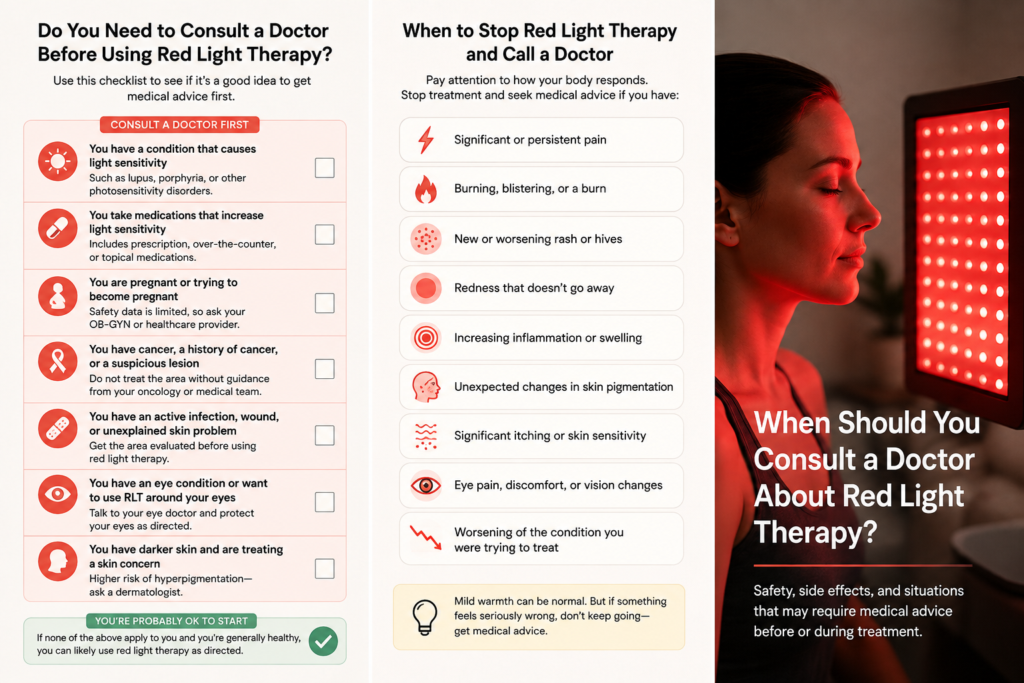
You Have a Condition That Makes You Sensitive to Light
If you already know that you have an unusually strong sensitivity to light, don’t assume that RLT is automatically fine because it doesn’t contain UV.
Certain medical conditions can cause photosensitivity, meaning that your body or skin reacts more strongly to light.
For example, the American Academy of Dermatology specifically mentions lupus as a condition that can make someone sensitive to light and potentially worsen with red light exposure.
This doesn’t mean everyone with a medical condition involving photosensitivity will react the same way. It does mean that experimenting with an at-home panel probably shouldn’t be the way you find out.
If you have lupus or another condition that causes photosensitivity, ask the healthcare professional treating that condition whether RLT is appropriate for you.
You Take Medications That Increase Light Sensitivity
Your health conditions aren’t the only thing to think about. Your medications matter too.
Some medications and topical treatments can increase the skin’s sensitivity to light. This is commonly called drug-induced photosensitivity.
The AAD recommends talking to a dermatologist before using an at-home red light device partly because RLT may interact with medications or treatments that increase light sensitivity.
This is one area of red light therapy safety where you don’t want to rely on a giant medication list you found online.
Not every medication that carries a warning about sunlight will necessarily interact with red or near-infrared light in exactly the same way. The wavelength of light matters, as does the medication and the person taking it.
If you’re unsure, ask your doctor or pharmacist a simple question: Does anything I’m taking make red light therapy a concern for me?
And don’t stop taking prescribed medication just so you can use an RLT device. That decision should come from the healthcare professional who prescribed it.
You’re Pregnant or Trying to Become Pregnant
Pregnancy is another situation where it’s better to ask than assume.
This doesn’t mean that red light therapy has been proven to harm a pregnancy. The problem is that there isn’t enough evidence to confidently say that every type of at-home RLT treatment, on every part of the body, using every device, is appropriate during pregnancy.
That’s where general red light therapy safety advice has its limits. Research showing that something is generally safe for adults doesn’t automatically answer every question about its use during pregnancy.
The safest option is pretty simple. If you’re pregnant, trying to become pregnant, or undergoing fertility treatment, mention RLT to your OB-GYN or other healthcare professional before starting.
This is especially worth discussing if you plan to use a device over your abdomen or use a full-body device.
What About Red Light Therapy If You Have Cancer?
This is probably one of the areas where the internet can make things unnecessarily confusing.
You may come across claims that red light therapy “feeds cancer” because PBM can affect cellular activity. That’s too simple of an explanation.
PBM has actually been studied in cancer care for managing some side effects of cancer treatment. A systematic review of 27 studies examining PBM for cancer-treatment toxicities found that most studies reported no side effects and concluded that the available literature did not indicate tumor-safety problems from PBM used for these purposes.
A separate systematic review looking at the oncologic safety of PBM found no evidence that PBM causes dysplastic changes in healthy cells under established treatment parameters.
But there is an important difference here.
PBM being used as part of medically managed cancer care is not the same as someone deciding to shine an at-home RLT device directly over a known or suspected tumor.
That’s why cancer deserves special attention in any discussion about red light therapy safety.
Cancer is complicated, and different cancers don’t behave the same way. Neither do different treatment protocols.
If you currently have cancer, are receiving cancer treatment, have a history of cancer in the area you want to treat, or have a suspicious lump or skin lesion, talk with your oncology or medical team before treating that area.
This isn’t because RLT has been proven to cause cancer. It’s because active or suspected cancer isn’t something that should be treated experimentally at home without your medical team knowing about it.
What If You Have a Wound, Infection, or Unexplained Skin Problem?
This one can sound strange because PBM itself has been researched for wound healing.
In fact, the 2025 clinical PBM consensus found evidence supporting PBM for certain types of wound ulcers.
So why would you need to talk to a doctor about a wound?
Because knowing why you have the wound matters.
There’s a big difference between a healthcare professional using PBM as part of a treatment plan for a diagnosed wound and someone finding a sore that won’t heal and deciding to put red light on it.
An unexplained wound could have an underlying cause that needs treatment. The same goes for a persistent rash, infection, unusual mole, lump, or skin lesion.
Good red light therapy safety isn’t just about avoiding side effects. It’s also about making sure RLT doesn’t distract you from a medical problem that needs to be properly diagnosed.
RLT shouldn’t become a reason to put off finding out what’s actually going on.
Talk to a Doctor If You’re Using Red Light Therapy Around Your Eyes
Eye safety gets tricky because there’s some fascinating research happening in this area.
Researchers are investigating red light and PBM for several eye conditions. A 2025 review of red light therapy in ophthalmology discussed potential applications involving myopia, glaucoma, age-related macular degeneration, and dry eye disease.
But that same review also noted that questions remain about dosing, safety, standardization, and the long-term effects of RLT on the eyes.
In other words, researchers studying carefully controlled red light treatments for eye conditions doesn’t mean you should stare directly into your red light therapy panel.
Those are two very different things.
Eye protection is an especially important part of red light therapy safety because the appropriate precautions can depend on the device you’re using.
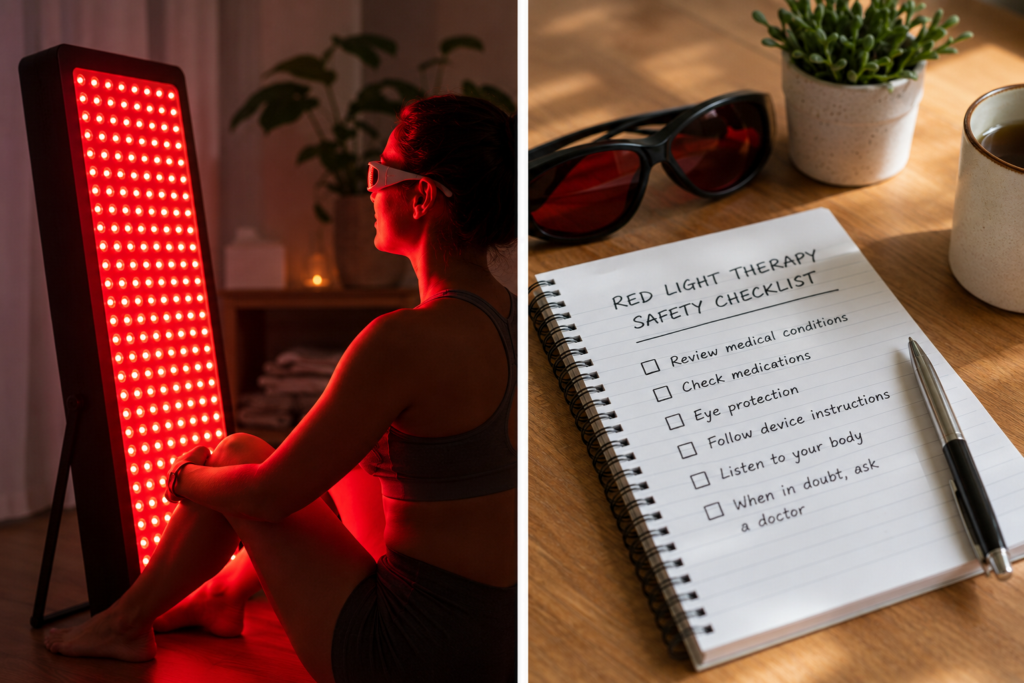
If your device tells you to wear eye protection, wear it. The AAD specifically recommends using the eye protection recommended by the manufacturer and not substituting regular sunglasses for protective goggles when goggles are required.
If you have an existing eye condition, have had eye surgery, take medication affecting your eyes, or specifically want to use RLT to improve an eye problem, talk with your eye doctor first.
What About People With Darker Skin?
Skin tone is another factor that doesn’t get discussed enough.
The American Academy of Dermatology notes that people with darker skin tones can be more sensitive to visible light, including red light, and may have a greater risk of developing hyperpigmentation.
Research supports the idea that visible light can produce different pigmentation responses depending on skin type. A review of visible light and the skin found that visible light can cause more intense and longer-lasting pigmentation in darker skin types.
This does not mean that people with darker skin shouldn’t use red light therapy.
It means that skin isn’t identical from one person to the next, which is another reason red light therapy safety shouldn’t be treated as a one-size-fits-all question.
If you’re particularly prone to hyperpigmentation or you’re using RLT specifically to treat pigmentation, dark spots, melasma, or another skin condition, a dermatologist may be able to help you determine whether RLT makes sense and how your skin should be monitored.
When Should You Stop Red Light Therapy and Call a Doctor?
Talking to a doctor isn’t only something to consider before you begin.
Pay attention to how your body responds once you start using RLT.
Feeling some warmth from a device isn’t necessarily a sign that something is wrong. But pain and significant skin reactions shouldn’t simply be brushed off as the therapy “working.”
Cleveland Clinic warns that misuse, such as using a device too frequently or not following its instructions, could potentially damage the skin or unprotected eyes.
This is one of the simplest red light therapy safety rules to remember: if a treatment is causing a significant or worsening reaction, don’t keep increasing the exposure and hope it gets better.
Stop treatment and consider contacting a healthcare professional if you develop symptoms such as:
- Significant or persistent pain
- Burning or blistering
- A new rash or hives
- Redness that doesn’t settle down
- Increasing inflammation
- Unexpected changes in skin pigmentation
- Significant itching or skin sensitivity
- Eye pain or discomfort
- Changes in your vision
- Worsening of the condition you were trying to treat
The severity matters too. A little temporary skin irritation isn’t the same thing as a burn or sudden change in vision.
If something feels seriously wrong, don’t keep increasing the treatment time because you think your body needs to “adjust.”
Don’t Let Red Light Therapy Delay an Actual Diagnosis
There is another red light therapy safety issue that doesn’t really have anything to do with the light itself being dangerous.
Sometimes the problem you’re trying to treat needs to be diagnosed first.
Let’s say you’re experiencing hair loss. You can buy red light therapy caps and helmets designed for certain types of hair loss, and there is research supporting PBM for androgenetic alopecia. But not every case of hair loss has the same cause.
The same thing applies to skin problems and pain.
A strange skin lesion isn’t automatically an age spot. Persistent joint pain isn’t automatically something that should only be managed at home. A wound that won’t heal may need more than light therapy.
Cleveland Clinic recommends seeing a dermatologist or other qualified professional because they can confirm whether the skin problem you think you have is actually what you’re dealing with.
Red light therapy can be useful without being the answer to everything.
Sometimes seeing a doctor isn’t about getting “permission” to use RLT. It’s about making sure you’re treating the right problem in the first place.
Does FDA Clearance Mean a Red Light Therapy Device Will Work for You?
You’ll see “FDA-cleared” on quite a few red light therapy products.
It’s a useful thing to look for, but it’s also commonly misunderstood.
The AAD explains that FDA clearance does not automatically tell you how effective a particular red light device will be for you.
The FDA also has specific regulatory guidance for photobiomodulation devices marketed as medical devices. At the same time, the agency notes that some low-risk light-emitting products intended only for general wellness may fall outside that particular guidance.
So don’t treat “FDA-cleared” as meaning that a device has been proven to do everything mentioned on a product page.
Also, don’t assume that because one RLT device has been studied for one purpose, every red light device will produce the same results.
The device matters.
So do the wavelength, output, treatment distance, exposure time, frequency, and intended use. Those factors are all part of red light therapy safety, not just technical numbers printed in a product manual.
Questions to Ask Your Doctor About Red Light Therapy
You don’t need to walk into an appointment with a research paper in your hand.
If you have a reason to be cautious, the questions can actually be pretty basic:
- Is red light therapy appropriate for what I’m trying to treat?
- Do any of my medications make me more sensitive to light?
- Is there any reason I shouldn’t treat this particular area?
- Does my medical history change the risks?
- Should I protect my eyes when using this device?
- Could RLT interfere with another treatment I’m receiving?
- How would I know if I should stop using it?
And, maybe most importantly:
Do we actually know what’s causing the problem I’m trying to treat?
That question can matter much more than whether you should use your panel for five minutes or ten.
The Bottom Line on Red Light Therapy Safety
For most healthy adults, red light therapy appears to have a generally favorable safety profile when it’s used appropriately. Overall, the available evidence on red light therapy safety is reassuring, but that doesn’t mean every situation is identical.
You don’t have to schedule a doctor’s appointment every time you turn on your panel.
But there are situations where getting medical advice first makes sense.
If you have a condition that causes photosensitivity, take medications that make you sensitive to light, are pregnant, have cancer or a suspicious lesion, have an unexplained wound or skin condition, or want to use RLT around your eyes, talking to the appropriate healthcare professional can help you make a more informed decision.
The same applies after you’ve started.
Pain, burns, blistering, persistent skin reactions, unexpected pigmentation changes, eye symptoms, or a condition that seems to be getting worse aren’t things you should ignore just because red light therapy is generally considered safe.
And that’s really the important distinction.
Red light therapy can be generally safe without being appropriate for every person in every situation.
Use the device as directed, pay attention to how your body responds, and when something falls outside the ordinary, that’s when getting an actual medical opinion makes more sense than guessing.
Ready for your RLT device? Check out our product and brand reviews to help with your decision. You can also use our comparison tool.