Key takeaway
Does skin pigmentation change the light that reaches tissue? It can. Melanin absorbs some incoming light, and studies have measured differences in how light passes through skin with different pigmentation. The effect appears more pronounced for visible red light than for some near-infrared wavelengths. Body area, tissue thickness, wavelength, and device design also matter.
Research on red light therapy and skin tone has an important limit: measuring light transmission does not tell us whether someone will get a different treatment result. One study found no detectable skin tone effect under its particular test conditions. There is currently no reliable rule telling home users to add minutes or increase intensity based on skin tone.
For now, follow your device’s instructions for distance and session length. To give clearer guidance, studies of red light therapy and skin tone need to measure pigmentation alongside device settings, light transmission, and actual treatment outcomes.
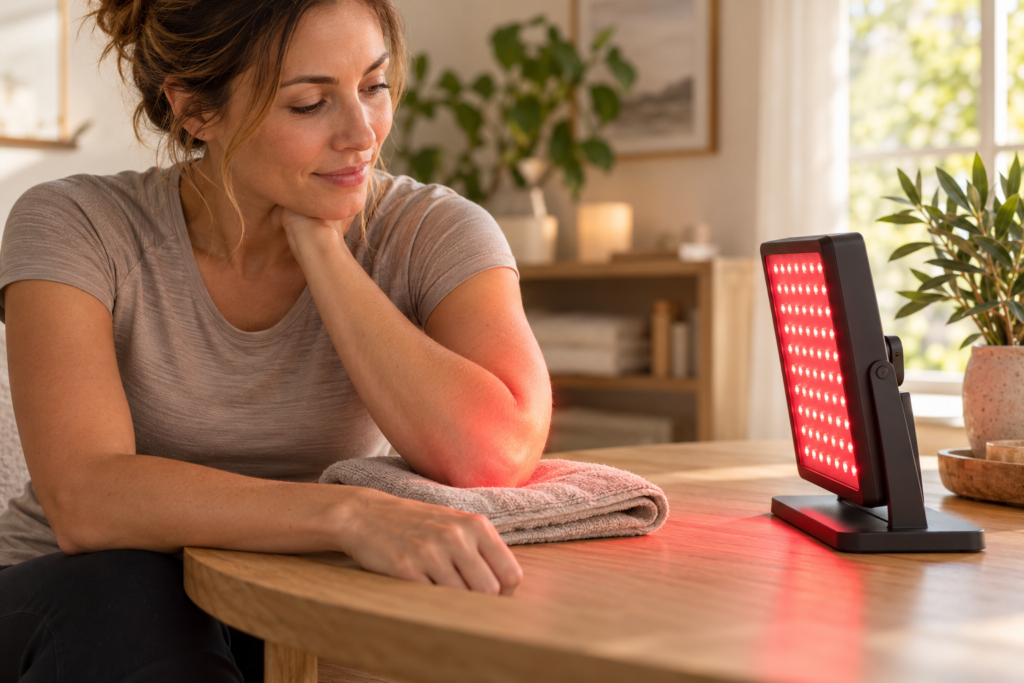
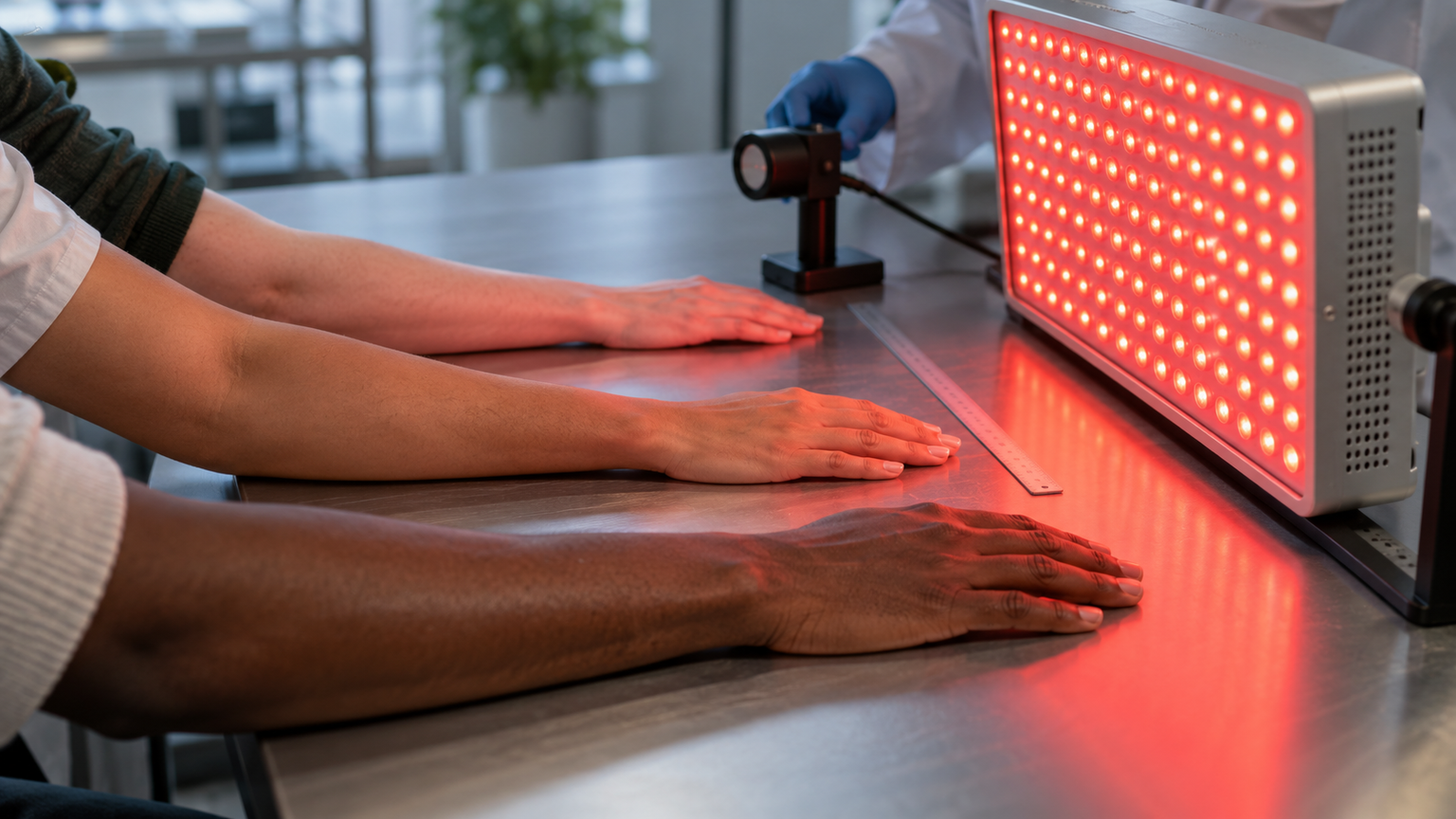
Imagine two people standing in front of the same red light panel. They use the same setting, stand the same distance away, and stay there for the same amount of time. Does the same amount of light reach the tissue beneath their skin?
It is a fair question, and one that device specifications cannot answer on their own. A panel can tell you about the light it emits. It cannot tell you exactly how much reaches a particular layer of your skin. To understand red light therapy and skin tone, we have to follow the light after it leaves the device.
What happens when light reaches skin?
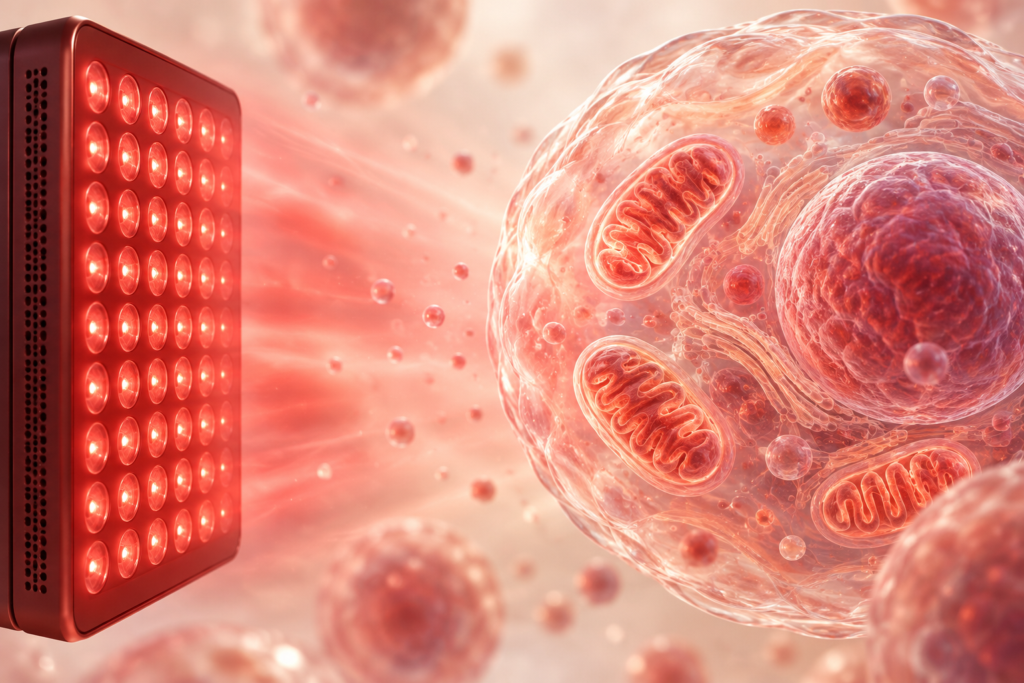
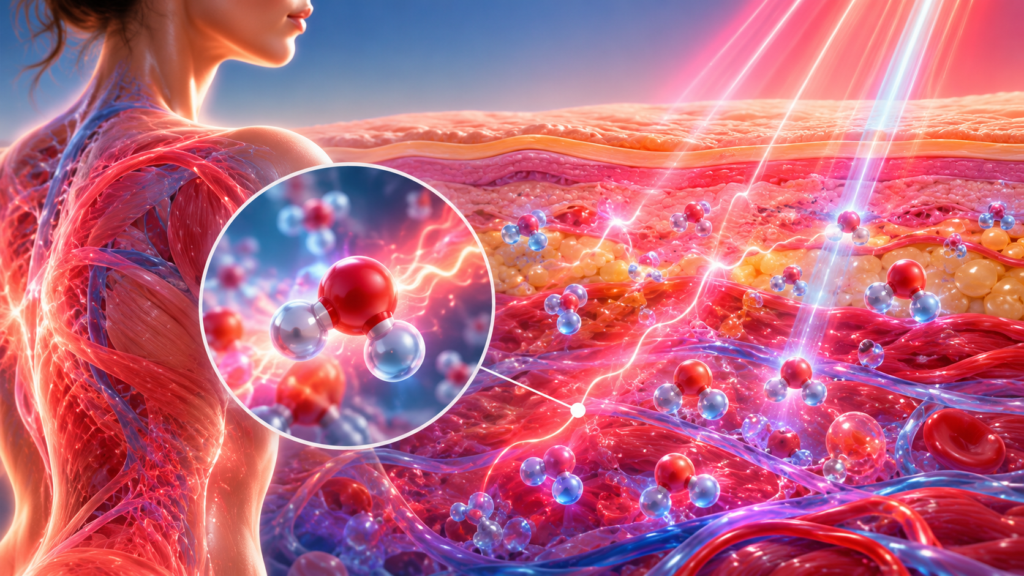
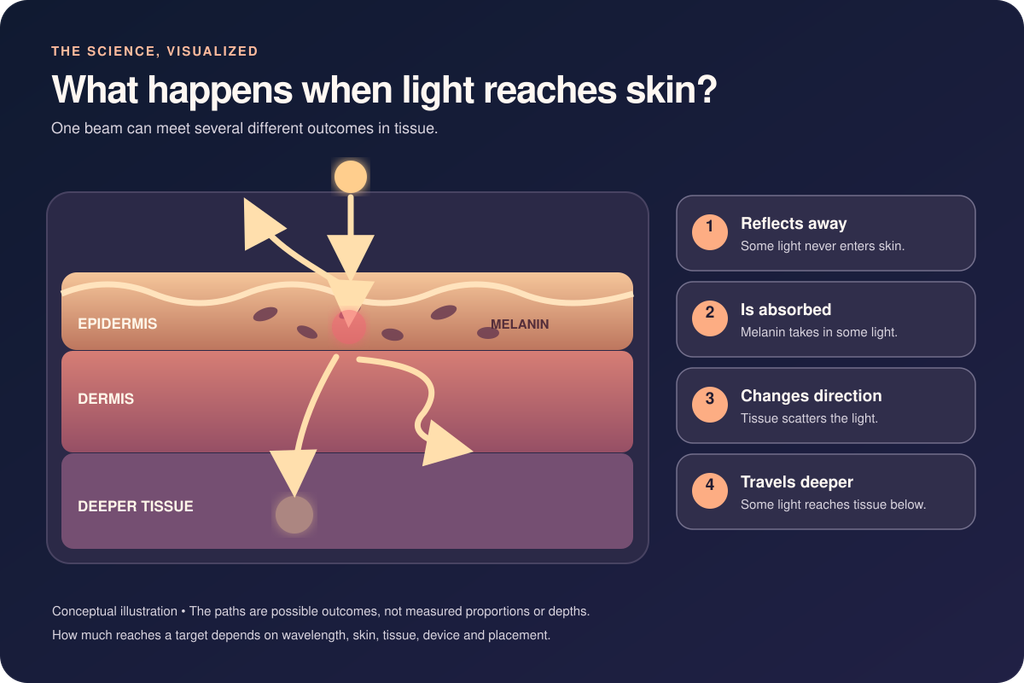
Some light reflects off the skin’s surface. Some enters and changes direction as it moves through tissue, a process called scattering. Some is absorbed. What remains at a deeper point depends on all three processes.
Melanin, the pigment that contributes to skin color, absorbs light. Blood and water also affect where light travels, while the thickness and structure of tissue influence how far it can go. That makes red light therapy and skin tone more complicated than asking whether darker skin “blocks” light. Skin is not a single filter through which every wavelength travels in a straight line.
There is also a difference between light measured at the surface and light measured beneath it. A device’s irradiance figure describes output under particular measurement conditions; it is not a measurement inside your body. Our guide to irradiance measurements explains why published readings can vary even before tissue enters the picture.
Researchers can investigate what happens beneath the surface, but they need to account for more than pigmentation. A 2026 modeling study used measured properties of human skin to examine light distribution. Beam size affected the calculated light beneath the surface, alongside wavelength and tissue properties. This is why red light therapy and skin tone cannot be reduced to one number printed on a device box.
Why does wavelength matter?
Red light is visible to us. Near-infrared light sits just beyond the visible range. Both are used in photobiomodulation, but changing the wavelength can change how light interacts with tissue.
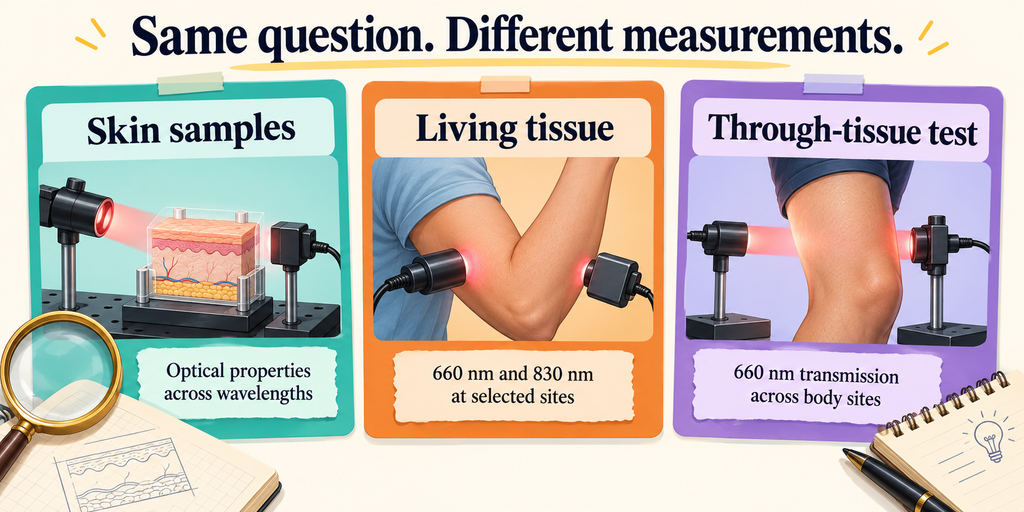
In one study, researchers examined 12 human skin samples across wavelengths from 500 to 1,300 nanometers. In the visible range, darker samples showed greater absorption and attenuation and less measured penetration. In the infrared range, the measured optical properties were more similar across samples. That gives us a useful clue about red light therapy and skin tone, although the study examined skin samples outside the body, not treatment results in living people.
Another research team measured 660 nm red light and 830 nm near-infrared light in 30 living participants. At the areas tested near the elbow and Achilles tendon, light transmission differed with melanin index and wavelength. Under those conditions, more 830 nm light was transmitted than 660 nm light. Tissue thickness, composition, beam diameter, and the equipment also mattered.
These measurements do not mean near-infrared is automatically the better choice for every person or goal. They show that wavelength belongs in a discussion of red light therapy and skin tone. Our 660 nm versus 850 nm guide explores the broader differences between commonly used red and near-infrared wavelengths.
Why did another study find no skin tone effect?
A 2019 study measured 660 nm light passing through several human body sites. The researchers found that factors such as tissue thickness and irradiance affected transmission. They did not detect an effect of skin tone in their measurements.
That result deserves a place in any honest article about red light therapy and skin tone. It also needs to be read alongside the study’s method. The researchers placed a light detector on the opposite side of tissue at selected body sites. The skin-sample study measured optical properties across many wavelengths. The 2024 study examined two wavelengths at specific areas near the elbow and Achilles tendon. These experiments looked at related questions in different ways.
The studies tell us that pigmentation can influence light transmission, but they do not establish that its effect will be equally large or detectable at every body site. When evaluating red light therapy and skin tone, the measured wavelength, tissue, device, and placement all matter.
Why is “skin type” an imperfect measurement?
Many studies describe participants using the Fitzpatrick skin-type scale. It is familiar in dermatology, but it was developed to describe how skin responds to ultraviolet exposure. A category on that scale is not an exact measurement of melanin in a treatment area, and it is not a measure of race.
That distinction matters for red light therapy and skin tone. Two people in the same broad Fitzpatrick category can have different pigmentation. Different areas of one person’s skin can vary, too. Researchers may use instruments to measure skin color or a melanin index more directly, although no surface measurement captures everything about the tissue beneath it. A dermatology review explains the limitations of using Fitzpatrick types as a stand-in for skin color.
This is one reason a chart that assigns device settings by skin-type number would promise more precision than the research can provide. Studying red light therapy and skin tone well requires researchers to say how they measured pigmentation, rather than relying only on a broad label.
Does less transmitted light mean less benefit?
Not necessarily. A sensor can measure light at a particular location. It cannot tell us, by itself, how someone’s skin will look after weeks of treatment or whether a recovery outcome will change.
This is the central unanswered question in red light therapy and skin tone: do the differences measured in some transmission experiments lead to meaningful differences in treatment outcomes? A 2026 review found that few photobiomodulation trials reported outcomes by skin tone. Without that information, it is difficult to connect the physics of light transmission to results for people with different pigmentation.
It would be premature to say that darker skin prevents red light therapy from working. It would also be premature to say pigmentation never matters. The evidence on red light therapy and skin tone is strongest when describing certain measured optical differences. It is much thinner when it comes to predicting who will benefit or by how much.
Should you change your session time based on skin tone?
At present, researchers have not established a dependable formula for doing that. The studies above cannot tell an individual home user to add a certain number of minutes or increase intensity by a particular percentage. More time at the surface does not answer the question of what amount reaches a specific target tissue.
If you are thinking about red light therapy and skin tone while setting up a device, start with the details you can check: its wavelengths, its instructions, the intended treatment area, and the recommended distance. Our articles on treatment distance and irradiance and dosage explain how those factors fit into a session.
Follow the instructions for your particular device rather than extending a session to compensate for an effect that has not been measured in you. If you have a skin condition or questions about whether a light treatment suits you, a dermatologist can help you consider your circumstances.
What would a better study tell us?
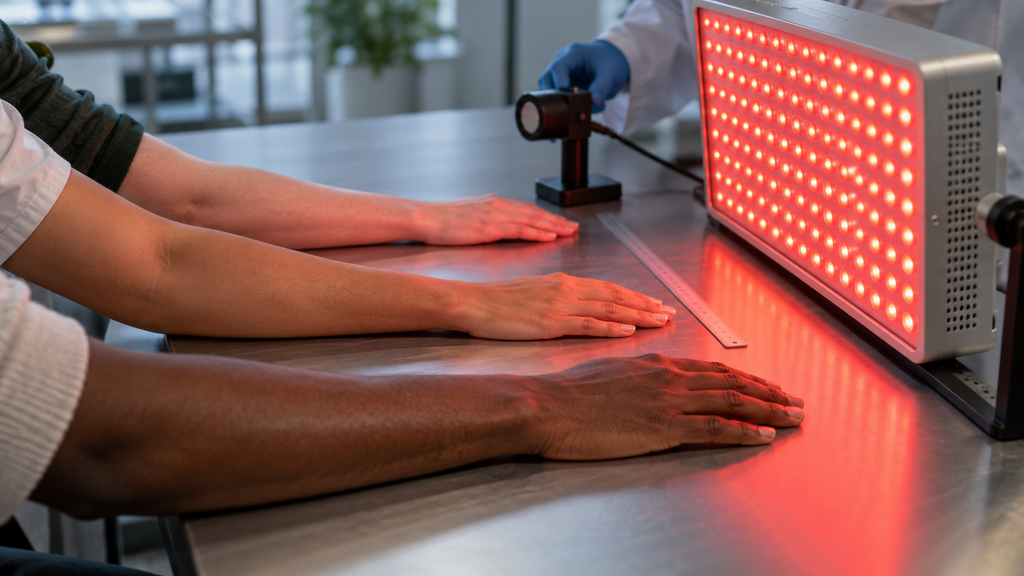
A useful next step for red light therapy and skin tone would be studies that measure pigmentation directly, describe the device and treatment site clearly, and report actual outcomes across participants with different pigmentation levels. Researchers would then be better able to test whether a difference in light transmission changes results.
For now, the answer is careful but useful: skin pigmentation can change how light travels through tissue, particularly in the visible range. It is one part of a larger picture that includes wavelength, device design, and the tissue being treated. The research has not yet turned those observations into a personal dosing rule.