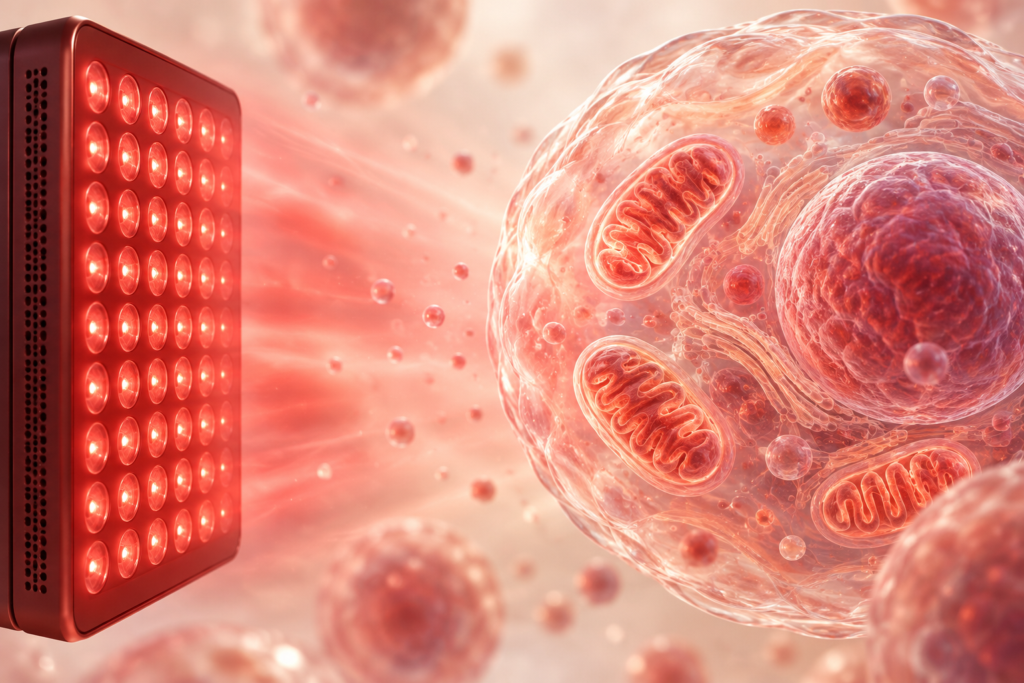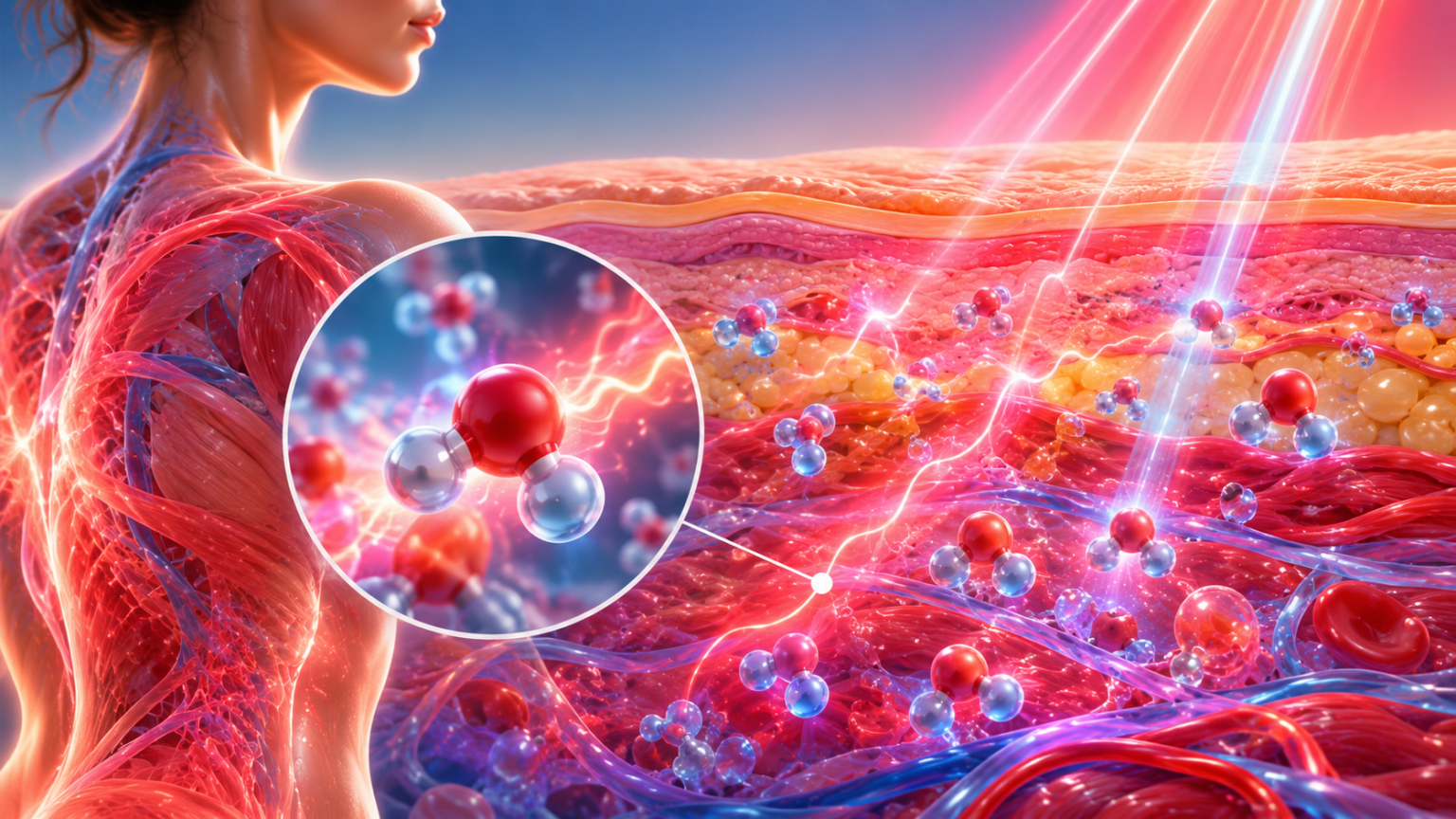
Water in the human body absorbs infrared light differently depending on the wavelength. When water molecules absorb certain infrared wavelengths, the light’s energy can excite molecular vibrations and eventually contribute to heat. However, water absorbs relatively little light at many wavelengths commonly used for red and near-infrared light therapy, while absorption becomes much stronger at certain longer infrared wavelengths.
- Water does not absorb every infrared wavelength equally.
- Water has notable infrared absorption bands around 970, 1,190, 1,450, and 1,940 nm.
- When water absorbs infrared energy, that energy can excite molecular vibrations and eventually contribute to heating.
- Water absorption is relatively low at many wavelengths commonly used for red and near-infrared light therapy, including around 810–850 nm.
- Stronger water absorption can limit how deeply certain longer infrared wavelengths travel through tissue.
- A longer wavelength does not automatically mean deeper penetration. Absorption and scattering both affect how far light travels.
- Water is only one part of the equation. Hemoglobin, melanin, lipids, proteins, and tissue structure also influence how light behaves inside the body.
The human body contains a lot of water. It is inside our cells, blood, muscles, organs, skin, and nearly every other tissue. So, how does water absorb infrared light when that light reaches the body?
The answer depends heavily on wavelength.
Water does not absorb every wavelength of infrared light equally. At some wavelengths, relatively little light is absorbed by water, giving photons more opportunity to travel through tissue. At others, water absorbs light much more strongly.
Understanding how water absorbs infrared light is important in everything from near-infrared light therapy to medical lasers and infrared imaging. It also helps explain something that can initially seem strange: a longer infrared wavelength does not necessarily travel deeper into the body.
To understand why, we first need to look at what actually happens to light after it reaches human tissue.
What Happens When Infrared Light Enters the Body?
Light does not simply pass straight through the body.
Once photons reach the skin, several things can happen. They can be reflected from the surface, scattered in different directions, absorbed by molecules in the tissue, or transmitted farther before eventually being scattered or absorbed.
Human tissue contains several substances that interact with light. Molecules or molecular groups that absorb particular wavelengths of light are often called chromophores.
Important absorbers in biological tissue include:
- Water
- Hemoglobin
- Melanin
- Lipids
- Proteins and other biological molecules
According to research on the optical properties of biological tissues, both absorption and scattering vary with wavelength and tissue composition.
That means the same beam of light can behave differently in skin, blood, fat, muscle, or another type of tissue.
Water is only one part of that system, but it becomes especially important at certain infrared wavelengths.
How Does Water Absorb Infrared Light at the Molecular Level?
A water molecule consists of two hydrogen atoms bonded to one oxygen atom: H₂O.
Those atoms are not frozen in place.
The bonds within water molecules undergo different types of molecular motion. The O-H bonds can stretch, while the angle between them can bend.
So, how does water absorb infrared light during all of this molecular movement?
Infrared radiation carries electromagnetic energy. At certain wavelengths, that energy can interact with molecular vibrations. When incoming infrared radiation corresponds with an allowed vibrational transition of the water molecule, the molecule can absorb that energy.
Put simply, some of the energy carried by the light is transferred to the water molecule.
The interaction becomes more complicated in the near-infrared region because researchers are often observing overtones and combination bands rather than only the molecule’s fundamental vibrational modes.
Research on short-wave infrared spectroscopy describes several water absorption features associated with combinations and overtones of O-H stretching and bending.
These molecular properties are why water has a recognizable infrared absorption spectrum.
Water Does Not Absorb Every Infrared Wavelength Equally
This is probably the most important point to understand when answering how does water absorb infrared light.
Saying “water absorbs infrared light” is technically correct, but it is incomplete.
Infrared covers a large range of wavelengths, and water’s absorption changes dramatically across that range.
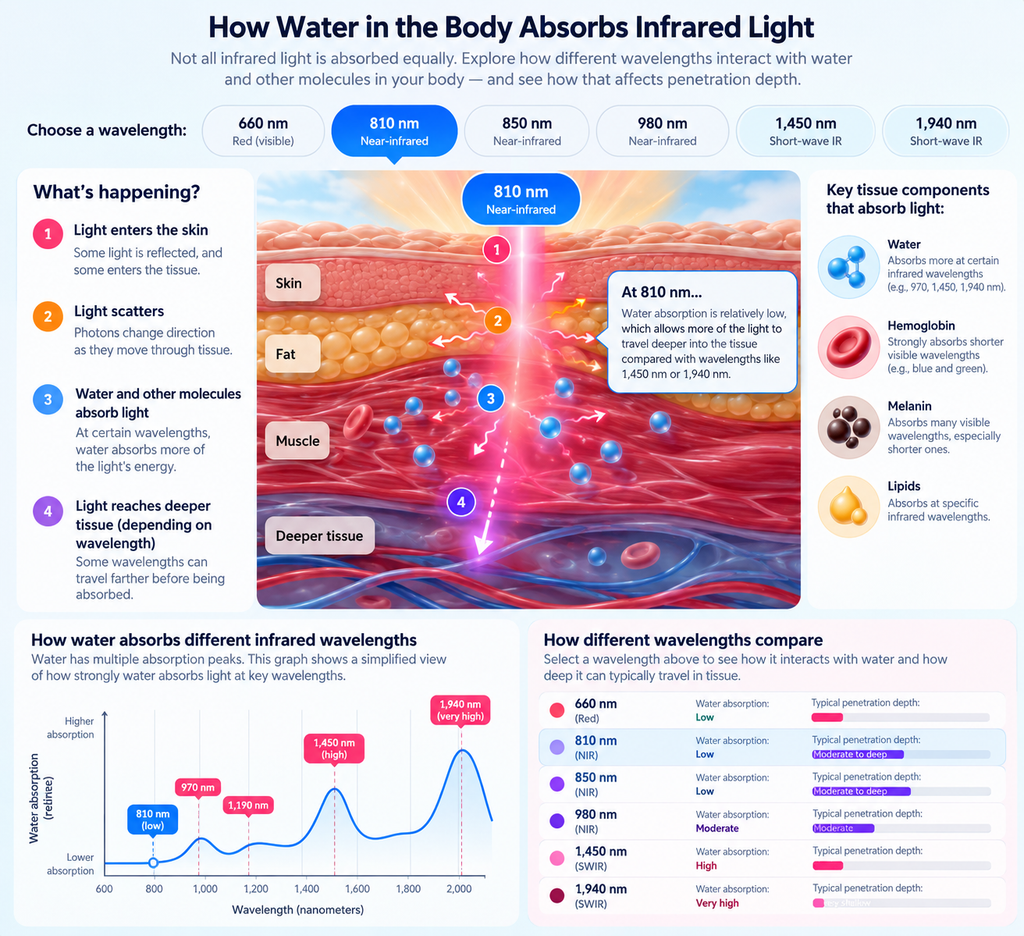
Researchers have identified notable water-related absorption regions around approximately:
- 970 nm
- 1,190 nm
- 1,450 nm
- 1,940 nm
These absorption bands are not equally strong.
Water absorption generally becomes much more significant in certain longer-wavelength regions.
Research examining water absorption in biological tissue describes prominent water absorption features in the near- and short-wave infrared spectrum, including particularly strong absorption farther into the infrared.
So, even though both 850 nm and 1,450 nm can be described as infrared wavelengths, water does not interact with them in the same way.
That difference has consequences for how far the light can travel through the body.
What Is a Water Absorption Peak?
To fully understand how water absorbs infrared light, it helps to understand an absorption peak.
An absorption peak is a region of the electromagnetic spectrum where a substance absorbs substantially more incoming radiation.
Imagine shining many different wavelengths through a sample of water and measuring how much light comes out the other side.
At some wavelengths, a relatively large amount could pass through.
At others, much less would emerge because water absorbed more of the incoming energy.
When scientists graph those measurements, areas where absorption increases appear as peaks in the absorption spectrum.
Water has multiple absorption peaks rather than one single wavelength at which it suddenly begins absorbing infrared radiation.
That is why it is more useful to ask:
How strongly does water absorb this particular wavelength?
rather than:
Does water absorb infrared light?
The answer to the second question is yes. The first question tells us much more about what the light might actually do inside tissue.
Why Can Some Near-Infrared Light Travel Farther Through Tissue?
This brings us to something called the tissue optical window, sometimes called the biological optical window.
There are regions of the electromagnetic spectrum where some of the body’s major light absorbers absorb comparatively little light.
One commonly discussed near-infrared optical window falls approximately between 650 and 950 nm, although its exact boundaries vary depending on the definition and application.
Within this region, hemoglobin absorption has decreased compared with many visible wavelengths, while water absorption has not yet reached some of its much stronger infrared bands.
That creates relatively favorable conditions for photons to travel through biological tissue.
Research into diffuse optical imaging describes the approximately 650–950 nm range as particularly useful for examining deeper tissue because absorption from major tissue chromophores is relatively low.
This does not mean light between 650 and 950 nm travels through the body untouched.
Photons are still being absorbed and scattered.
It simply means there can be a better opportunity for light to propagate through tissue than at wavelengths where one of the body’s major absorbers captures light much more strongly.
How Does Water Absorb Infrared Light at 850 nm vs. 1,450 nm?
Consider two infrared wavelengths: 850 nm and 1,450 nm.
At approximately 850 nm, water absorption is relatively low compared with major water absorption bands farther into the infrared.
This gives photons more opportunity to travel through water-rich tissue before being absorbed by water, although scattering and absorption by other tissue components still occur.
Now consider approximately 1,450 nm.
Water absorption is much stronger in this region.
Researchers can actually take advantage of this property. Short-wave infrared imaging techniques use water absorption features to create contrast and investigate water-containing biological tissues. Research on water absorption and SWIR imaging demonstrates how these wavelength-dependent properties can be useful for biomedical imaging.
So we have:
850 nm → comparatively weak water absorption
1,450 nm → much stronger water absorption
This difference helps determine where optical energy is deposited inside tissue.
It also reveals why wavelength alone cannot tell us how deeply light will penetrate.
Does a Longer Wavelength Always Penetrate Deeper?
No.
This is one of the easiest light-therapy concepts to oversimplify.
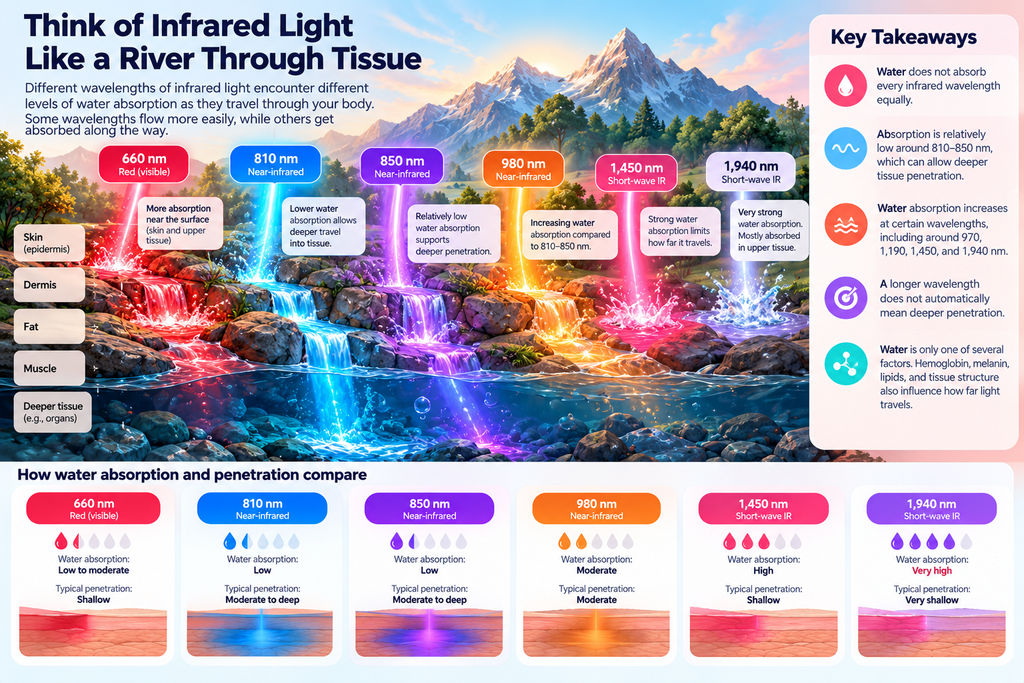
It is sometimes assumed that increasing wavelength automatically means increasing penetration:
660 nm → 810 nm → 850 nm → 1,000 nm → deeper and deeper
Real biological tissue does not behave that neatly.
Two important processes are happening at the same time: scattering and absorption.
Generally, light scattering in tissue decreases as wavelength increases across certain portions of the visible and near-infrared spectrum.
Lower scattering can favor deeper light propagation.
But eventually another factor becomes increasingly important.
Water absorption increases substantially in particular infrared regions.
At that point, the advantage of reduced scattering can be counteracted by stronger absorption.
This relationship between wavelength-dependent scattering and absorption is a major part of how scientists study light propagation through biological tissue.
So there is no simple rule saying that a longer wavelength always penetrates deeper.
Instead, researchers have to consider both how much the tissue scatters the light and how strongly its components absorb it.
What Happens After Water Absorbs Infrared Light?
Another part of understanding how water absorbs infrared light is knowing what happens to that energy afterward.
When a water molecule absorbs infrared radiation, the photon’s energy is transferred to the molecule.
That energy can increase molecular vibrational energy.
The energy does not necessarily remain in one molecule. Through interactions with surrounding molecules, it can be redistributed throughout the local environment.
Ultimately, some absorbed optical energy can contribute to molecular motion and heat.
This is one reason certain infrared wavelengths are useful in applications designed specifically to heat tissue.
But an important distinction needs to be made.
Absorbing infrared light does not automatically mean tissue will experience a significant temperature increase.
The thermal effect can depend on:
- Wavelength
- Irradiance
- Total energy delivered
- Exposure duration
- Treatment area
- Tissue composition
- Blood flow
- Heat dissipation
- Distance from the light source
A low-powered light source and a high-powered surgical laser can both produce photons that are absorbed by water while creating dramatically different effects in tissue.
Is Water Absorption Why Infrared Light Feels Warm?
It can be one reason.
When infrared radiation is absorbed by water and other molecules in tissue, some of that energy can ultimately contribute to heating.
But we have to be careful with the word infrared.
Infrared is not one wavelength or one type of treatment.
Near-infrared photobiomodulation, an infrared sauna, and a high-powered infrared medical laser may all involve infrared wavelengths, but they can differ enormously in wavelength, power, dose, treatment area, and intended biological effect.
Some medical laser systems intentionally use wavelengths that are strongly absorbed by water because that absorption allows energy to be deposited in a relatively small amount of tissue.
That can be useful when the intended effect is thermal.
Photobiomodulation generally operates under very different conditions.
This is why feeling heat is not required for light to interact with tissue, and feeling more heat does not automatically mean a light therapy treatment is producing a greater photobiomodulatory effect.
How Does Water Absorb Infrared Light Used in Red Light Therapy?
Understanding how water absorbs infrared light helps explain why different wavelengths used in light therapy can behave differently inside the body.
First, visible red light is not infrared light.
Common red light therapy wavelengths such as 630 and 660 nm are visible red wavelengths.
Wavelengths such as 810, 830, and 850 nm are near-infrared and cannot normally be seen by the human eye.
Water absorption remains relatively low around many of these commonly studied red and near-infrared wavelengths compared with stronger absorption bands farther into the infrared.
That is one of several factors that can allow light within certain optical windows to propagate farther through biological tissue.
It does not mean water has nothing to do with these wavelengths.
It also does not establish that one wavelength is automatically more therapeutically effective than another.
Wavelength is only one treatment parameter. Irradiance, dose, exposure time, treatment distance, tissue type, treatment target, and the biological mechanisms involved also matter.
This is why simply knowing that a device produces “infrared light” tells us surprisingly little.
The specific wavelength matters.
What Is Different About 980 nm?
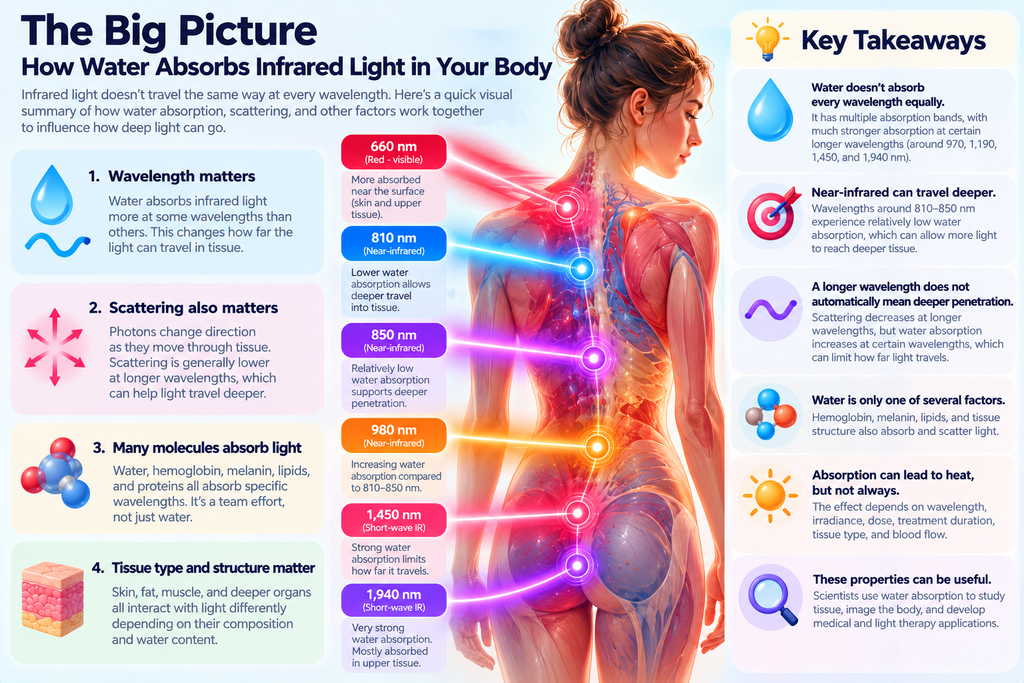
The region around 970–980 nm is particularly interesting because water absorption becomes more noticeable than it is around wavelengths such as 810 or 850 nm.
That has led researchers to investigate whether water itself could contribute to some biological responses produced by light around this wavelength.
Laboratory research comparing different photobiomodulation wavelengths has suggested that 810 and 980 nm light may not necessarily act through identical cellular pathways.
Some researchers have proposed that water absorption around 980 nm could influence temperature- or light-sensitive ion channels, including TRPV1, potentially affecting calcium signaling.
A review of photobiomodulation mechanisms and treatment parameters discusses evidence supporting multiple possible photoacceptors and mechanisms depending on wavelength.
However, this is an area where wording matters.
It would be premature to say that scientists have established water as the mechanism responsible for the effects of 980 nm photobiomodulation
FAQ
How does water absorb infrared light?
Water absorbs infrared light when electromagnetic energy interacts with molecular vibrations in water molecules. These include movements involving the stretching and bending of O-H bonds.
How strongly water absorbs the light depends on the wavelength. This is why some infrared wavelengths are absorbed much more readily by water than others.
Does the water in your body absorb red light?
Yes, but water absorption is relatively weak at visible red wavelengths compared with certain longer infrared wavelengths.
Other molecules, including hemoglobin and melanin, also affect how red light travels through tissue.
Is 850 nm light absorbed by water?
Yes. Water absorbs some radiation around 850 nm, but the absorption is relatively weak compared with major water absorption bands farther into the infrared spectrum.
This relatively low water absorption is one factor that allows wavelengths around this region to travel through tissue more effectively than wavelengths that water absorbs very strongly.
What infrared wavelengths does water absorb?
Water absorbs light across many parts of the infrared spectrum rather than at one wavelength. Notable water-related absorption bands relevant to biological tissue occur around approximately 970, 1,190, 1,450, and 1,940 nm, among others.
The strength of absorption can vary considerably between these wavelengths.
At what wavelength does water absorb infrared light the most?
There isn’t one absorption peak that describes water across the entire infrared spectrum. Water has numerous absorption bands, with some becoming extremely strong farther into the infrared.
For biological tissue applications, approximately 1,450 and 1,940 nm are notable regions of strong water absorption compared with wavelengths commonly used for red and near-infrared photobiomodulation.
Does near-infrared light heat the water in your body?
It can contribute to heating when the light is absorbed, but that does not mean every near-infrared exposure significantly heats tissue.
The temperature change depends on factors such as wavelength, irradiance, dose, treatment duration, tissue composition, blood flow, and the body’s ability to dissipate heat.
Why does near-infrared light penetrate deeper than some longer infrared wavelengths?
Longer wavelengths can experience less scattering, but scattering is only part of the equation.
At certain longer infrared wavelengths, water absorbs light much more strongly. More of the light can therefore be absorbed before it travels farther through the tissue.
This is why a longer wavelength does not automatically mean deeper penetration.
Does infrared light boil or evaporate the water inside your body?
Not under ordinary photobiomodulation conditions.
The fact that water absorbs infrared radiation does not mean the water inside tissue starts boiling or evaporating. That would require enough energy to produce a substantial increase in temperature.
High-powered medical lasers can intentionally create strong thermal effects, but that is very different from typical red and near-infrared light therapy exposure.
Is infrared light the same as heat?
No. Infrared radiation is a form of electromagnetic radiation. Heat refers to thermal energy transfer associated with differences in temperature and microscopic molecular motion.
Infrared radiation can transfer energy to tissue and contribute to heating when absorbed, but infrared light itself is not simply another word for heat.
Why is water absorption important in red light therapy?
Water absorption is one of several factors that determine how light travels through biological tissue.
Many wavelengths commonly studied in red and near-infrared photobiomodulation fall within regions where water absorption is relatively low compared with stronger infrared water absorption bands. This can give photons more opportunity to travel through water-rich tissue.
However, scattering and absorption by other tissue components still matter.
Does drinking more water make red light therapy work better?
There is not good evidence showing that drinking extra water before red light therapy makes photobiomodulation more effective.
Hydration is important for normal body function, but the fact that water absorbs infrared light does not mean drinking more water will make the body absorb a therapeutically useful amount of additional light.