Key Takeaway
- Some clinical studies suggest that red light therapy for tendonitis may reduce pain, but results vary.
- Pain relief does not automatically mean a tendon has repaired itself or regained its strength.
- Clinical laser findings do not establish that a home LED panel will produce the same results.
- Light therapy should not replace assessment or prescribed tendon rehabilitation.
An elbow that hurts when you pick up a grocery bag. An Achilles tendon that makes your first steps uncomfortable. A shoulder that complains every time you reach overhead.
When pain keeps interrupting ordinary movements, you want something that helps. If you have been researching red light therapy for tendonitis, you have probably seen claims about reducing inflammation, increasing collagen, and speeding recovery.
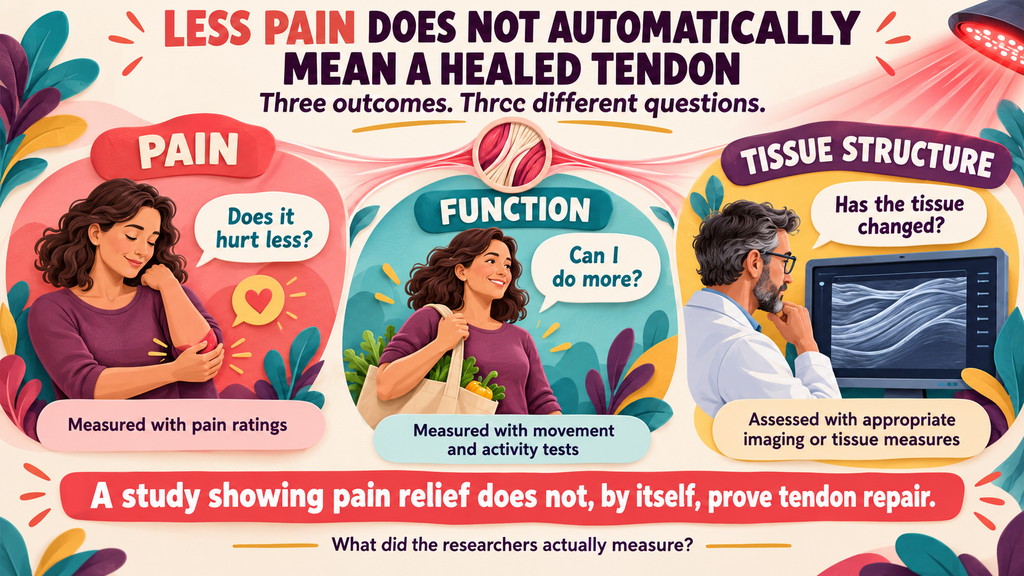
But those claims describe different outcomes. Feeling less pain is useful. Moving more comfortably matters, too. Neither automatically proves that a tendon has repaired itself or regained its ability to handle demanding activity.
Here is what researchers have found, what remains uncertain, and why the device used in a study matters.
Quick Answer
Red light therapy for tendonitis may help reduce pain in some settings. Clinical studies of photobiomodulation have reported benefits, including when used alongside exercise, but results vary. These findings do not establish that a home LED panel will repair a tendon or reproduce a clinical laser treatment.
These distinctions reflect the varied findings and treatment methods in clinical tendinopathy research.
What Is Tendonitis—and Why Do Studies Call It Tendinopathy?
Tendons are the strong connective tissues that attach muscles to bones. When your muscles contract, tendons transmit that force so you can move.
Tendonitis, also spelled tendinitis, refers to inflammation of a tendon. It can cause pain and tenderness near a joint, making movement uncomfortable. The NHS tendonitis guide explains these symptoms and common triggers.
In research, you will often see the broader term “tendinopathy.” It describes persistent tendon pain and impaired function associated with loading the tendon.
That distinction matters. A long-lasting tendon problem can involve changes in tendon cells and tissue organization. Describing every case as inflammation alone oversimplifies the biology. Researchers also recognize that pain, function, and tissue findings do not always closely match.
You do not need to memorize the terminology. Just know that a study about one particular tendon condition may not answer every question about another.
How Might Red Light Therapy Affect Tendon Tissue?
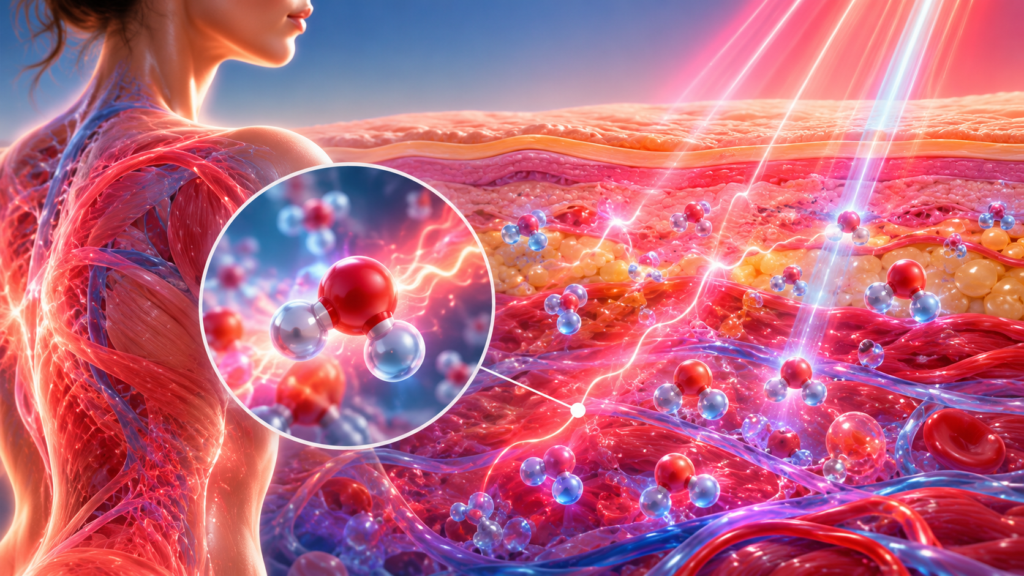
The research term for this approach is photobiomodulation, or PBM. It involves using light to influence biological activity.
Researchers investigate red and near-infrared light because of their potential effects on cellular processes. However, an explanation of how light might work is different from evidence that a treatment improves recovery in people.
Cellular Activity and Inflammatory Signaling
A review of light therapy and tendon repair discusses proposed effects on cellular energy processes, inflammatory signaling, and cells involved in tissue repair.
Much of this mechanistic evidence comes from laboratory experiments and animal models. These studies help identify possible biological pathways. They cannot, by themselves, tell us how much benefit a person will experience from a home device.
What About Collagen Production?
Collagen is a major structural component of tendons. Researchers have investigated whether light influences collagen-related activity during repair.
That is an interesting possibility, but “more collagen” is an incomplete explanation of recovery. The same review examines repair as a process involving inflammation, cell proliferation, and tissue remodeling—not simply producing additional material.
For readers considering red light therapy for tendonitis, the practical question is whether these biological effects translate into meaningful improvements in pain, movement, and tendon capacity.
What Do Human Studies Show About Red Light Therapy for Tendonitis?
Human studies give us a more useful picture than mechanism claims alone. Even then, the comparison matters.
Did researchers compare light with a sham treatment? With exercise? With another therapy? Did both groups receive rehabilitation?
Those details change what we can reasonably conclude.
Some Research Supports Pain Relief
A 2025 systematic review and meta-analysis identified 35 controlled clinical trials. In a pooled analysis of chronic tendinopathy, low-level laser therapy produced greater pain relief than minimal intervention.
The authors also found an association between more treatment sessions and greater pain benefit. That does not mean increasing treatment frequency indefinitely improves results. The finding concerned relationships within the included studies, rather than a tested schedule for every device.
This review supports a potential pain benefit. Its available abstract does not establish faster structural tendon repair.
Light Alongside Exercise Has Shown Benefits
A 2021 review of 17 randomized trials, involving 835 participants, found that photobiomodulation plus exercise improved some pain and function outcomes compared with sham light plus exercise.
However, results differed across comparisons. Light did not consistently outperform other active interventions, and the evidence quality ranged from very low to moderate.
That is a more balanced finding than either “it works” or “it does nothing.” There are encouraging results, alongside limits that deserve attention.
Achilles Tendon Results Are Less Consistent
A 2020 Achilles-specific review concluded that the evidence was insufficient to support routine laser use for Achilles tendinopathy. Its evidence certainty was low to very low.
A more recent 2025 randomized trial involving 46 runners compared three approaches:
- An exercise loading program.
- Exercise plus radial pressure-wave treatment.
- Exercise plus radial pressure-wave treatment and photobiomodulation.
At three months, the group receiving all three treatments did not significantly outperform exercise alone on the main Achilles symptom and function score. All groups improved.
The trial was small and did not include an exercise-plus-light-only group, so it cannot isolate light’s contribution. Still, it shows why adding another treatment does not automatically produce a better result.
Does Less Pain Mean Your Tendon Has Healed?
When you are uncomfortable, pain relief is meaningful. It may make daily activities easier and help you feel more confident about movement.
But three different questions remain:
| Outcome | What it tells you |
|---|---|
| Pain | How much discomfort you experience |
| Function | How well you perform movements or activities |
| Tissue structure | What examination or imaging shows about the tendon |
These outcomes can change differently. Tendon research documents imperfect relationships between pain, function, and tissue findings.
A study measuring pain scores therefore answers a pain question. It does not automatically answer whether tissue structure improved or whether the tendon can tolerate heavier activity.
This is why a headline claiming that red light therapy for tendonitis “heals tendons” needs closer examination. Ask what the researchers actually measured.
Similarly, feeling better after a session should not be your only reason for returning to demanding activity. The Dutch Achilles tendinopathy guideline emphasizes gradual progression and sufficient active rehabilitation before returning to provocative sports loading.
Can a Home Red Light Panel Reproduce Clinical Laser Results?
This is one of the biggest questions for anyone considering red light therapy for tendonitis.
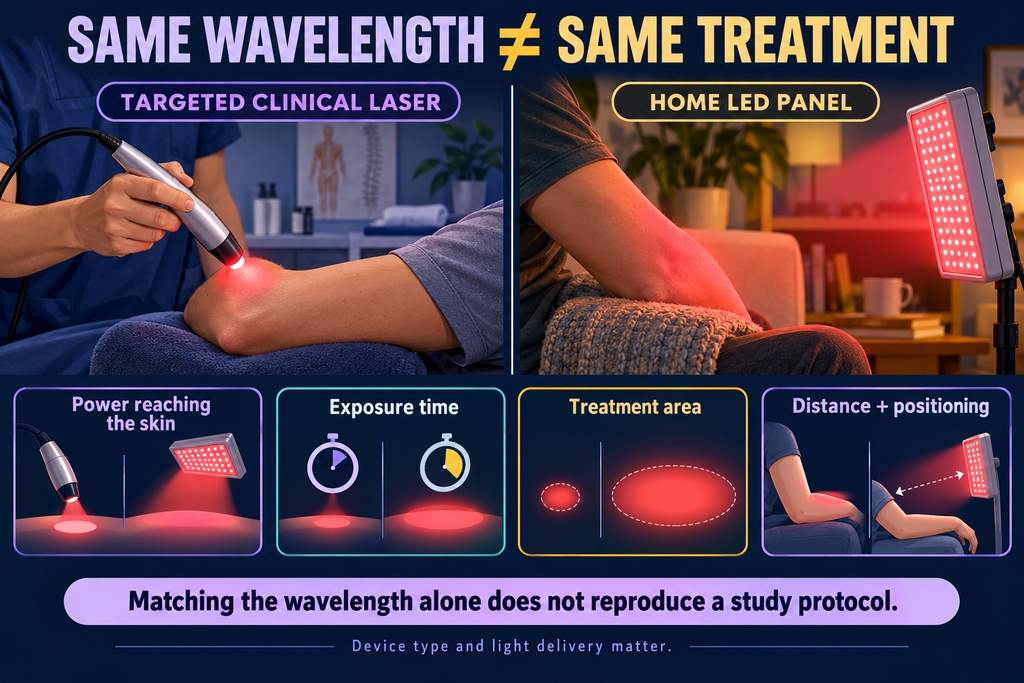
A clinical study tests a particular treatment setup. It does not test every device that emits a similar color of light.
Matching a Wavelength Is Only Part of the Comparison
A review of photobiomodulation parameters explains that treatment involves several variables, including wavelength, irradiance, energy, exposure duration, pulsing, and repetition.
Wavelength describes the light. Irradiance describes the power reaching an area. Exposure time influences the energy delivered. Changing these variables can change the treatment being tested.
For example, a targeted laser applied to selected treatment points differs from a broad panel used at a distance. Even if both devices include near-infrared light, that similarity does not establish equivalent delivery.
A Study Dose Is Not a Universal Home Routine
The same parameter review highlights disagreement about treatment protocols and the difficulty of comparing studies with different settings.
That means a recommendation such as “use any panel for 15 minutes” needs evidence of its own. Copying a session duration without matching the rest of the treatment does not reproduce a study.
This does not prove that home devices cannot help. It means we should distinguish evidence for a specific clinical protocol from assumptions about a different device.
Where Does Red Light Therapy Fit Alongside Rehabilitation?
Light research often receives attention because it sounds simple: expose the area, then wait for improvement.
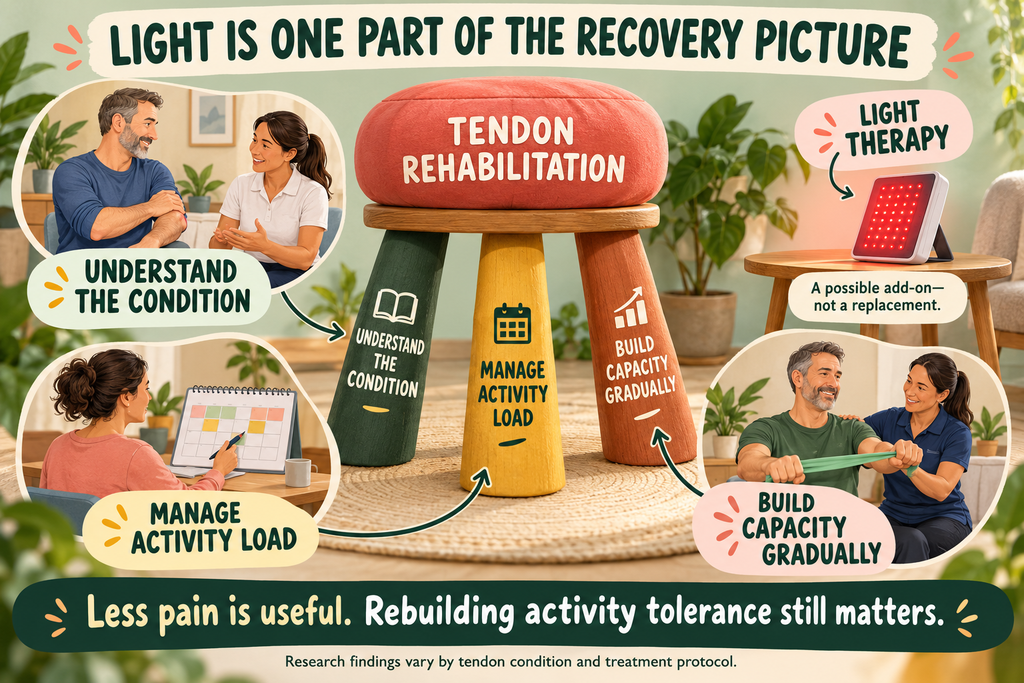
Tendon rehabilitation involves a broader question: how can the tendon gradually handle the activities you need it to perform?
For Achilles tendinopathy, the Dutch multidisciplinary guideline recommends an initial approach combining education, load management, and progressive calf strengthening for at least 12 weeks.
The exercise plan should suit the person. The guideline also discusses adjusting aggravating activities and gradually increasing loading.
That provides useful context for red light therapy for tendonitis. A possible additional treatment should be evaluated alongside the work of rebuilding capacity.
The question is not just whether you feel better immediately afterward. It is whether the overall plan helps you return to ordinary movement and activity in a sustainable way.
When Should Tendon Pain Be Assessed?
Before choosing a treatment, it helps to know what is causing the pain.
Pain near a tendon is not enough to establish a diagnosis. Seek assessment when symptoms persist, worsen, or interfere with movement.
Sudden severe pain during an activity—especially with a popping or snapping sound—can indicate a tendon rupture. The NHS advises urgent help for possible tendon tears. A suspected tear should not be treated as an opportunity to try a home light routine first.
Frequently Asked Questions
Can Red Light Therapy Help Achilles Tendonitis?
It may offer benefits in some treatment settings, but Achilles-specific findings are inconsistent. A systematic review found insufficient evidence for routine laser use, while a recent small trial did not show a significant advantage for a combined treatment including light over exercise alone on its main outcome.
Does Red Light Therapy Help Tennis Elbow?
A review of randomized tennis elbow trials found pain benefits in certain wavelength and application subgroups. Other protocols did not show the same result. These findings concern particular laser treatments, rather than every home device marketed for elbow pain.
Is Red or Near-Infrared Light Better for Tendon Pain?
The research does not establish a universal winner for every tendon condition and device. Wavelength is one treatment variable among several, so choosing a light color alone does not identify an effective protocol.
How Long Does Red Light Therapy Take to Help Tendonitis?
There is no reliable timeline that applies to every person and home device. Studies use different schedules and measure different outcomes. The association between session number and pain benefit in the 2025 review does not establish when a particular reader should expect improvement.
Can Red Light Therapy Repair a Torn Tendon?
The pain studies discussed here do not establish that a home red light device can repair a torn tendon. A suspected tear requires assessment and an appropriate treatment plan.
Can Red Light Therapy Replace Physical Therapy?
The evidence discussed here does not justify replacing prescribed rehabilitation with light. Achilles guidance places education, load management, and progressive exercise at the center of initial care.
The Practical Takeaway
Red light therapy for tendonitis is a reasonable subject to investigate. There are encouraging clinical findings, particularly for pain, alongside inconsistent results and unanswered questions.
The most useful approach is to keep the outcomes separate. Pain relief matters. Function matters. Claims about tendon repair need evidence that actually measures repair.
If you are considering light, look beyond a wavelength or a promising headline. Ask which condition was studied, how treatment was delivered, and what improved. That gives you a clearer picture of what the research supports—and what it still cannot tell you.