Key Takeaways
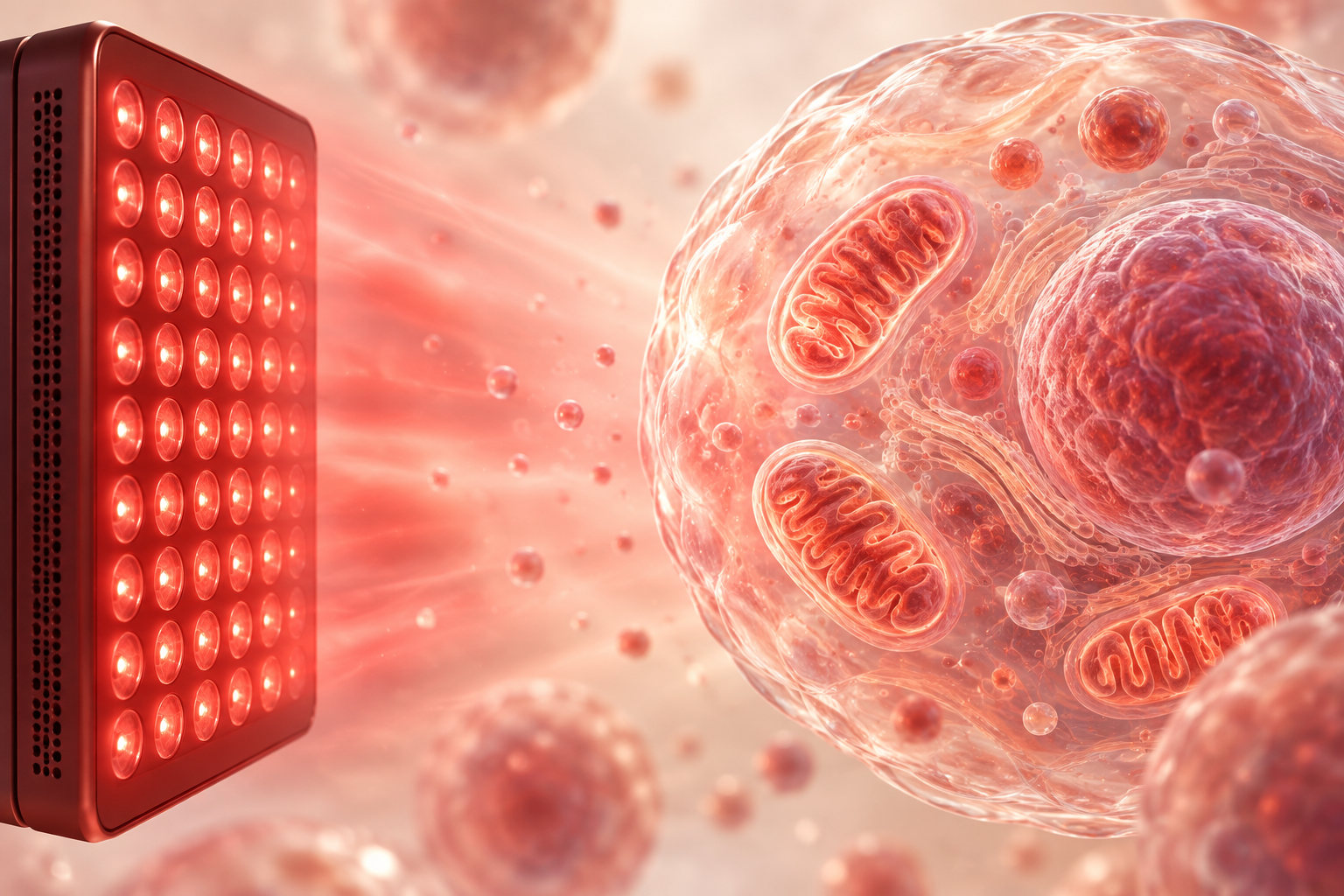
- How red light therapy works depends on light reaching tissue and interacting with molecules that can absorb it.
- Looking red does not tell you a device’s wavelength range, light intensity, or suitability for a particular application.
- Scientists investigate mitochondrial activity and cellular signaling, but the complete explanation remains unsettled.
- Changes measured in cells are different from improvements demonstrated in human studies.
- Brighter light and longer sessions do not automatically produce better results. Evidence applies to particular devices, exposures, and outcomes.
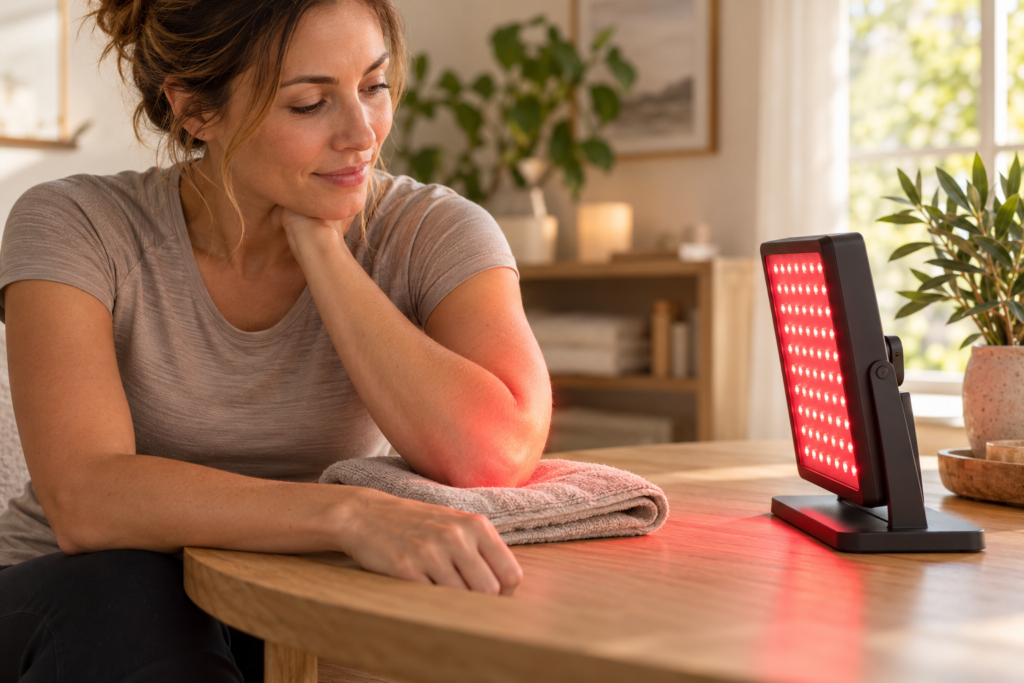
You’re sitting in front of a red light panel. Nothing is touching your skin. You’re not applying a cream, taking a supplement, or exercising. The device is simply shining light at you.
So how is that supposed to help?
It’s a reasonable question. You can picture a moisturizer forming a layer over dry skin. You can understand a muscle responding to the challenge of lifting a weight. But understanding how red light therapy works asks you to make a less obvious connection between something outside your body and something happening inside a cell.
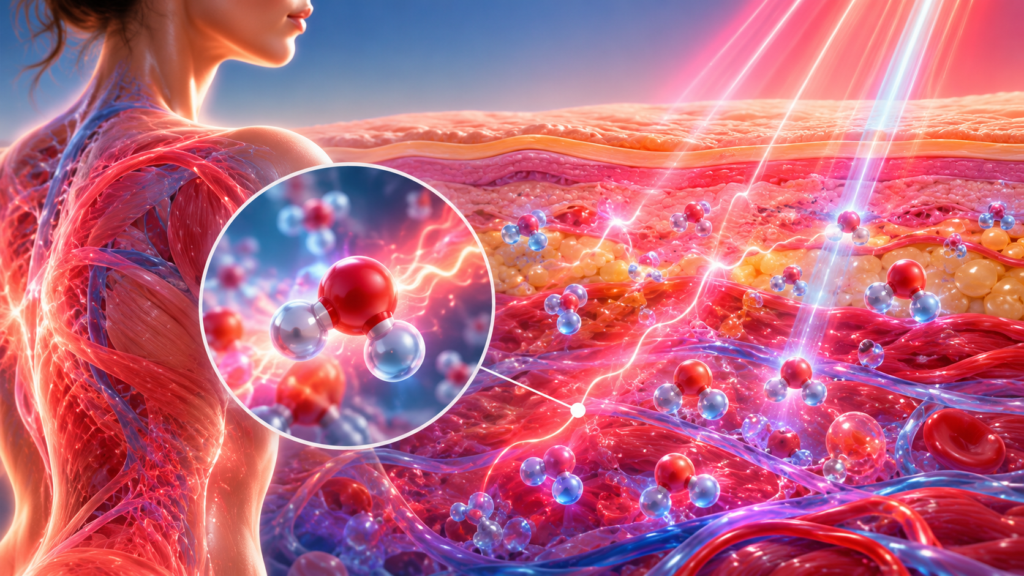
The missing piece is absorption. Light carries energy, and certain molecules can absorb that energy. Under particular conditions, that interaction can influence biological activity.
That gives us a starting point. To understand how red light therapy works, though, you need to follow what happens after the device switches on.
First, what is actually coming out of the light?
A red light therapy device usually contains light-emitting diodes, or LEDs. These produce light using a semiconductor, a material whose electrical properties allow it to control the movement of electrical charge.
When current passes through an LED, electrons can transition between energy states and release energy as photons. A photon is a small packet of electromagnetic energy.
Think of the LED as converting electrical energy into light. The semiconductor’s properties help determine which wavelengths it produces. The Department of Energy explains this distinction between LED technology and bulbs that produce light by heating a filament. www.energy.gov
This is the first part of how red light therapy works. Before light can interact with your body, the device has to produce it.
You’ll often see numbers such as 660 nm or 850 nm in device specifications. The letters “nm” stand for nanometers, the unit used to describe wavelength.
Wavelength is the distance between repeating points in a light wave. It helps determine the light’s color and how it interacts with matter. Around 660 nm is visible red light; around 850 nm is near-infrared, which your eyes generally cannot see.
An LED labeled 660 nm usually emits a narrow range around that value. It does not produce one perfectly exact wavelength with nothing on either side. The Department of Energy describes single-color LEDs as producing narrow wavelength ranges. www.energy.gov
Understanding how red light therapy works therefore starts with the light’s actual properties. A red appearance tells you much less than a measured spectrum.
How does the light get beneath your skin?
Your skin is a barrier, but it does not block every wavelength completely.
When light reaches it, several things happen. Some reflects from the surface. Some enters and changes direction as it encounters structures within the tissue. Some is absorbed.
That change in direction is called scattering.
Picture trying to walk through a busy department store. You enter through the front door, but shoppers, clothing racks, and display tables keep redirecting your path. You might eventually reach the back, but your route is much less direct than it looked from outside.
Light moving through tissue also takes complicated paths. Researchers measuring the optical properties of human skin layers examine absorption and scattering separately because both influence where the light goes.
To understand how red light therapy works beneath the surface, remember that entering the skin is only one step. The light still has to reach relevant tissue and interact with something there.
Its amount generally decreases with depth. Researchers call this attenuation, which simply means the light becomes weaker as it travels.
There isn’t one universal depth where every red photon suddenly stops. Wavelength, tissue thickness, pigmentation, blood, and other tissue properties all affect transmission.
This also explains why “the light reaches several centimeters” is an incomplete claim. Detecting a small amount of light at a depth is different from showing that enough reaches a target to produce a useful effect.
That distinction matters when explaining how red light therapy works on a deeper structure. A surface measurement cannot tell you the exact exposure received by every cell underneath.
For more on one factor affecting transmission, see our explanation of red light therapy and skin tone.
When light meets your skin
Reflection · Some light bounces back from the surface.
Illustrative paths, not measured depths or amounts. All three processes can occur during one exposure.
Your cells don’t have eyes. What is absorbing the light?
They don’t need eyes. They need molecules capable of absorbing particular wavelengths.
These molecules are called chromophores.
You can think of a chromophore as a material with a particular appetite for light. It absorbs some wavelengths more readily than others because of its molecular structure.
You already know a familiar example. Pigments absorb certain wavelengths and reflect others, which is why a red dress and a black dress look different under the same lighting.
Inside tissue, absorption can do more than create an appearance. Depending on the molecule and exposure, it can initiate a physical or chemical response.
This is where how red light therapy works becomes a biological question. Which molecules absorb the light, and what happens when they do?
The scientific term for this area is photobiomodulation, often shortened to PBM. “Photo” refers to light, “bio” refers to living systems, and “modulation” means influencing or changing activity.
You’ll frequently encounter mitochondria in explanations of PBM. Mitochondria are structures inside cells that participate in energy metabolism and many other cellular processes.
One proposed light-absorbing target is cytochrome c oxidase, an enzyme in the inner mitochondrial membrane. It is part of the machinery involved in cellular respiration. Scientists discuss its potential role in proposed mechanisms of photobiomodulation. pubmed.ncbi.nlm.nih.gov
However, how red light therapy works cannot be reduced to “your mitochondria see red light.” Researchers are investigating molecular interactions, and the complete explanation is still developing.
What does light have to do with cellular energy?
Your cells continually perform work. They build molecules, move substances, maintain electrical and chemical balances, and respond to their surroundings.
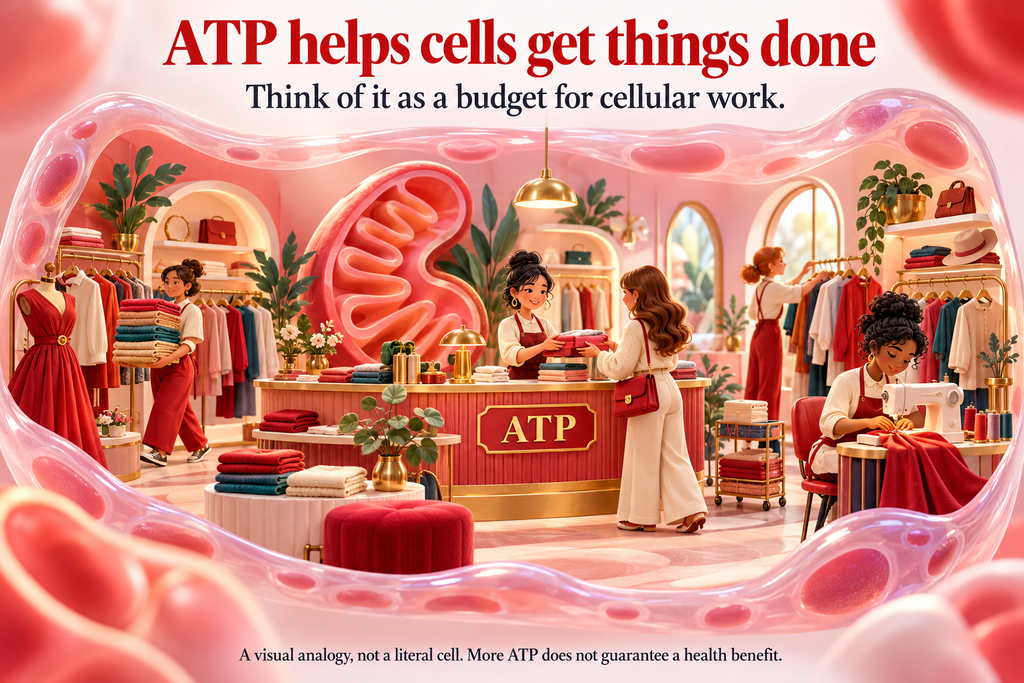
Much of that work involves ATP, short for adenosine triphosphate. ATP helps transfer energy to processes that need it.
Imagine a clothing store with money in its business account. The account supports paying staff, operating equipment, and receiving deliveries. ATP plays a role in making energy available for cellular tasks, although cells are much more complicated than a store’s finances.
Mitochondria help produce ATP through a series of reactions involving electrons, oxygen, and a difference in proton concentration across a membrane.
That concentration difference is a proton gradient. You can picture it as water held behind a dam. When protons flow through an enzyme called ATP synthase, that flow helps drive ATP production.
One proposed explanation of how red light therapy works is that absorbed light can influence parts of this energy-making system.
But the light is not supplying all the energy a cell needs. Your body still depends on nutrients, oxygen, and ordinary metabolic processes.
Researchers have investigated whether light exposure changes ATP-related processes, mitochondrial membrane potential, and other measures of cellular activity. These measures are related, but they are not interchangeable. A test of metabolic activity is not automatically a direct measurement of ATP.
That precision matters when interpreting how red light therapy works. “Mitochondrial activity changed” is a narrower finding than “this treatment gives you more energy.”
Even an increase in ATP in cultured cells does not establish that you will feel more awake, recover faster, or experience less pain.
Those are separate questions that require their own evidence.
Is the mitochondrial explanation completely settled?
No. This is a useful place to pause, because many explanations make the mechanism sound more certain than it is.
One widely discussed hypothesis involves nitric oxide, a small molecule that participates in signaling. Under certain conditions, it can also interfere with mitochondrial respiration by interacting with cytochrome c oxidase.
The hypothesis suggests that light might release nitric oxide from the enzyme, allowing respiration to proceed more effectively.
It is an appealing explanation of how red light therapy works. But an appealing explanation still has to survive experiments.
In a 2021 isolated-enzyme study, researchers tested 670 nm and 830 nm light. They found no significant change in the enzyme’s oxygen-consumption kinetics under the conditions studied. Irradiation also did not reverse the inhibition produced by a nitric oxide donor.
That finding challenges the idea that this particular mechanism explains everything.
It does not mean the experiment reproduced every condition inside a living cell. An isolated enzyme in a reaction chamber is different from an intact cell, which is different again from living human tissue.
The honest way to discuss how red light therapy works is to distinguish a proposed mechanism from an established observation. Scientists can measure a response while still investigating exactly what caused it.
Cells can respond through signals as well as energy metabolism
Energy production is only part of the research.
Cells also communicate through chemical signals. These signals can influence how a cell responds to stress, interacts with nearby cells, or changes the activity of particular genes.
Think of a store again. Having enough money helps the business operate, but instructions still matter. Someone has to tell the stockroom what to unpack, the floor staff what to display, and the manager what needs attention.
In cells, these instructions involve networks of molecules rather than people.
Researchers exploring how red light therapy works investigate signaling involving nitric oxide, calcium, and reactive oxygen species, among other pathways.
Reactive oxygen species, or ROS, are reactive oxygen-containing molecules. You may associate them with damage, but they also have normal signaling roles. Their effects depend on their amount, location, and timing.
Calcium also acts as an internal signal. A change in calcium inside a cell can help initiate a response, rather than simply contributing to bone health.
Mechanistic research discusses how these pathways may interact with mitochondrial responses. They should not be presented as one guaranteed chain that happens identically after every session. pubmed.ncbi.nlm.nih.gov
This helps explain why how red light therapy works can depend on a cell’s starting condition. A stressed cell and a healthy cell may not respond in the same way to the same exposure.
How could any of this affect your skin or inflammation?
Knowing that cells respond to light is interesting. But you probably care more about whether that response changes something you can see or feel.
This is the next question in understanding how red light therapy works. How could a molecular interaction contribute to a useful tissue response?
Skin cells and collagen-related processes
Fibroblasts are cells that help produce and maintain components of the extracellular matrix. This is the network of material surrounding cells, including collagen, that contributes to tissue structure.
Think of it as part of the fabric and stitching holding a garment together. Maintaining that structure requires coordinated work, not simply adding more material anywhere you like.
Researchers have studied how light affects collagen-related protein and gene activity in stressed human fibroblasts grown in the laboratory. pubmed.ncbi.nlm.nih.gov
That gives scientists a way to investigate possible repair-related responses.
However, a cell-culture finding is not a before-and-after result in your face. The next step is testing whether a defined treatment produces a meaningful change in people.
Immune cells and inflammatory signals
Macrophages are immune cells involved in responding to injury and coordinating tissue processes.
In a 2019 laboratory study, researchers exposed mouse-derived macrophage cells to red or infrared light. They observed changes in the expression of particular inflammatory mediator genes, with responses varying by wavelength and measurement time. pubmed.ncbi.nlm.nih.gov
That is evidence of a specific cellular response.
It does not establish that shining a panel on your body switches off all inflammation. Inflammation involves many cells, signals, tissues, and causes.
Keeping those levels separate makes how red light therapy works easier to understand. A possible biological pathway and a demonstrated benefit are connected questions, but they are not the same finding.
How do researchers know it does something in people?
A convincing explanation is not enough. Researchers need to test outcomes.
For example, if you want to understand how red light therapy works for wrinkles, a useful study needs to assess wrinkles. Measuring a cellular marker alone cannot answer that question.
Human trials can use comparison groups and sham devices. A sham is designed to resemble the treatment while delivering a different or reduced exposure.
This helps researchers investigate whether changes exceed those seen with the comparison treatment.
A 2025 randomized, double-blind trial included 60 participants and tested a facial mask combining 630 nm red light with 850 nm near-infrared light.
The sham device retained lower-output red light but did not emit the near-infrared component. Assessors found significant between-group differences in crow’s-feet grading at several points during the 16-week study. pubmed.ncbi.nlm.nih.gov
That is more informative than an uncontrolled photograph because the researchers defined the treatment, comparison, participants, and outcome.
Still, it does not establish identical results from every mask or panel. Nor does it prove that the observed improvement happened through one particular mitochondrial pathway.
When reading about how red light therapy works, look for the outcome actually measured. “Wrinkle grades improved in this trial” tells you more than a broad claim that light rejuvenates every cell.
Then why can’t you use any red light bulb?
Now the skepticism returns. If molecules respond to light, why would a regular red bulb be different?
Understanding how red light therapy works requires looking at the exposure delivered to tissue. The color you see is only one part of that exposure.
A conventional incandescent bulb produces light by heating a filament. A red coating or filter changes the wavelengths that pass through it. The remaining output depends on both the lamp and the filter.
A red LED bulb generates light differently, but its red appearance still does not tell you how much optical power reaches a particular area of skin.
A therapy device also needs scrutiny. Calling something a “red light therapy panel” does not establish its measured output or effectiveness.
| What you need to know | Why it matters |
|---|---|
| Wavelength range | Different wavelengths interact differently with tissue and molecules |
| Irradiance at the stated distance | Describes the incident optical power reaching an area |
| Exposure duration | Helps determine the energy delivered over time |
| Coverage and positioning | Affect which areas receive light and how evenly |
| Relevant human evidence | Shows whether a tested exposure helped a particular outcome |
There is also an important exception to simplistic bulb comparisons. Specialized water-filtered infrared-A systems use filtered halogen output and have been investigated clinically, including in wound-healing research.
These systems involve different exposure conditions and thermal effects. They are not equivalent to a decorative red bulb, and their findings should not be casually transferred to a home LED panel. pmc.ncbi.nlm.nih.gov
The practical lesson about how red light therapy works is that tissue responds to the light delivered. It does not recognize a brand name, price tag, or marketing category.
Why brighter and longer are not automatically better
Three terms help you understand the exposure.
Wavelength describes the light. Irradiance describes incident optical power per unit area. Radiant exposure describes energy delivered per unit area over time.
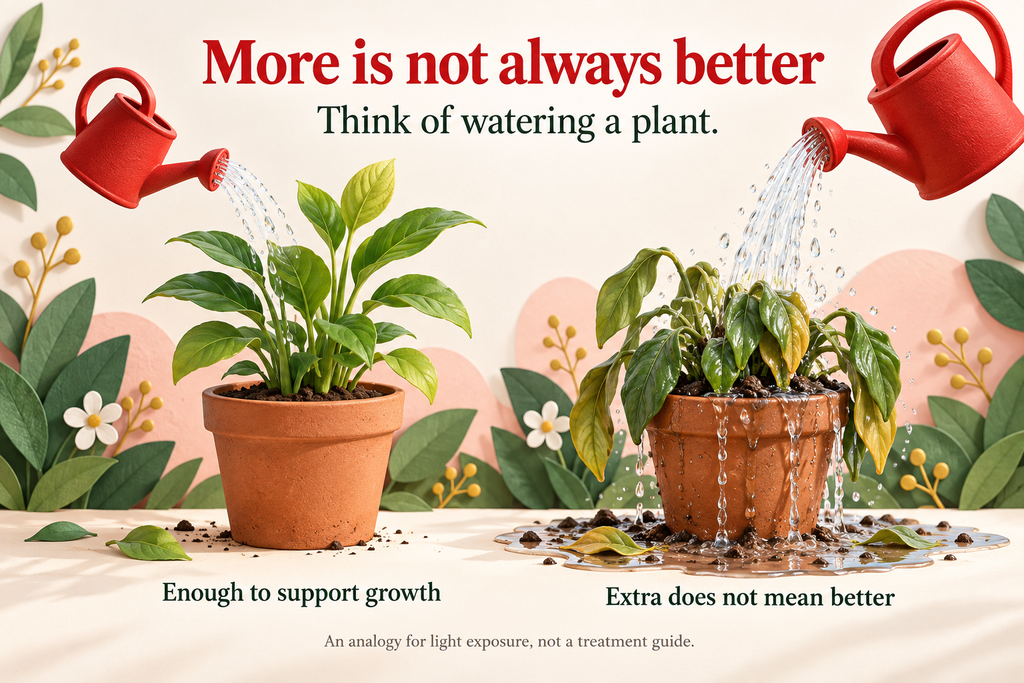
Imagine watering a plant. The flow rate tells you how quickly water arrives. The time tells you how long you leave the tap running. Together, they determine how much water you deliver.
With constant irradiance, the calculation works similarly. An incident irradiance of 20 mW/cm² over 300 seconds gives a surface radiant exposure of 6 J/cm².
That is an arithmetic example, not a treatment recommendation. It also describes the surface, not the exact energy absorbed by a deeper target.
Understanding how red light therapy works means looking beyond the total number. Different rates of delivery, wavelengths, and schedules may produce different responses.
In a 2020 human fibroblast experiment, some lower exposures increased cell numbers and measures of mitochondrial activity. Higher exposures produced decreases in some of those measures. journals.sagepub.com
The cells were grown in a laboratory. You should not use their exposure settings as instructions for your device.
The study illustrates why increasing exposure can change the response rather than simply improve it. Research also questions whether equal total energy delivered at different intensities always produces equivalent effects. pmc.ncbi.nlm.nih.gov
This is an important part of how red light therapy works, and a reason to follow the instructions for your exact device rather than assuming longer sessions are better.
Our article on whether you can overdo red light therapy explores that question further.
So, how can a light actually help you?
A light can influence living tissue because particular molecules absorb its energy and can respond to it. Researchers investigate how those interactions affect metabolism, signaling, and tissue processes.
The harder question is whether a specific exposure produces a useful result for a specific problem.
You now have a better way to assess how red light therapy works. Ask what light was delivered, what response was measured, and whether the evidence came from isolated molecules, cultured cells, animals, or people.
A detailed cellular explanation helps you understand the possibility. A relevant human study helps you assess the practical result.
You deserve both.
Frequently Asked Questions
Is red light therapy just a heat treatment?
Photobiomodulation is generally intended to influence biology without relying primarily on tissue heating. However, devices can still produce warmth, and some light-based treatments deliberately involve thermal effects. Feeling warm does not establish that a particular cellular response occurred. Researchers need to consider temperature when investigating the mechanism.
Can a regular red LED bulb replace a red light therapy device?
Its red appearance is not enough to establish equivalence. You would need to know its wavelength range, measured irradiance at your position, coverage, and exposure conditions. You should not assume a room bulb reproduces a treatment tested in a clinical study.
Does red light therapy work without near-infrared light?
Some research investigates red light alone, while other studies use near-infrared or combined wavelengths. The answer depends on the application and treatment conditions. Adding near-infrared does not automatically make a device more effective for every goal.
Does increasing ATP mean I will feel more energized?
Not necessarily. ATP is involved in cellular energy transfer, but feeling energetic is a different outcome. An ATP increase measured in laboratory cells does not establish a noticeable change in alertness or fatigue in people.
Do scientists know exactly how red light therapy works?
They have proposed several mechanisms and measured responses in different experimental systems. However, the complete explanation remains unsettled. The role of cytochrome c oxidase, nitric oxide, and other pathways continues to be investigated.
Why can’t I copy the settings from a study?
The study may use a different light source, tissue target, application method, or measurement setup. A laboratory cell culture also receives light differently from cells beneath your skin. Matching the session length alone does not reproduce the treatment.
Does light reaching deeper tissue mean it will work better?
No. Depth is only one consideration. The amount reaching the target, the molecules absorbing it, and the response produced also matter. Deeper transmission does not automatically establish a better outcome.
This article is for educational purposes and is not medical advice. Follow your device’s instructions, including eye protection guidance. Discuss persistent symptoms or treatment decisions with a qualified healthcare professional.