

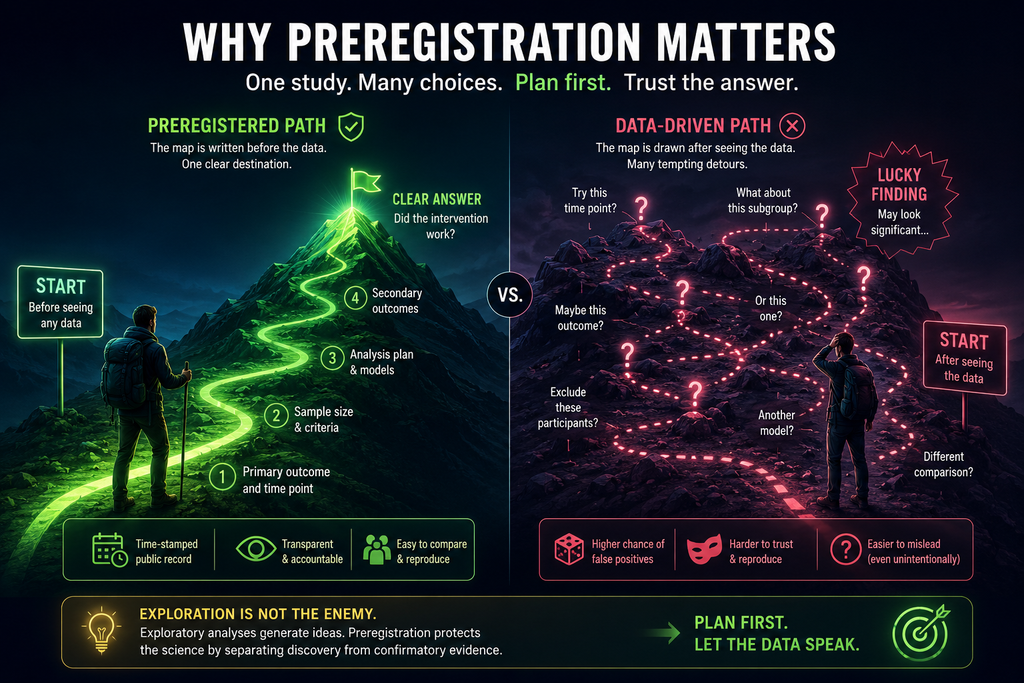
A photobiomodulation study may measure pain, strength, sleep, inflammation, skin appearance, mobility, or dozens of other outcomes. It may also test several wavelengths, doses, treatment schedules, time points, subgroups, and statistical models. When researchers make all those decisions after seeing the data, an apparently persuasive result can emerge by chance.
Photobiomodulation trial preregistration creates a public, time-stamped record of important plans before results are known. It can make undisclosed changes easier to detect and help readers separate confirmatory tests from exploratory findings. But registration is not a quality certificate. A registered study can still be underpowered, poorly blinded, inadequately dosed, selectively reported, or interpreted too confidently.
This guide explains what preregistration is, how it differs from a full protocol and statistical analysis plan, what it can realistically prevent, and what to verify when evaluating a red or near-infrared light study.
Research note: This article discusses study transparency and critical appraisal. It does not determine whether a particular photobiomodulation protocol is effective or appropriate for an individual health condition.
What photobiomodulation trial preregistration means
Preregistration records a study’s intended design and analysis before the relevant data are examined. For a clinical trial, that record normally appears in a recognized registry and includes the condition, intervention, comparator, eligibility criteria, planned sample size, primary and secondary outcomes, time points, study dates, and sponsor information.
The timing matters. A record entered before the first participant is enrolled is prospective registration. A record created after enrollment begins—or after investigators could have observed outcome data—is retrospective registration. Late registration can still provide useful information, but it offers weaker protection against decisions influenced by emerging results.
A registry record is also a public index. It gives a study a persistent identifier, allows patients and reviewers to find it, and can reveal completed trials that never became journal articles. This helps address publication bias, in which positive or exciting findings are more likely to appear in the literature than negative or inconclusive ones.
Why flexible PBM studies need clear advance plans
Photobiomodulation has many adjustable parameters. Researchers may choose red, near-infrared, or combined wavelengths; continuous or pulsed output; contact or noncontact delivery; different irradiances, radiant exposures, distances, treatment areas, and session schedules. A study can also evaluate multiple conditions and outcomes.
That flexibility is scientifically useful, but it creates a large “researcher degrees of freedom” problem. Imagine a trial that measures pain at four time points, function on three scales, two inflammatory markers, and results in several participant subgroups. If enough comparisons are tested without correction, at least one may look statistically significant by chance.
Preregistration forces the investigators to identify which question is primary before the answer is visible. Exploratory analyses remain valuable, but they should be labeled as exploratory and tested again in new data. The problem is not exploration; it is presenting a data-driven discovery as though it were a single, prespecified confirmatory test.
Registration, protocol, and statistical analysis plan are different
These documents overlap, but they are not interchangeable:
- Trial registry entry: a structured public summary containing core design and outcome information.
- Study protocol: a fuller description of the rationale, procedures, intervention, safety monitoring, recruitment, randomization, masking, measurements, and planned analyses.
- Statistical analysis plan: detailed rules for preparing and analyzing the data, ideally finalized before treatment assignments are revealed or outcome analysis begins.
- Published article: the report of what was actually done and found.
A short registry record may not specify how missing data will be handled, which covariates will enter a model, whether transformations are planned, how repeated measures will be analyzed, or how multiplicity will be controlled. Those details may appear in the protocol or analysis plan. Strong transparency means the documents can be found, dated, and compared.
What preregistration can help prevent
Switching the primary outcome
The primary outcome is the main result a trial is designed to test. Changing it after seeing the data can make a chance finding look central. A time-stamped record lets readers compare the registered primary outcome and time point with the published claim.
Selective outcome reporting
A paper may highlight outcomes that improved while omitting registered outcomes that did not. Registration does not physically prevent omission, but it creates evidence that the missing measurements were planned. Reviewers can ask where those results went.
Undisclosed changes to time points
A PBM effect may appear immediately after treatment but not at later follow-up, or vice versa. Choosing the most favorable time point after analysis can exaggerate confidence. Registration should identify when the primary endpoint is measured.
Unplanned subgroup emphasis
A study may find a larger effect in older participants, women, people with severe symptoms, or a particular dose group. Such findings can generate useful hypotheses, but small subgroups are unstable. A preregistered subgroup hypothesis carries more confirmatory weight than one discovered after many comparisons.
Invisible completed trials
Registries can show that a study was completed even if no paper is published. That does not reveal every result, and registry reporting may be incomplete, but it gives systematic reviewers a lead and makes an entirely missing trial less invisible.
What preregistration cannot prevent
A weak research question
Registering a study does not make its comparison clinically meaningful. An active device may be compared with no treatment when a credible sham was possible, or a narrow surrogate outcome may be chosen instead of an outcome that matters to patients.
Poor photobiomodulation dosimetry
A record can faithfully preserve an inadequately specified intervention. If wavelength, irradiance, radiant exposure, beam area, pulse settings, distance, treatment geometry, and session frequency are missing or unreliable, later researchers may be unable to reproduce the exposure. Registration documents a plan; it does not validate the optical measurements.
Failed blinding
Visible red light, warmth, fan noise, displays, or treatment sensations may reveal whether a device is active. Preregistration can state who should be blinded and how, but it cannot make an unconvincing sham credible. The final report still needs enough detail to judge masking.
Small samples and imprecision
A registered trial with too few participants can produce wide confidence intervals and unstable estimates. Preregistration may expose the intended sample size and power calculation, yet it does not guarantee adequate enrollment, realistic assumptions, or complete follow-up.
Protocol deviations
Real studies rarely proceed exactly as planned. Equipment fails, recruitment lags, eligibility rules need clarification, and analysis assumptions break. Deviations are not automatically misconduct. The transparency standard is to date, explain, and justify important changes instead of quietly rewriting the plan.
Spin and exaggerated interpretation
Investigators can register outcomes correctly and still describe a small, uncertain, or surrogate effect in promotional language. Readers must compare the magnitude and confidence interval with the conclusion, not merely look for a registration number.
Prospective registration versus retrospective registration
The strongest record exists before participant enrollment because investigators have not yet seen trial data. If registration occurs after recruitment starts, ask how much information could already have influenced the entry. Were any participants assessed? Could staff have noticed obvious effects? Were outcomes or time points changed between the initial protocol and registry submission?
Retrospective registration should not make a study disappear from consideration. It should lower confidence in claims that depend on prespecification. Authors should state the registration date, first-enrollment date, reason for the delay, and whether the record was created before any outcome analysis.
Dates should be checked rather than assumed. A paper may say “registered” without saying “prospectively registered.” Registry histories can also show when fields were added or changed.
How outcome switching can distort a PBM result
Consider a hypothetical knee-pain trial with a registered primary outcome of pain at 12 weeks. The treatment group shows no clear advantage at 12 weeks, but a secondary mobility score improves at two weeks. Reporting the mobility finding as the main success changes the question after the results are known.
The two-week result may be real, but its evidential status is different. If many outcomes and time points were examined, chance becomes a more plausible explanation. The appropriate next step is transparent reporting of the registered result, clear labeling of the mobility finding as exploratory, and confirmation in a trial designed around that endpoint.
Not every difference between a registry and paper is suspicious. An instrument can become unavailable, a new safety concern can require monitoring, or a statistical method can be improved before unblinding. Context and timing determine whether a change is reasonable.
Version history matters more than a registration badge
Many registries retain the original submission and later updates. That history is crucial. A current record may perfectly match a published paper because it was edited after the results were known. Readers should compare the earliest public version with later changes and note when recruitment, completion, and publication occurred.
Useful questions include:
- Was the first record submitted before enrollment?
- Were the primary outcome, metric, and time point specific?
- Did the planned enrollment change?
- Were outcomes added, removed, promoted, or demoted?
- Did changes occur before or after the study completion date?
- Does the paper explain important discrepancies?
A registry identifier is valuable only when the underlying entry is informative and timely.
Prespecified does not mean automatically correct
Preregistration reduces hindsight bias, but it should not freeze a bad analysis. Investigators may discover that a model’s assumptions are violated, that a measurement distribution requires a different method, or that missing data are more extensive than expected. Blind adherence to an unsuitable plan can also mislead.
The best practice is often to report the prespecified analysis, explain why an alternative was needed, and show how conclusions change under reasonable methods. Distinguishing planned from post hoc work lets readers judge both without pretending that scientific learning stops when a protocol is filed.
Trials versus systematic-review registration
Clinical trials are commonly registered in trial registries. Systematic reviews may prospectively register protocols in services such as PROSPERO and follow PRISMA-related guidance. The purposes overlap, making planned methods visible and deterring selective decisions, but the records describe different work.
A 2026 meta-research study examined protocol registration among 285 systematic reviews of photobiomodulation published from 1999 through 2025. Its authors called for stronger prospective registration and transparent reporting. That finding concerns reviews, not the registration rate of individual PBM clinical trials, but it illustrates why protocol availability matters throughout the evidence pipeline.
A preregistered review can specify databases, eligibility criteria, outcomes, risk-of-bias tools, and synthesis methods before the reviewers know which combination produces the most favorable conclusion. As with trials, registration is useful only if readers can compare the plan with the finished report.
What current reporting guidance expects
The CONSORT 2025 guidance for randomized trials places trial registration, access to the protocol and statistical analysis plan, data sharing, funding, and conflicts of interest within an open-science section. It recommends reporting the registry, registration number, date, and a link where possible. Outcome-focused guidance also emphasizes defining outcomes completely so readers can determine what was measured, how, and when.
Reporting guidance cannot enforce good conduct, but it provides a practical checklist for authors, editors, peer reviewers, and readers. A paper that omits registration timing, protocol access, or prespecified outcomes leaves preventable uncertainty.
A reader’s checklist for preregistered PBM research
- Find the registry name, identifier, registration date, and first-enrollment date.
- Open the registry record instead of relying on the word “registered.”
- Check the earliest version and the update history.
- Compare the registered and published primary outcome, metric, method, and time point.
- Look for missing, added, or reclassified secondary outcomes.
- Compare planned and actual sample sizes and review the explanation for shortfalls.
- Find the full protocol and statistical analysis plan when available.
- Check whether PBM parameters are specified well enough to reproduce the exposure.
- Separate prespecified subgroup analyses from post hoc exploration.
- Look for results posted in the registry if no full article exists.
- Read the effect estimate and confidence interval, not just the significance label.
- Check funding, device-provider involvement, and conflicts of interest.

The bottom line
Photobiomodulation trial preregistration is a transparency tool, not a guarantee of truth. Its main value is that it fixes a visible record of the intended question before results can influence the story. That makes outcome switching, undisclosed time-point changes, selective reporting, and post hoc subgroup claims easier to identify.
Confidence is strongest when registration is prospective, the entry is specific, the protocol and analysis plan are accessible, changes are dated and explained, and the final report presents all important outcomes. Readers should still evaluate randomization, blinding, sample size, optical dose, missing data, effect magnitude, safety, conflicts, and replication.
A registration number earns a closer look, not an automatic pass.
Last reviewed: August 23, 2026.