You see red light therapy devices at wildly different price points, and it confuses you. Which one is the right one? Maybe your instinct is to go for the cheaper one because “all red light therapy devices are the same.” Or you go for the expensive one because you’ve been taught that a higher price means better results, so you might as well throw your budget in the trash.
No.
You don’t need to abandon your budget to buy a useful device. But you also shouldn’t assume you’ve found an equivalent product just because it costs less and glows red.
Cheap red light therapy devices can be worth considering. Expensive ones can leave you paying for features you don’t need. The challenge is figuring out what you’re actually getting before either one reaches your doorstep.
That starts with looking beyond the price.
A cheaper alternative isn’t necessarily an equivalent one
A recent shopping article promoted a red light therapy lamp advertised at $54 as an alternative to masks costing hundreds of dollars. It highlighted the lamp’s adjustable positioning and a customer’s positive experience.
Those are reasonable things for a shopper to consider. Affordability matters, and being able to position a light toward different areas may be useful.
However, the article did not present comparative testing demonstrating that the lamp and the more expensive mask delivered equivalent performance or results. Are you getting a comparable treatment, or another product in the same broad category?
That distinction matters when shopping for cheap red light therapy devices. An affordable product can be a legitimate option without being a proven replacement for something else.
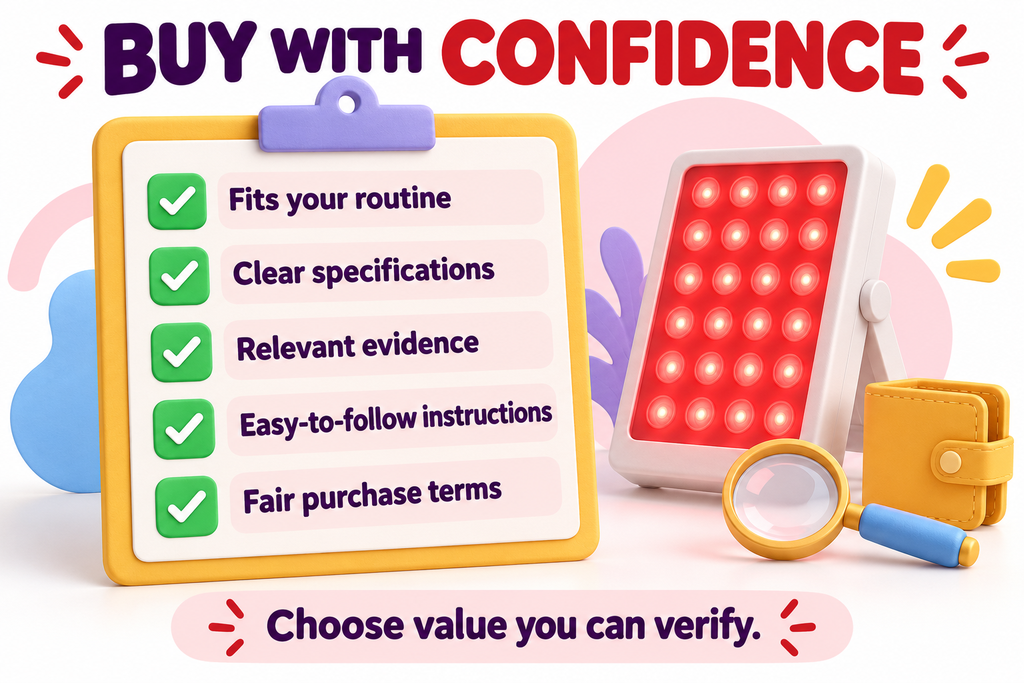
Here are seven things worth checking before you decide that the lower price makes it the better purchase.
Look beyond the price tag 🔎
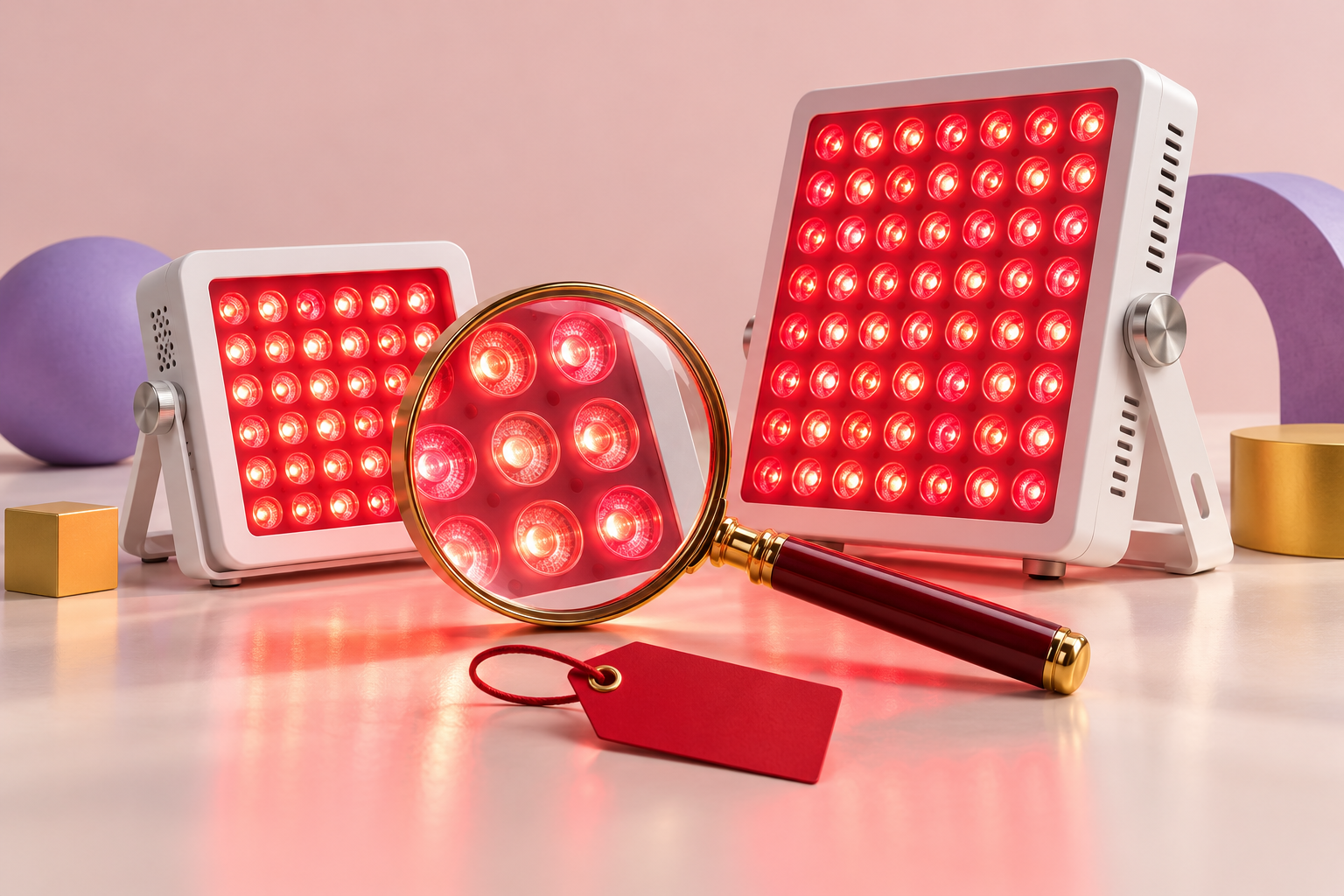
Two fictional devices. Two very different prices. Tap each clue to see what the price alone can’t tell you.
Device A
Device B
Illustrative examples only. Prices and descriptions do not represent real products, test results, or a relationship between price and quality. No device is scored or ranked. Decorative dots do not represent LED counts.
1. Matching wavelengths don’t tell you the whole story
You’re comparing two devices. Both advertise red and near-infrared light. Both list similar wavelengths. One costs considerably less.
It’s understandable to wonder why you would pay more.
When comparing cheap red light therapy devices with premium options, matching wavelengths can make the products seem interchangeable. But wavelength describes only one part of the treatment.
You also need to consider light output, the area receiving light, treatment distance, and exposure time. Researchers identify these treatment parameters as essential to understanding and reproducing light therapy treatments.
For example, two products could list the same wavelengths while providing different information about how much light reaches the treatment area. Without those details, you cannot confidently compare their delivery.
A wavelength list can help you understand a product’s intended use. It cannot establish that two devices deliver equivalent results.
This applies to cheap red light therapy devices and expensive ones alike. Adding more wavelengths to a specification sheet doesn’t automatically prove better results for your particular goal.
2. Impressive numbers can be difficult to compare
Browse listings for cheap red light therapy devices, and you’ll likely encounter LED counts, wattages, and claims about powerful output.
Those numbers describe different things.
Electrical wattage tells you about power consumption. It is not the same as the optical power delivered to your skin. LED count tells you how many light sources a device contains, but it doesn’t establish how much light reaches each part of the treatment area.
Irradiance describes light power reaching a given area, commonly expressed in milliwatts per square centimeter. Even that measurement needs context.
At what distance was it measured? Was the figure recorded at the brightest point or averaged across an area? What equipment and method were used?
Research on accurate light measurement explains why measurement methods and the distribution of light matter when interpreting reported output. A single number can leave out meaningful differences across the illuminated area.
You don’t need to become an engineer to evaluate cheap red light therapy devices. Look for measurements with enough context to understand what they describe.
If those details are missing, ask the seller. A clear answer is more useful than another impressive-looking number.
3. A bargain can still be the wrong device for your routine
Some cheap red light therapy devices may suit someone who wants to use light on one limited area.
If you want to cover several larger areas, a small device may require repeated repositioning. You might discover that your routine takes more time or effort than you expected.
That doesn’t make the product defective. It makes it a poor fit for how you hoped to use it.
Before buying, picture an ordinary session in your home.
Where will the device sit? Can you maintain the recommended distance comfortably? Do you need to hold it? Does the price include a suitable stand? Where will you store it afterward?
Masks, handheld devices, and panels offer different practical experiences. A mask may appeal to someone focused on facial use. An adjustable panel may suit someone who wants more positioning options.
The most useful cheap red light therapy devices for your routine may be different from what works for someone else. A compact product could be convenient for you and frustrating for a person seeking broader coverage.
Choose around your intended use rather than the size of the advertised discount.
4. Reviews and research answer different questions
Customer reviews can help you narrow down cheap red light therapy devices, especially when people discuss setup, comfort, delivery, and support.
But a review saying someone loves their device cannot establish that it works as well as another product.
Technical test reports and clinical studies also serve different purposes. An output test can help verify a specification. A clinical study examines outcomes under particular conditions.
When a product page says “backed by science,” look at what the linked research actually tested.
Was it the exact device? A different product? A particular wavelength used under controlled conditions? Does the study examine the concern you’re buying the device for?
The American Academy of Dermatology notes that differences in devices, treatment schedules, and study questions make comparisons between research results difficult.
That matters when cheap red light therapy devices reference general research as evidence for their own performance. The connection between the study and the product needs to be explained.
Missing product-specific research doesn’t automatically mean a device cannot help. It does mean broader research should not be presented as proof of that product’s exact results.
Premium brands deserve the same scrutiny.
5. Clear instructions are part of a useful purchase
Before choosing among cheap red light therapy devices, check whether you can access the instructions for the exact model.
Look for guidance on treatment distance, session duration, frequency, positioning, and any required eye protection or precautions.
“Use daily” leaves plenty unanswered if the product doesn’t also explain how.
A small laboratory study of five home-use devices, including handheld and intraoral products, found variations in output and output stability, alongside problems aligning manufacturer instructions with calculated light delivery.
The study did not compare the whole consumer market or establish that inexpensive products perform worse. It illustrates why instructions deserve attention alongside specifications.
Don’t assume you can borrow another brand’s schedule because the products look similar. Also, don’t try to resolve uncertain output by inventing longer sessions.
If sellers of cheap red light therapy devices cannot explain how their products should be used, that is a reason to ask more questions before purchasing.
You should be able to understand the intended routine without piecing it together from unrelated reviews.
6. The checkout price may leave out costs that matter
The appeal of cheap red light therapy devices is obvious when you compare the initial prices. The full cost of ownership takes a little more reading.
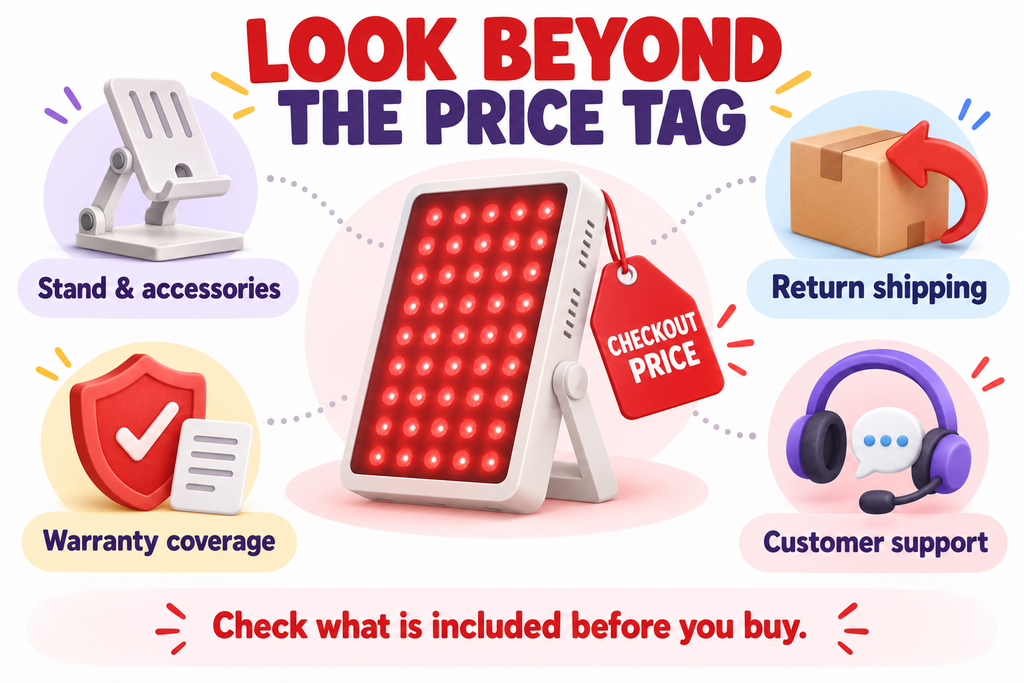
Check whether you need to purchase mounting equipment or other accessories separately. Then look at what happens if the device arrives damaged, stops working, or doesn’t suit your space.
Who pays return shipping? Are there restocking fees? Does the return policy allow you to open and try the product? What does the warranty cover?
A long warranty sounds reassuring, but its exclusions and claim process matter too. Check whether repairs, replacement parts, shipping, or labor are covered.
These questions don’t assume cheap red light therapy devices will fail sooner. They help you understand the financial consequences if something goes wrong with any purchase.
A premium product with restrictive terms can also be poor value.
Keep promises about lifespan separate from what the company actually agrees to provide in writing.
7. A higher price needs a clear explanation too
After comparing cheap red light therapy devices, you may decide that a more expensive option offers something useful.
Perhaps the additional cost buys documented testing, coverage better suited to your needs, a more convenient setup, or service terms you prefer.
Those differences may matter to you. Other features may add little to your experience.
An app is useful if you want its controls. Extra modes are useful if you understand their purpose and plan to use them. A larger panel makes sense if its coverage suits your intended routine.
You don’t need every available feature to make a sensible purchase.
Also, avoid assuming the strongest advertised output is necessarily the best option. Device suitability involves the treatment conditions and intended use, rather than a competition to find the largest number.
The goal when evaluating cheap red light therapy devices is to understand the tradeoffs. The same goal applies when evaluating premium products.
If a seller cannot explain the benefit beyond broad claims of superior quality, keep comparing.
What to check before buying cheap red light therapy devices
Use the same questions for an affordable lamp and a premium panel.
| What to check | What you want to understand |
|---|---|
| Intended use | Whether the device suits your goal and treatment area |
| Wavelengths | What the device emits and which claims the evidence supports |
| Output | How it was measured and at what distance |
| Coverage | The area illuminated at the recommended position |
| Instructions | How to use that exact model |
| Evidence | Whether documentation supports the claims being made |
| Setup | Whether positioning and storage work in your home |
| Returns and warranty | Your options if the purchase doesn’t work out |
When comparing cheap red light therapy devices, missing information should prompt a question rather than an automatic assumption.
An affordable device may be a sensible choice when its specifications are clear, its intended use matches your needs, and its purchase terms are acceptable.
A more expensive device may justify its price through differences you can identify and value.
Either way, you deserve enough information to make that decision.
Final thoughts
You work for your money. Wanting to save it is reasonable.
Cheap red light therapy devices deserve a fair evaluation. A low price alone doesn’t tell you whether a product is useful, just as a high price doesn’t establish better results.
Before spending, ask what the device delivers, how you will use it, and what support comes with it.
You may find an affordable option that meets your needs. You may find a clear reason to spend more. Let those answers guide your budget.
Frequently asked questions
Can cheap red light therapy devices work?
An affordable device may be useful, but price alone cannot establish effectiveness. Evaluate its intended use, documented specifications, instructions, and the evidence supporting its claims.
Why do red light therapy devices vary so much in price?
Devices differ in size, construction, features, testing, accessories, and service arrangements. Branding and sales channels can also affect pricing. A higher price doesn’t tell you which differences account for the cost, so compare the details.
Do matching wavelengths mean two devices work equally well?
No. Matching listed wavelengths leave other important factors unanswered, including output at the treatment area, coverage, distance, and exposure time.
Is a more powerful red light therapy device always better?
No. A higher advertised output does not independently establish better results. Evaluate the measurement in context and follow the instructions for the specific device.
What should I check first when comparing cheap red light therapy devices?
Start with your intended use and treatment area. Then check whether the seller provides meaningful output measurements, clear instructions, relevant supporting evidence, and understandable return and warranty terms.