OVERALL
4.5
BEST FOR
Half-Body Sessions, Home User, Serious Recovery
$999.99
WAVELENGTHS
630nm-830nm
IRRADIANCE
1,400 mW/cm² (no published measured distance)
COVERAGE AREA
Half body
WEIGHT
7.5 kg (approx 27 Ibs)
Our Review
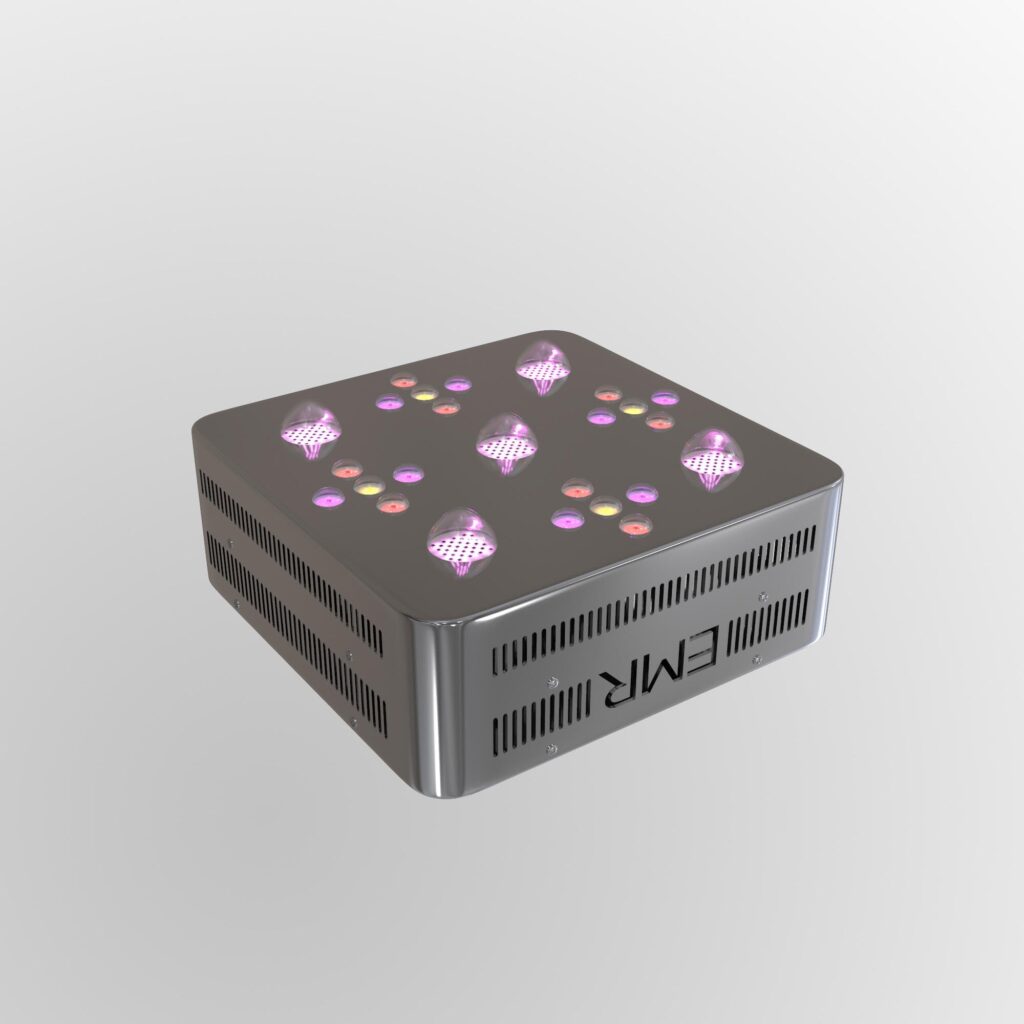
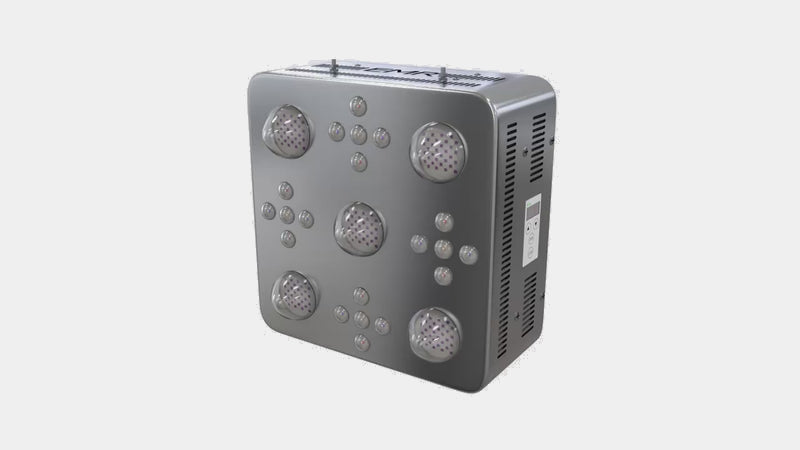
The biggest reason to choose the EMR-TEK Firestorm is its shape. Rather than stretching vertically for head-to-toe coverage, it puts its light across a wider area, which can be far more useful when your regular sessions focus on the back, chest, abdomen, hips, or thighs. At around $999.99, it makes the strongest case for someone who specifically wants that broad treatment field and doesn’t need the upgraded electronics of the Firestorm Pro.
There is a catch we’d want to sort out before spending the money. EMR-TEK doesn’t document the current standard Firestorm as thoroughly or consistently as we’d expect from a panel at this price. The exact wavelength configuration, electronics, and included hardware shouldn’t be something you have to piece together yourself. We’d confirm those details directly before ordering, especially since the Firestorm Pro isn’t dramatically more expensive and comes with several clearly defined upgrades.
The Firestorm is easier to understand once you stop thinking of it as a smaller full-body panel. That’s not really its job. Its wider shape is meant to concentrate light across a substantial section of the body at once. For someone regularly focusing on the back or torso, that can actually be more useful than having a narrow panel that technically reaches farther vertically but doesn’t cover as much from side to side.
EMR-TEK also uses COB technology in this part of its lineup. COB stands for chip-on-board, but you don’t need to know the engineering behind it to understand why it matters here. Instead of relying entirely on individual LEDs spaced across a panel, COB technology groups many light-emitting components closely together to create a more concentrated source of light. EMR-TEK uses that approach to deliver substantial output from a relatively compact enclosure.
We wouldn’t treat COB as an automatic reason to buy the Firestorm. What matters is whether you actually benefit from a concentrated, wide treatment field. If your routine usually involves your back, chest, abdomen, hips, or thighs, there’s a clear advantage. If you want one-position exposure from your shoulders down through your legs, the Firestorm’s shape won’t suddenly behave like a six-foot panel just because the output is high.
The wavelength configuration is where we’d want more clarity from EMR-TEK. Current public information for the standard Firestorm isn’t consistent enough for us to confidently assign the Firestorm Pro’s wavelength specifications to this model. We wouldn’t assume two similarly named panels use identical LEDs simply because they sit next to each other in the lineup.
For that reason, we’d confirm the exact wavelengths on the current Firestorm before purchasing. The same goes for any technical feature that matters to your decision. The Pro version specifically advertises upgraded Mean Well drivers, zero-flicker operation, and very low magnetic fields. Unless EMR-TEK confirms otherwise for the current standard Firestorm, we wouldn’t assume those Pro features carry over.
Where the Firestorm can be genuinely convenient is large-area targeted use. A small panel may be perfectly capable of treating your back, but that doesn’t mean you’ll enjoy moving it several times just to cover the whole area. The Firestorm gives you considerably more room to work with in one position.
The same applies to the chest, abdomen, hips, and thighs. You can position a broader section of the body in front of the device instead of treating red light therapy like a grid where you have to keep moving from one square to the next. For someone who uses a panel regularly, reducing that kind of friction can matter more than another impressive number on the specification sheet.
That convenience has a limit. Once you start talking about the entire body rather than one broad region, you’ll still need to reposition. If your ideal session involves standing in one place and exposing most of yourself at once, we’d look at a taller setup rather than trying to make the Firestorm fill that role.
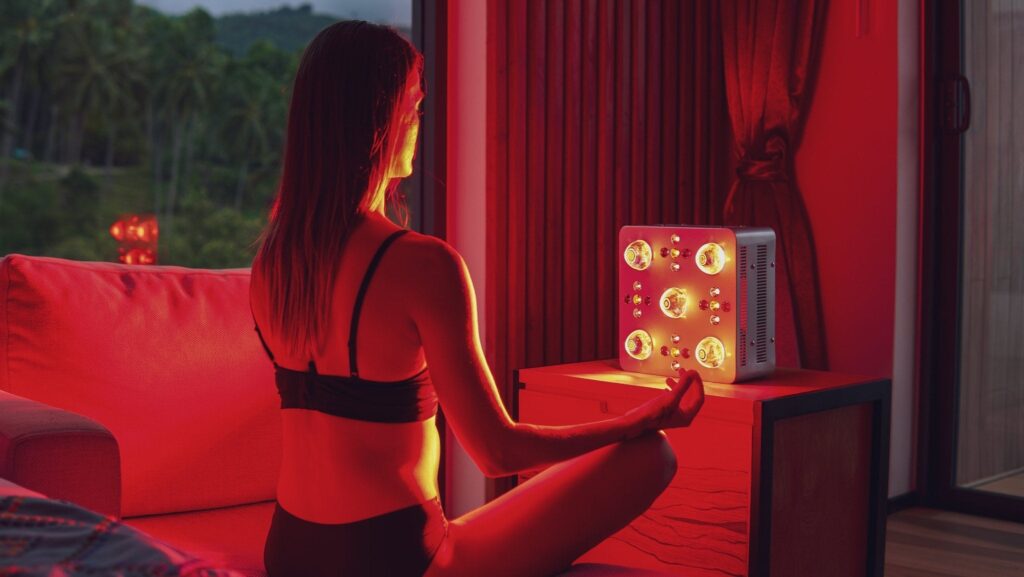
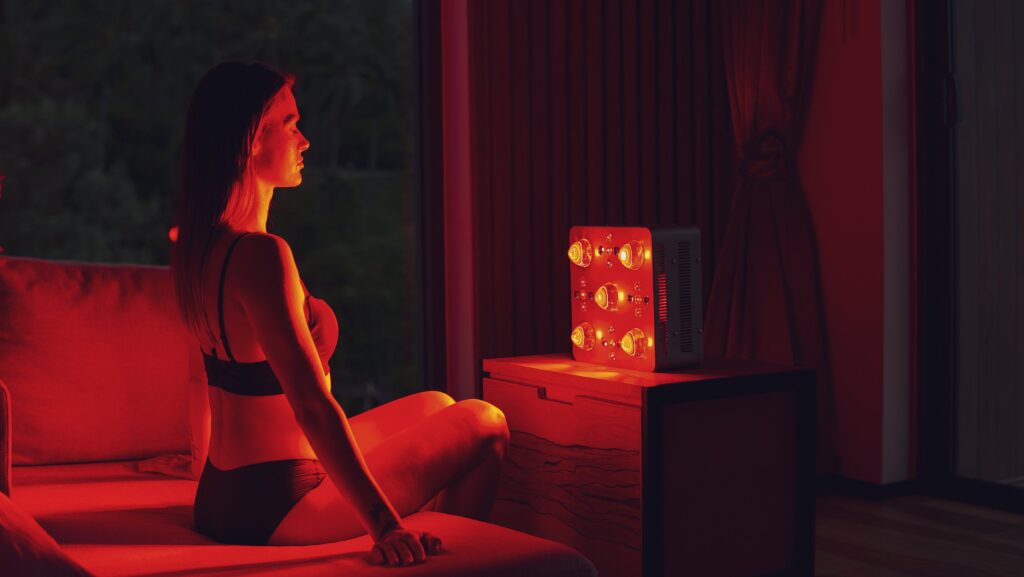
You’ll also want to give a high-output panel like this appropriate treatment distance. A smaller physical enclosure doesn’t necessarily mean it belongs inches from your skin. Moving farther away allows the light field to spread across a larger area, which is part of how a wider, concentrated device like this can cover more of the body than its dimensions initially suggest.
That means room size matters. Don’t just measure whether the Firestorm fits against the wall. Think about where you’ll actually stand or sit in front of it. A panel can look compact online and still require a surprising amount of usable space once you account for treatment distance, your body, and the stand or mounting setup.
We’d also think about fan noise if this is going into a bedroom or particularly quiet wellness space. High-output panels need cooling, and active fans can be more noticeable than product photos suggest. In a home gym or recovery room, that may barely register. During a quiet evening routine, you may care considerably more.
At around $999.99, the Firestorm isn’t inexpensive enough for us to overlook uncertainty about what we’re getting. The wide treatment format has real value, but we’d want the exact current configuration documented before putting down roughly $1,000.
The Firestorm Pro also creates an interesting problem for the standard model because the price difference isn’t enormous. We’d compare the two based on the features you’ll actually live with rather than automatically choosing the cheaper option.
The Pro is where EMR-TEK specifically emphasizes Mean Well drivers, zero-flicker operation, very low magnetic fields, and upgraded electronics. If those are features you were already looking for, we’d seriously consider spending more once rather than saving on the standard Firestorm and wondering later whether you compromised on the wrong things.
On the other hand, not everyone needs Pro-level hardware. If you’re primarily interested in the Firestorm’s broad treatment field and don’t particularly care about upgraded drivers or the Pro electrical specifications, the standard version can give you access to the format without paying for features you weren’t looking for in the first place.
That’s how we’d judge the value here. The Firestorm isn’t the bargain version of the Firestorm Pro. It makes more sense as the simpler option for someone who wants the wide COB-oriented treatment format and has no reason to pay extra for the Pro package.
We’d decide where the Firestorm will live before it arrives. This is the kind of equipment that becomes much easier to use when you already have a treatment position figured out. Having to pull out a heavy panel, find somewhere to put it, adjust the angle, and then put everything away after every session can turn even excellent hardware into something you stop reaching for.
We’d also confirm exactly what positioning hardware comes with the current package. Don’t assume the stand or mounting arrangement pictured in promotional material is automatically included with the base panel. Accessories can change the actual purchase price substantially, and they’re especially important with a device where height and angle affect which part of your body receives the light.
Before ordering, we’d think through the whole setup: where the Firestorm sits, where you sit or stand, how much treatment distance you need, whether you can comfortably turn around for the opposite side of the body, and whether the panel can remain there between sessions. Those details sound boring until you’re actually living with the device.
Once it arrives, we’d inspect everything before beginning regular use. Check the product label, wavelength information, included components, physical condition, and any accessories against what you were told you were buying. If something doesn’t match, we’d address it before moving beyond basic inspection.
EMR-TEK’s return policy is probably the most important piece of fine print to understand before buying the Firestorm. The advertised 30-day return period shouldn’t be read as a 30-day trial where you can complete treatments for several weeks and then decide whether you like the panel.
Returns are generally subject to unused-condition requirements. Once you’ve gone beyond inspection and started using the device, you shouldn’t assume you can simply return it because you realize the coverage, treatment distance, noise, or overall format doesn’t work for you.
That restriction changes how we’d shop for the Firestorm. We’d settle the major ownership questions before the first real session rather than relying on the return period to answer them afterward. Measure the room, understand the coverage, confirm the wavelengths, verify what’s included, and decide whether the standard model gives you enough compared with the Pro.
The standard Firestorm carries a two-year warranty. That provides some protection if a covered problem develops, although we’d prefer longer coverage for equipment around the $1,000 mark. We’d also read the complete warranty rather than stopping at the two-year headline so you know what is actually covered and how a claim is handled.
The warranty also shouldn’t be confused with the return policy. A warranty can help when a covered component fails. It doesn’t necessarily help when the panel works exactly as intended but turns out to be the wrong size or format for your routine. That’s why EMR-TEK’s restrictive used-return policy deserves so much attention before buying.
The standard Firestorm doesn’t have the depth of clearly model-specific owner feedback we’d ideally like to see before a purchase at this price. We wouldn’t take broader reviews of EMR-TEK equipment and present them as though every customer were specifically reviewing this panel.
That leaves some practical ownership questions less settled than we’d prefer. We’d especially like to see more long-term Firestorm owners discussing fan noise, reliability, positioning, and whether the wider format remains convenient after months of regular use. Those details are much more useful to a prospective buyer than someone simply saying the panel feels powerful.
Broader EMR-TEK feedback can still tell you something about buying from the company. There are owners who speak highly of the performance and intensity of its lights, while other customers have reported issues involving fulfillment, accessories, communication, or after-sale support. We’d treat those as brand-level experiences rather than evidence that a particular Firestorm will or won’t have problems.
The lack of a large Firestorm-specific review pool matters more because you don’t have a particularly forgiving used-return policy to fall back on. With a product you can freely try for 30 or 60 days, limited owner feedback is easier to accept. Here, we’d want to be more certain about the panel before we start using it.
The Firestorm ultimately has a fairly straightforward reason to exist: it gives you EMR-TEK’s wide, concentrated COB-style treatment format without requiring you to pay for every upgrade found on the Firestorm Pro. For regular back, chest, abdomen, hip, or thigh sessions, that can be exactly the right approach.
We’d choose it because that wider treatment field matches the way we intend to use red light therapy, not simply because it costs less than the Pro. If the Pro’s upgraded drivers, zero-flicker performance, very low magnetic fields, and other hardware improvements already matter to you, the relatively small price difference makes the upgrade easier to justify. If they don’t, the standard Firestorm can be the more sensible purchase. We’d just confirm the exact current wavelengths, electronics, included hardware, and positioning requirements before ordering. At this price, and with EMR-TEK’s restrictive return terms once the panel has been used, those details are worth settling before the first session.
Key Features
Useful for broad torso/back coverage.
EMR-TEK's concentrated-light approach.
Lower cost than Firestorm Pro
Designed for sustained high output
Panel operation/timing on device
Standard panel protection
Full Specifications
Wavelengths:
Final Verdict
4.5

Join red light therapy users comparing devices, sharing protocols, and posting honest results. Free to join, no sales pitch.
Protocol sharing
Device comparisons
Safety-first advice
Tec Specs
Wave Lengths
630nm-830nm
IRRADIANCE:
1,400 mW/cm² (no published measured distance)
Coverage Area:
Half body
Overall Category Scores
Category
Score
Best Quality
Ease of Use
Features
Value
Support
Staying informed with the latest research and reviews.
10 Minute Read
10 Minute Read