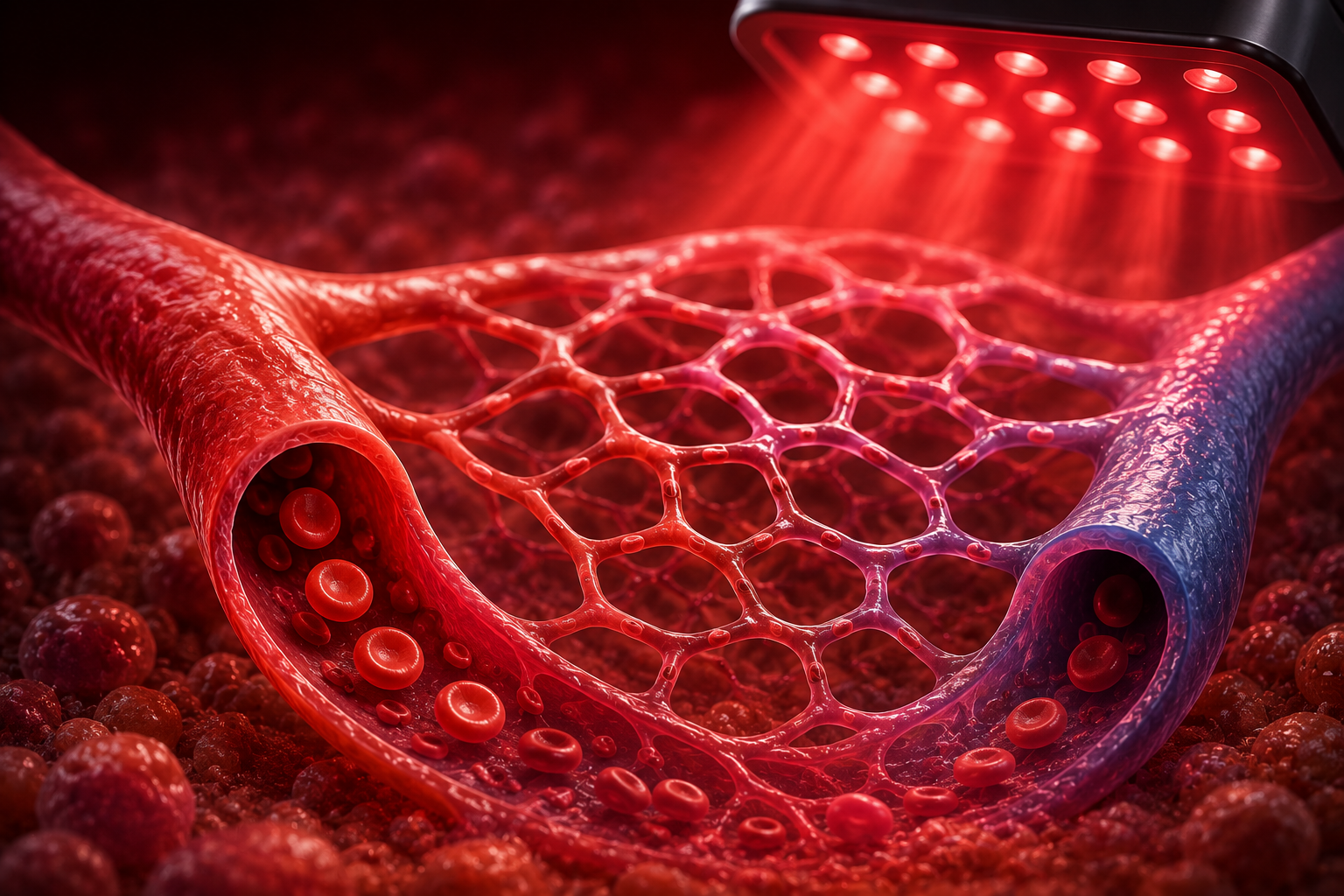
When people talk about circulation, they usually mean the big stuff, like heart rate and blood pressure. But most of what your blood actually does happens somewhere you’ll never feel directly. It happens in vessels so small they’re measured in millionths of a meter, thinner than a strand of hair, doing the real work of getting oxygen out of your blood and into your cells. That system has a name: microcirculation. And it’s the part of your body that red light therapy is supposedly working on.
We went through the actual studies and here’s what the research actually shows.
What Microcirculation Actually Is
Blood doesn’t move through your smallest vessels the way it moves through your arteries. Red blood cells are almost exactly as wide as the tiniest capillaries, so they have to line up single file to get through, the way cars merge into one lane at a construction site. How smoothly that squeeze happens affects how much oxygen actually reaches your tissue.
Your body also has a smart system for deciding where blood goes. When a muscle needs more oxygen, tiny valves called arterioles open up to send more its way. Nearby vessels can pass that signal down the line fast, almost like word spreading through a crowd, so a whole area gets more blood at once instead of just one spot.
None of that has anything to do with light. It’s just how blood normally moves, and it’s worth understanding before anyone tells you a light panel can improve on it.
Explore Your Microcirculation
Tap the structures below to see how blood moves through the body’s smallest vessels. Turn on the PBM layer to see where photobiomodulation may interact with this system.
Arteriole
Arterioles regulate how much blood enters a local capillary network. When nearby tissue needs more oxygen, these small vessels can widen and increase local blood flow.
Where might photobiomodulation interact?
Research discussed in this article proposes effects on cellular signaling and vascular responses. But a proposed biological mechanism is not the same as proof of improved circulation throughout the body.
What was actually measured?
Why This Tiny System Matters
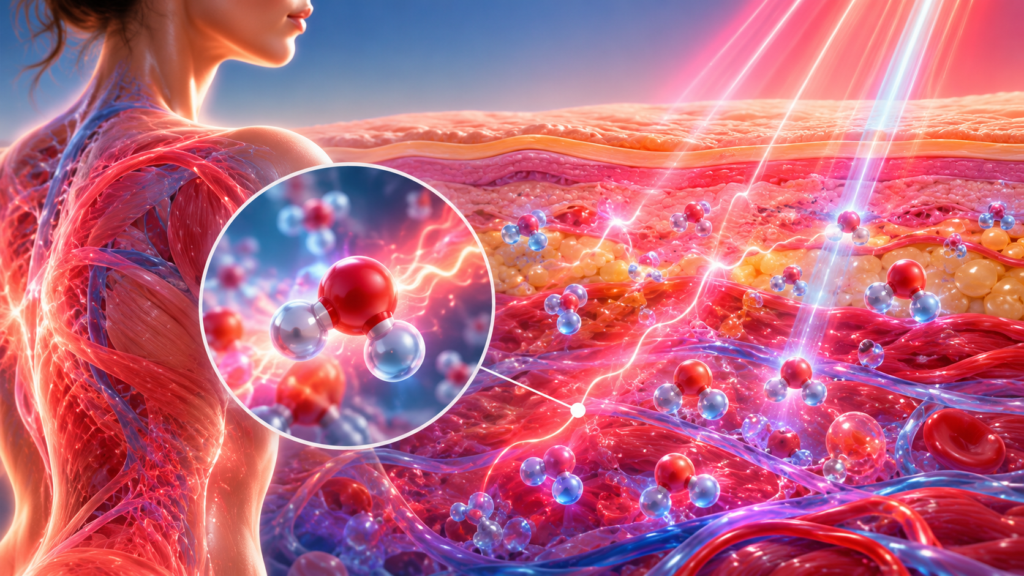
It’s easy to think of your smallest vessels as an afterthought next to your arteries. Researchers who study them disagree, and the data backs them up. Trouble in the microcirculation can show up before trouble in the big vessels does, and in some studies, it predicts heart disease even more reliably than large-vessel problems do. Your endothelium, the thin layer of cells lining every vessel, releases a gas called nitric oxide that tells vessels to relax and widen. That system starts breaking down early in cardiovascular disease, well before a standard test would catch anything.
That’s the reason microcirculation is worth caring about, separate from whatever therapy claims to influence it.
What Red Light Therapy Is Actually Proposed to Do
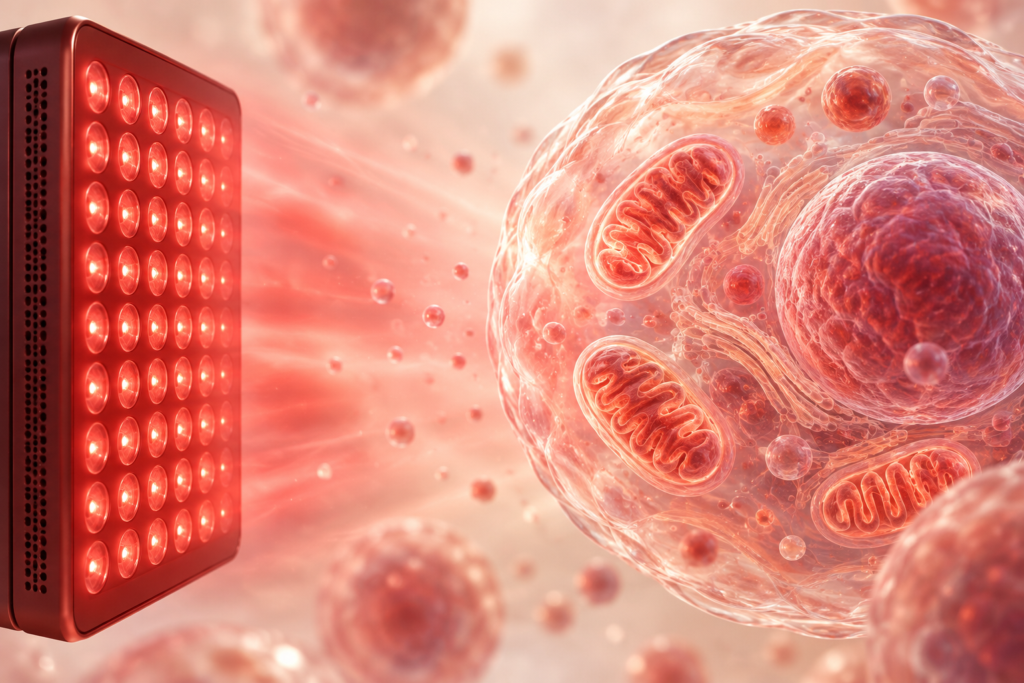
Photobiomodulation, the technical name for red and near-infrared light therapy, rests on a fairly specific idea. Inside your cells, tiny structures called mitochondria absorb certain wavelengths of light, and that absorption is thought to change how much energy the cell produces. From there, researchers propose a chain of downstream effects: shifts in cell signaling, and in some tissue types, more of the growth factors that drive new blood vessel formation.
That’s a real, actively studied idea. It’s also just an idea about mechanism, not proof that shining a light on your skin measurably changes your blood flow. Those are two different claims, and the gap between them is exactly where red-light marketing tends to get ahead of the science.
The Direct Evidence on Blood Flow
Only one part of the research really answers this question directly, so it’s worth being specific about what it found.
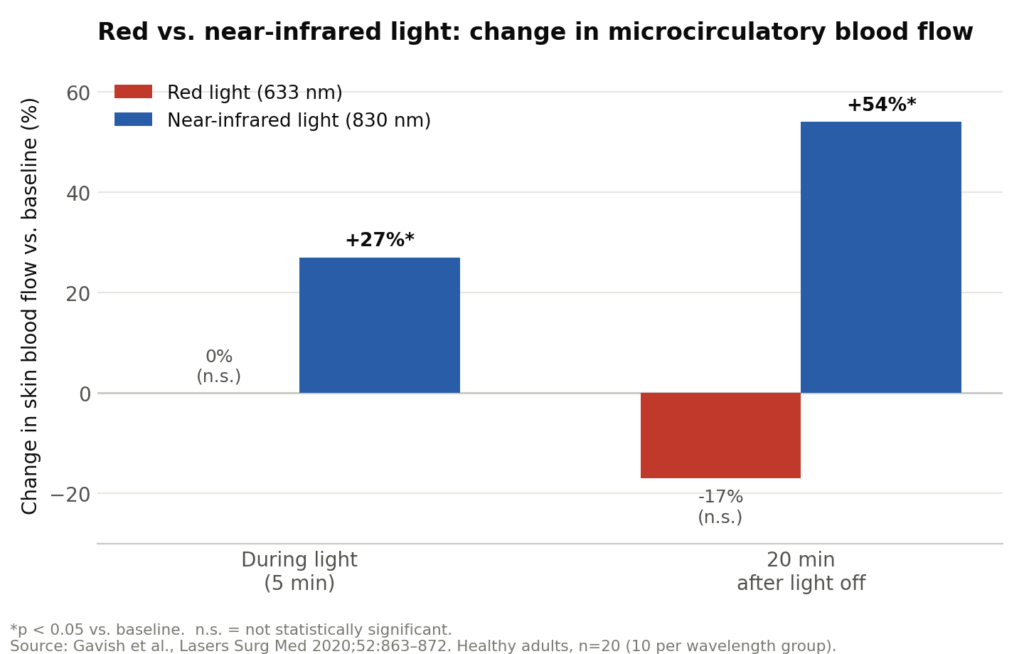
A 2020 randomized controlled trial split 20 healthy adults into two groups. One group got red light (633 nanometers) on the wrist for five minutes. The other got near-infrared light (830 nanometers), same site, same duration. Researchers then measured actual blood flow in the palm using laser Doppler flowmetry, a validated way to track microcirculation in real time.
The near-infrared group showed a real jump in flow: 27% right after the light turned off, climbing to 54% twenty minutes later. The red light group showed no significant change at all.
A separate trial published in 2026 found a similar pattern with a different near-infrared wavelength (890 nanometers) on the arm, this time against a genuine placebo light: blood flow rose significantly, anywhere from about a third to more than three-quarters higher, depending on the exposure pattern and the participant’s age. One catch worth flagging: in the longest version of that exposure, skin temperature also rose enough that heat itself may have played a role. The shorter, pulsed version of the same treatment raised skin temperature far less and still showed a real increase.
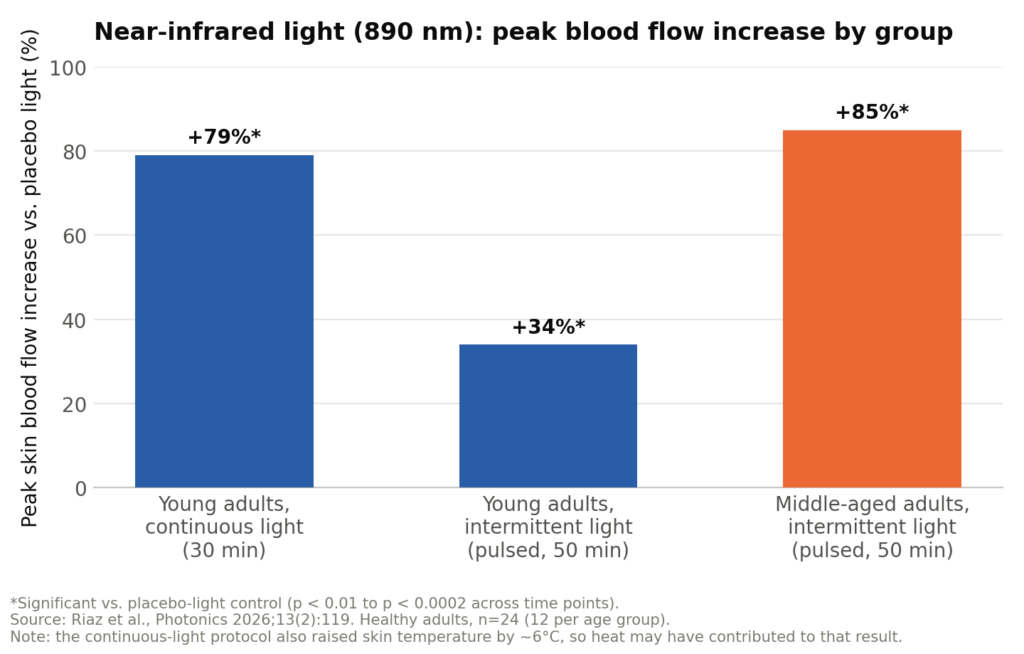
So here’s the honest summary. Near-infrared light produced a measurable increase in local blood flow in two separate controlled human trials. Red light, in the one trial that tested it head-to-head against near-infrared, did not. Any claim that “red light improves circulation,” without that distinction, is overstating what the closest available evidence actually shows.
Why Some People Respond, and Others Don’t
Here’s a detail most red-light content skips entirely. In that first trial, only half the participants responded to the light at all. Whether someone responded had nothing to do with effort or how long they sat under the light. It came down to their skin temperature before treatment even started. People whose hands were already warm, or already cold, didn’t respond. Only people in a middle range did.
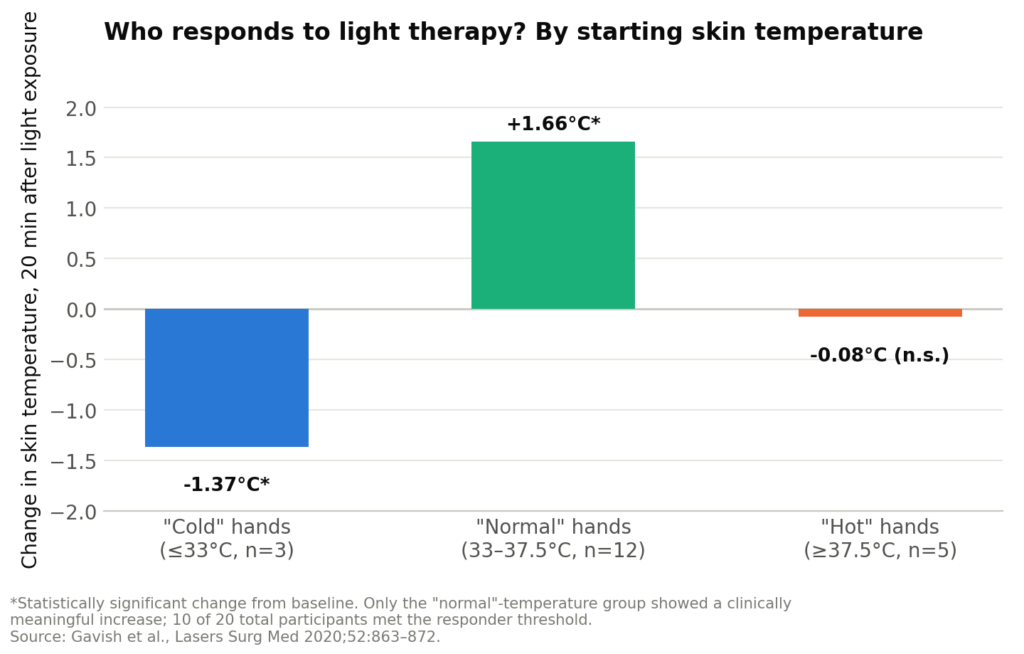
That pattern held up in the second study, too, in an interesting way: middle-aged participants responded just as strongly as the younger group, sometimes more so. Age wasn’t the deciding factor. Starting physiology was.
A separate study on healthy people’s arteries adds a useful data point here. Blood flow improved compared to before treatment, but it didn’t beat a placebo control in that particular trial. The researchers’ own explanation was that healthy people under low physical stress may not have much room left to improve. Read narrowly, that points to something more useful than a pass-or-fail verdict: who the light works for seems to matter just as much as whether it works at all.
Where the Evidence Is Strongest: Damaged Tissue, Not Healthy Skin
The clearest, most consistent human results for light therapy and blood flow don’t come from healthy volunteers at all. They come from people with diabetes and existing circulation problems. In one controlled trial, diabetic patients with foot ulcers who were treated with laser light healed faster, and their tissue showed a jump in nitric oxide alongside a drop in a growth factor tied to poor oxygen supply, a sign the tissue was under less hypoxic stress. A separate study on diabetic patients with known circulation problems found their skin blood flow rose by roughly a third within just a couple of minutes of light exposure.
That’s a real pattern, seen more than once. It’s also a pattern specific to tissue that’s already struggling. It doesn’t automatically carry over to someone with normal, healthy circulation hoping to feel a boost after a light session.
What We Can’t Say Yet
A few things deserve to be said plainly, because they’re exactly the points that tend to disappear once a health topic turns into a sales pitch.
Every direct measurement in this body of research happened at the treatment site, not throughout the whole body. Nothing here shows red or near-infrared light changing your overall cardiovascular health. Every trial tracked effects over minutes, not weeks, so there’s no data yet on what happens with repeated, long-term use. And a recent independent review of vascular light therapy, published in 2025, concluded plainly that the current evidence “prevent[s] the categorical assertion of its efficacy.” That’s the researchers’ own word choice, not a critic’s.
None of that means light therapy does nothing. The mechanism is plausible, and the near-infrared blood-flow data is real. It means the honest version of this story has some real edges to it, and those edges are worth keeping in when you read (or write) about it.
The Bottom Line
Near-infrared light has produced a measurable, short-term boost to local blood flow in more than one controlled human trial. Red light, tested the same way, hasn’t produced the same result. Who responds seems to depend on the body’s starting point more than the light itself. And the strongest human evidence for nitric-oxide-driven vascular benefits currently lives in damaged tissue, not healthy skin.
That’s a smaller, more specific claim than “red light boosts your circulation.” It’s also the one the research can actually back up.
Ready to find your RLT device? Check out our product and brand reviews and try our comparison tool to find the right fit for your goals.