Key takeaway
Red light therapy for hidradenitis suppurativa (HS) is being studied as a possible way to help manage pain and inflamed lesions. There is currently no cure for HS, and light has not been established as a way to manage the condition.
In one small study of red light alone, 12 of 15 participants reported less pain after four weekly sessions. Because there was no comparison group, the study cannot establish that red light caused the improvement or show how long it might last.
Other HS studies used photodynamic therapy (PDT), which combines light with a light-sensitive substance. Those results do not show that an at-home red light device works for HS. Researchers need larger, controlled studies to find out whether red light alone can help.
Do you remember where you were when you discovered you had hidradenitis suppurativa? Better yet, do you remember your reaction when you learned no cure existed? What about that one inflammation that made you want to rip your hair out? Living with HS is no joke. It impacts your comfort, basic movement, and daily plans.
For example, you can plan to go to the gym one day, but a gigantic boil the size of Texas stands in your way. Or something as simple as turning over in bed to your other side can feel like level-10 pain. But while there’s no cure, researchers are exploring some helpful ways to manage this condition. One question they’re asking is whether red light therapy for hidradenitis suppurativa could help.
There’s limited research on red light therapy for hidradenitis suppurativa, and the studies haven’t all found consistent results. Different approaches have produced different outcomes. Still, there’s enough interest to keep asking whether light could help with pain, inflammation, or the number of lesions you deal with. Let’s look at what researchers have tried, what they found, and what we still can’t say.
Same red light. Three different experiments.
The extra step changes what a study can tell us. Open each path to see what researchers actually tested.
Red light aloneNo light-sensitive substance
What happened: 12 of 15 participants reported less pain. See the study registry. What it cannot prove: There was no comparison group, so we cannot say red light caused the change or that a home device would do the same.
Red light + light-sensitive gelPhotodynamic therapy on the skin
What happened: In a 32-person pilot, 13 of 32 PDT-treated body areas had a complete response under the study’s definition, versus 3 of 32 areas treated with clindamycin. Read the pilot study. What it cannot prove: This tested gel plus light, not red light alone; longer follow-up is needed.
Substance + light inside the lesionIntralesional photodynamic therapy
What happened: A review reported good to complete responses in 78–94% of treated body sites across three small studies. Read the review. What it cannot prove: These results are for a clinical combination procedure, not a home red light panel. The studies were small.
The steps are a teaching diagram, not a scale drawing of how far light travels through skin.
First, what are researchers trying to help with?
When you’re in pain, “managing HS” can sound frustratingly vague. What does that actually mean on a day when sitting down hurts? Studies of red light therapy for hidradenitis suppurativa need to answer that in ways that matter to your life.
In these studies, researchers looked at things you would recognize: how many painful lumps or abscesses people had, whether a lesion shrank, whether the skin looked less inflamed, whether pain changed, and whether daily life felt more manageable. Those are meaningful outcomes. But improvement in a study is not the same thing as a cure, and it does not mean every person with HS will respond the same way.
The American Academy of Dermatology says HS currently has no cure, but treatment can help control the condition. That is why researchers keep looking for more options. No one should have to hear “there’s no cure” as “there’s nothing left to try.”
What happened when researchers tested red light on its own?
A small study in Brazil tested something called photobiomodulation. In plain English, the researchers applied red light to HS lesions without first administering a photosensitizing medication. They used 660-nanometer light once a week for four weeks and analyzed results from 15 people with 48 lesions.
The results posted in the trial registry reported that 80% of participants (12 of 15) had less pain. The same proportion had better scores on a quality-of-life questionnaire. Researchers also reported fewer abscesses and inflamed nodules and less visible redness, swelling, and drainage. These are the kinds of changes people hope for when they look up red light therapy for hidradenitis suppurativa.
If you’ve ever had a flare that made getting dressed feel like a project, it’s easy to see why those outcomes caught our attention. Less pain could mean more than a number on a form. It could mean moving through your day with one less thing demanding your attention.
But here’s the part we need to keep beside those results: there was no comparison group. Everyone received red light. Without a group that did not receive it, researchers cannot tell how much of the improvement was caused by the light.
Fifteen people also cannot tell us who is most likely to benefit or whether any relief lasts. These findings are reported in a trial registry. They give us a reason to study red light therapy for hidradenitis suppurativa further, but they do not show that an at-home device would produce the same results.
Why do other HS studies use red light with a cream or injection?
This is where the research gets confusing. Search for red light therapy for hidradenitis suppurativa, and you’ll find studies of two very different approaches that both involve red light.
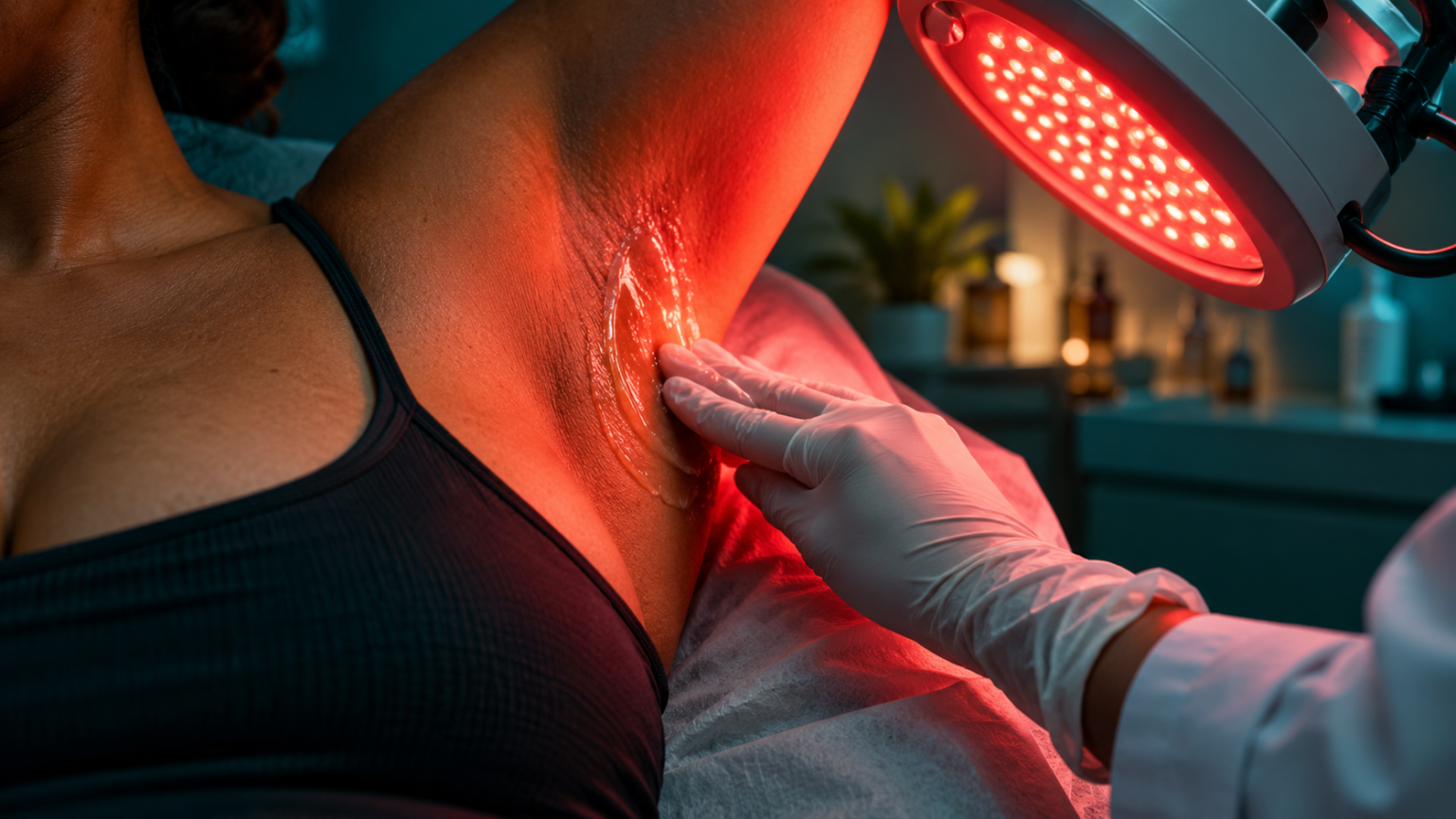
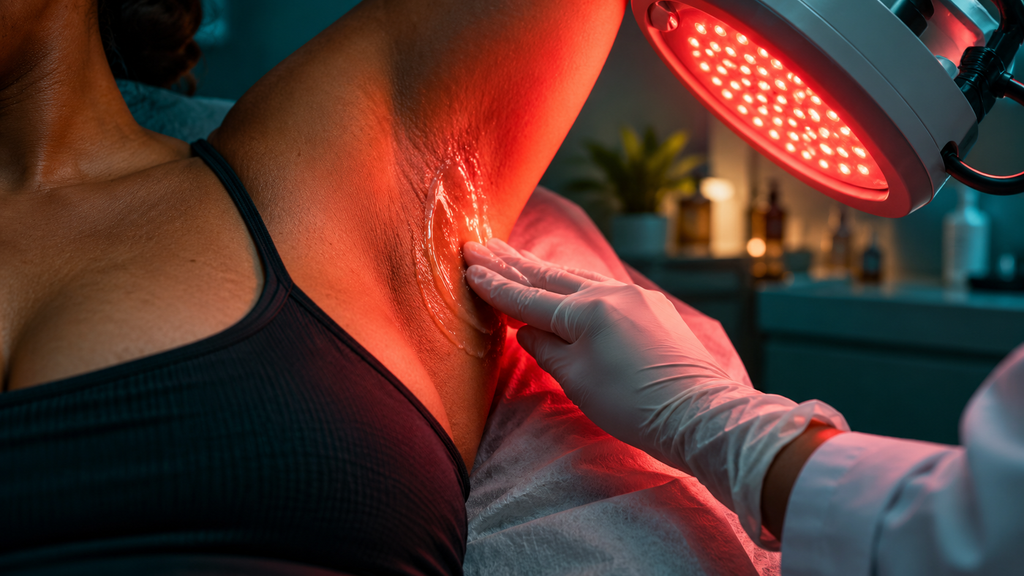
Many studies used photodynamic therapy, or PDT. A clinician applies or injects a substance that responds to light and then shines light on the area. In some procedures, the light is delivered inside a lesion through a thin fiber. Think of it as a combination procedure: the light and the substance work together. You cannot look at its results and give all the credit to red light alone.
In one study of 41 people, clinicians injected a light-sensitive dye into HS lesions and used 635-nanometer red light. Researchers found that 58.5% of treated lesions shrank by at least 75% in their maximum diameter. That number refers to the size of lesions, not the percentage of people cured. It also cannot tell us whether red light therapy for hidradenitis suppurativa works without the injected dye.
A 2024 pilot study compared two areas on each of 32 people’s bodies. One side received a light-sensitive gel followed by red light in a clinical setting; the other received topical clindamycin. After six weeks, 13 of 32 areas treated with PDT had a complete response under the study’s definition, compared with 3 of 32 areas treated with clindamycin.
That is an interesting result, especially if you’re used to hearing that options are limited. It still tells us about gel plus red light, not a red light panel on its own. Some participants were also taking another HS medication during the study, and longer follow-up is needed to see whether the changes last.
So is red light therapy for hidradenitis suppurativa promising?
It depends on which treatment you mean. A systematic review examined 18 earlier studies of PDT for HS. The most encouraging results came from a procedure that placed a light-sensitive substance and delivered light inside lesions. Across three studies, 78% to 94% of treated body sites had a good to complete response. The review also found mixed results across other red-light PDT methods.
There’s a reason researchers did not stop at those numbers and declare victory. Many of the studies were small, used different methods, or had a high risk of bias. The review searched studies published through September 2019, so it did not include the newer studies described above.
To know whether red light therapy for hidradenitis suppurativa makes a lasting difference, we still need larger studies that compare treatments fairly and follow people long enough to see what happens when HS flares again.
Where does the research stand right now?
If you came here hoping for one clear answer, I know “we need more research” can feel like the last thing you wanted to read. You deserve something more useful than that: red light therapy for hidradenitis suppurativa has shown early signs of possible benefit in a very small study, but it has not been established as a way to manage HS. Some forms of PDT have stronger results, but those are separate, clinician-delivered procedures.
If you’re curious about red light therapy for hidradenitis suppurativa, bring the question to a dermatologist who knows your HS history. Ask which kind of light treatment they mean, whether it uses a light-sensitive substance, what outcome they would expect for your lesions, and how it would fit alongside your current care. HS treatment is individualized; what makes sense for one person’s flares may not make sense for yours.
For now, red light therapy for hidradenitis suppurativa is a research question, not a promise that a device will fix your next flare. Researchers have seen enough to warrant continued investigation into pain, inflammation, and lesion changes.
The HS community needs studies big enough to tell us who benefits, how much, and for how long. Until then, you deserve clear information and care that takes your pain seriously.
Frequently asked questions
Can red light therapy cure hidradenitis suppurativa?
No. There is currently no cure for HS, and no study has shown that red light therapy for hidradenitis suppurativa cures it. Researchers are investigating whether light might help with specific symptoms, such as pain or inflamed lesions.
Is photodynamic therapy the same as using a red light device at home?
No. Photodynamic therapy, or PDT, combines light with a substance that responds to it. Depending on the procedure, a clinician may apply that substance to the skin or place it inside a lesion. A standard at-home red light device does not recreate those study conditions.
Has red light by itself been tested on HS?
Yes, but the evidence for red light therapy for hidradenitis suppurativa is early. In one small study of 15 people, researchers applied red light to lesions once a week for four weeks. Twelve participants reported less pain, and twelve had improved quality-of-life scores. Because the study had no comparison group, it cannot establish that red light caused those changes or show how long they might last.
Should I replace my current HS treatment with red light therapy?
The research does not support replacing an established care plan with red light therapy. If you are interested in light-based care, ask your dermatologist what has been studied, whether a procedure is available or appropriate for your type of HS, and how it would fit with the care you already receive.