Quick Answer
Can Red Light Therapy Make Melasma Worse?
Research on red light therapy and melasma has produced mixed findings. Some LED studies report improvement, while others find no significant clinical benefit. Red light has also caused pigmentation changes under certain experimental exposure conditions, but those findings do not establish how often home devices worsen melasma. Wavelength, dose, and your skin’s response matter. If your patches darken or your skin becomes irritated, pause treatment and discuss the device with your dermatologist.
Key Takeaways
- Different wavelengths can affect pigmentation differently. Findings about blue light or sunlight cannot automatically be applied to red light.
- The evidence is still developing. Research on red light therapy and melasma does not establish that every home mask or panel treats the condition.
- Dose matters alongside wavelength. High-dose red-light safety trials have documented pigmentation changes, but they do not describe the risk from every home device.
- Near-infrared light and heat are different things. A device’s wavelength does not tell you exactly how warm your skin will become.
- Keep established melasma care in place. Sun protection, visible-light protection, and dermatologist-directed treatment remain central to managing the condition.
If you have melasma, adding something new to your skincare routine can feel like a gamble. You may have spent months fading the patches on your cheeks or forehead. The last thing you want is a treatment that makes them more noticeable.That is why questions about red light therapy and melasma deserve more than a quick reassurance. You hear that light can worsen pigmentation, but you also see LED devices promoted for clearer, more even-looking skin.
How can both be true?
The answer depends on which light we are discussing, how it is delivered, and what researchers actually measured. Some studies are encouraging. Others leave important questions unanswered.
Why melasma makes light therapy a complicated question
Melasma commonly appears as brown or gray-brown patches on the face. It often affects the cheeks, forehead, nose, or upper lip. It can fade and return, and it may persist for years.
Hormonal changes, including pregnancy and certain medications, can contribute. Light exposure also matters. The American Academy of Dermatology explains that treatment often combines sun protection with medication applied to the skin, sometimes alongside a procedure.
Melasma is different from an individual sunspot or the dark mark left behind by acne. These conditions all involve pigmentation, but evidence that a treatment improves one does not establish that it treats the others.
That distinction matters when reading about red light therapy and melasma. A product’s claim about “dark spots” may come from research on general sun damage rather than diagnosed melasma.
We need to look at who participated in the study and which condition was assessed.
Red light is not the same as blue light or sunlight
Light is described by its wavelength, usually measured in nanometers, or nm. Different wavelengths can interact with skin differently.
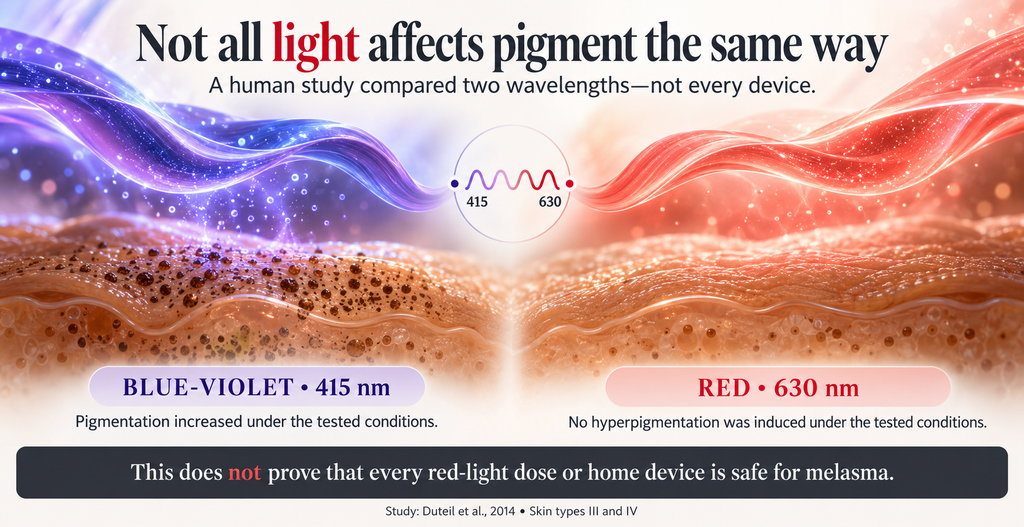
In a human pigmentation study, researchers compared blue-violet light at 415 nm with red light at 630 nm. Blue-violet exposure produced pigmentation in participants with skin types III and IV. The response increased with the exposure dose.
Red light at 630 nm did not induce hyperpigmentation under the conditions tested.
This is a useful distinction in the discussion of red light therapy and melasma. However, it does not establish that every red wavelength, dose, or treatment schedule produces the same result.
Visible light covers a range of wavelengths. A broad visible-light source and a device delivering a specific red wavelength are different exposures.
A 2025 experimental study found that broad visible-light exposure darkened melasma lesions more than adjacent unaffected skin. That supports the importance of visible-light protection. It does not establish that a narrow-band red LED session will have the same effect. The research was sponsored by Beiersdorf and authored by company employees.
Check what your device actually emits. A mask may offer red, blue, or combined modes. A panel may combine red and near-infrared wavelengths. Its name alone does not describe the exposure.
What studies on red light therapy and melasma actually show
The clinical evidence is mixed. Studies have used different wavelengths, treatment schedules, and comparison methods.
An earlier LED study reported improvement
A 2018 study enrolled 60 women with melasma and skin types V and VI. Participants received 36 LED treatments over nine months. Researchers reported improvement using subjective and objective assessments.
However, participants were grouped according to skin type, and both groups received treatment. The abstract does not describe an untreated or sham-treatment comparison group.
Without that comparison, it is harder to determine how much improvement came from the treatment itself.
Small amber-light research also found improvement
A 2022 investigation examined amber LED light in laboratory experiments and a clinical component involving ten melasma patients. Researchers reported improvements in pigmentation and redness.
The small sample limits what we can conclude. Amber light is also different from red light.
This study belongs in a discussion of LED treatment research, but it should not be presented as direct proof that a red-light-only home mask treats melasma.
A newer randomized trial found no significant clinical improvement
A 2025 randomized pilot trial compared amber photobiomodulation with topical tranexamic acid.
Twenty-one women received active amber-light treatment with placebo cream or sham light treatment with 5% liposomal tranexamic acid cream for 12 weeks.
Neither group showed significant improvement in the main clinical severity measures. The trial ended early and was underpowered. Both groups reported improved quality of life, but this differs from a measurable reduction in pigmentation severity.
Taken together, research on red light therapy and melasma supports further investigation. It does not establish that every consumer device produces reliable improvement.
| Study | What researchers reported | Main limitation |
|---|---|---|
| 2018 LED study | Improvement during a nine-month treatment course | No sham or untreated comparison group described in the abstract |
| 2022 amber LED investigation | Improved pigmentation and redness | Ten patients; amber-light findings do not directly establish red-light effectiveness |
| 2025 randomized amber trial | No significant improvement in the principal clinical severity measures | Small sample and early termination |
These differences help explain why one positive study cannot settle the treatment question.
Can red light itself cause pigmentation changes?
Yes. Pigmentation changes have been documented in red-light research.
In two randomized safety trials, researchers applied high-dose red LED exposures to healthy forearm skin. Some participants experienced mild, temporary hyperpigmentation or redness. At higher exposures, some developed blistering or prolonged redness.
These were safety experiments, rather than studies of routine home-mask use. They also did not measure facial melasma flares.
Their relevance to red light therapy and melasma is specific: red light should not be described as incapable of affecting pigmentation.
At the same time, these experiments cannot tell us how likely a particular home device is to worsen someone’s patches.
The absence of UV does not answer every safety question. Exposure conditions and skin response still need consideration.
What about heat and near-infrared light?
Near-infrared describes a wavelength range. Heat describes a rise in temperature.
A device’s near-infrared output does not tell you exactly how warm your face will become. Temperature also depends on output, duration, distance, ventilation, and design.
When discussing red light therapy and melasma, separating these factors helps avoid unsupported claims about an entire category of devices.
The authors of the 2025 amber trial proposed unusually high environmental temperatures as a possible explanation for their results. However, the study did not experimentally isolate temperature as the cause.
We therefore cannot use that finding to declare every near-infrared device unsuitable or every red-only device suitable.
Warmth alone also cannot tell you whether melasma is improving or worsening. If a device feels uncomfortably hot or causes burning, stop the session. Do not tolerate discomfort because you assume it means the treatment is working.
Why findings may not apply to your LED mask
Two devices can look similar while delivering different exposures.
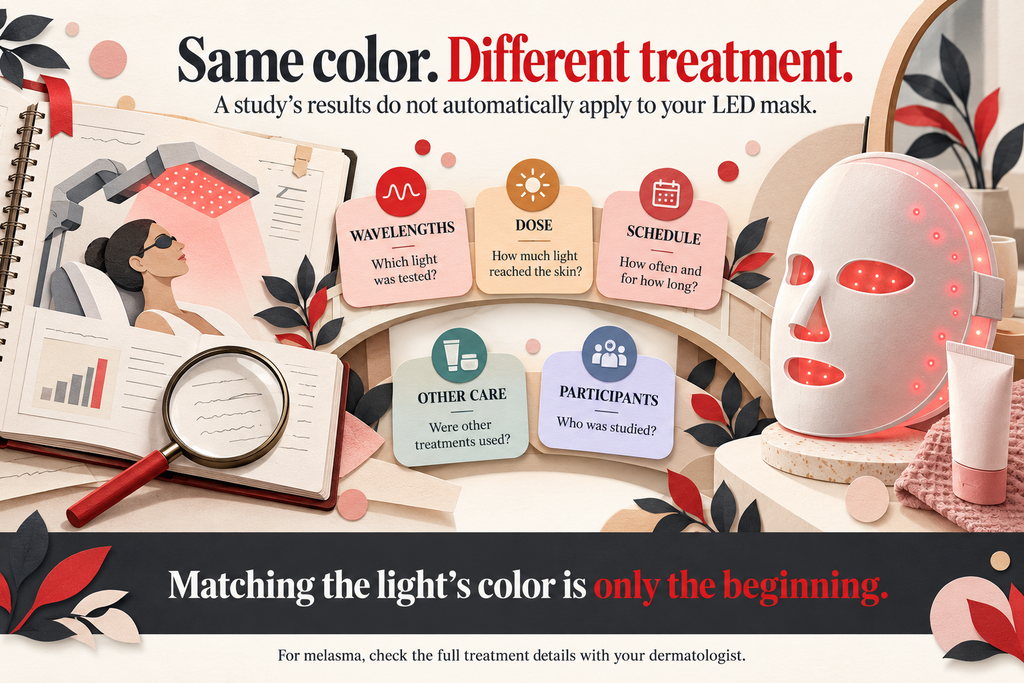
To interpret red light therapy and melasma research, look beyond the color of the light.
Wavelengths
Was the study conducted with red, amber, near-infrared, or a combination? Does your device deliver the same wavelengths?
Irradiance
Irradiance describes the light power reaching a given area. The amount reaching your skin can depend on the device and its position.
Exposure duration
Time contributes to the delivered dose. Ten minutes with one device may not be equivalent to ten minutes with another.
Treatment schedule
A single exposure differs from repeated treatment over weeks or months.
Other care
Were participants also using medication, sunscreen, or another procedure? Combined treatments can make individual effects harder to identify.
Participants
Skin type, melasma severity, and other patient characteristics affect how broadly findings apply.
Researchers studying red-light safety identify dose, power density, exposure duration, delivery pattern, and treatment frequency as relevant parameters. Matching a wavelength alone does not establish equivalent treatment.
Our skin pigmentation guide explores how skin characteristics can influence light exposure. Visit our education library for more explanations of device measurements and clinical research.
What to do if your patches look darker
If you are trying red light therapy and melasma becomes more noticeable, take the change seriously. Timing alone does not identify the cause, but it is a reason to reassess your routine.
Your dermatologist may need to consider the device, sun exposure, skincare changes, irritation, and the underlying course of your condition.
- Pause the device. Avoid longer sessions or higher settings to try to correct the change.
- Document your skin. Take photographs in consistent lighting. Shadows and camera exposure can make pigmentation comparisons misleading.
- Record the details. Note the device, mode, session duration, frequency, and symptoms such as burning or persistent redness.
- Speak with your dermatologist. Bring your photographs and device instructions.
- Avoid changing several products at once. Follow your clinician’s advice about your existing treatment plan.
The studies discussed here do not establish that darker patches are a necessary “purging” stage. You should not feel that you must push through worsening pigmentation to get results.
What remains central to melasma care
Whatever you decide about red light therapy and melasma, established care should stay in place.
The AAD’s self-care guidance recommends broad-spectrum sunscreen with SPF 30 or higher. It also recommends tinted sunscreen containing iron oxide to help protect against visible light.
Gentle, fragrance-free skincare is part of its advice because irritation can worsen discoloration.
Visible-light protection has also been examined in a randomized sunscreen trial. Researchers compared UV-only sunscreen with UV and visible-light protection in patients receiving hydroquinone for melasma.
A dermatologist can help select treatment based on your skin and medical history. An LED device should not displace care that is helping simply because its advertising promises an even skin tone.
Frequently asked questions
What does research on red light therapy and melasma tell us?
Some LED studies report improvement, but findings are mixed and protocols differ. The available evidence does not establish that every home device treats melasma.
Can a red-light mask make melasma worse?
Red light has produced pigmentation changes under experimental exposure conditions. However, those findings do not establish how often home masks worsen melasma. Pause use if your patches darken or your skin becomes irritated.
Is blue light different from red light for pigmentation?
Yes. In the 2014 comparison, 415 nm blue-violet light induced pigmentation, while 630 nm red light did not under the tested conditions. Device wavelengths and operating modes matter.
Is near-infrared light safe if I have melasma?
The evidence discussed here does not establish one answer for every device. Its wavelengths, exposure, temperature, and your treatment plan need individual consideration.
Does a warm mask mean my pigmentation is getting worse?
Warmth alone cannot establish that. It also does not prove treatment is working. Stop if the warmth becomes uncomfortable, and discuss persistent redness, irritation, or pigmentation changes with your dermatologist.
Is there a proven home-treatment schedule?
These studies do not establish a schedule that applies to every mask or panel. A research protocol should not be copied without accounting for the device and the individual.
Can I combine an LED device with prescription treatment?
Ask the clinician managing your melasma about the specific device and prescription. General skincare instructions do not necessarily address every medication or medical condition.
The practical takeaway
Research on red light therapy and melasma gives us reasons to investigate further, but it does not establish a universal treatment or safety guarantee.
Some LED studies have reported improvement. A newer amber-light pilot found no significant clinical improvement. High-dose red-light experiments have also documented pigmentation changes.
Consider the actual device, its exposure conditions, and your skin’s response. Keep photoprotection and established care in place. If pigmentation worsens, pause and reassess with your dermatologist.