Quick Answer
Research on red light therapy and nitric oxide examines whether light can release nitric oxide bound to cytochrome c oxidase, an enzyme involved in mitochondrial respiration. This proposed process, called photodissociation, could relieve nitric oxide-related inhibition and influence ATP production. However, experiments have produced mixed findings. It is not a confirmed explanation for what happens during every red light therapy session.
Key Takeaway
- Research on red light therapy and nitric oxide explores a proposed connection between light absorption and mitochondrial respiration.
- Nitric oxide is a useful signaling molecule that can also reversibly inhibit cytochrome c oxidase.
- Releasing bound nitric oxide and producing new nitric oxide are different processes. Neither automatically proves that ATP production increased.
- Laboratory findings depend on oxygen availability, the enzyme’s chemical state, wavelength, and experimental conditions.
- A proposed molecular mechanism does not establish that every home device increases cellular respiration.
What does “helping your cells make energy” actually mean?
You have probably seen red light therapy described as something that “boosts ATP” or “supports your mitochondria.” Those phrases sound straightforward. The biology behind them takes a little more explaining.
Research on red light therapy and nitric oxide looks at one possible step between light reaching your tissue and a change in cellular energy production.
Nitric oxide is a small signaling molecule that can interact with an enzyme called cytochrome c oxidase. Under certain conditions, that interaction inhibits mitochondrial respiration.
Scientists have proposed that light could release the bound nitric oxide, relieving inhibition and allowing respiration to recover. The process is called photodissociation.
The question is how reliably that sequence occurs, especially inside living human tissue.
Cellular respiration begins with energy from nutrients
To understand red light therapy and nitric oxide, it helps to start with what mitochondria normally do.
Cells break down nutrients and transfer some of the resulting energy into ATP, or adenosine triphosphate. ATP powers many cellular activities.
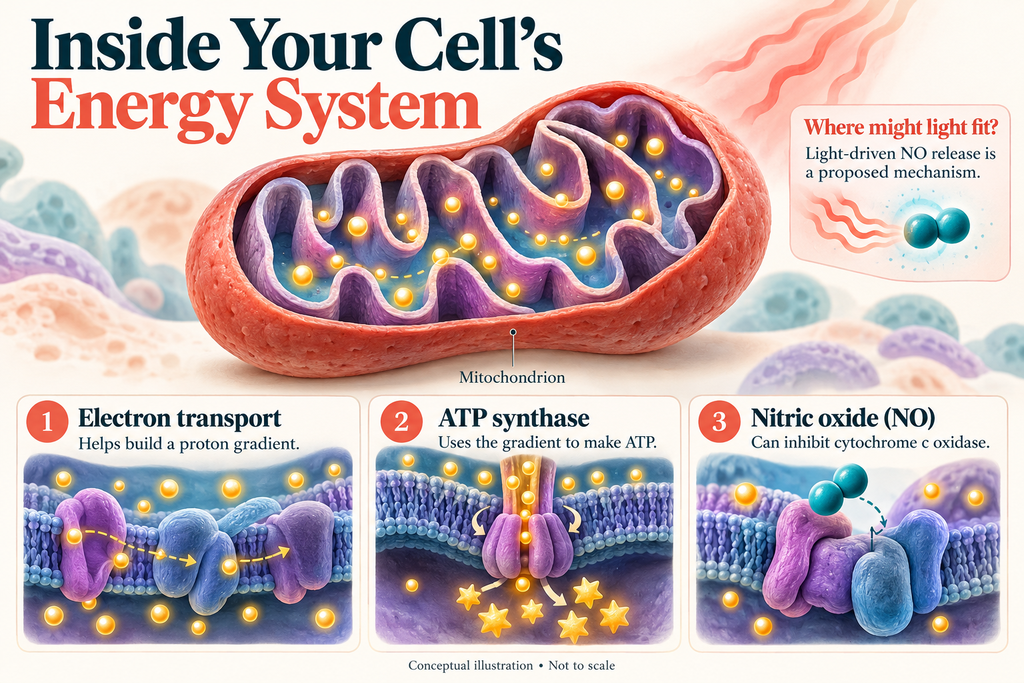
Inside mitochondria, electrons move through a series of proteins called the electron transport chain. Energy from those transfers helps establish an electrochemical gradient across the inner mitochondrial membrane.
That gradient powers ATP synthase, the enzyme that makes ATP.
This process is called oxidative phosphorylation. Oxygen accepts electrons at the end of the chain and is converted to water.
Breathing supplies oxygen to your body. Cellular respiration describes the biochemical processes through which your cells use nutrients and oxygen.
The connection between red light therapy and nitric oxide concerns what may happen at the final oxygen-processing step.
Cytochrome c oxidase helps mitochondria process oxygen
Cytochrome c oxidase, abbreviated CCO, is also called complex IV.
It receives electrons from cytochrome c and transfers them to oxygen. Its activity contributes to the proton gradient that supports ATP synthesis.
The enzyme contains an active site called the heme a₃–CuB binuclear center. The name refers to a reaction site involving heme iron and copper.
This is where oxygen-processing chemistry occurs. The structure and function are described in research on mitochondrial electron transport.
CCO is central to discussions of red light therapy and nitric oxide because NO can interact with this oxygen-processing machinery.
CCO does not directly manufacture ATP. It participates in the respiratory process that helps ATP synthase do its job.
How nitric oxide can inhibit respiration
Nitric oxide, or NO, has useful signaling functions throughout the body. It can also inhibit cytochrome c oxidase and reduce mitochondrial oxygen consumption.
A 1994 experiment demonstrated this in isolated nerve-terminal preparations. The inhibition was reversible and appeared to involve competition between NO and oxygen at cytochrome oxidase.
Oxygen concentration mattered. At lower oxygen concentrations, less NO was needed to produce inhibition.
This finding provides an important foundation for research on red light therapy and nitric oxide. There is a biochemical interaction that light might potentially influence.
But two questions remain separate. Can NO inhibit respiration? And can therapeutic light reliably reverse that inhibition?
Evidence answering the first question does not automatically answer the second.
What photodissociation actually means
Photodissociation means separation caused by light.
In research on red light therapy and nitric oxide, the proposed event is NO leaving a molecular binding site after light absorption.
The molecule is released from its attachment. It is not necessarily destroyed, removed from the body, or newly produced.
Early experiments investigated photodissociation in particular CCO–NO complexes. A spectroscopy study reported action-spectrum peaks around 640–660 nm and below 400 nm. It also studied NO recombination at extremely low temperatures.
An action spectrum describes how effectively different wavelengths produce a particular measured response.
These experiments help researchers investigate molecular behavior. However, an enzyme complex studied under specialized laboratory conditions differs substantially from an enzyme inside your mitochondria.
That is why research on red light therapy and nitric oxide needs more than a wavelength match. The chemical state, temperature, surrounding molecules, and biological environment also matter.
How releasing nitric oxide could affect cellular respiration
The proposed pathway begins with light reaching and being absorbed by a relevant molecular target.
If that absorption causes inhibitory NO to dissociate from CCO, oxygen processing could recover. Changes in electron transport could then influence the proton gradient and ATP synthesis.
This is the inhibition-relief hypothesis discussed in research on red light therapy and nitric oxide.
A 2021 experimental paper describes this model and tests its predicted effect on oxygen consumption.
Every step is conditional.
Light reaching tissue does not guarantee absorption at the required site. NO release does not guarantee a measurable respiratory change. A respiratory change does not establish a particular health benefit.
The hypothesis also concerns restoring activity when inhibition is present. That differs from demonstrating that light increases activity above an already functioning system’s normal level.
A direct experiment challenged the proposed mechanism
Some of the most useful research on red light therapy and nitric oxide tests whether the predicted respiratory response actually occurs.
In the 2021 study, researchers exposed isolated CCO to 670 nm red light or 830 nm near-infrared light.
They measured oxygen consumption with and without irradiation. They also introduced a nitric oxide donor to inhibit the enzyme and tested whether light relieved that inhibition.
Neither wavelength significantly changed oxygen-consumption kinetics. Irradiation also failed to relieve the inhibition caused by the NO donor.
The results challenged the inhibition-relief model under those experimental conditions.
This finding does not represent every feature of living tissue. It does directly test a prediction of the proposed mechanism.
A balanced explanation needs to account for negative results alongside supportive observations.
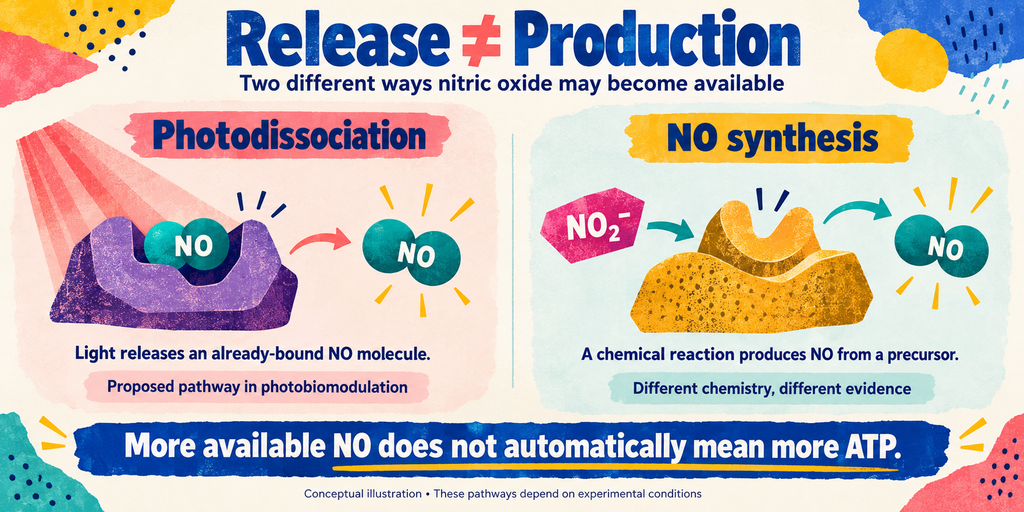
Nitric oxide release and nitric oxide production are different processes
One of the easiest mistakes when discussing red light therapy and nitric oxide is treating all increases in NO as evidence of photodissociation.
Photodissociation releases NO that is already bound to a molecular site. Synthesis produces NO through a chemical reaction.
In a 2011 study, researchers investigated CCO’s ability to produce NO from nitrite, written as NO₂⁻.
Low-intensity light stimulated this nitrite-dependent production. The strongest stimulation occurred around 590 ± 14 nm.
The study did not find increased oxygen consumption by CCO.
For readers exploring red light therapy and nitric oxide, the distinction matters. More available NO does not automatically mean that inhibitory NO was released from CCO or that respiration increased.
It also matters that the strongest response occurred around 590 nm. That finding cannot simply be assigned to every red or near-infrared panel.
Nitric oxide also affects signaling outside mitochondria
NO has biological targets beyond cytochrome c oxidase.
One is soluble guanylyl cyclase, an enzyme involved in producing cyclic GMP, or cGMP. This signaling pathway participates in functions including blood vessel relaxation.
Experimental research on soluble guanylyl cyclase signaling demonstrates that NO can affect biological activity through pathways distinct from mitochondrial oxygen consumption.
When evaluating red light therapy and nitric oxide claims, keep circulation, NO availability, and ATP production separate.
A finding about blood flow does not establish increased mitochondrial respiration. A finding about NO concentration does not identify the pathway responsible.
NO should therefore not be presented as something your mitochondria simply need to eliminate. Its effects depend on where it is, how much is present, and what it interacts with.
What human research can tell us
Laboratory chemistry is one part of the evidence. Human research asks whether measurable changes occur after treatment in a more complex biological setting.
A 2026 study involving 12 healthy adults applied photobiomodulation to one randomly selected leg. The other leg received sham treatment with no light emitted.
After one session, researchers assessed mitochondrial respiration in skin and muscle samples. They found no increase in the measured respiratory outcomes compared with the control leg.
This study provides context for red light therapy and nitric oxide, but it did not directly measure NO photodissociation.
It cannot establish whether that molecular event occurred. It does challenge the assumption that every session must increase mitochondrial respiration.
Its limits also matter. The results concern a small group of healthy adults, one session, a particular protocol, and measurements from tissue samples.
Why experimental conditions change the interpretation
An isolated enzyme is being studied in a different environment from a mitochondrion inside living tissue.
Oxygen availability, NO concentration, enzyme chemistry, wavelength, and exposure conditions all influence what an experiment can establish.
Early CCO–NO photodissociation research found appreciable photodissociation under continuous illumination at room temperature in a particular azide-containing complex. That preparation is not equivalent to ordinary physiological conditions.
These details help explain why findings about red light therapy and nitric oxide cannot be transferred directly from every laboratory preparation to home use.
They also explain why your sensations cannot identify the mechanism.
Feeling warm, relaxed, or more energetic does not tell you whether NO detached from CCO. Investigating that event requires appropriate molecular measurements.
How to read claims about cellular energy
When you encounter red light therapy and nitric oxide claims, start by asking what researchers measured.
| Measurement | What it can help establish |
|---|---|
| NO concentration or availability | Whether the measured NO signal changed |
| NO release from a defined complex | Whether photodissociation occurred under the tested conditions |
| Oxygen consumption | Whether respiratory activity changed in the experimental system |
| ATP levels | Whether the measured ATP pool changed |
| A clinical outcome | Whether participants experienced a measured response under the study protocol |
These outcomes are related, but they are not interchangeable.
Check whether the study used isolated enzymes, cultured cells, animals, or people. Then look at the wavelengths, exposure settings, and comparison groups.
A study can provide useful evidence without proving an entire proposed pathway.

What this means for your understanding of red light therapy
The strongest conclusion about red light therapy and nitric oxide is that the relationship involves several distinct biochemical questions.
NO can reversibly inhibit CCO. Light-driven release of bound NO is a proposed way of influencing that interaction. Some experiments challenge whether therapeutic red or near-infrared light reliably produces the expected respiratory response.
Understanding the distinction helps you evaluate claims about “mitochondrial energy.” Look for evidence of the specific event being described, rather than assuming that one measurement proves every step.
Frequently Asked Questions
What is nitric oxide photodissociation?
It is the light-driven release of NO from a molecular binding site. One proposed target in photobiomodulation is NO bound to cytochrome c oxidase.
Does red light therapy increase nitric oxide?
Some experiments report light-related changes in NO production or availability. These findings do not establish that every home session produces the same response or that photodissociation caused it.
Does releasing nitric oxide always increase ATP?
No. NO release, oxygen consumption, and ATP production are separate measurements. Demonstrating release alone would not establish increased ATP synthesis.
Is nitric oxide harmful to mitochondria?
NO can inhibit respiration, but it also serves useful signaling functions. Its effects depend on concentration, location, and biological conditions.
Do red and near-infrared light affect nitric oxide the same way?
They should not be assumed to. A finding at one wavelength and under one set of conditions does not automatically apply to another.
Has the proposed connection between red light therapy and nitric oxide been proven during home use?
The studies discussed here do not establish that NO photodissociation reliably occurs during ordinary home-panel sessions. More direct evidence in relevant living systems is needed to confirm when this mechanism contributes to a biological response.