You’ve probably heard “collagen” a thousand times, on a supplement label, in a serum ad, in someone’s skincare routine video. Almost nobody talks about the cell that actually makes it.
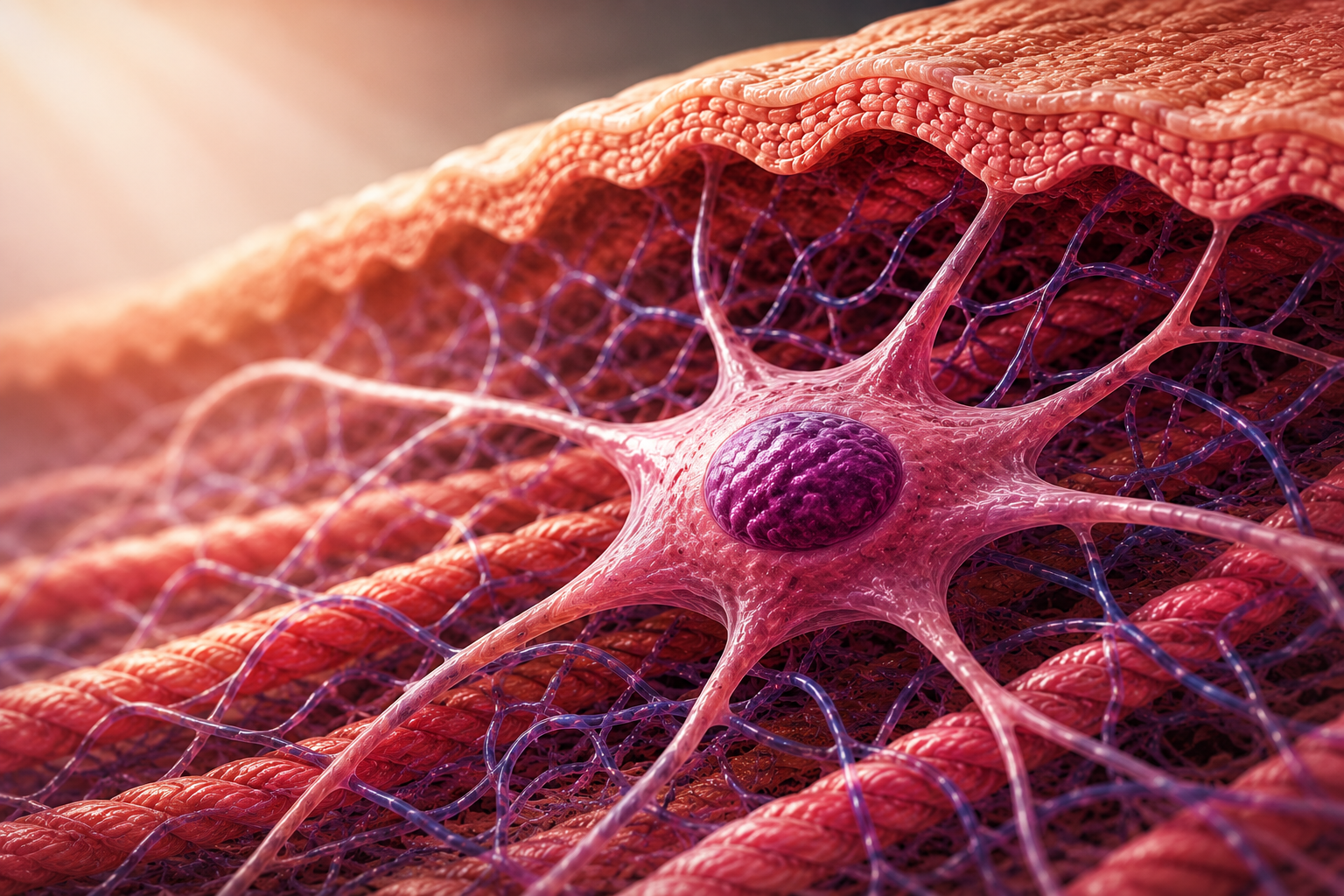
That cell is the fibroblast. It’s the construction worker underneath your skin, building and maintaining the scaffolding that gives your face its structure. If you want to understand why skin firms up, sags, wrinkles, or holds a shape at all, fibroblasts are where that story actually starts. So let’s start there.
What a Fibroblast Actually Is
Fibroblasts were first described all the way back in 1858, by a pathologist named Rudolf Virchow, who noticed spindle-shaped cells scattered through connective tissue. Scientists have spent a long time since then figuring out exactly what those cells do, and the short version is: a lot.
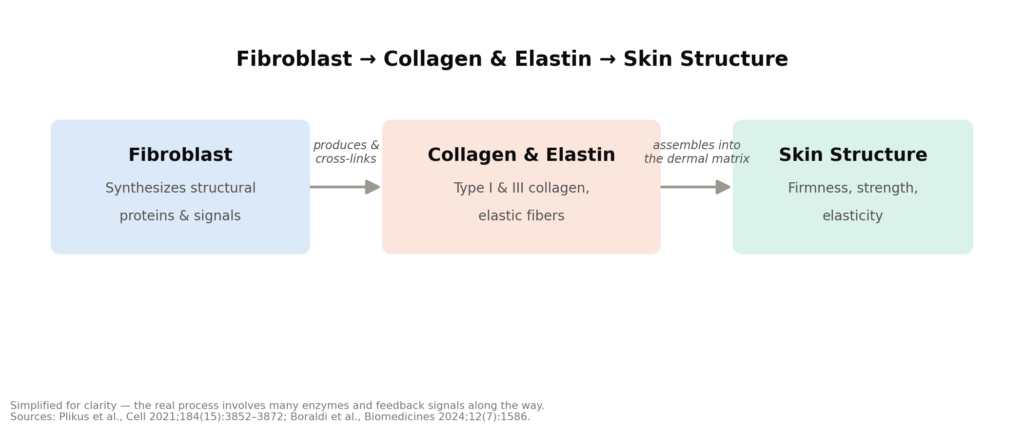
A fibroblast’s main job is producing and maintaining what researchers call the extracellular matrix, the mesh of proteins that sits between your cells and gives tissue its physical form. In skin, that mesh is mostly collagen and elastin. Fibroblasts also secrete signaling molecules that talk to neighboring cells, and during an injury, some of them transform into a more muscular version of themselves called a myofibroblast, which helps physically pull a wound closed. Once the repair is done, they typically return to their resting state.
Fibroblasts aren’t one uniform type doing one uniform job, either. Your skin has different fibroblast populations layered on top of each other: a set near the surface (the papillary dermis) supporting the outermost skin cells, a thicker, deeper set (the reticular dermis) producing the dense structural matrix that gives skin its real strength, and specialized fibroblasts tucked inside hair follicles that actually help regulate the hair growth cycle. Different jobs, same general cell type.
Collagen and Elastin, By the Numbers
Here’s where it gets concrete. Type I collagen makes up roughly 70% of the dry weight of adult skin. Type III collagen adds another 8 to 11%. Elastic fibers, the stretchy component that lets skin snap back into place, make up a much smaller 2 to 4%.
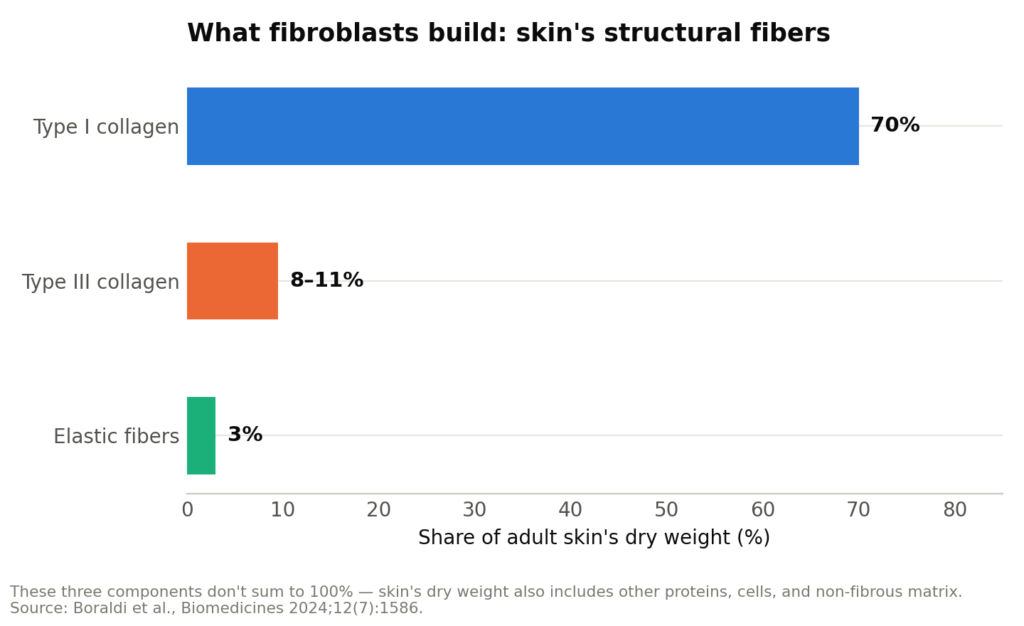
Those three numbers alone tell you something useful: skin structure isn’t mostly about elasticity, it’s mostly about collagen, and specifically Type I collagen. Elastin matters, but it’s doing a smaller, more specific job on top of a much bigger collagen foundation.
The ratio between the two collagen types changes across your life, too. In fetal skin, Type I and Type III collagen sit at roughly 1:1. In adult skin, that shifts to about 4:1, favoring Type I, the stiffer, more structural type, over Type III, which is more flexible.
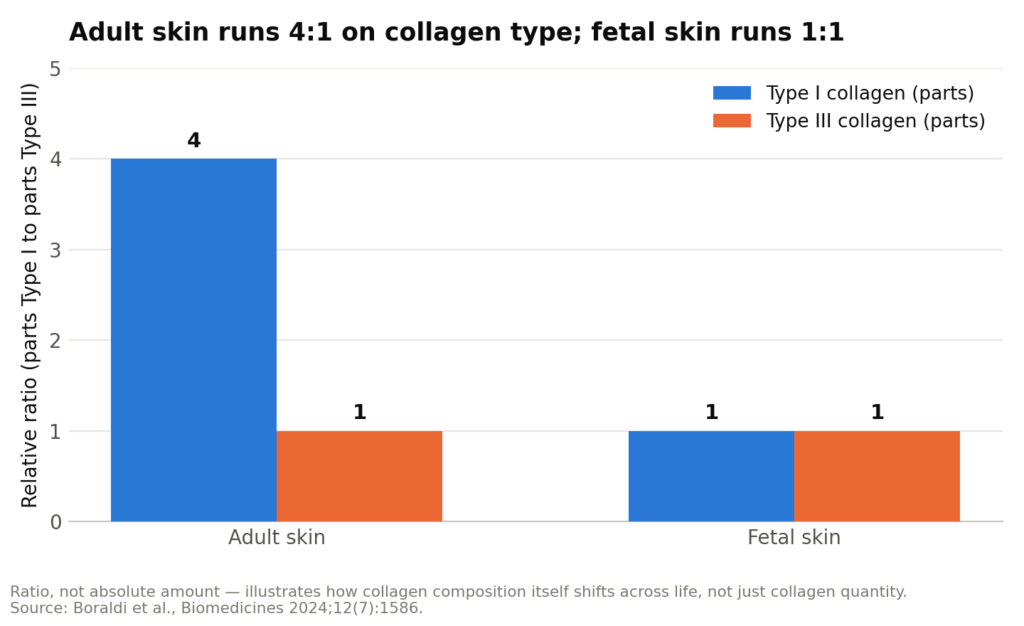
That’s not a story about collagen disappearing. It’s a story about the composition of your skin’s scaffolding changing shape over time, well before anyone would call it “aging” in the way we usually mean it.
Put those two ideas together and you get a simple picture worth keeping in mind: fibroblasts build collagen and elastin, and those fibers assemble into the structure that gives skin its firmness and elasticity.
Why Fibroblast Activity Changes Over Time
This is the part most skincare content skips entirely, or replaces with something vague like “collagen production slows down.” It’s worth being specific about what’s actually happening.
Fibroblasts, like most cells, can accumulate damage: oxidative stress, DNA damage, shortening telomeres (the protective caps on the ends of chromosomes), and mitochondrial dysfunction. Enough of that damage pushes a fibroblast into a state called senescence, where the cell permanently stops dividing. Two specific proteins, p16INK4a and p21CIP1/WAF1, act as the switches that lock the cell into that arrested state.
Senescent fibroblasts don’t quietly retire, though. They shift into something researchers call a senescence-associated secretory phenotype, which is a mouthful for a simple, frustrating fact: they start actively releasing enzymes that break down existing collagen and elastin. Older skin makes less new collagen. Its fibroblasts also break down more of what’s already there.
The measured differences between aged and younger skin reflect that directly: about 35% fewer fibroblasts by density, a 68% drop in Type I procollagen, and a 30% decrease in fibroblasts’ collagen-synthesizing capacity.
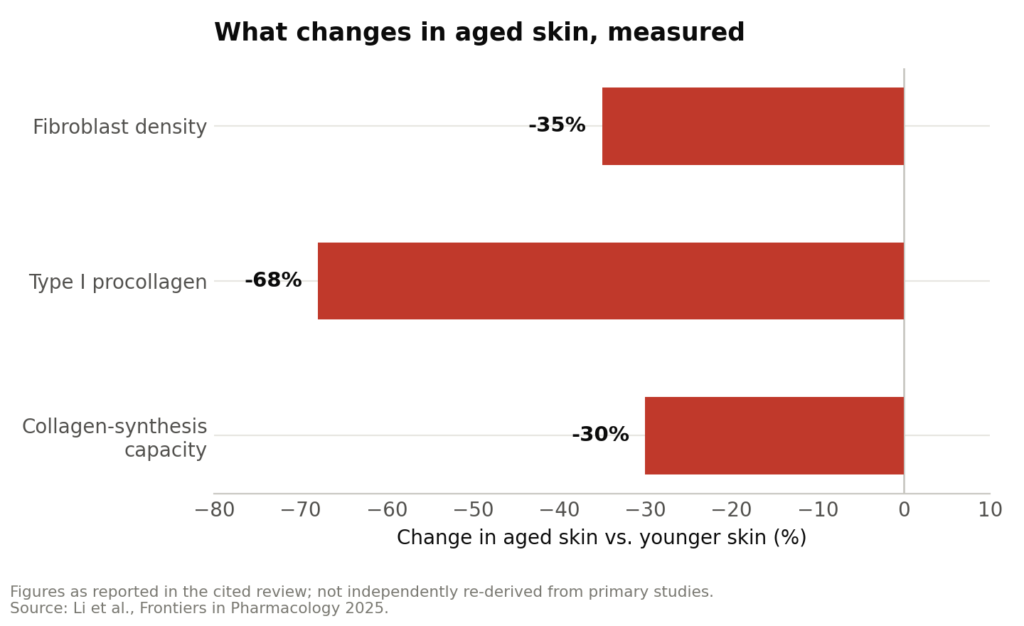
That’s a real, well-documented mechanism, and it’s worth sitting with before jumping to any kind of fix. Fewer fibroblasts, each one less capable of producing new collagen, in an environment where existing collagen is being broken down a little faster. Three separate problems compounding each other, not one simple dial turning down.
Where Photobiomodulation Enters the Picture
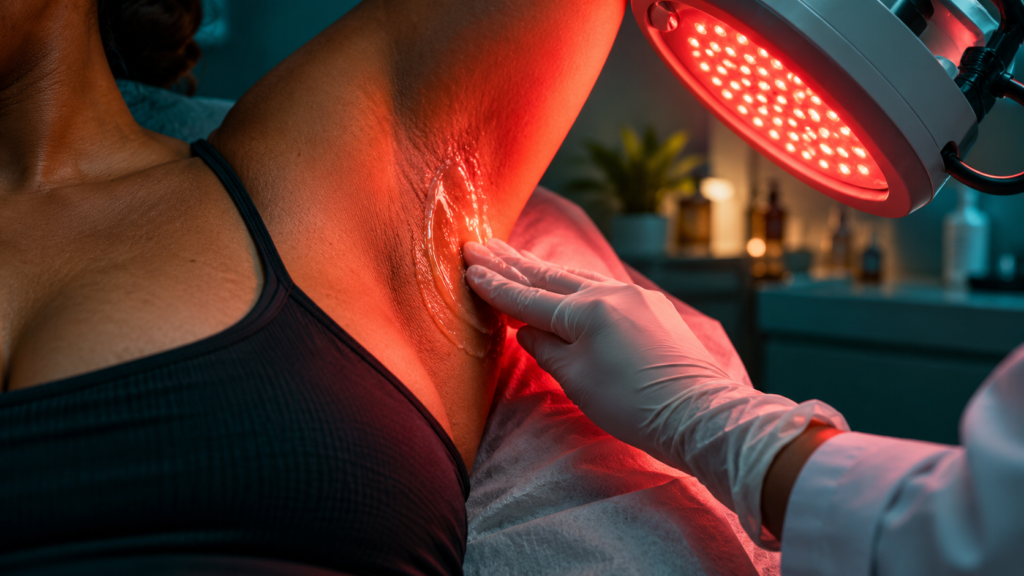
A lot of red-light content jumps straight to “and light therapy reverses all of that.” We’re not going to do that, because the research doesn’t support that leap yet. What the research does support is a smaller, more specific claim: photobiomodulation, the general term for red and near-infrared light therapy, is an active area of study looking at fibroblast activity, and some of what’s been found is worth knowing.
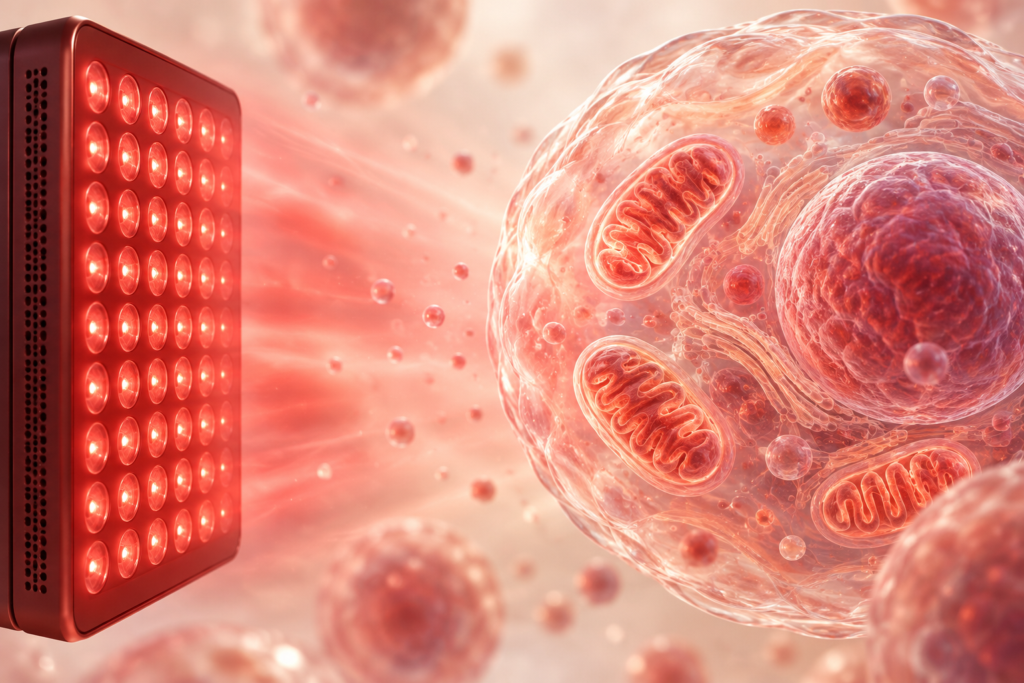
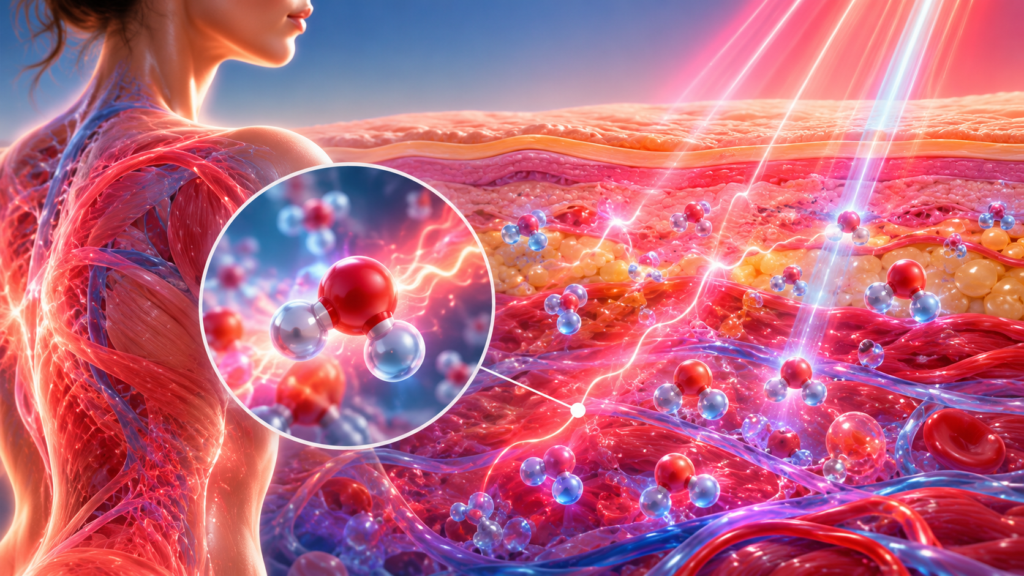
The proposed mechanism starts inside the cell. Mitochondria, the structures that generate a cell’s energy, contain a light-absorbing enzyme called cytochrome c oxidase. Red and near-infrared wavelengths get absorbed there, and that absorption is thought to change how much ATP (cellular energy currency) the mitochondria produce, along with the level of reactive oxygen species inside the cell. Those shifts can then switch on signaling pathways that influence whether a fibroblast proliferates, moves, or ramps up collagen production.
That’s a real, actively studied mechanism. It’s also, on its own, just a proposed chain of events, not proof that shining a light on skin reliably changes what fibroblasts do in a living person. Getting from “here’s a plausible mechanism” to “here’s what happens in real skin” is exactly where the next two sections matter.
The Detail Almost Nobody Mentions: Dose Determines the Direction
Most red-light content leaves out an interesting wrinkle: at lower doses, red and near-infrared light are associated with more fibroblast proliferation and more collagen production, along with less breakdown of the collagen already there. At high doses, the same wavelength range is associated with the opposite: less fibroblast proliferation and less collagen, an effect researchers are studying deliberately as a way to reduce excess scar tissue.
One study made this especially concrete. Researchers exposed cultured human dermal fibroblasts to a high, deliberately anti-fibrotic dose of red light (640 joules per square centimeter, a substantial amount of light energy) and measured the gene-level response. A collagen-degrading gene, MMP1, jumped by more than double. A separate gene tied to anti-fibrotic activity, PRSS35, increased more than thirtyfold. Cell counts measurably dropped by 48 hours. At that dose, in that context, the light was doing the opposite of what a simple “red light boosts collagen” claim implies.
That’s not two studies disagreeing with each other. It’s dose determining direction, on the same basic mechanism. Worth remembering any time “red light and collagen” gets flattened into one simple claim.
What Happens in Real People, Not a Lab Dish
The best evidence for the lower-dose, rejuvenation-direction story doesn’t come from cell cultures. It comes from two controlled human trials.
In one, 76 patients were randomly assigned to near-infrared light, red light, both combined, or a genuine sham treatment, applied to one side of the face, twice a week for four weeks, with the other side serving as an internal comparison. The combined treatment produced wrinkle reduction of up to 36% and an elasticity increase of up to 19%. Researchers also took skin biopsies, and treated skin showed more collagen, more elastic fibers, and fibroblasts that looked visibly more active under the microscope.
A second, larger trial treated 137 women, ages 40 to 65, with red light on one side of the face and amber light on the other, at matched doses, for ten sessions over four weeks. Periocular wrinkle volume dropped by 31.6% with red light and 29.9% with amber, essentially the same result from two different colors of light.
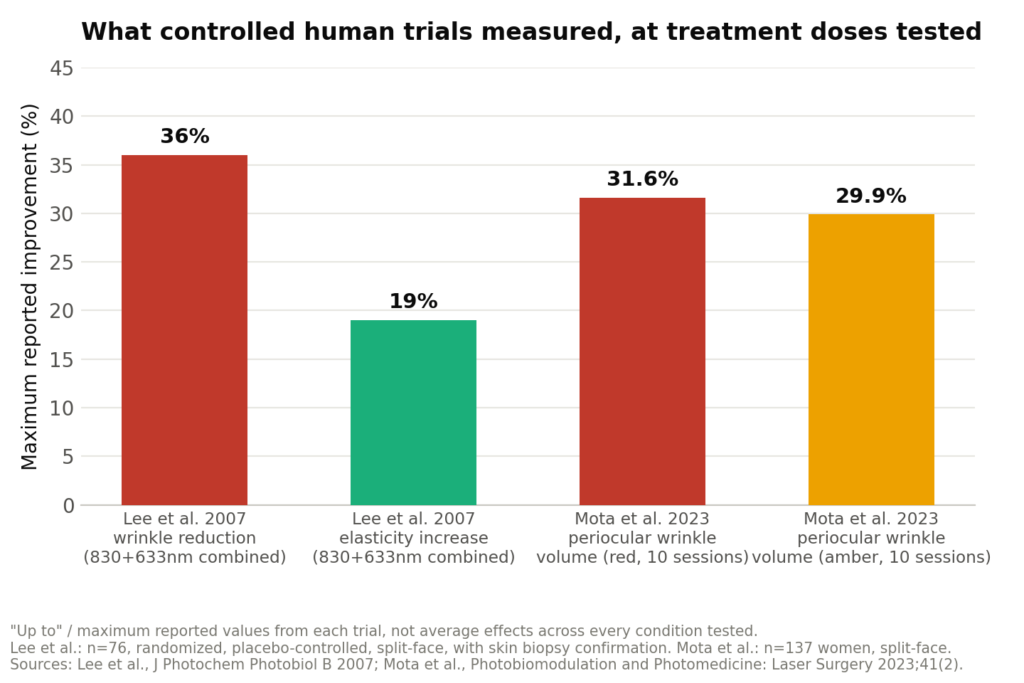
Those are real, controlled, human results, and they’re worth taking seriously. They’re also specific: specific doses, specific measurements, specific populations. Neither trial tells us that any particular at-home device, at any dose someone happens to pick, will reproduce these numbers. What they do tell us is that, at tested doses, light exposure has produced a measurable, biopsy-confirmed connection between treatment and increased collagen, elastin, and fibroblast activity in real skin.
What We Can Say, and What We Can’t
Let’s be precise about where that leaves things, because precision is the whole point of writing about this honestly.
Established, well-supported by multiple lines of evidence: fibroblasts build and maintain skin’s collagen and elastin, skin composition changes measurably with age, and fibroblast senescence is a documented mechanism behind that decline.
Promising, with real but narrower evidence: lower-dose red and near-infrared light is linked to increased fibroblast activity and collagen production across lab studies and two controlled human trials, with visible, biopsy-confirmed results in people.
Mechanistic and still being worked out: exactly how the light-to-mitochondria-to-signaling chain plays out at every dose, and whether it can meaningfully influence fibroblasts that have already become senescent, as opposed to fibroblasts that are simply under-stimulated.
Not something the current evidence supports: that light therapy reverses fibroblast aging, that any single dose or device is definitively optimal, or that the anti-fibrotic, high-dose findings and the pro-collagen, lower-dose findings are just two points on one clean, continuous curve. They’re related, but the research treats them as distinct dose regimes, not one settled slope.
The Bottom Line
Fibroblasts are the reason your skin has structure at all, building collagen and elastin according to a composition that shifts across your life, and losing ground over time as more of them slip into a senescent state that actively works against the collagen that’s left. Photobiomodulation is a real, active area of research into whether light exposure can support fibroblast activity, with encouraging results in controlled human trials, at specific, tested doses.
That’s a more careful claim than “red light fixes collagen.” It’s also the one the evidence can actually back up.
Ready to find your RLT device? Check out our product and brand reviews and try our comparison tool to find the right fit for your goals.
Meet your fibroblasts: the data behind the post
Fibroblasts build collagen and elastin, which assemble into skin’s structure. Click a tab below to explore what changes across life, and what controlled trials have measured with light therapy.