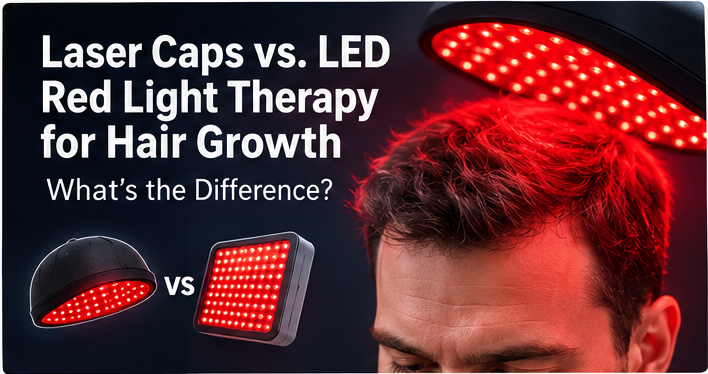
If you’ve looked into red light therapy for hair growth, you’ve probably seen laser caps, LED helmets, red light panels, and other devices that claim to help with thinning hair. When comparing laser caps vs LED red light therapy, the obvious question is whether one actually works better than the other.
Not necessarily.
Both lasers and LEDs can be used for photobiomodulation, which is the process behind red light therapy. Research on low-level laser and LED therapy has found improvements in hair density in people with androgenetic alopecia, better known as male and female pattern hair loss. Studies have used lasers, LEDs, and devices that combine both.
The bigger question with laser caps vs LED red light therapy isn’t simply where the light comes from. It’s whether the right kind of light reaches the scalp at an appropriate dose, and whether you use it consistently enough to give it a chance to work.
How Can Light Help Hair Grow?
Hair grows from follicles underneath the skin. Those follicles are living structures made up of cells that need energy to function.
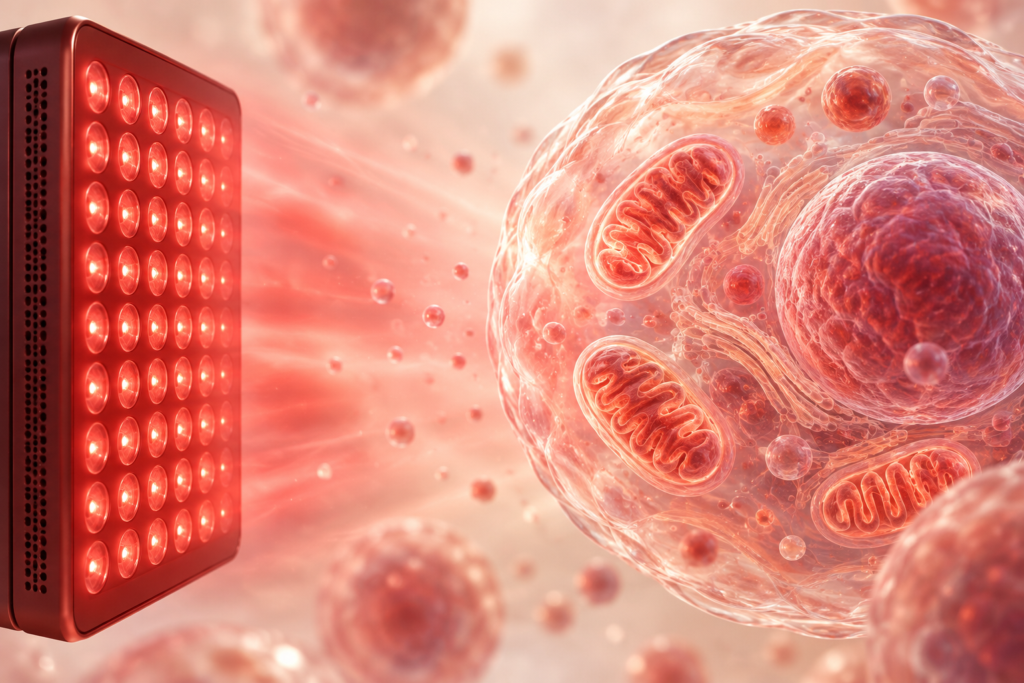
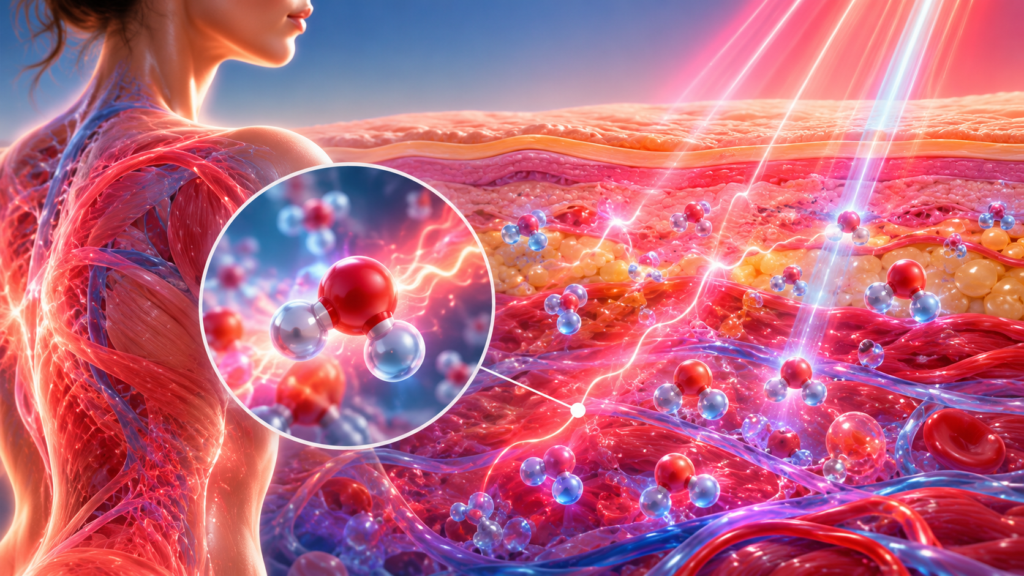
Red light therapy exposes the scalp to specific wavelengths of light. The light can penetrate into the skin, where it interacts with cells. One of the main theories behind photobiomodulation involves the mitochondria.
Mitochondria are the parts of our cells that help produce ATP. ATP is basically usable energy for the cell. Think of it less like “giving the follicle energy” and more like supporting the system the cell already uses to produce its own energy.
Red light may also affect other cellular signals related to blood flow, inflammation, and tissue activity. Researchers believe these combined effects may help create conditions that support active hair follicles.
There may also be an effect on the hair growth cycle.
Hair doesn’t grow continuously. Each follicle moves through different phases. Anagen is the active growth phase. Catagen is a short transition phase, and telogen is the resting phase that eventually ends with the hair shedding.
One theory is that photobiomodulation may help encourage follicles to enter or remain in the active anagen phase. That could explain why studies sometimes find increases in hair density or thickness after several months of regular treatment.
There are still things researchers don’t fully understand about the mechanism. What matters from a practical standpoint is that clinical research has found measurable improvements in hair growth in some people, particularly those with pattern hair loss.
Laser Caps vs LED Red Light Therapy: What Is the Difference?
A laser and an LED can both produce red light, but they produce it differently.
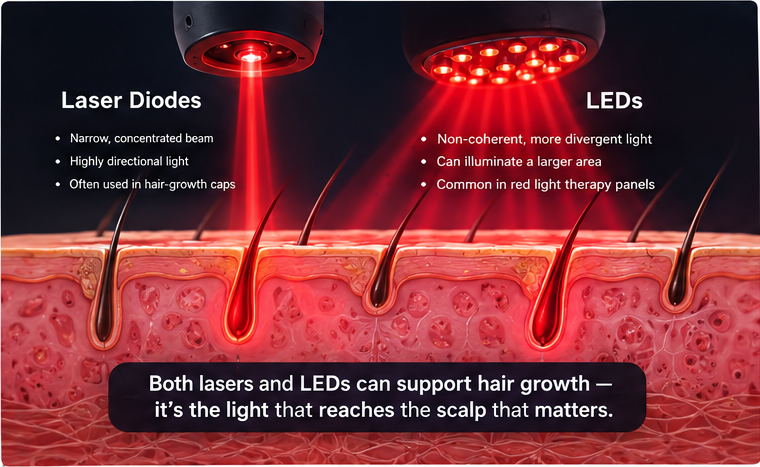
A laser produces a narrow, concentrated beam. The light is highly directional and typically centered around a very specific wavelength. That’s one reason lasers are commonly used in caps, helmets, bands, and combs made specifically for hair growth.
An LED produces light that spreads out more. This makes LEDs useful when you want to illuminate a larger area. LEDs are common in red light therapy panels, masks, and some hair-growth caps and helmets.
This technical difference is real. But it doesn’t mean a laser automatically causes more hair growth than an LED.
The cells in your scalp aren’t checking whether the photons came from an expensive laser diode or an LED. What matters is the light that actually reaches the tissue and the biological response it produces.
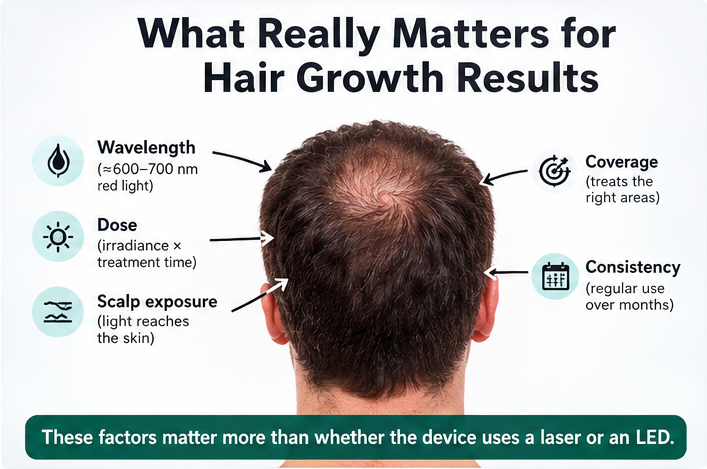
That’s an important point when comparing laser caps vs LED red light therapy. Wavelength, dose, coverage, treatment time, and consistency can matter more than the name of the light source.
Are Laser Caps Better Than LED Red Light Therapy for Hair Growth?
This is where marketing can make things confusing.
Laser hair-growth devices often sound more advanced because “laser” feels more medical than “LED.” Brands may also advertise large numbers of laser diodes as a major selling point.
But the research doesn’t give us a good reason to say that lasers are always better.
Both laser and LED devices have been studied as forms of low-level light therapy. A 2025 systematic review and meta-analysis looked at 38 studies involving 3,098 patients and found that low-level laser and LED therapy significantly increased hair density in people with androgenetic alopecia. The researchers also noted that there wasn’t enough statistical information to reach the same conclusion for the other types of alopecia included in the review.
There are also devices that use lasers and LEDs together.
One systematic analysis of photobiomodulation treatment variables found that the number of lasers or LEDs wasn’t significantly associated with greater improvements in hair density. Factors including the energy delivered per session and treatment duration showed stronger relationships with hair-density changes.
So if you’re choosing between laser caps vs LED red light therapy, don’t let a huge diode count make the decision for you. A cap with 300 diodes isn’t automatically better than one with 200. That number tells you something about how the device is built, but it doesn’t tell you the whole story about the dose reaching your scalp.
What Matters More Than Laser vs. LED?
Instead of starting with “laser or LED?”, it makes more sense to look at how the device actually delivers light.
Wavelength
Wavelength tells you what type of light a device produces. It’s measured in nanometers, or nm.
A lot of hair-growth research has focused on red light in roughly the 600 to 700 nm range. A review of FDA-cleared home-use light therapy devices found wavelengths ranging from about 620 to 678 nm among the devices it examined, with 650 nm being common.
Some red light therapy devices also use near-infrared light. Near-infrared wavelengths are longer than visible red wavelengths and penetrate tissue differently.
This doesn’t mean there is one magic wavelength that grows hair. A device using 655 nm isn’t automatically effective just because that number appeared in a study. The amount of light delivered and the treatment protocol still matter.
Dose
Dose is one of the more confusing parts of red light therapy because several numbers are involved.
A device can tell you its wavelength, but that doesn’t tell you how much light your scalp actually receives.
Irradiance describes the amount of light power reaching an area. Treatment time then affects the total energy delivered. Distance from the light also matters because moving farther away can change how much light reaches the skin.
An easy way to understand this is sunlight. Being outside for five minutes isn’t the same exposure as being outside for three hours, even though you’re dealing with the same sun.
Red light therapy works on a much more controlled scale, but the basic point is similar. The amount of exposure matters.
Research looking at different treatment parameters has found that energy delivered per session and treatment duration can influence outcomes. More isn’t automatically better, though. Follow the treatment schedule for the device rather than doubling your sessions because you want faster hair growth.
Whether the Light Reaches Your Scalp
This sounds obvious, but it’s one of the biggest practical issues with using light for hair.
Hair can block light.
If you have significant thinning, getting light onto the scalp may be fairly easy. If you have thick or long hair with mild thinning underneath, a lot of the light can hit your hair instead of the skin.
This is one area where dedicated hair caps and helmets have an advantage because the light sources sit very close to the head and are arranged specifically to cover the scalp. Even then, the hair itself can still affect how much light reaches the skin.
With an external LED device, positioning matters more. Parting your hair can help expose the areas you’re trying to treat. The American Academy of Dermatology has also discussed the importance of getting the light to the scalp and hair follicles.
This is one of the biggest practical differences between laser caps vs LED red light therapy. No matter how impressive a device’s specifications look, light that doesn’t reach your scalp can’t do much for the follicles underneath it.
Coverage
Hair thinning doesn’t always happen in one small spot.
Someone with pattern hair loss might have thinning around the temples, hairline, crown, or across a large part of the top of the scalp.
A full cap or helmet can make coverage easier because the light sources surround much of the head. Smaller bands and combs require you to treat different areas.
An external LED device may cover a large area at once, but you need to position yourself correctly.
The best setup is the one that reliably gets light onto the areas you actually want to treat.
Consistency
Hair grows slowly. Any treatment that affects the hair-growth cycle is going to take time.
The American Academy of Dermatology notes that red light therapy requires repeated treatments and that results take time. It also points out that not everyone sees results.
This makes convenience more important than it might seem.
A technically impressive device isn’t very useful if the treatment routine is so annoying that you stop using it after three weeks.
Laser Hair Caps: The Pros and Cons
Laser caps and helmets are made specifically for the scalp. That’s their biggest advantage.
You put the device on your head, start the session, and the lights are already positioned around your scalp. Many models are hands-free, so you can read, work, or watch TV during treatment.
They’re also one of the most established formats in hair-growth photobiomodulation research. A meta-analysis of home-use low-level light therapy devices found significant increases in hair density compared with sham devices and reported improvements with both comb-style and helmet-style systems.
The main downside is price. Good laser caps can cost hundreds or even thousands of dollars.
They’re also highly specialized. If you spend $1,000 on a laser cap, you basically own a $1,000 device for your scalp.
That’s perfectly reasonable if hair growth is your main goal. But someone interested in red light therapy for several areas of the body may prefer something more versatile.
LED Red Light Therapy: The Pros and Cons
LED red light devices work differently from a cap because the light usually comes from outside the scalp rather than sitting directly on it.
That creates more flexibility.
A larger red light therapy device can be used on the scalp and then used on other areas of the body. You aren’t buying something that only has one purpose.
LEDs also aren’t automatically a weaker form of photobiomodulation. LED-based devices have been included in hair-growth research, and the 2025 systematic review of laser and LED therapy found low-level light therapy to be a promising option for androgenetic alopecia.
The tradeoff is convenience.
You need to pay more attention to distance and positioning. You may also need to part your hair so the light can reach your scalp.
And not every product with red LEDs is a legitimate photobiomodulation device. A cheap red lamp isn’t automatically equivalent to a device with known wavelengths and output.
That’s why comparing laser caps vs LED red light therapy based only on the type of light source doesn’t tell you very much about which device is actually the better fit.
Hair-Growth Brands to Consider
There are several established companies making dedicated light-therapy products for hair.
HairMax
HairMax is one of the better-known names in low-level light therapy for hair growth. The company makes laser caps, laser bands, and comb-style devices.
HairMax devices have also appeared in randomized clinical research and reviews of home-use LLLT devices, which makes the brand useful as an example of the dedicated laser approach.
The downside is the same as most dedicated systems: you’re buying a device primarily for one purpose.
iRestore
iRestore takes the helmet approach. Its systems place the light sources around the scalp and are designed specifically for repeated hair-growth treatments.
Some iRestore systems combine lasers and LEDs rather than choosing one technology exclusively. The devices have also been included in research reviewing FDA-cleared home-use LLLT systems.
That makes treatment fairly simple. Put the helmet on and the positioning is largely taken care of.
For someone whose main goal is treating thinning hair and who values convenience, this type of setup can make sense.
Capillus
Capillus makes laser caps designed to be worn more like a normal hat.
The appeal is portability and convenience. You’re getting a dedicated scalp device without needing to sit in front of a panel or manually move a comb across your head.
Capillus devices have also been included in published reviews of FDA-cleared home-use hair-growth devices.
The tradeoff is price. Cap-style laser systems can sit toward the premium end of the hair-growth device market.
Theradome
Theradome is another dedicated laser hair-growth system, this time using a helmet design.
Theradome devices were among the home-use systems examined in a systematic review of low-level light therapy device designs.
Like the other dedicated systems, its biggest advantage is that the device handles positioning and scalp coverage for you.
Vital Red Light
Vital Red Light takes a different approach.
Rather than buying a device that only goes on your head, a red and near-infrared LED device can be used as part of a broader red light therapy routine.
That versatility can make more sense for someone who is interested in photobiomodulation beyond hair.
There is a tradeoff, though. A panel or external LED device doesn’t automatically solve the scalp-coverage problem the way a cap does. You need to position yourself correctly and make sure your hair isn’t preventing the light from reaching the scalp.
That’s an important difference when looking at laser caps vs LED red light therapy as two ways of approaching hair-focused photobiomodulation.
Laser Caps vs LED Red Light Therapy: Which Should You Buy?
It depends on what you actually want.
If hair growth is your main concern and you want the easiest possible routine, a dedicated cap or helmet has a clear advantage. It’s built for your head, the lights are already positioned, and treatment is usually hands-free.
If you’re interested in red light therapy for more than your hair, an LED red light device may offer better value because you’re not limited to treating your scalp.
Neither choice is automatically better. Researchers reviewing home-use devices have noted that there isn’t enough head-to-head research to establish the clinical superiority of one device over another.
So when deciding between laser caps vs LED red light therapy, think about what you’ll actually use. A laser cap that sits in a closet isn’t going to beat an LED device you use correctly and consistently. At the same time, a powerful LED device isn’t useful for hair if most of its light is hitting your hair instead of your scalp.
How Long Does It Take to See Hair Growth?
Don’t expect to use a light device for two weeks and suddenly see new hair.
Hair grows slowly, and the follicles themselves move through long growth and resting cycles. In the 2025 meta-analysis of low-level laser and LED therapy, androgenetic alopecia studies involved treatment periods ranging from 4 to 26 weeks.
Even then, “working” doesn’t necessarily mean a dramatic transformation.
Researchers may measure changes in the number of hairs within a specific area or changes in hair thickness. Those improvements can be meaningful without producing a completely different head of hair.
Taking a photo once a month under the same lighting, at the same angle, and with your hair styled the same way is more useful than checking the mirror every morning.
Who Is Red Light Therapy Most Likely to Help?
The strongest evidence is for androgenetic alopecia.
That’s the common type of gradual pattern hair loss seen in both men and women. In men, it often appears as a receding hairline or thinning crown. In women, it often appears as broader thinning around the part and top of the scalp.
The 2025 systematic review covering multiple types of alopecia found a significant improvement in hair density for androgenetic alopecia. For the other forms of alopecia it examined, there wasn’t enough statistical information to reach the same conclusion.
That doesn’t mean light therapy will work for everyone with pattern hair loss.
It also doesn’t mean every kind of hair loss should be treated with red light.
Sudden shedding, round bald patches, scalp pain, inflammation, heavy scaling, or rapidly progressing hair loss can have very different causes. The American Academy of Dermatology recommends identifying the cause of hair loss so the right treatment can be chosen.
For example, hair loss can be related to autoimmune conditions, nutritional deficiencies, hormonal changes, medications, illness, or significant physical stress. Shining red light on the scalp doesn’t fix an iron deficiency or diagnose alopecia areata.
If you don’t know why you’re losing hair, figuring that out should come before buying a device.
Is Red Light Therapy for Hair Growth Safe?
Low-level light therapy generally has a good safety profile when it’s used appropriately. The American Academy of Dermatology says short-term red light therapy appears to be safe, with temporary mild pain or irritated skin among the possible side effects.
Unlike surgical or hair-removal lasers, these devices aren’t supposed to burn or destroy tissue. The goal is to produce a biological response without causing significant heat or damage.
That still doesn’t mean you should ignore the instructions.
Follow the manufacturer’s treatment time, distance, frequency, and eye-protection guidance. Don’t assume using the device for twice as long will give you twice the hair growth.
The American Academy of Dermatology recommends speaking with a board-certified dermatologist before using an at-home device, particularly if you have a condition that causes light sensitivity or take medication that increases sensitivity to light.
The Bottom Line on Laser Caps vs LED Red Light Therapy
When it comes to laser caps vs LED red light therapy, both approaches can deliver the type of light used in photobiomodulation. The strongest hair-growth evidence is currently for people with male or female pattern hair loss.
Lasers aren’t automatically better because they’re lasers, and an enormous diode count doesn’t guarantee better results. Wavelength, dose, scalp coverage, treatment time, and consistency all matter.
Dedicated laser caps have one major advantage: they’re built specifically to put light close to your scalp. LED red light devices have a different advantage: they’re much more versatile and can be used for more than hair.
Whichever route you choose, make sure you’re comparing what the device actually delivers rather than buying based on the word “laser” or the biggest number on the product page.
And if your hair loss is sudden, severe, patchy, or unexplained, start with a dermatologist instead of a light device.
Ready for your red light therapy device? Check out our product reviews and brand reviews or leverage our product comparison tool to find the best device for you.