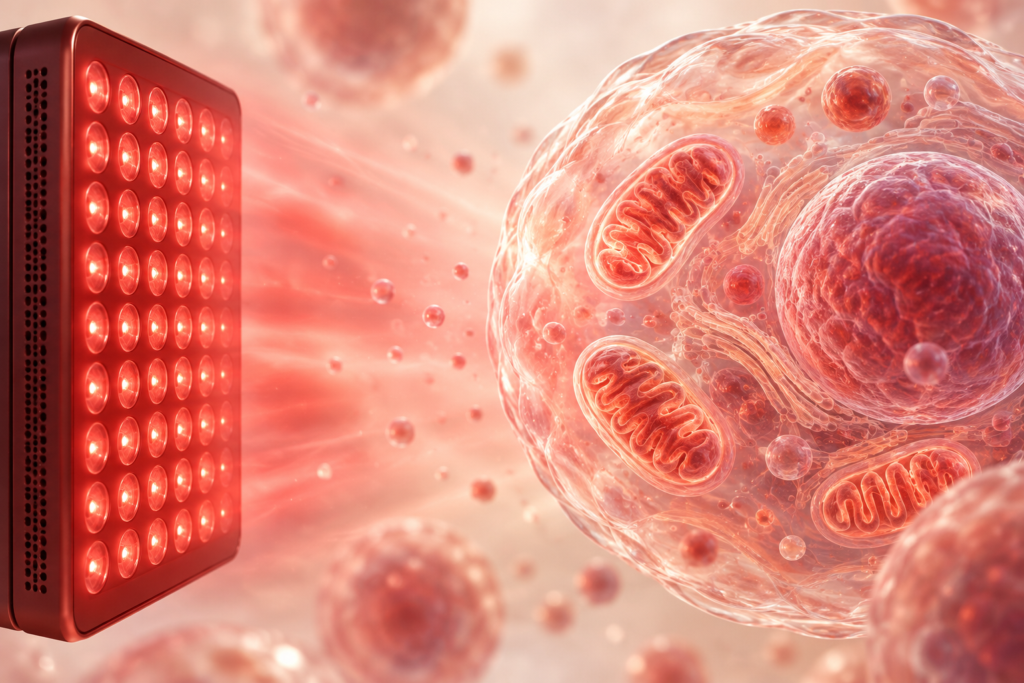
You received your red light therapy device, perhaps a panel, and are already exploring the benefits of red light and near-infrared light (NIR). But you probably realized that while you can see the red light, you don’t see the NIR light, so you ask: If red light therapy devices can use both visible red light and invisible near-infrared light, why does the device look red? First off, DO NOT ship your device back thinking it’s broken or bother customer support, complaining about not seeing your NIR lights.
Secondly, think of it like this: you don’t see electromagnetic waves cooking or heating your food in the microwave, nor do you see ultraviolet, infrared, or radio waves. But that doesn’t mean they’re not there. It’s just that they’re part of the electromagnetic spectrum, which includes several types of radiation that remain invisible to the naked human eye.
In this article, we’ll delve deeply into why electromagnetic waves, especially NIR, are invisible, how red and NIR light differ, what happens when they reach your skin, and why your red light therapy device can use both types of light at the same time.
What Are Electromagnetic Waves and How Do They Pertain to NIR?
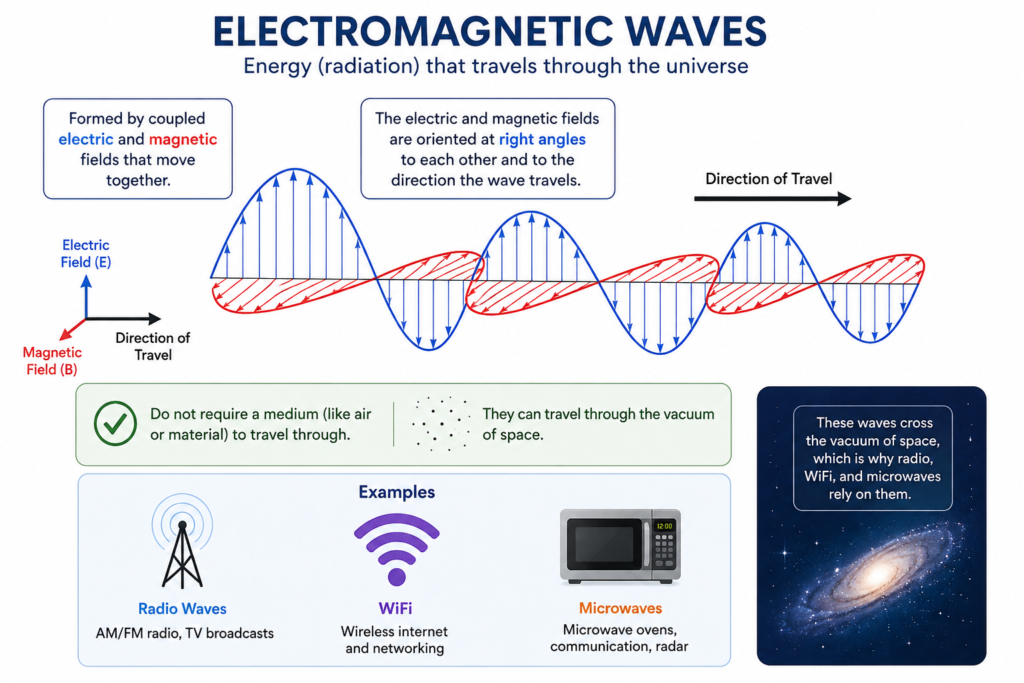
Electromagnetic waves are forms of energy, or radiation, that travel through the universe. They form when electric and magnetic fields are coupled and move together, with the two fields oriented at right angles to each other in the direction the wave travels. These waves don’t require anything, like air or material, to move through, unlike sound waves. They can cross the vacuum of space, which is why radio, WiFi, and microwaves rely on them.
The full range is called the electromagnetic spectrum, and the waves differ in wavelength and frequency. Some, like radio waves, can have wavelengths stretching for many meters, while others, like gamma rays, have incredibly short wavelengths.
However, we only see a sliver of that whole range. The part we can see is what we call visible light, which appears as the colors of the rainbow from red to violet. Everything else, including radio waves, microwaves, infrared, and X-rays, is outside the range of human vision. Visible spectrum
This is where NIR comes in.
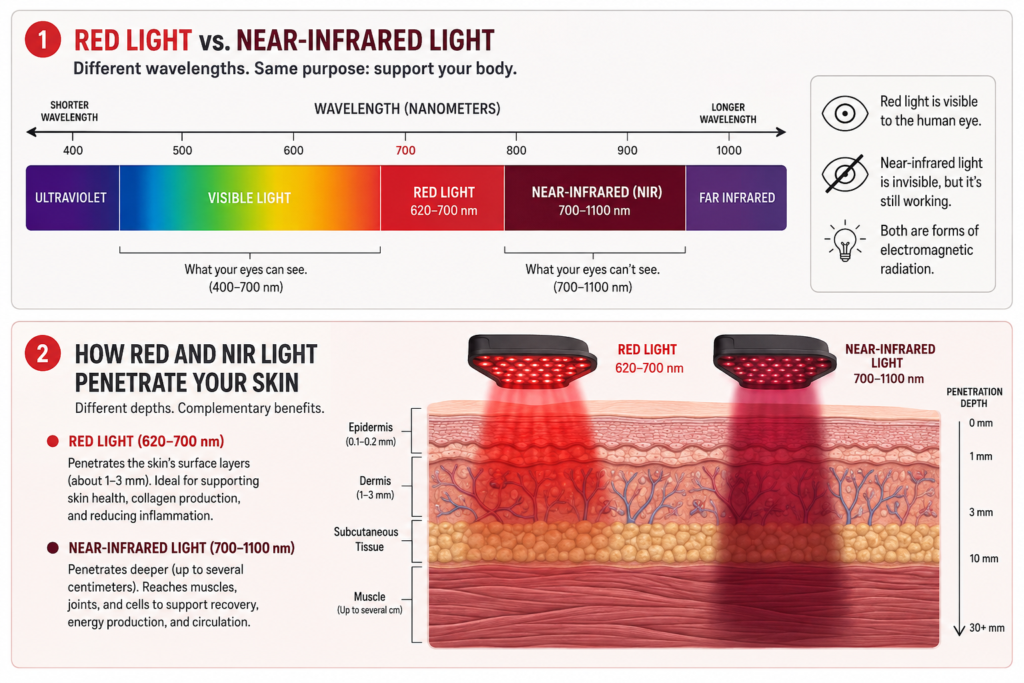
Near-infrared lies just beyond the red end of visible light. Its wavelengths are longer than those of visible red light, so your eyes simply don’t have the ability to detect it.
That doesn’t mean NIR isn’t reaching you. It means you can’t see it.
Red Light and Near-Infrared Light Are Not the Same Thing
Some people, whether new to red light therapy or highly familiar with the treatment, don’t know the difference between red light and NIR. After all, the way NIR is pronounced is “near-infra-red.” However, the two are different because their wavelengths fall into different parts of the electromagnetic spectrum.
Photobiomodulation (PBM), the scientific term for red and near-infrared light therapy, uses specific wavelengths of light in both the visible red and near-infrared portions of the spectrum. A clinical review describes red light used in PBM as approximately 620–700 nm, while NIR occupies wavelengths beginning around 700 nm and extending farther into the infrared range.
Another review examining red and NIR PBM identifies 630–680 nm as a commonly studied red-light range and 800–830 nm as a commonly studied NIR range.
So, Different studies have varied determinations on different colors’ wavelength ranges. For example, a clinical review describes red light used in PBM as approximately 620—700 nm, while NIR occupies wavelengths, according to some studies, beginning around 700 nm and extending farther into the infrared range. Howeverk
Again, the important distinction is wavelength.
Red and NIR aren’t fundamentally different because one is “light” and the other isn’t. Both are electromagnetic radiation. The difference is that their wavelengths fall in different parts of the electromagnetic spectrum.
And this distinction matters because changing the wavelength can change how that light interacts with biological tissue.
So Why Can You See the Red LEDs?
So, when using your RLT device, you probably notice that you only see the red lights and therefore believe they’re the only ones working.
Don’t ship your device back thinking the NIR lights aren’t working. 😂
The red light visible from an RLT device comes from the red-wavelength light emitted by the LEDs. Because these wavelengths fall within the portion of the electromagnetic spectrum detectable by the human eye, they appear red.
At the same time, a device can emit NIR wavelengths that are outside the visible spectrum. PBM research commonly uses invisible NIR wavelengths such as 810–850 nm. PBM wavelength review
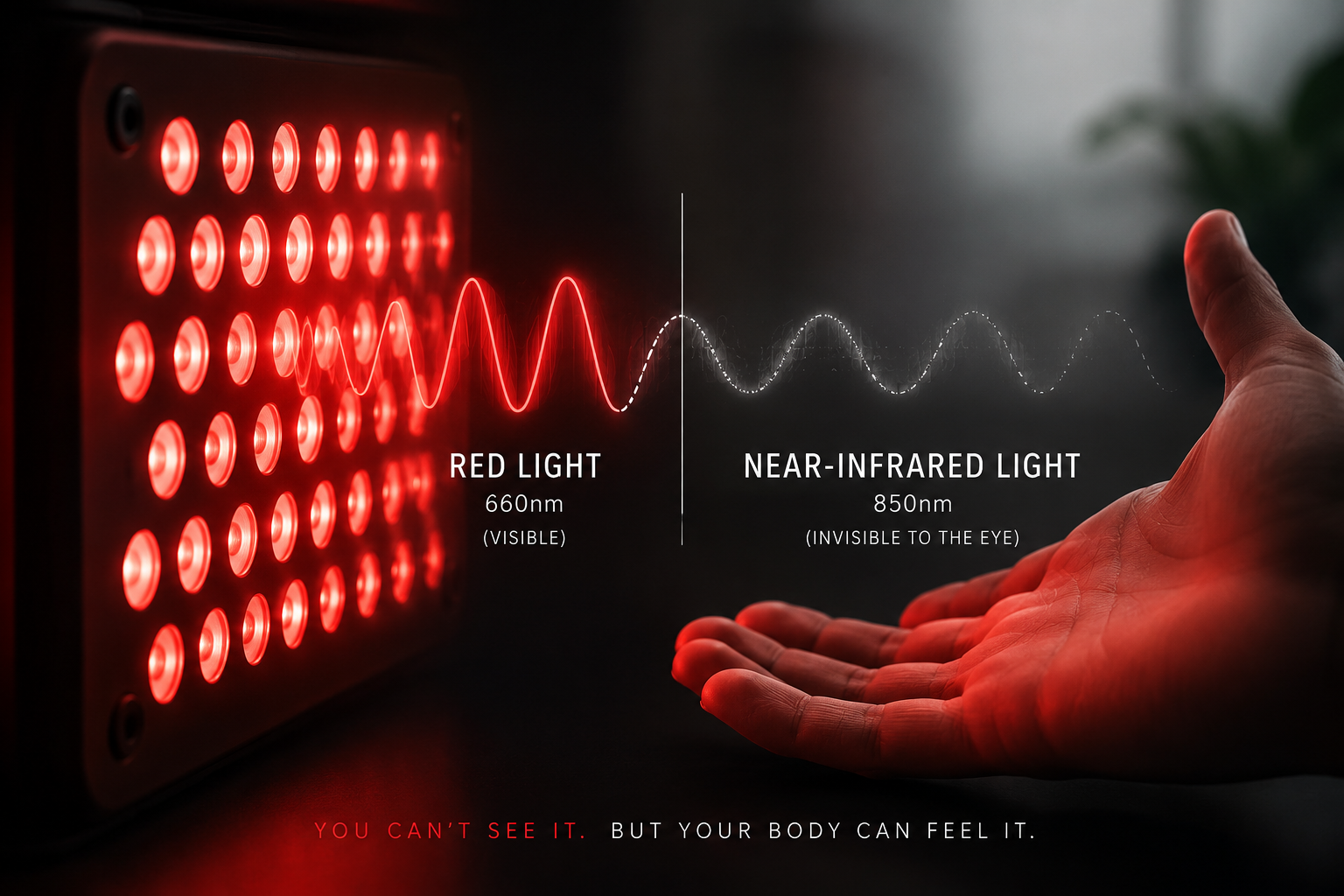
If a device emits both 660 nm red light and 850 nm NIR light, your eyes can see the 660 nm light but cannot see the 850 nm light.
So if you’re staring at your panel and thinking, “I only see red. Where is the infrared?”, the answer is simple: you can’t see it because your eyes aren’t sensitive to that wavelength.
This is similar to how you can listen to a radio station without seeing the radio waves carrying the signal. The fact that you can’t see a form of electromagnetic radiation doesn’t mean it isn’t there.
What Happens to the Light When It Reaches Your Skin?
Now that we know why you can see the red light but not the NIR, the next question is what happens once those wavelengths actually reach your skin.
Light doesn’t simply travel straight through your body unchanged.
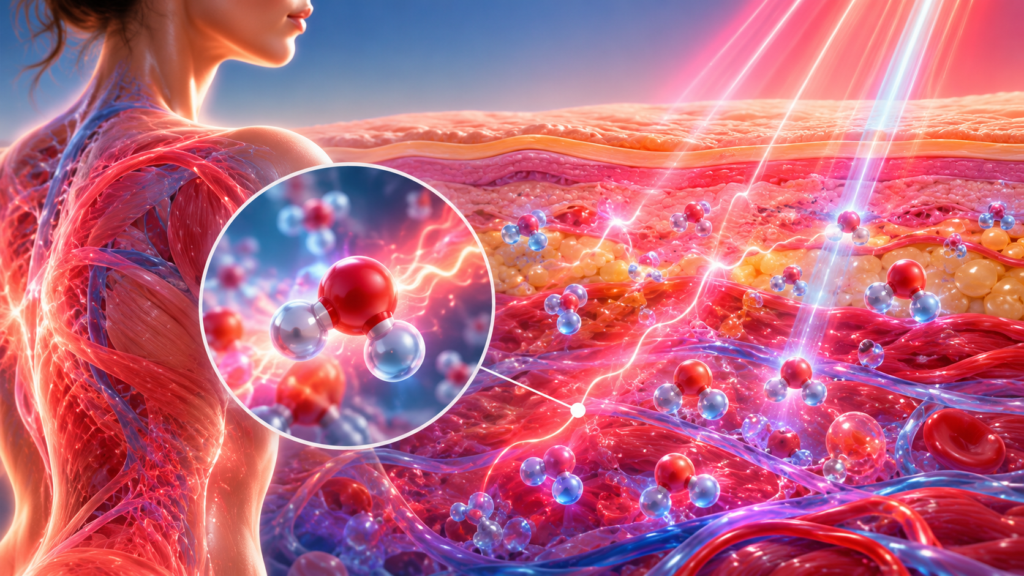
When light reaches biological tissue, some of it can be reflected, scattered and absorbed. How the light behaves depends on several factors, including its wavelength and the characteristics of the tissue it encounters.
This is one reason wavelength matters so much in red light therapy.
Research examining red and NIR PBM commonly focuses on red wavelengths around 630–680 nm and NIR wavelengths around 800–830 nm. These wavelengths have different optical properties and interact with tissue differently.
A review examining the penetration of visible and NIR light through tissue also found that penetration depends on factors including wavelength and tissue characteristics. In other words, there isn’t one universal depth that applies to every type of light or every person.
So when you hear that NIR can penetrate deeper than visible red light, don’t picture the light traveling through your body like a perfectly straight beam.
Penetration does not mean every photon reaches the same depth.
Some light is reflected at the surface. Some is scattered as it moves through tissue. Some is absorbed along the way.
The wavelength helps determine how that interaction occurs.
Why Do Red Light Therapy Devices Use Both Red and Near-Infrared Light?
If red and NIR light are different, you may be wondering why a red light therapy device would use both.
The answer comes back to wavelength.
PBM research doesn’t focus on one single wavelength. Studies have investigated a broad range of red and NIR wavelengths, including approximately 630–680 nm red light, 800–850 nm NIR and longer wavelengths such as 1064 nm.
A systematic review of 1064-nm PBM, for example, identified 22 independent clinical studies examining that wavelength for different applications. That doesn’t mean 1064 nm is automatically better than 660 or 850 nm. It simply shows how broad the range of wavelengths being studied in PBM actually is.
You may therefore see an RLT device advertised with wavelengths such as:
- 630 nm
- 660 nm
- 810 nm
- 830 nm
- 850 nm
- Or a combination of several wavelengths
These numbers aren’t arbitrary marketing labels. They identify the wavelength of the emitted light, measured in nanometers.
A device that combines red and NIR wavelengths is essentially using different portions of the electromagnetic spectrum to deliver light to the body.
Why Does Wavelength Matter?
Different wavelengths interact with tissue differently.
For example, researchers have observed differences in how human skin cells respond to different wavelengths. In one study, researchers exposed human dermal fibroblasts to several wavelengths, including 650 nm red light and 850 nm NIR light. The researchers observed wavelength-dependent differences in cellular responses, showing that changing the wavelength can change the biological response.
Another study comparing 660 nm red light with 980 nm NIR found different cellular responses between the wavelengths, including differences in ATP production and the duration of the response. The researchers concluded that the two wavelengths produced different response patterns.
This doesn’t mean that one wavelength is universally better than another.
It means that wavelength matters because different wavelengths can interact with biological tissue in different ways.
And that’s why you shouldn’t look at “red light therapy” as if it refers to one single wavelength.
It doesn’t.
What Does “Nanometer” Mean?
If you’ve ever looked at a red light therapy product page and wondered what all those numbers mean, here’s the simple answer.
A nanometer (nm) is one-billionth of a meter.
So when a device says it emits 660 nm light, the 660 nm refers to the wavelength of that light.
It does not tell you how powerful the device is.
That’s an important distinction because consumers can easily confuse:
wavelength ≠ intensity ≠ dose
Wavelength tells you what type of light is being emitted.
Irradiance tells you how much optical power is being delivered over a particular area, commonly expressed in mW/cm².
Fluence, also called radiant exposure, describes the amount of energy delivered over an area, commonly expressed in J/cm².
Treatment time tells you how long you’re exposed to the light.
All of these factors can contribute to the overall treatment parameters.
Does More Wavelengths Mean a Better Device?
Not necessarily.
It can be tempting to look at one device with two wavelengths and another with five and assume the one with more must be better.
But PBM doesn’t work that simply.
Research emphasizes that treatment parameters can include wavelength, fluence, treatment duration and output power, among other factors.
There is also substantial variation among PBM studies in the wavelengths, doses, treatment times and devices used. That makes it difficult to say that simply adding more wavelengths automatically makes one device more effective than another.
Think about it this way.
If you’re comparing two RLT devices, you wouldn’t only ask, “How many wavelengths does this one have?”
You’d also want to know:
- What wavelengths does it use?
- What is the irradiance?
- What treatment area does it cover?
- How far should you stand or sit from it?
- How long is each session?
- How often should it be used?
- What does the manufacturer recommend?
The number of wavelengths is only one piece of the puzzle.
What Should You Look for When Reading a Red Light Therapy Device’s Specifications?
If you’re trying to understand an RLT device, the first thing to remember is that wavelength is not the same thing as dose.
Wavelength tells you what type of light the device produces.
Irradiance tells you the optical power being delivered over an area, commonly measured in mW/cm².
Fluence or radiant exposure tells you the amount of energy delivered over an area, commonly measured in J/cm².
Treatment time tells you how long that exposure lasts.
These measurements work together.
PBM research emphasizes that treatment outcomes can depend on multiple treatment parameters rather than one number alone.
This is also why you shouldn’t necessarily assume that the device with the highest irradiance, the most LEDs or the greatest number of wavelengths is automatically the best choice.
The actual treatment protocol matters.
And yes, this is one of those situations where more isn’t automatically better.
The Bottom Line: Why Does Red Light Therapy Look Red If NIR Is Invisible?
So, let’s bring it all the way back to the original question.
Why does your red light therapy device look red if it also uses invisible near-infrared light?
Because your eyes can detect the visible red wavelengths, but they cannot detect the NIR wavelengths.
A device can emit both at the same time.
For example, if your device produces 660 nm red light and 850 nm NIR light, the 660 nm wavelength falls within the visible range, so you see it. The 850 nm wavelength falls outside the range of human vision, so you don’t.
That doesn’t mean the NIR isn’t being emitted.
It simply means your eyes aren’t equipped to see it.
So the next time you’re sitting in front of your RLT panel thinking, “Why can I only see the red?”, remember:
You see the red because it’s visible. You don’t see the NIR because it’s infrared. Both can be emitted simultaneously.
And that’s the interesting thing about light therapy. What you see coming from the device is only a small part of what’s actually happening.
Ready for your red light therapy device? Check out our product and brand reviews to drive your decision, or leverage our comparison tool.