The “skin barrier” has become a popular term in skincare conversations, and with that popularity comes a wave of products and devices promising to “repair,” “restore,” or “strengthen” it. Red light therapy is sometimes folded into these claims. This guide explores red light therapy skin barrier research, what current evidence says about barrier function, and why gentle skincare remains the foundation of healthy skin.
Let us be candid from the start: direct, high-quality evidence specifically showing that red light therapy repairs the skin barrier is limited. There is interesting research on light and skin more broadly, but barrier-specific claims should be read with caution. Understanding the difference will help you make sensible decisions and avoid overpaying for promises.
Understanding the Red Light Therapy Skin Barrier
The skin barrier usually refers to the outermost layer of the skin, the stratum corneum. A common analogy describes it as a brick wall: flattened skin cells are the “bricks,” and a mix of lipids (fats) acts as the “mortar” holding everything together. This layer has two main jobs: keeping moisture in and keeping irritants, allergens, and microbes out.
When the barrier is working well, skin tends to feel comfortable, hydrated, and calm. When it is compromised — by harsh products, over-exfoliation, weather, or certain conditions — skin can feel dry, tight, sensitive, or reactive. Supporting the barrier is largely about protecting that lipid “mortar” and not stripping it away.
How Red Light Therapy May Affect the Skin Barrier
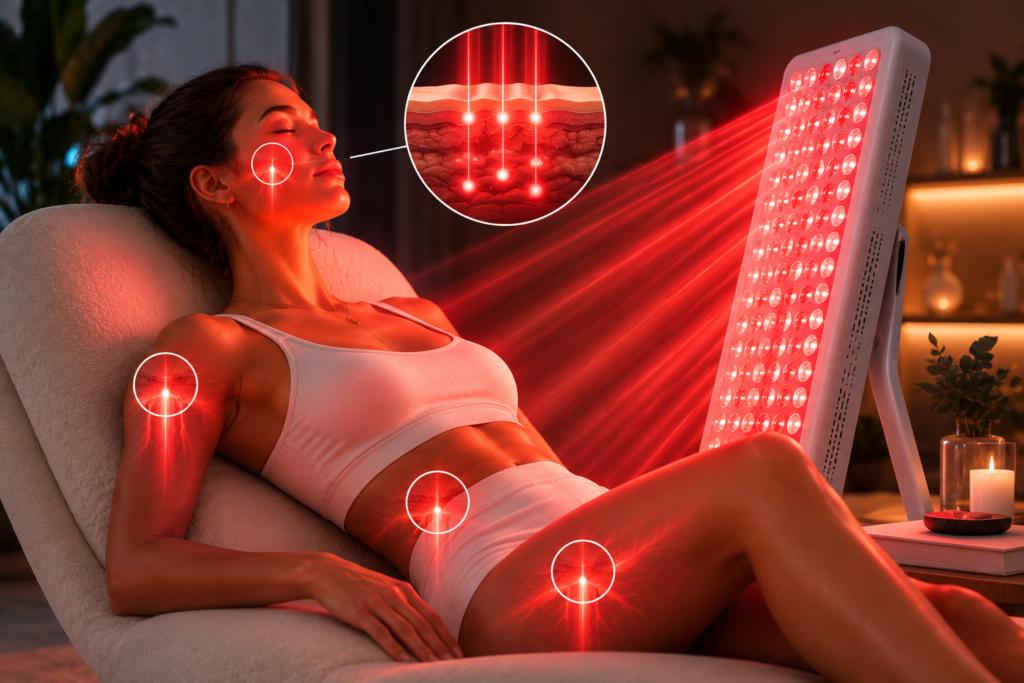
Red light therapy is studied as a form of photobiomodulation, in which red and near-infrared light is absorbed by cells and may influence cellular energy and signaling. Cleveland Clinic describes red light therapy as using low levels of red light that may influence skin cells without the damage associated with ultraviolet light. From there, it is tempting to assume it must therefore “fix” the barrier — but that leap is not well supported by direct evidence.
A review by Avci and colleagues on low-level light therapy in skin discusses light’s potential roles in stimulating, healing, and restoring skin, including effects relevant to wound healing and skin appearance. A broader review of phototherapy with light-emitting diodes in dermatology similarly surveys a range of skin applications. These sources show that light can interact meaningfully with skin cells. What they do not provide is robust, barrier-specific proof that a home device reliably repairs or strengthens the stratum corneum in everyday users.
What Red Light Therapy Skin Barrier Research Shows
This is the heart of the matter. There is a difference between “light interacts with skin cells and may support healing-related processes” and “red light therapy repairs your moisture barrier.” The first is reasonably supported in the research literature; the second is a marketing-friendly extrapolation that outpaces the direct evidence. Much of the relevant research uses varied devices, doses, and outcomes that are not specifically about barrier function, and reviewers consistently call for larger, more standardized studies.
So the honest summary is this: red light therapy may support skin appearance and skin-cell processes for some people, and some research is encouraging, but claims that it “repairs the skin barrier” go beyond what we can confidently say. Results vary, and more research is needed before strong statements are warranted.
What Supports the Red Light Therapy Skin Barrier
While the role of red light therapy in barrier health remains uncertain, the fundamentals are well established and far more important. A few habits do most of the work.
Be Gentle
The fastest way to damage the barrier is to overdo active ingredients, scrub too hard, or wash with very hot water and harsh cleansers. Gentle cleansing and easing off aggressive exfoliation often help a struggling barrier recover on its own.
Moisturize
Moisturizers support the barrier by adding and sealing in hydration. Ingredients like ceramides, glycerin, and other emollients mimic or reinforce the skin’s natural lipids. For most people, consistent moisturizing does more for barrier comfort than any device.
Protect From the Sun
Ultraviolet exposure damages skin over time. Daily sun protection is foundational for overall skin health and helps prevent the kind of cumulative damage that no light device can undo.
Using Red Light Therapy for Skin Barrier Health
Yes — as a possible, modest addition rather than a barrier “treatment.” If you already use and enjoy red light therapy for general skin appearance, there is no strong reason it would harm a healthy barrier when used at recommended doses, and it is generally considered low-risk for healthy adults. The key is to frame it correctly: it may support skin appearance for some people, but it should not replace gentle care and moisturizing, which remain the real foundation of barrier health.
It is also worth noting the dosing principle from photobiomodulation research: more is not better. Overusing any light device in hopes of “fixing” the barrier faster is misguided. If your barrier feels compromised, the priority is to simplify your routine and be gentle, not to add more interventions.
When Red Light Therapy Skin Barrier Concerns Need a Dermatologist
If your skin is persistently dry, irritated, flaky, stinging, or reactive despite gentle care, that may point to a condition worth evaluating — such as eczema or another dermatologic issue — rather than a simple barrier dip. Red light therapy is not a treatment for these conditions, and a dermatologist can identify what is actually going on and recommend appropriate care. Persistent or worsening symptoms always warrant professional attention.
Evaluating Red Light Therapy Skin Barrier Claims
When a product or device promises to “repair” or “rebuild” your skin barrier, ask what evidence supports that specific claim for that specific product. Often the answer is general research about light or ingredients, not a direct demonstration of barrier repair. Healthy skepticism protects both your skin and your budget, and steers you toward the gentle fundamentals that genuinely help.
Everyday Habits That Affect the Red Light Therapy Skin Barrier
It is easy to focus on what you put on your skin and forget how much daily life shapes the barrier from the outside and the inside. Environmental factors play a large role: cold, dry winter air, low indoor humidity, wind, and long hot showers can all draw moisture out of the skin and leave the barrier feeling tight and depleted. Frequent hand washing and harsh soaps strip protective lipids, which is why hands often show barrier stress first.
Over-exfoliating with scrubs or strong acids, or piling on too many active ingredients at once, is one of the most common self-inflicted causes of a compromised barrier. Internal and lifestyle factors matter too — adequate sleep, hydration, and not smoking all support overall skin health, as the broader literature on skin and aging consistently notes. Against this backdrop, it becomes clear why a single device is unlikely to be the deciding factor: the barrier responds most to the sum of these everyday habits. Red light therapy, if you use it, is one small input among many far more influential ones.
Building a Simple Red Light Therapy Skin Barrier Routine
When skin feels irritated, dry, or reactive, the instinct is often to add more — another serum, a richer cream, a new device. Counterintuitively, the more reliable path is usually to do less. Paring a routine back to a gentle cleanser, a basic moisturizer, and daily sun protection gives the barrier room to recover without competing irritants. Once skin feels calm and comfortable again, you can reintroduce other steps slowly, one at a time, watching how your skin responds.
This “less is more” approach is well aligned with how dermatologists generally advise caring for sensitive or compromised skin. If you wish to keep red light therapy in the mix during this process, use it at the recommended dose and treat it as optional rather than central, since the recovery is being driven by gentleness and simplicity, not by adding interventions. The takeaway is steadying: a healthy barrier is built mostly by restraint and consistency, and no device changes that basic truth.
The Bottom Line
Red light therapy skin barrier research suggests light may support skin-cell activity and overall skin appearance, but direct evidence that it repairs or strengthens the skin barrier remains limited. Red light therapy may support skin appearance for some people, and light clearly interacts with skin cells, but direct evidence that it repairs the skin barrier is limited. Treat barrier-repair claims cautiously, lean on the proven basics, simplify when skin is struggling, and see a professional for skin that stays irritated despite gentle care.
Ready to get your red light therapy device? See our brand and product reviews, and try out our product comparison tool to inform your decision.
Frequently Asked Questions
Does red light therapy repair the skin barrier?
Direct evidence for barrier repair is limited. Light does interact with skin cells, and some research is encouraging for skin appearance, but specific claims that red light therapy repairs or strengthens the skin barrier go beyond what current evidence confidently shows.
What is the skin barrier?
It is the outermost layer of skin, often pictured as a brick wall where skin cells are the bricks and lipids are the mortar. Its job is to keep moisture in and irritants out, which helps skin feel comfortable and hydrated.
What is the best way to support my skin barrier?
Gentle care matters most: avoid harsh scrubbing, very hot water, and over-exfoliation; use a moisturizer with ingredients like ceramides or glycerin; and protect skin from the sun. These fundamentals do more than any device.
Can red light therapy damage my skin barrier?
At recommended doses it is generally considered low-risk for healthy adults. Overusing any light device is not advisable, since research shows more is not better. If your barrier feels compromised, simplifying your routine is wiser than adding interventions.
When should I see a dermatologist about my skin barrier?
If your skin is persistently dry, irritated, stinging, or reactive despite gentle care, see a professional. That can signal a condition like eczema rather than a simple barrier dip, and red light therapy is not a treatment for such conditions.
This article is for general educational purposes only and is not medical advice. Red light therapy is not a substitute for professional care. Talk with a qualified healthcare professional about your individual situation.