Almost everyone who exercises has felt it: the deep, achy stiffness that settles in a day or two after a hard or unfamiliar workout. This is delayed onset muscle soreness, usually shortened to DOMS, and it is a normal part of training. It is also one of the most common reasons people reach for red light therapy. This article looks at what the evidence actually says about red light and muscle soreness, with an emphasis on honest expectations. Studies on red light therapy muscle soreness have drawn increasing attention from researchers.
The short version is that some low-certainty research suggests red light therapy may help reduce the feeling of soreness for some people, but results vary and the science is far from settled. Importantly, soreness from normal exercise is not an injury, and red light therapy is not a cure for either soreness or injury. Understanding that distinction keeps expectations grounded. When examining red light therapy muscle soreness, it helps to look carefully at the underlying research.
What DOMS Actually Is
Delayed onset muscle soreness typically appears 12 to 24 hours after exercise, peaks around a day or two later, and fades within a few days. It tends to follow workouts that are new, more intense than usual, or heavy on lengthening (eccentric) movements, like the lowering phase of a squat or the downhill portion of a run. The soreness is associated with microscopic stress to muscle fibers and a temporary inflammatory response as the body adapts. [source] The evidence around red light therapy muscle soreness remains an active area of investigation.
Crucially, DOMS is a normal, self-resolving part of getting fitter. It is not the same as a strain, tear, or other injury. That difference matters when thinking about what any recovery tool can and cannot do. For those exploring red light therapy muscle soreness, setting realistic expectations matters.
How Red Light Is Thought to Relate to Soreness
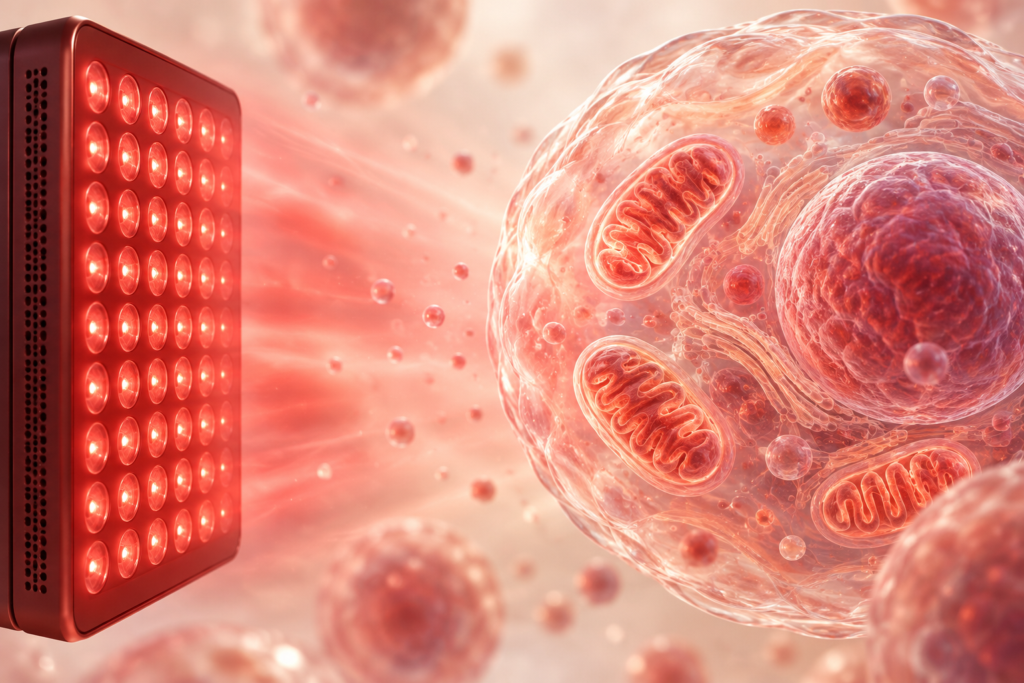
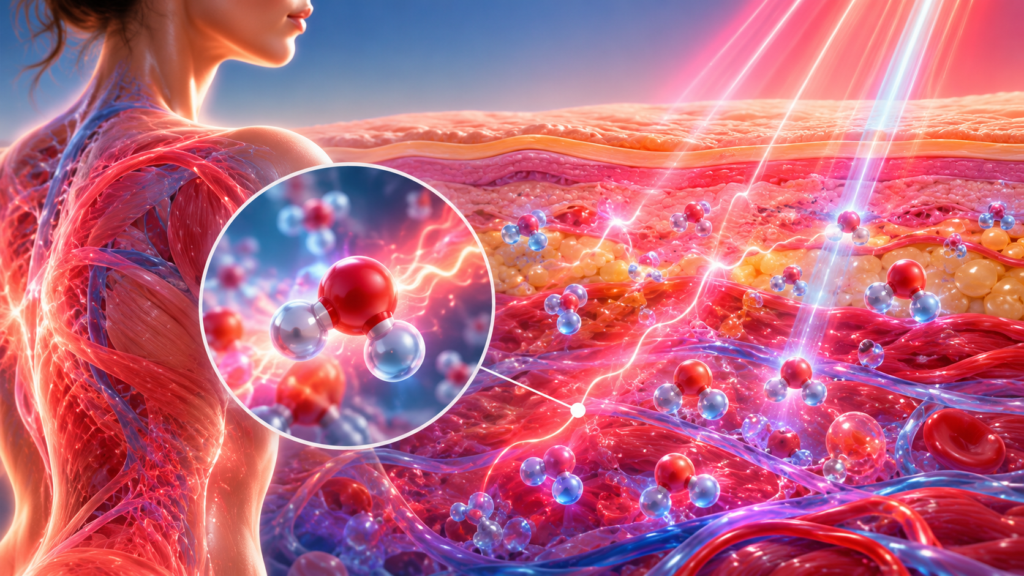
The rationale for using red light therapy on sore muscles comes from its proposed cellular effects. Red and near-infrared light is thought to be absorbed by mitochondria, potentially supporting cellular energy and influencing signaling related to recovery. Research on the anti-inflammatory effects of photobiomodulation describes mechanisms by which light may influence inflammatory signaling, which is one reason researchers have explored it for exercise-related soreness. [source] Understanding red light therapy muscle soreness requires separating marketing claims from published data.
It is worth stressing that describing a plausible mechanism is not the same as proving a reliable real-world benefit. The cellular story is interesting, but the question that matters to you is whether it noticeably reduces how sore you feel — and that is where the evidence becomes mixed. Anyone researching red light therapy muscle soreness will find the science is still developing.
What the Research Suggests
A systematic review and meta-analysis of photobiomodulation for muscular performance and fatigue in healthy people looked at outcomes including fatigue and recovery, and reported small measured effects in some trials, while noting considerable variability. A broader review of photobiomodulation for sport performance and recovery similarly discusses soreness and recovery outcomes, concluding that results are promising in places but inconsistent, with protocols differing across studies. [source] The current state of red light therapy muscle soreness research points to early, modest findings.
Taken together, the literature supports a cautious statement: red light therapy may reduce the perception of soreness or support recovery comfort for some individuals, but the certainty is low, the effects when present tend to be modest, and not everyone responds. This is a reasonable thing to try if you are curious, provided you keep expectations realistic. Interest in red light therapy muscle soreness has grown alongside broader photobiomodulation research.
Why Results Are So Variable
Several factors explain the mixed findings. Studies use different wavelengths, doses, devices, and timing. People differ in skin characteristics, fitness levels, and how they perceive soreness. And soreness itself is subjective and self-resolving, which makes it genuinely difficult to measure whether a tool sped up recovery or whether the body simply did what it always does. All of this is why honest sources avoid strong claims. Most published reviews on red light therapy muscle soreness call for larger, better-controlled trials.
Dose: The Detail That Is Easy to Miss
If you do experiment with red light for soreness, dose deserves attention. Research describes a biphasic dose response, meaning a moderate amount of light may help while too much can reduce or reverse the benefit. Doubling your session time in hopes of less soreness is not supported by the science and may be counterproductive. A clear-eyed look at red light therapy muscle soreness means separating anecdote from controlled evidence.
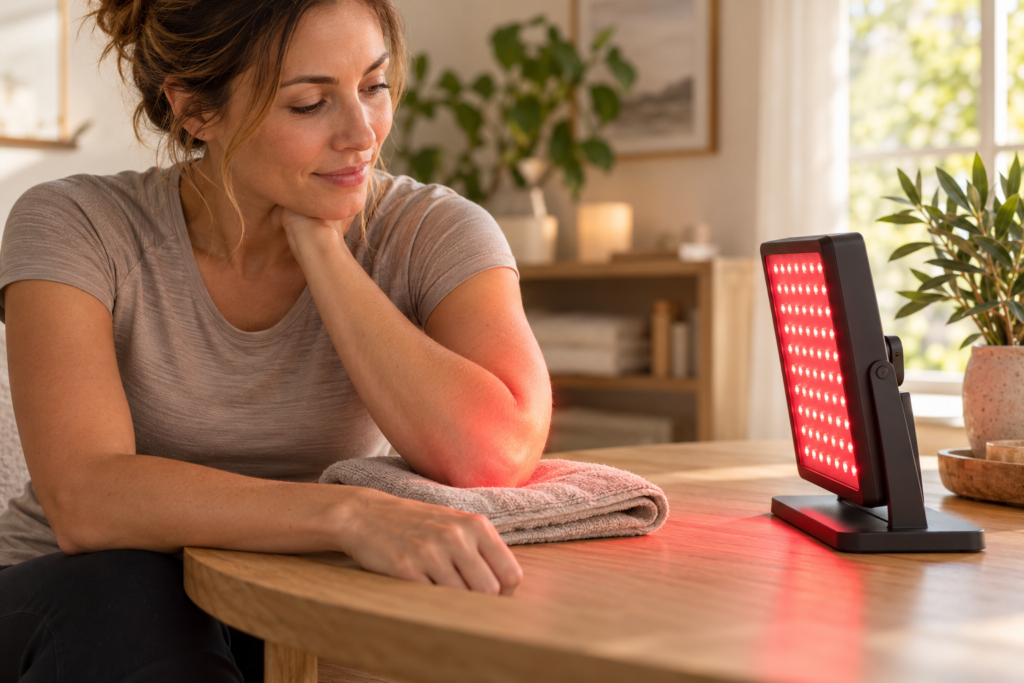
Practically, this means following the manufacturer’s guidance on distance and session length, exposing bare skin, and being patient rather than aggressive. More light is not better, and a sensible, consistent routine is more likely to give a fair trial than an intense one. Consulting a healthcare provider about red light therapy muscle soreness is always a sensible step.

Where Red Light Fits Among Recovery Tools
Red light therapy is one of many things people use for soreness, and it is worth keeping it in perspective. The most established contributors to feeling better after training are unglamorous: adequate sleep, sensible progression so you do not overload too quickly, gentle movement, and time. Red light therapy, if you choose to use it, is best seen as an optional addition to those fundamentals rather than a replacement for them. Devices marketed for red light therapy muscle soreness vary widely in power output and wavelength.
Viewing it this way also protects you from disappointment. If soreness improves, that is a welcome bonus; if it does not, you have lost little, and the basics are still doing the real work. Practitioners field frequent questions about red light therapy muscle soreness from clients.
When Soreness Is Not Just Soreness
Normal DOMS is achy, symmetrical, and improves within a few days. Some sensations are different and deserve attention. Sharp or stabbing pain, swelling, bruising, pain that is severe or worsening, pain isolated to one spot rather than spread across a muscle, or discomfort that does not improve after several days may signal an injury rather than ordinary soreness. In those cases, the right step is to stop and consult a healthcare professional. Studies on red light therapy muscle soreness have drawn increasing attention from researchers.
Red light therapy is not a treatment for injuries and does not reliably heal damaged tissue, so it should never be used to mask or push through pain that seems abnormal. It is not a replacement for medical care. For most healthy adults at consumer doses, red light therapy is generally considered low-risk, with mild, temporary side effects, but anyone who is pregnant, takes photosensitizing medication, or has a relevant condition should check with a professional first, and eye protection around bright light is sensible. When examining red light therapy muscle soreness, it helps to look carefully at the underlying research.
Common Questions People Have About Soreness and Light: Red light therapy muscle soreness Notes
A few practical confusions come up again and again, and clearing them up helps set expectations. The first is the belief that feeling more sore means a workout was more effective, and therefore that reducing soreness might reduce results. In reality, soreness is not a reliable measure of how productive a session was, and easing the feeling of soreness does not undo the training itself. The second is the assumption that warmth from a device is doing the work; the proposed effects of photobiomodulation are thought to come from light absorption at the cellular level, not from heating tissue, and the light is low-intensity rather than a heat source.
A third common question is whether red light therapy can prevent soreness entirely if used beforehand. The honest answer is that some research on pre-exercise use is suggestive for fatigue and soreness-related outcomes, but it is far from a guarantee, and many people will still feel the normal aches of a hard or unfamiliar workout. Treating the light as one small, optional variable — rather than a switch that turns soreness off — keeps the experience grounded and reduces the chance of disappointment.
The Bottom Line
Delayed onset muscle soreness is a normal, temporary part of training, not an injury. Low-certainty evidence suggests red light therapy may help some people feel less sore or recover more comfortably, but results vary, effects are modest, and it is not a cure for soreness or injury. Treat it as an optional complement to sleep, sensible training, and time, mind the dose, and see a healthcare professional for any pain that is sharp, severe, persistent, or worsening.
Frequently Asked Questions
Does red light therapy help with muscle soreness or DOMS?
Low-certainty evidence suggests it may help some people feel less sore or recover more comfortably, but results vary and effects tend to be modest. It is not a guaranteed remedy and the research is mixed.
Is DOMS the same as a muscle injury?
No. Delayed onset muscle soreness is a normal, self-resolving response to exercise that fades within a few days. Sharp, severe, one-sided, or worsening pain is different and should be evaluated by a healthcare professional.
How soon would I notice less soreness?
This varies and is not guaranteed. Because soreness resolves on its own within days, it is genuinely hard to know whether any tool sped recovery. Patience and a consistent routine give the fairest sense of whether it helps you.
Should I use more light to reduce soreness faster?
No. Research describes a biphasic dose response, so more light is not better and too much may reduce the benefit. Follow the manufacturer’s guidance on distance and session length.
Can red light therapy replace rest and sleep for recovery?
No. Sleep, sensible training progression, gentle movement, and time are the established contributors to recovery. Red light therapy is at most an optional addition and is not a substitute for those fundamentals or for medical care.
Ready to get your red light therapy device? See our brand reviews and product reviews, and try out our product comparison tool to inform your decision.