Few claims in the red light therapy world generate more excitement — and more exaggeration — than the idea that light can boost muscle performance. Marketing copy promises stronger lifts, longer endurance, and quicker gains. The actual research tells a more careful and more interesting story, one in which some performance-related measures show modest signals while others remain unconvincing. This article examines the evidence on red light therapy and muscle performance honestly, sorting what the studies suggest from what they do not, and explaining why the picture is so mixed. Studies on red light therapy muscle performance have drawn increasing attention from researchers.
The headline conclusion is unglamorous but accurate: red and near-infrared light may influence certain measures related to muscle fatigue and endurance for some people, the evidence for raw strength is weaker and inconsistent, and across the board the findings come with significant uncertainty. There are no guarantees here, and anyone claiming otherwise is reading the marketing, not the data. When examining red light therapy muscle performance, it helps to look carefully at the underlying research.
How Researchers Study Muscle Performance
To make sense of the evidence, it helps to know that muscle performance is not a single thing. Studies measure different outcomes: muscular endurance, time to exhaustion, the number of repetitions before fatigue, peak force or strength, and markers of fatigue and recovery. Red light therapy could plausibly affect some of these without affecting others, which is exactly what the research seems to show. [source] The evidence around red light therapy muscle performance remains an active area of investigation.
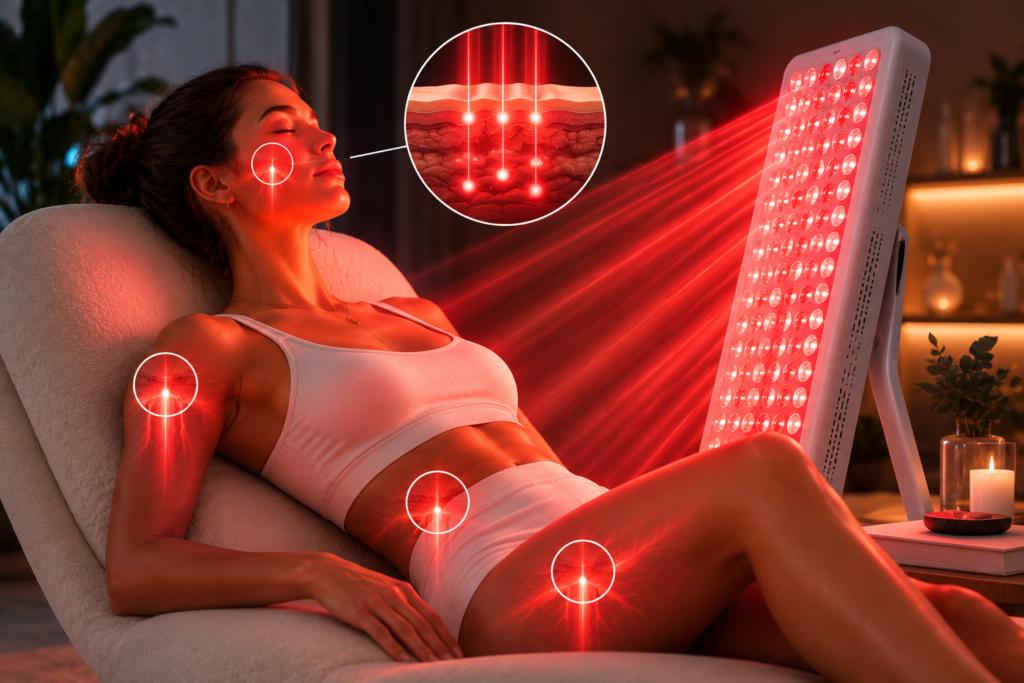
The proposed mechanism, as described in foundational work on photobiomodulation, involves light being absorbed by mitochondria and potentially supporting cellular energy and signaling. In principle, better cellular energy availability might most plausibly influence fatigue-related and endurance measures. But a plausible mechanism does not settle the question, and the human data are what matter. For those exploring red light therapy muscle performance, setting realistic expectations matters.
What the Reviews Actually Found
Endurance and Fatigue
A systematic review and meta-analysis of photobiomodulation for muscular performance and fatigue in healthy people reported that light, particularly when applied before exercise, may have a modest effect on measures related to muscular performance and fatigue. This is the more encouraging side of the evidence: there is a plausible signal that light might help muscles resist fatigue or perform a little longer in some contexts. [source] [source] Understanding red light therapy muscle performance requires separating marketing claims from published data.
Even here, caution is essential. The authors note variation across studies in devices, wavelengths, doses, and timing, and the effects are modest rather than dramatic. A signal in a meta-analysis is meaningful, but it is not the same as a reliable, large benefit you can count on personally. Anyone researching red light therapy muscle performance will find the science is still developing.
Strength
When it comes to maximal strength, the evidence is noticeably weaker. Findings are inconsistent across studies, with some reporting small effects and others little or none. A broad umbrella review of photobiomodulation across multiple health outcomes underscores this theme: while some outcomes show promise, the overall certainty of evidence is frequently low, and results are heterogeneous. For muscle strength specifically, the honest position is that red light therapy has not been shown to reliably increase it. The current state of red light therapy muscle performance research points to early, modest findings.
Why the Findings Are So Mixed
Several factors explain the inconsistency, and understanding them is more useful than picking a single study to believe. Interest in red light therapy muscle performance has grown alongside broader photobiomodulation research.
First, dosing. Research describes a biphasic dose response, where a moderate dose may help and too much can reduce the effect. Studies that happened to use a dose near the helpful range may show benefit, while others using too little or too much may not. Without standardized dosing, results scatter. Most published reviews on red light therapy muscle performance call for larger, better-controlled trials.
Second, heterogeneity. Studies differ in the population tested, the muscle group, the timing of light relative to exercise, the wavelengths used, and how performance was measured. Pooling such different studies produces averages that can obscure real differences and widen uncertainty. A clear-eyed look at red light therapy muscle performance means separating anecdote from controlled evidence.
Third, individual variation. People differ in muscle mass, training status, skin characteristics, and how light reaches deeper tissue. An average effect across a group does not guarantee a comparable effect for any one person, which is part of why personal experiences with red light therapy vary so widely. Consulting a healthcare provider about red light therapy muscle performance is always a sensible step.
How to Read a Performance Study Critically
Because so much marketing cites individual studies, it helps to know how to weigh one. A single small trial showing a benefit is a starting point, not a conclusion; effects in small studies can be inflated and may not replicate. Systematic reviews and meta-analyses, which pool many studies, give a more reliable picture, which is why this article leans on them. When reading any claim, it is worth asking what was actually measured: a study reporting more repetitions to fatigue is not the same as one reporting greater maximal strength, and conflating the two is a common way that modest findings get oversold. Devices marketed for red light therapy muscle performance vary widely in power output and wavelength.
It is also worth noting who was studied and under what conditions. Much of the research involves healthy, often younger or trained participants in controlled settings, which may not match an older recreational athlete using a consumer device at home. The gap between a controlled study and real-world use is one more reason to treat even favorable findings as suggestive rather than definitive. None of this means the research is worthless; it means a thoughtful reader holds it lightly, looking for consistent signals across good-quality reviews rather than seizing on any single dramatic result. Practitioners field frequent questions about red light therapy muscle performance from clients.

What This Means for Realistic Expectations
Taken together, the evidence supports a measured stance. Red light therapy may offer modest support for fatigue and endurance-related measures for some people, especially when used thoughtfully before exercise. It has not been shown to reliably boost maximal strength. And because the certainty of evidence is often low and results are mixed, no benefit can be promised to any individual. Studies on red light therapy muscle performance have drawn increasing attention from researchers.
That is not a dismissal. A modest, plausible, low-risk possibility is still worth something to people who enjoy experimenting with recovery and performance habits. It is simply not the dramatic ergogenic aid that some marketing suggests. The most accurate way to describe red light therapy and muscle performance is with the same words researchers use: may, modest, and uncertain. When examining red light therapy muscle performance, it helps to look carefully at the underlying research.
Using the Evidence Wisely: Red light therapy muscle performance Notes
If you choose to try red light therapy for performance-related goals, let the evidence shape your approach. Follow your device’s recommended distance and time rather than chasing larger doses, since more is not better. Give any routine several weeks and pay attention to fatigue and endurance rather than expecting strength miracles. And keep it in proportion: training quality, progressive overload, sleep, and nutrition remain the established drivers of performance, with red light therapy a small optional addition at most.
Safety and a Note on Limits
For most healthy adults, red light therapy at consumer doses is generally considered low-risk, with mild and temporary effects like brief warmth or redness. People who are pregnant, take photosensitizing medication, or have a relevant condition should consult a healthcare professional first, and eyes should be protected from bright light.
Finally, the limits deserve restating because performance marketing so often blurs them. Red light therapy does not cure injuries, does not reliably heal tissue, and does not guarantee performance gains. If muscle or joint pain is severe, persistent, or worsening, that is a reason to see a healthcare professional, not to lean harder on a recovery device. Approached as a modest, evidence-aware experiment rather than a guaranteed edge, red light therapy can have a sensible place in a performance-minded routine, anchored always to the fundamentals that actually move the needle. The most credible position any athlete can hold is the one the science itself takes: open to a modest, plausible possibility, but unwilling to mistake it for a certainty.
Frequently Asked Questions
Does red light therapy improve muscle performance?
It may modestly support fatigue and endurance-related measures for some people, especially when used before exercise, based on reviews of the research. Effects are modest and uncertain, and strength benefits are not reliably shown. No benefit is guaranteed.
Is red light therapy better for endurance or strength?
The evidence is somewhat more encouraging for fatigue and endurance-related measures than for maximal strength, where findings are inconsistent. Even the endurance signal is modest and varies across studies and individuals.
Why do studies on red light therapy and performance disagree?
Studies use different doses, wavelengths, timing, populations, and outcome measures, and dosing follows a biphasic curve where too much can reduce benefit. This heterogeneity, plus individual variation, produces mixed and uncertain results.
Can I expect red light therapy to make me stronger?
No. Red light therapy has not been shown to reliably increase maximal strength. Treat it as a possible, modest recovery and fatigue aid rather than a strength booster, and rely on progressive overload for actual strength gains.
Is the evidence strong enough to recommend it for performance?
Not strongly. Reviews often report low certainty and mixed results. Red light therapy is low-risk for most healthy adults, so a cautious trial is reasonable, but expectations should be modest and grounded in the uncertainty of the evidence.
Ready to get your red light therapy device? See our brand reviews and product reviews, and try out our product comparison tool to inform your decision.