
Crossing several time zones can leave you wide awake at 3 a.m. and exhausted at midday. That mismatch between your internal clock and local time is jet lag, and it is one of the most common travel complaints. Because light and sleep are so closely linked, some travelers wonder whether red light therapy could help. This article explains what is actually known, and the honest answer is that jet lag is managed mainly by timed bright light and schedule adjustments, not by red light therapy panels. Studies on red light therapy jet lag have drawn increasing attention from researchers.
It is worth stating clearly at the outset: there is little direct evidence for red light therapy as a jet lag remedy. The well-established tools for jet lag work through the eyes and the body clock, which is a different mechanism from what red light therapy devices target. When examining red light therapy jet lag, it helps to look carefully at the underlying research.
What Causes Jet Lag
Jet lag happens because your circadian rhythm, the internal clock that governs sleep and wakefulness, is still set to your departure time zone after you arrive somewhere new. The NIH explains that circadian rhythms are roughly 24-hour cycles influenced strongly by light, and that these rhythms can be thrown out of sync when light cues change abruptly, such as during travel across time zones. Until your internal clock realigns with local time, you may feel sleepy during the day, alert at night, and generally out of step. [source] The evidence around red light therapy jet lag remains an active area of investigation.
The key insight is that jet lag is fundamentally a timing problem. The solution, therefore, is to help your body clock shift to the new time zone, and light is the most powerful tool for doing that. For those exploring red light therapy jet lag, setting realistic expectations matters.
Why Light Is the Main Tool
Because the body clock is set primarily by light detected through the eyes, strategically timed light exposure is the cornerstone of managing jet lag. The Sleep Foundation describes using light, including daylight, to help shift the circadian rhythm toward the destination time zone. Getting bright light at the right times can advance or delay your clock, helping you adapt faster. [source] Understanding red light therapy jet lag requires separating marketing claims from published data.
This is bright light reaching the eyes, typically daylight or a bright light source, acting on the circadian system. It is a fundamentally different approach from red light therapy, which delivers red and near-infrared wavelengths to the skin or body rather than using bright light through the eyes to reset timing. Anyone researching red light therapy jet lag will find the science is still developing.
Timing Is Everything
With jet lag, when you get light matters as much as whether you get it. Depending on the direction of travel, light at the wrong time can actually worsen the misalignment. General guidance, such as that from the Sleep Foundation, emphasizes seeking or avoiding light at particular times relative to your destination’s schedule. This is why simple, well-timed daylight exposure, combined with adjusting meals and sleep toward local time, tends to be the practical backbone of jet lag management. [source] The current state of red light therapy jet lag research points to early, modest findings.
Where Red Light Therapy Does and Does Not Fit
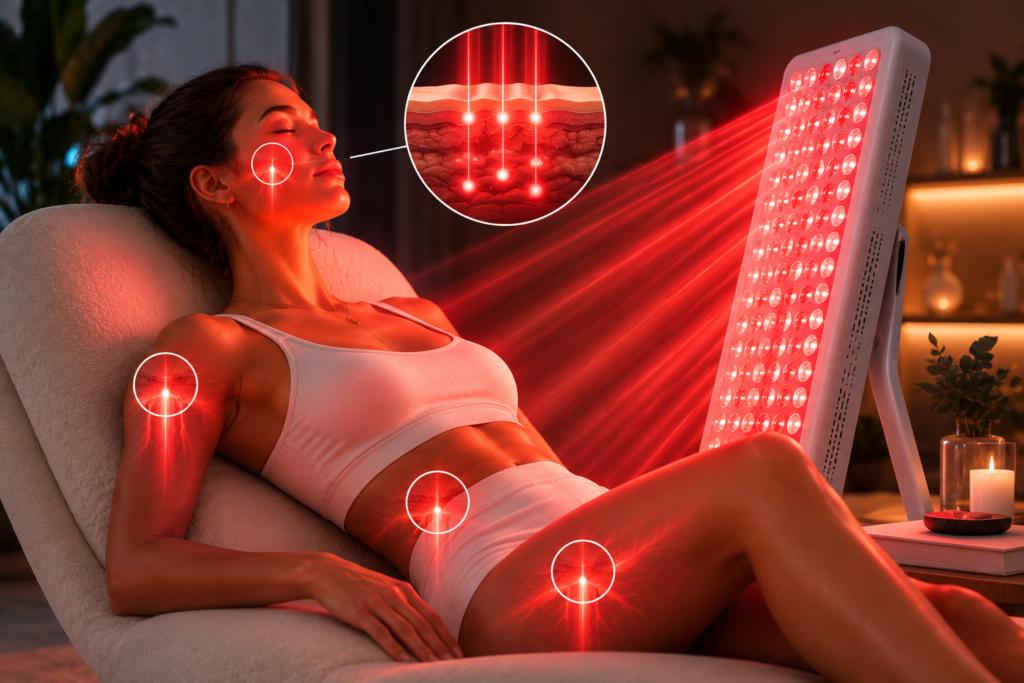
It is easy to assume that because red light therapy involves light, it must help with a light-driven problem like jet lag. But the two involve different things. Jet lag is addressed by influencing the central body clock through bright light reaching the eyes. Red light therapy devices are generally aimed at the skin and tissues and are studied mostly for goals like skin appearance and recovery, not circadian resetting. Interest in red light therapy jet lag has grown alongside broader photobiomodulation research.
There is little direct evidence that red light therapy panels shift the body clock or relieve jet lag. So while a relaxing red light session might be part of a calming wind-down routine for some travelers, it should not be mistaken for a jet lag treatment. The established, evidence-based approach is timed bright light and gradual schedule shifts. Most published reviews on red light therapy jet lag call for larger, better-controlled trials.
What About Melatonin and Evening Light?
Travelers often hear about melatonin and about avoiding bright light at night. These relate to the same circadian system. Bright, blue-rich light in the evening can suppress melatonin and delay the body clock, which is why managing evening light exposure is part of adjusting to a new time zone. Red wavelengths appear to suppress melatonin minimally compared with bright blue light, so dim red light in the evening is unlikely to be strongly disruptive. However, that is a statement about not interfering much, not about actively curing jet lag, and it remains an indirect, limited consideration rather than proven benefit. A clear-eyed look at red light therapy jet lag means separating anecdote from controlled evidence.
Practical, Evidence-Informed Jet Lag Tips
If you want approaches with genuine support behind them, focus on timing and light through the eyes. Where possible, begin shifting your sleep schedule toward your destination a few days before travel. After arrival, seek bright daylight at the times that help shift your clock in the needed direction, and limit bright light when it would push your clock the wrong way. Adjust meals, activity, and sleep toward local time as soon as you arrive. Keep evenings dim and the bedroom dark to support melatonin. The Sleep Foundation offers detailed, direction-specific guidance, and consulting it or a healthcare professional is wise for significant trips. Consulting a healthcare provider about red light therapy jet lag is always a sensible step.

Three Light Practices Travelers Confuse
Part of the confusion around red light therapy and jet lag comes from lumping different practices under the single phrase light therapy. It helps to keep three distinct ideas separate. The first is timed bright light, including daylight, reaching the eyes to shift the body clock, which is the evidence-based approach for jet lag. The second is evening light hygiene, meaning dimming lights and avoiding bright blue light at night to protect melatonin, which supports adjustment to a new time zone. The third is red and near-infrared photobiomodulation devices, the usual meaning of red light therapy, which are aimed at the skin and studied mainly for non-sleep goals. Bright light therapy boxes, used to deliver intense light to the eyes, belong to the first category and are entirely different from red light therapy panels. Recognizing these distinctions prevents the common mistake of assuming any device that emits light will reset your clock. Devices marketed for red light therapy jet lag vary widely in power output and wavelength.
Direction of Travel Changes the Plan
One reason general jet lag advice can feel contradictory is that the ideal timing of light depends on which way you traveled. Flying east generally requires advancing the body clock to an earlier schedule, while flying west generally requires delaying it. Because light at the wrong moment can shift the clock the opposite way you want, the same action that helps after one trip can hinder after another. This is precisely why jet lag is best handled with the direction-specific, timed bright-light guidance from sources like the Sleep Foundation, and why a fixed red light routine, which does not act on circadian timing in this way, is not a substitute for that planning. Practitioners field frequent questions about red light therapy jet lag from clients.
A Note of Caution: Red light therapy jet lag Notes
Jet lag is usually temporary and resolves as the body clock catches up. Red light therapy is not a proven treatment for jet lag and does not guarantee faster adjustment or better sleep, and the direct evidence is very limited. Bright light therapy boxes, which are distinct from red light therapy panels, are sometimes used to influence circadian timing, but they involve intense light to the eyes and should be used thoughtfully. If jet lag is severe, persistent, or you have an underlying health or sleep condition, or if you are considering bright light therapy, consult a healthcare professional. These strategies support adaptation; they do not replace medical advice. Studies on red light therapy jet lag have drawn increasing attention from researchers.
The Bottom Line
Jet lag is a timing problem caused by your body clock lagging behind local time, and it is managed mainly by timed bright light, especially daylight reaching the eyes, plus gradual schedule shifts. Red light therapy panels target a different mechanism and have little direct evidence for relieving jet lag, so they are best regarded as optional and unproven for this purpose. Lean on well-timed light and schedule adjustments, keep evenings dim, and see a professional for severe or persistent jet lag. When examining red light therapy jet lag, it helps to look carefully at the underlying research.
Frequently Asked Questions
Can red light therapy fix jet lag?
There is little direct evidence that red light therapy relieves jet lag. Jet lag is a timing problem managed mainly by timed bright light reaching the eyes and gradual schedule shifts, which is a different mechanism from what red light therapy devices target.
What actually helps with jet lag?
Strategically timed light exposure, especially daylight, is the cornerstone, along with adjusting sleep, meals, and activity toward the destination time zone. The direction of travel determines when to seek or avoid bright light.
Why does light help jet lag but red light therapy may not?
Jet lag is addressed by bright light reaching the eyes to reset the central body clock. Red light therapy delivers red and near-infrared wavelengths mainly to the skin and is not established as a way to shift circadian timing.
Is a bright light therapy box the same as red light therapy?
No. Bright light therapy boxes deliver intense light to the eyes to influence circadian rhythms and are distinct from red light therapy panels, which target the skin and body. They should not be confused.
When should I see a professional about jet lag?
If jet lag is severe or persistent, if you have an underlying health or sleep condition, or if you are considering bright light therapy, consult a healthcare professional. Jet lag strategies support adaptation but do not replace medical advice.
Ready to get your red light therapy device? See our brand reviews and product reviews, and try out our product comparison tool to inform your decision.