
Once people decide to try red light therapy for their skin, a very practical question quickly follows: is it better to do it in the morning or in the evening? It feels like there should be a “right” answer, the way some skincare ingredients are recommended for day or night. This guide explores the best time for red light therapy skin, what current research says about morning versus evening use, and why consistency matters more than the clock.
The short answer up front: for most people and most skin goals, there is no strong evidence that morning is better than evening or vice versa. What the research and sensible practice point to is that doing it regularly matters more than when you do it. Let us unpack why.
Best Time for Red Light Therapy Skin: Does Timing Matter?
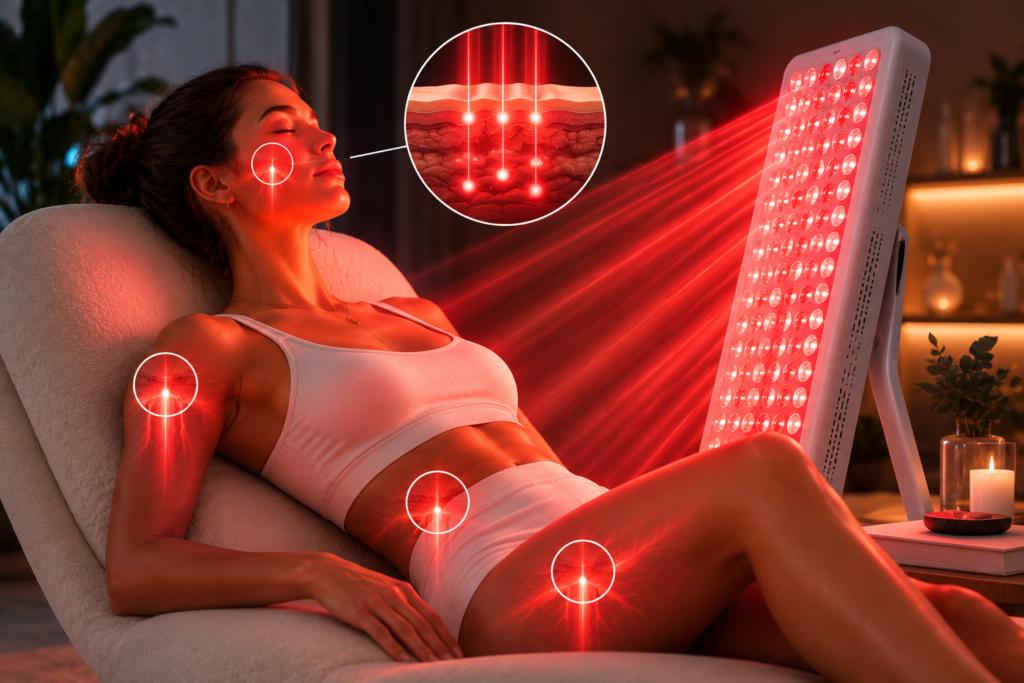
Red light therapy works through photobiomodulation: red and near-infrared light is absorbed by skin cells and may influence cellular energy and signaling. A review of phototherapy with light-emitting diodes in dermatology surveys these skin applications, and nothing in the core mechanism depends on whether the sun is up. The cellular targets respond to the light dose they receive, not to the hour on the clock.
This is different from, say, bright light boxes used for circadian or mood support, which are deliberately timed because they act through the eyes and the body clock. Skin-focused red light therapy is aimed at the skin and tissues, so the circadian timing logic that applies to those light boxes does not straightforwardly carry over. In practical terms, the skin does not “know” whether it is 7 a.m. or 9 p.m.; it responds to the wavelengths and dose delivered.
Why the Best Time for Red Light Therapy Skin Is the Time You’ll Stick With
If timing is largely flexible, what actually drives results? Regular use over weeks. Studies that report skin-appearance benefits from red light typically involve repeated sessions across an extended period, not a single perfectly timed treatment. The realistic takeaway is that the best time for red light therapy is simply the time you will reliably stick with.
For one person that might be a few quiet minutes in the morning before the day gets busy; for another it might be part of a wind-down routine at night. Both can be perfectly valid. A session you actually do beats a “better-timed” session you keep skipping. Building a sustainable habit is the single most useful thing you can do, far more than optimizing the hour.
Best Time for Red Light Therapy Skin: Dose vs. Timing
It is worth restating a principle from photobiomodulation research: the relationship between light dose and benefit is biphasic. Studies on dosing describe how a moderate dose may help while too much light can reduce or even reverse the effect. This means that doubling up — doing a long morning session and a long evening session in pursuit of faster results — is not a smart strategy. Following the device’s recommended distance and time, at whatever hour suits you, is far more important than the timing itself.
How to Choose the Best Time for Red Light Therapy Skin
Because timing is flexible, the practical question becomes how to weave sessions into your day so they actually happen. A few approaches tend to work well.
Anchor It to an Existing Habit
Attaching a new behavior to something you already do reliably makes it stick. Many people pair a session with their existing morning or evening skincare step, or with another fixed routine, so it becomes automatic rather than something to remember.
Use Clean, Bare Skin
Light reaches skin best when the area is clean and bare, since makeup, heavy creams, or sunscreen can sit on the surface. A sensible sequence is to cleanse, do your red light session on bare skin, and then apply moisturizer and other products afterward.
Keep Sessions Realistic
Choose a session length and frequency you can maintain, in line with your device’s guidance. A short routine you keep up for months will serve your skin better than an ambitious plan you abandon in a week.
Best Time for Red Light Therapy Skin and Photosensitivity
While the hour of day is mostly flexible, there is an important interaction worth understanding. Some skincare ingredients and medications can increase the skin’s sensitivity to light. DermNet describes how a range of drugs can cause drug-induced photosensitivity, making skin react more strongly to light exposure. Certain topical ingredients are also typically recommended for nighttime use partly because they can make skin more sensitive.
The cautious approach is to avoid layering a red light session directly on top of products known to increase light sensitivity, and to be especially careful if you take any medication that affects how your skin responds to light. This is exactly the kind of situation where checking with a healthcare professional or pharmacist is wise. If you use prescription topicals or photosensitizing medications, ask whether and how to time red light therapy around them, rather than guessing.
Putting the Best Time for Red Light Therapy Skin Into Practice
For many people, this is a small adjustment: do your red light session on clean skin, apply potentially photosensitizing or irritating products afterward (or at a separate time as directed), and follow any guidance specific to your medications. The point is not that red light therapy is dangerous, but that thoughtful sequencing around light-sensitizing products is sensible.
Choosing the Best Time for Red Light Therapy Skin
Because the evidence does not favor a particular hour, the most useful question is simply when a session will reliably fit into your day. A few common scenarios illustrate how flexible this can be. A morning person who has a few calm minutes after waking might do a session before applying sunscreen and starting the day, which works well as long as the skin is clean and bare.
Someone with a hectic morning may find that the evening, as part of winding down before bed, is far easier to sustain — and an evening session pairs naturally with cleansing off the day’s makeup and sunscreen. People who work from home sometimes slot a session into a midday break. None of these is superior in terms of effect on the skin; they differ only in how easily each fits a particular life. The right choice is the one you can repeat without friction, week after week, because that repetition is what gives the practice a fair chance to do whatever it may do.
What the Best Time for Red Light Therapy Skin Won’t Change
It is worth being clear about the limits of timing so it does not become a distraction. Choosing the “perfect” hour will not speed up results, intensify them, or guarantee that you respond at all. The variables that genuinely matter — appropriate dose, consistent use over weeks, the device’s wavelengths and output, and your individual skin — sit entirely apart from the time of day.
Likewise, no timing strategy turns red light therapy into something it is not: it will not erase wrinkles, reverse aging, or replace sun protection and gentle skincare, regardless of when you use it. Keeping timing in proportion frees you from a false sense that you must optimize the clock, and lets you put your energy where it counts — into building a sustainable habit and following sensible dosing. In that sense, the freedom around timing is good news: one fewer thing to agonize over, and one more reason to simply pick a slot and stick with it.
Setting Realistic Expectations
Whatever time you choose, keep expectations grounded. Red light therapy may support the appearance of skin for some people, but it does not deliver overnight transformation and does not erase wrinkles or reverse aging. Changes, when they occur, tend to be gradual and subtle and to emerge over weeks of consistent use. Results vary from person to person, and red light therapy is not a replacement for medical care or for the fundamentals of sun protection and gentle skincare.
The Bottom Line
For skin-focused red light therapy, morning versus evening is mostly a matter of personal preference and convenience — there is no strong evidence that one beats the other. Consistency over weeks and an appropriate dose matter far more than the hour. Pick the time you will actually keep, do sessions on clean skin, and take care with photosensitizing ingredients and medications. Done that way, timing becomes the easy part, and habit becomes the thing that counts.
Ready to get your red light therapy device? See our brand and product reviews, and try out our product comparison tool to inform your decision.
Frequently Asked Questions
Is it better to do red light therapy in the morning or at night?
For most people and skin goals, there is no strong evidence that one is better. The skin responds to the light dose it receives, not the time of day. The best time is whichever you will do consistently.
Does timing affect how well red light therapy works on skin?
Not in a well-established way for skin-focused use. Unlike bright light boxes timed for the body clock, skin red light therapy is aimed at the skin and tissues, so the hour matters less than regular use and an appropriate dose.
Can I do red light therapy twice a day for faster results?
That is not advisable. Research describes a biphasic dose response, where too much light can reduce or reverse the benefit. Following the device’s recommended distance and time at one suitable hour is wiser than doubling up.
Should I apply skincare before or after a session?
Generally do your session on clean, bare skin, then apply moisturizer and other products afterward, since makeup and heavy creams can sit on the surface. Be cautious about layering sessions over products that increase light sensitivity.
Do I need to worry about timing with my medications or skincare?
Yes, this is the one timing factor worth taking seriously. Some medications and ingredients increase the skin’s sensitivity to light. If you use photosensitizing products or medications, ask a healthcare professional or pharmacist how to time red light therapy around them.
This article is for general educational purposes only and is not medical advice. Red light therapy is not a substitute for professional care. Talk with a qualified healthcare professional about your individual situation.