OVERALL
3
DEVICES
Red light therapy panels and portable devices.

2016
Panels ~ Portable devices ~ Accessories
From $950
About Block Blue Light
BlockBlueLight may be better known for blue-light-blocking glasses and sleep-friendly lighting, but red light therapy has grown into a pretty serious part of the brand. Its current lineup includes small targeted devices, portable panels, larger multi-wavelength PowerPanels, a face mask, wearable options, a mat, a blanket, and full-body panel systems. That gives you considerably more room to choose based on coverage and how you actually want to use red light therapy. The larger PowerPanels are where the lineup gets especially interesting, with more wavelengths and control options than the simpler portable devices, although prices climb quickly as you move toward full-body setups.
Editor's Take
BlockBlueLight is worth a closer look if you want a feature-heavy red light panel with several wavelengths and plenty of control over your sessions. The larger PowerPanels are the strongest part of the lineup, but the broad product selection, varying warranties, and restrictive rules around some sale-item returns mean you should compare the exact device and policy before buying.

We get it. If you hear the name BlockBlueLight, a red light therapy panel probably isn’t the first product that comes to mind.
But the company’s red light therapy side has become large enough that it makes more sense to evaluate it almost like its own product category.
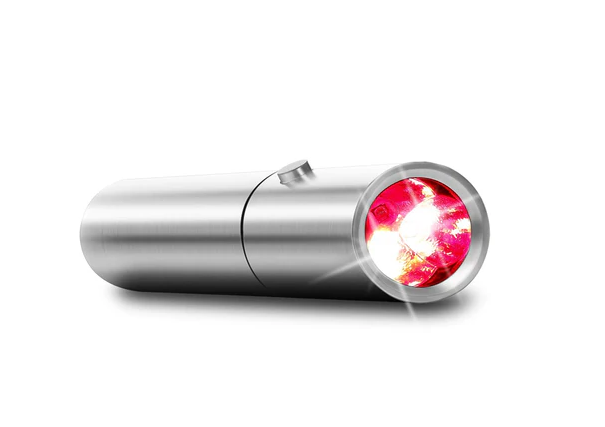
BlockBlueLight currently sells everything from a small rechargeable Target Torch and Portable PowerPanel to tabletop devices, several larger PowerPanels, a face mask, wearable options, a mat, a blanket, and very large full-body systems.
That means someone wanting to shine light on one specific area isn’t stuck shopping from the same setup as someone building a full-body red light station at home.
And that’s probably the best place to begin with this brand: decide how much of your body you actually want to cover before you start comparing the numbers.
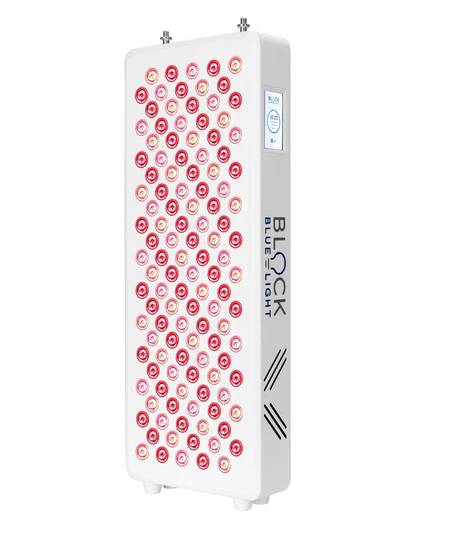
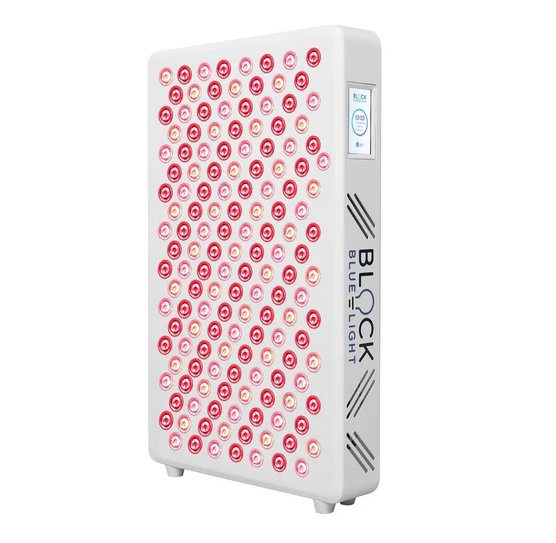
If we were shopping BlockBlueLight specifically for red light therapy, the PowerPanels would get most of our attention.
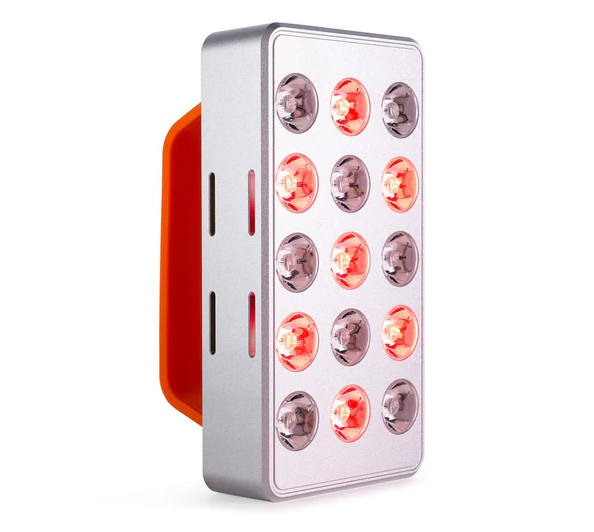
The lineup starts small and gradually increases in both coverage and features. The Portable currently costs $299.95, the Mini $499.95, the TableTop $599.95, the MID $699.95, the PRO $899.95, the MAX $1,099.95, and the MEGA $1,499.95. There are even larger options after that, including the newer MEGA PLUS and full-body ELITE and ULTIMATE XXL systems.
That price ladder is useful because you don’t necessarily have to jump straight into a huge panel.
The downside is that there are enough PowerPanels that the names can start blending together.
We wouldn’t choose simply because one says PRO, MAX, or MEGA. Look at how much area you need to cover, whether you need the more advanced controls, how much space you have, and whether you actually want a system large enough for full-body sessions.
This is where BlockBlueLight separates its newer panels from its simpler models.
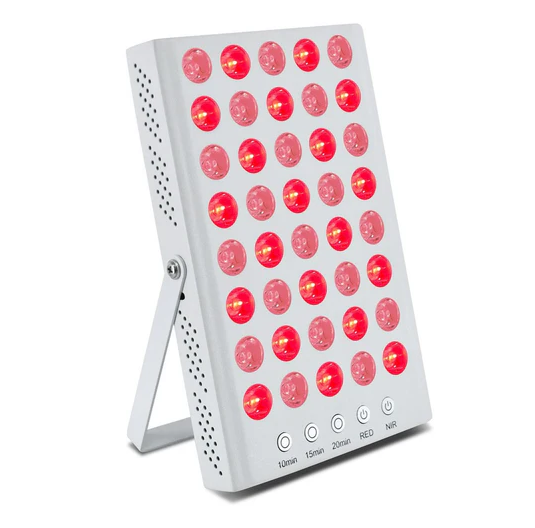
The Portable uses 660 nm red light and 850 nm near-infrared light. That’s a straightforward combination that makes sense for someone who wants a small device without a huge menu of settings.
The newer TableTop and larger Generation 6.0 PowerPanels expand that considerably.
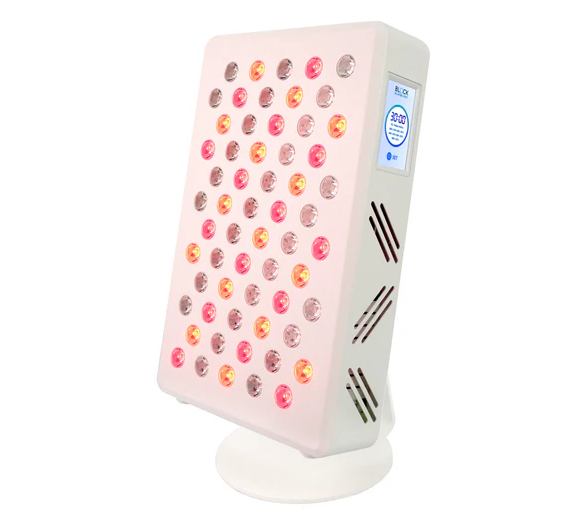
The TableTop uses 590, 630, 650, 810, 830, 850, and 1060 nm. Several of the larger panels use that same general combination of amber, red, and near-infrared wavelengths.
Why does that matter?
Mostly because you’re getting more flexibility over which parts of the light spectrum you use instead of being locked into one red wavelength and one near-infrared wavelength.
But we’d keep expectations reasonable. Seven wavelengths sounds impressive on a product page, but more wavelengths don’t automatically mean better results for every person or every goal.
If all you want is a simple red and near-infrared setup, you may not need the more complicated system.
The TableTop is a good example of why someone might pay more.
Rather than simply turning the panel on and off, BlockBlueLight gives you independent wavelength control, adjustable intensity, pulsing, a timer, and the ability to save custom presets.
That’s useful if you actually like changing your sessions instead of using the same settings every time.
The larger MID, PRO, MAX, MEGA, and related systems also add features such as dimming and pulsing while increasing the treatment area.
For some people, that’s going to be a selling point.
For others, it’ll be extra technology they rarely touch.
We wouldn’t pay more for customization simply because it exists. We’d pay more if you know you’ll use it.
BlockBlueLight publishes two irradiance measurements for many of its panels, and we actually appreciate the distinction.
You’ll often see a higher number measured with a solar meter and a lower number measured with a light spectrometer. On the TableTop, for example, BlockBlueLight currently lists 140 mW/cm² at six inches using a solar meter and 58 mW/cm² using a light spectrometer.
Those are very different numbers for the same device.
The company says the spectrometer measurement should be used for dosing, while the solar-meter figure is provided largely for comparison with competitors.
That’s important context because irradiance numbers can look wildly impressive when you’re comparing panels online, yet the measurement method can change what number you see.
We’d rather compare like with like than assume the biggest advertised number automatically means the strongest or best panel.
This is why BlockBlueLight’s smaller devices still have a place in the lineup.
The Target Torch currently costs $199.95 and uses 630 nm, 660 nm, and 850 nm wavelengths. It’s rechargeable and designed for focused use rather than covering large areas.
The Portable moves up to a wider treatment area while staying rechargeable. Then the Mini becomes a small mains-powered panel.
That progression makes sense.
If you’re constantly trying to use light on your face, knee, shoulder, or another small area, buying a huge panel may be overkill.
If you’re trying to cover your back, legs, or multiple large muscle groups after training, repeatedly moving a tiny device around could get annoying pretty quickly.
Choose based on the routine you’re actually willing to stick with.
BlockBlueLight also sells a dedicated Red Light Therapy Face Mask for $349.95.
The mask uses four wavelengths: 590 nm amber, 630 nm red, and 810 and 830 nm near-infrared light. It has 488 LED chips, a flexible silicone design, adjustable intensity, three wavelength modes, and a 10-minute timer.
That’s a completely different experience from sitting in front of a PowerPanel.
If your interest in red light therapy is almost entirely centered on your face, there’s a good argument for looking at a mask first. It’s shaped for facial coverage, wearable, and easier to use while sitting or moving around.
On the other hand, a panel gives you far more freedom to use the same device on your face, neck, torso, legs, or other areas.
This isn’t really a question of which format is better. It’s which one matches what you’re paying for.
BlockBlueLight has also moved beyond traditional panels with its Red Light Therapy Mat and Blanket.
The mat is currently $999.95 and uses 660, 810, and 830 nm wavelengths across a much larger surface. Instead of standing or sitting in front of a panel, you can lie directly on it.
The $1,699.95 blanket takes that concept further with a sleeping-bag-style design that surrounds more of the body with light. It uses the same 660, 810, and 830 nm combination and lets you adjust brightness and treatment modes through separate controllers.
The convenience is obvious.
You don’t need to stand a certain distance away, rotate midway through a session, or build a large panel setup around yourself.
But you’re giving up some versatility.
A traditional panel can be positioned around many different areas and used by multiple people in different ways. A mat or blanket makes the most sense if you genuinely prefer lying down for your sessions.
This is where BlockBlueLight moves well outside impulse-buy territory.
The ULTIMATE XXL currently costs $4,499.95 without an upgraded stand. It measures about 180 by 60 centimeters and contains 1,200 dual-chip LEDs, making it a genuine full-body system rather than a panel you’ll repeatedly reposition.
That’s a serious amount of coverage.
It’s also a serious amount of money.
Once you’re spending several thousand dollars on red light therapy, we’d compare BlockBlueLight against other premium panel manufacturers rather than evaluating the device in isolation.
At that point we’d look closely at treatment area, measured output, wavelengths, panel controls, modularity, mounting options, warranty protection, customer service, and what competing brands offer for roughly the same money.
BlockBlueLight gives you plenty of hardware for the price. That doesn’t mean it’s automatically the best use of several thousand dollars.
This is one section where you need to pay attention to the specific product.
BlockBlueLight’s general warranty information states that its products come standard with a 12-month warranty against manufacturing defects.
But individual red light therapy products advertise different coverage.
The Target Torch, Portable, and Mini are listed with one-year warranties. The face mask has a two-year warranty. The TableTop has three years. The MID, PRO, MAX, MEGA, and several of the larger PowerPanels advertise five-year warranties.
That’s actually pretty solid coverage once you reach the larger panel range.
It’s just not one simple brand-wide warranty.
We’d save a copy of the product page or warranty information for the exact model you purchase, especially when spending four figures.
BlockBlueLight repeatedly advertises a 30-day trial on its red light therapy pages.
That’s reassuring, but we’d still read the general return policy before assuming every purchase is refundable under the same terms.
One of the biggest catches involves sale items.
BlockBlueLight’s current policy says sale items are non-refundable, although they can be exchanged or returned for store credit within the 30-day period. It also says that using a discount code greater than 15% causes an order to be treated as a sale item.
That matters.
A big discount can look like the perfect time to buy an expensive panel, but it may also change what happens if you decide you want your money back.
Red light therapy stands are another exception. The company says its base, vertical, horizontal, heavy-duty, and motorized stands aren’t eligible for refunds or exchanges.
So if you’re buying a panel-and-stand setup, don’t assume every part of that purchase carries the exact same return rights.
BlockBlueLight displays a large number of very positive reviews on its own product pages.
For example, its MID panel currently displays a 4.9 out of 5 rating, while the Portable and Mini also show strong ratings based on brand-hosted customer reviews. Some customers praise build quality, ease of use, panel size, portability, and the ability to customize sessions.
That’s useful feedback, but we don’t like relying only on reviews displayed by the company selling the product.
Independent feedback is much less flattering.
At the time of our review, BlockBlueLight’s Trustpilot profile had a 2.2 out of 5 TrustScore based on 13 reviews. Sixty-two percent of those reviews were one star.
That’s a small sample, so we’d be careful about declaring that it represents every BlockBlueLight customer.
Still, the complaints deserve attention.
Recent Trustpilot reviewers have described problems involving customer service, returns, product quality, and confusion around return eligibility. Several of those complaints involve products outside the red light therapy panel lineup, so they shouldn’t automatically be treated as evidence that the PowerPanels themselves have a reliability problem.
But they do tell us something about experiences people have reported when dealing with the company.
This is actually one of the most important things we found.
If you look only at BlockBlueLight’s PowerPanel pages, customer sentiment appears overwhelmingly positive.
If you look only at Trustpilot, you’d probably walk away with the opposite impression.
Neither source should be treated as the entire story.
The brand-hosted reviews include verified buyers discussing the actual red light devices, which is useful when you’re trying to understand panel size, controls, portability, and everyday use.
The independent reviews are more useful for seeing complaints that may not appear prominently on a company’s own website, especially around support and returns.
We’d use both.
What we wouldn’t do is claim there’s a proven widespread defect affecting BlockBlueLight red light panels when the independent evidence we found doesn’t establish that.
BlockBlueLight markets its red light products around things like skin appearance, recovery, cellular energy, sleep, and general wellness.
There is legitimate research around photobiomodulation and certain uses of red and near-infrared light.
That doesn’t mean every marketing statement on a product page has been clinically proven for that specific BlockBlueLight device.
The company does include disclaimers stating that its products are general wellness and fitness products and aren’t intended to diagnose, cure, or prevent medical conditions.
We’d take the same approach we use with any red light brand: evaluate the hardware first, then look at the evidence for the particular reason you’re considering red light therapy.
A panel having seven wavelengths isn’t evidence that it’ll solve seven different health problems.
The PowerPanel lineup is genuinely flexible.
You can start with something portable, move into a tabletop setup, choose a mid-size panel, or build out a much larger full-body system without leaving the same product family.
The Generation 6.0 controls are another advantage. Being able to adjust individual wavelength intensity, brightness, pulsing, and session settings gives people who care about customization much more control than they’d get from a simple on/off panel.
We also like that BlockBlueLight publishes both solar-meter and spectrometer irradiance figures and tells customers that the spectrometer result is the more appropriate figure for dosing.
And once you reach the larger PowerPanels, five-year warranty coverage is competitive enough to make the ownership side more reassuring.
The lineup needs a simpler explanation.
Portable, Mini, TableTop, MID, PRO, MAX, MEGA, MEGA PLUS, ELITE, and ULTIMATE XXL is a lot to sort through, particularly when several devices share many of the same wavelengths and features.
We’d also like the warranty information to be clearer at the brand level. A general page saying 12 months while individual products advertise one, two, three, or five years makes it too easy for someone to misunderstand their coverage.
The return policy deserves similar attention. A 30-day trial sounds simple until you discover that certain sale purchases aren’t eligible for refunds and some accessories can’t be returned at all.
And while 13 Trustpilot reviews aren’t enough to define a company this size, the current concentration of negative feedback around customer service and returns is something we’d want to see improve.
We’d put BlockBlueLight fairly high on the research list for someone who likes the idea of having several panel sizes within one ecosystem and wants more control over wavelengths, intensity, pulsing, and session settings.
It’s especially interesting once you get into the TableTop and larger Generation 6.0 PowerPanels, where the lineup moves beyond a simple 660 and 850 nm setup.
It can also make sense if you’re specifically looking for a full-body panel, mat, blanket, or facial mask and would rather buy those devices from the same brand.
We’d be more cautious if hassle-free returns are one of your biggest priorities, especially if you’re shopping during a major sale or using a discount above 15%. We’d also shop around if you’re spending several thousand dollars, because there are enough premium red light therapy brands competing in that price range that comparison becomes worth the effort.
Yes, there’s enough here to take the red light side of BlockBlueLight seriously.
This isn’t a blue-light-glasses company that happens to sell one random red lamp. It now has a broad lineup ranging from targeted devices to sophisticated multi-wavelength panels and full-body systems.
The Generation 6.0 PowerPanels are the most convincing part of that lineup. The wider wavelength selection, adjustable controls, low-EMF and flicker-free design, published irradiance measurements, and longer warranties on the larger models give shoppers real features to compare.
But we’d still pay close attention to the ownership details.
The warranty varies depending on the device, sale purchases can have more restrictive return rights, and independent customer feedback currently includes enough complaints about returns and support that we wouldn’t ignore it.
Our verdict: BlockBlueLight is worth considering if you want a highly adjustable red light therapy panel with several size and wavelength options, particularly in the newer PowerPanel range. The hardware looks competitive on paper, but compare the exact model, warranty, return eligibility, and similarly priced alternatives before committing, especially once you’re spending $1,000 or more.

Join red light therapy users comparing devices, sharing protocols, and posting honest results. Free to join, no sales pitch.
Protocol sharing
Device comparisons
Safety-first advice
Category
Score
Product Range
Price & Value
Warranty & Returns
Customer Support