If you’ve spent any time in the wellness world lately, you’ve probably been told you need to work on your nervous system regulation.
Maybe you’ve heard that you’re stuck in “fight or flight.” Maybe someone recommended deep breathing, morning sunlight, cold plunges, meditation, magnesium, vagus nerve exercises, or a long list of other things that are supposed to “reset” your nervous system.
And if you already feel stressed or exhausted, being told that your nervous system is somehow broken or out of balance can give you one more thing to worry about.
The reality is less alarming.
Your nervous system is constantly responding to what’s happening around and inside you. Stress, relaxation, exercise, sleep, work, excitement, fear, food, and even changes in your environment can influence those responses. Nervous system regulation is not about forcing your body into a permanently calm state. It is better understood as your body’s ability to respond appropriately to different demands and move between states as those demands change.
That brings us to another wellness tool that has increasingly entered conversations about recovery and the nervous system: red light therapy.
There is legitimate research connecting photobiomodulation, the scientific term commonly used for therapeutic applications of red and near-infrared light, with cellular processes and even nervous tissue. But there is an important difference between that research and saying that sitting in front of a red light therapy panel will “reset your nervous system.”
So, what do we actually know?
What Does Nervous System Regulation Actually Mean?
To understand nervous system regulation, it helps to start with your autonomic nervous system.
Your autonomic nervous system manages many processes you don’t have to consciously think about, including heart rate, blood pressure, digestion, breathing and other functions. According to the Cleveland Clinic’s overview, it includes sympathetic, parasympathetic and enteric divisions.
The two you probably hear about most often are the sympathetic and parasympathetic nervous systems.
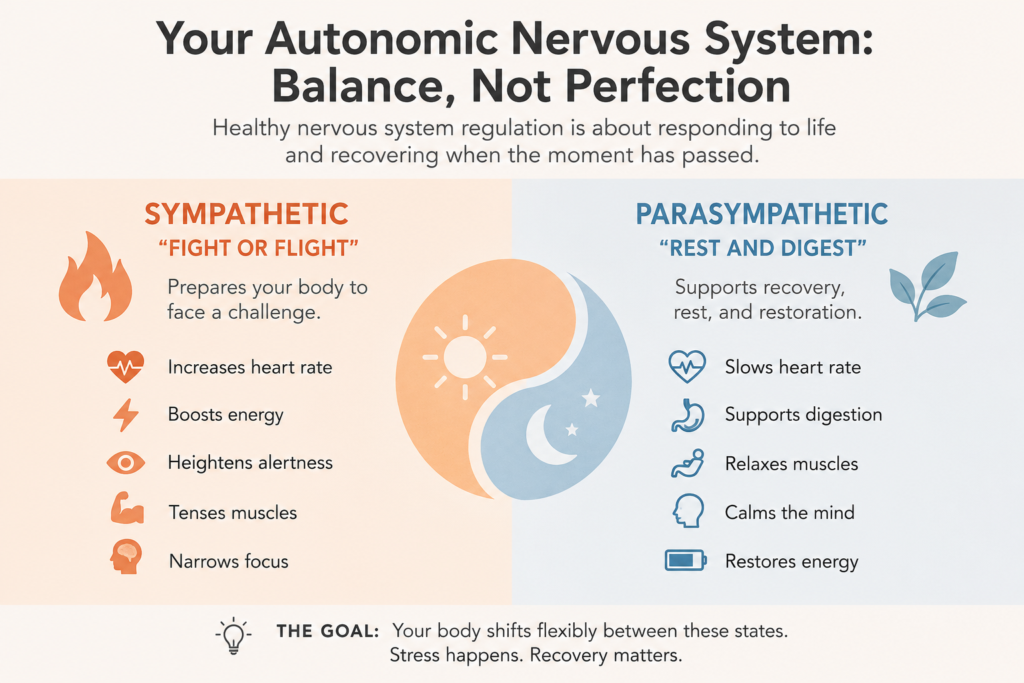
Your sympathetic nervous system prepares your body to respond when greater action or alertness is required. It is commonly associated with the “fight-or-flight” response.
Your parasympathetic nervous system is more active during periods of rest. It supports processes commonly summarized as “rest and digest.” The parasympathetic system also helps balance sympathetic nervous system activity.
Neither one is the bad guy.
You need sympathetic activity when you’re exercising, concentrating, responding to a challenge, or reacting quickly to something happening around you. You also need parasympathetic activity to support periods of rest and recovery.
Healthy nervous system regulation isn’t about spending your entire life in “rest and digest.” Your body needs to be able to respond to a challenge when necessary and settle when that challenge has passed.
Is Being in “Fight or Flight” Bad for You?
“Fight or flight” sounds frightening, especially when it’s described online as something you need to escape.
But sympathetic activation is a normal part of being human.
Imagine you’re about to start a hard workout. Your heart beats faster, you become more alert, and your body prepares to meet a greater physical demand. You wouldn’t necessarily want your body responding as if you were settling down for a nap.
The same system that helps you respond to a threatening situation also helps you rise to ordinary challenges.
The issue isn’t that your sympathetic nervous system ever becomes active. When people become interested in nervous system regulation, what they’re often trying to address is the feeling that they have difficulty winding down, recovering, or shifting out of a heightened state once the immediate demand has passed.
That distinction matters because it changes the goal. You’re not trying to eliminate stress responses. You’re trying to give your body adequate opportunities to recover from them.
Can Your Nervous System Become “Dysregulated”?
This is where wellness language can become confusing.
People use the word “dysregulated” to describe everything from feeling wired before bed to being overwhelmed after a stressful week. Those feelings can be very real, but “nervous system dysregulation” shouldn’t automatically be treated as a self-diagnosis.
There are actual disorders affecting the autonomic nervous system that require appropriate medical evaluation.
For everyday wellness, it can be more useful to think about nervous system regulation in terms of stress and recovery. Are you sleeping enough? Do you ever get time to decompress? Are you constantly switching between notifications, work, intense workouts, caffeine, and other sources of stimulation? Does your routine give you opportunities to slow down?
You don’t have to attach a diagnosis to yourself to recognize that you may need more recovery.
If you’re experiencing persistent symptoms, significant changes in heart rate or blood pressure, fainting, breathing problems, severe fatigue, or anything else that concerns you, that belongs in a conversation with a healthcare professional rather than a wellness trend on social media.
What Does Healthy Nervous System Regulation Look Like?
There isn’t one perfect morning routine or breathing exercise that creates ideal nervous system regulation.
Start with the basics.
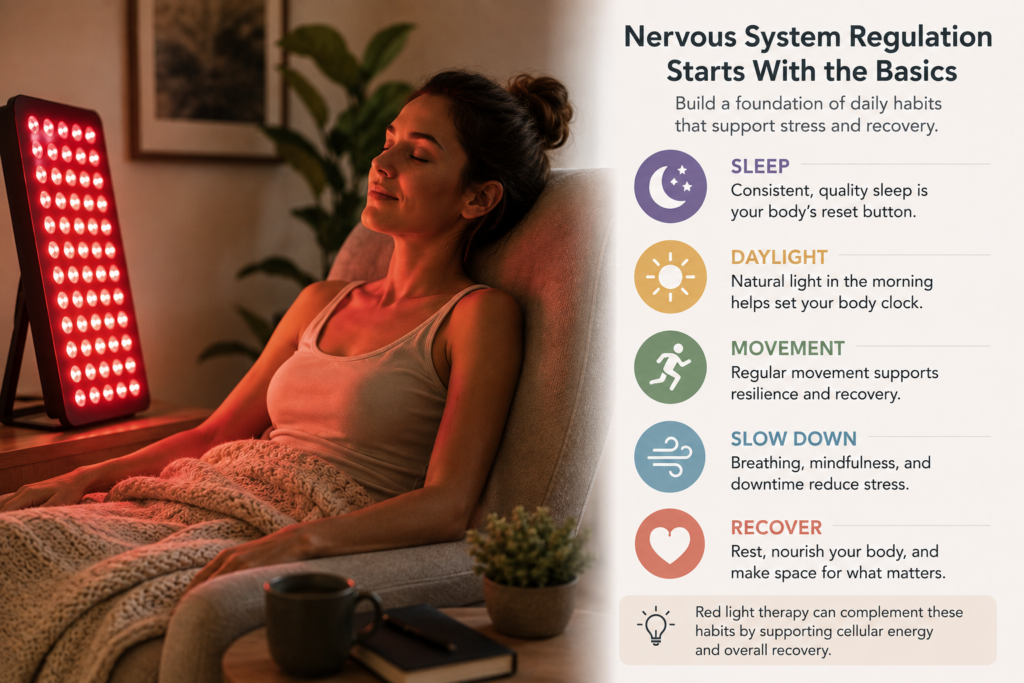
Protect Your Sleep
Sleep is one of the most important recovery periods you have.
Rather than immediately adding another supplement or device, look at whether you’re giving yourself enough time to sleep and whether your schedule is reasonably consistent.
That may mean creating a more predictable bedtime, reducing stimulation when you’re trying to wind down, and recognizing that recovery requires actual time.
Get Light During the Day
Your body uses environmental light as an important signal for circadian timing. Getting outside during the day, particularly earlier in your day, is a simple way to provide that signal.
This is also where an important distinction needs to be made.
Outdoor light exposure and red light therapy are not the same thing.
When we’re talking about daylight and circadian timing, we’re talking about your body’s response to the natural light-dark cycle. When researchers study red light therapy or photobiomodulation, they’re investigating specific wavelengths and doses of light and their biological interactions with tissue.
They shouldn’t be treated as interchangeable.
Move Your Body
Exercise can temporarily increase sympathetic nervous system activity, yet regular physical activity is still an important part of overall health.
This is a good example of why nervous system regulation isn’t synonymous with “being calm.”
Your body is supposed to respond to physical exertion. The recovery that follows is part of the process too.
Give Yourself Ways to Slow Down
You don’t need an elaborate ritual.
Slow breathing, gentle movement, meditation, a quiet walk, reading, listening to music, or simply putting your phone away for a while can create opportunities to reduce stimulation.
That doesn’t mean one breathing exercise literally “resets” your entire nervous system. It means you’re giving your body and mind a different set of conditions to respond to.
Where Does Red Light Therapy Fit Into Nervous System Regulation?
This is where we need to separate an interesting scientific connection from a much bigger marketing claim.
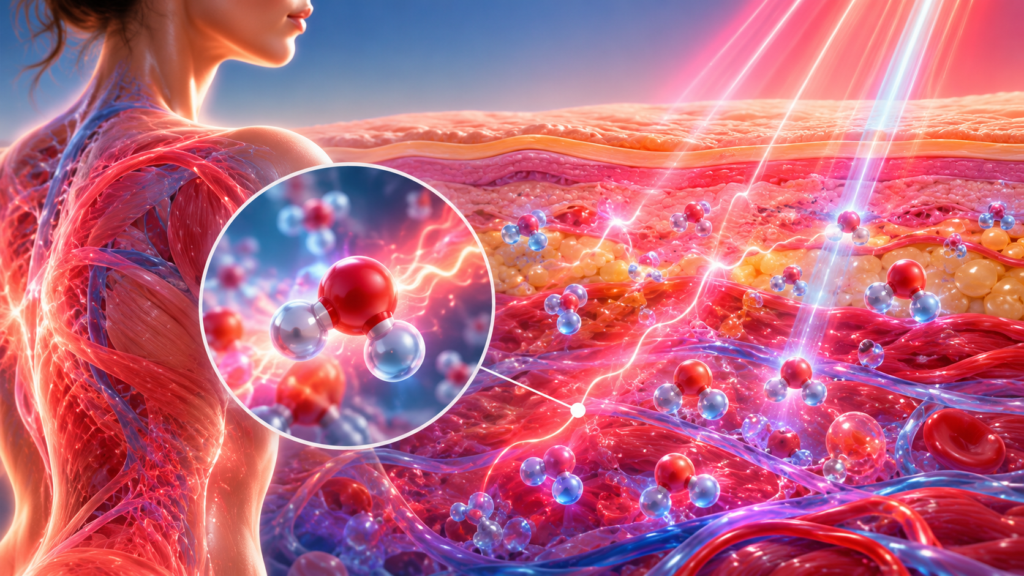
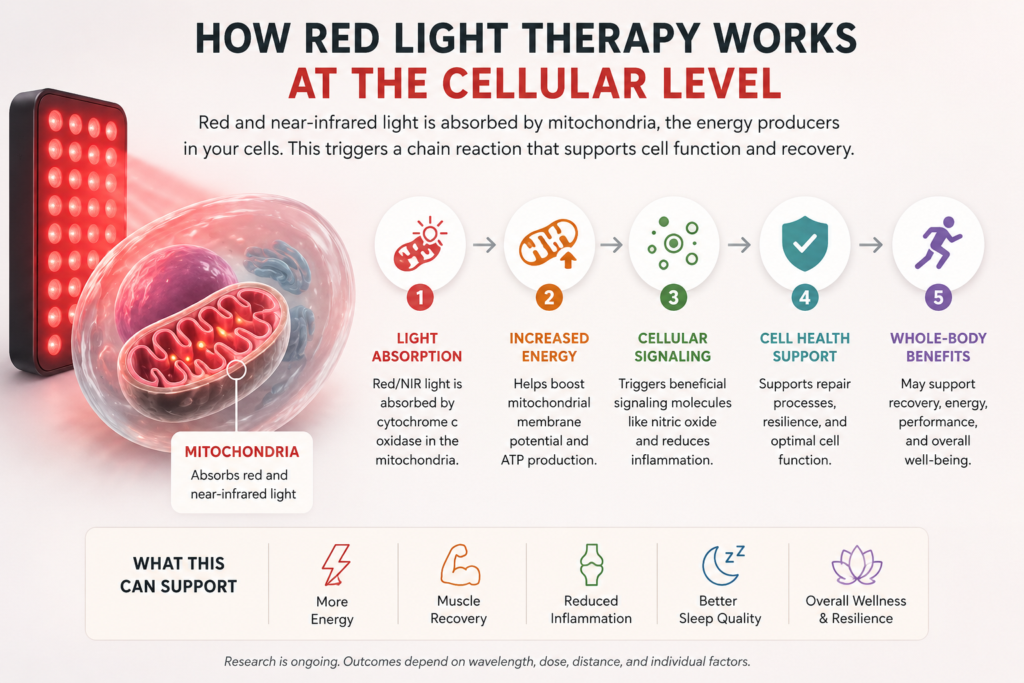
Red light therapy, or photobiomodulation (PBM), uses red and near-infrared light to produce photobiological effects in cells and tissues.
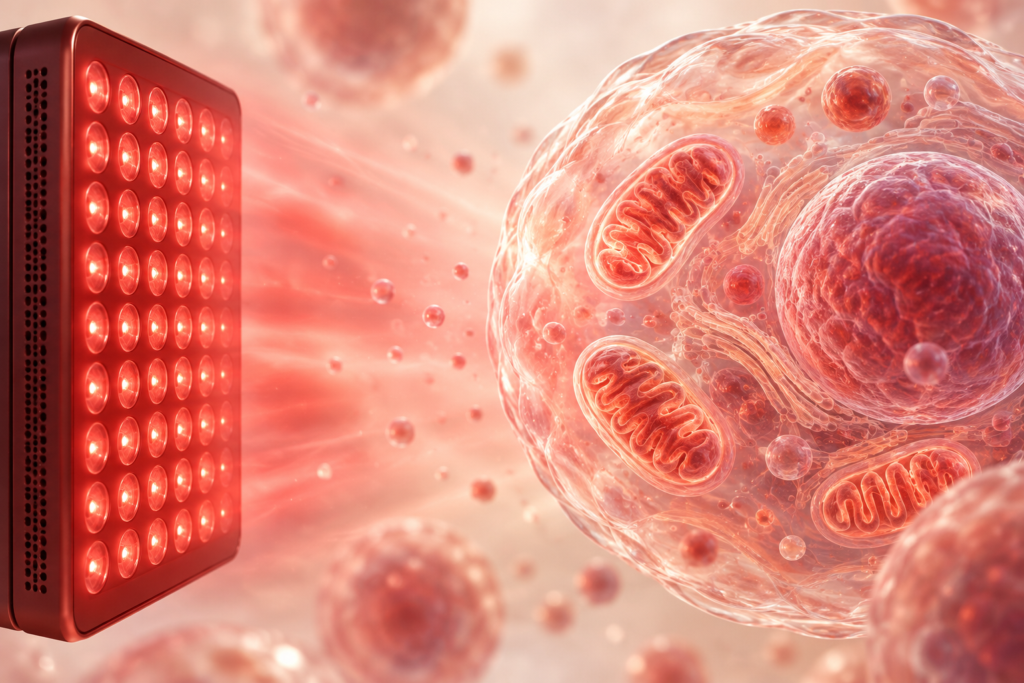
A frequently cited photobiomodulation review published in Photochemistry and Photobiology discusses mitochondria as an important site of interaction with red and near-infrared light, with cytochrome c oxidase proposed as one significant photoacceptor.
Why does that matter?
Mitochondria play a central role in producing ATP, the form of chemical energy cells can use. PBM research has investigated changes involving mitochondrial membrane potential, nitric oxide, reactive oxygen species, ATP and downstream cellular signaling.
That’s a real and fascinating area of research.
But it does not automatically mean red light therapy has been proven to create nervous system regulation in the broad way the phrase is used online.
Cellular activity and autonomic state are not the same outcome.
Red Light Therapy and the Nervous System: What Has Actually Been Studied?
Researchers have investigated photobiomodulation in nervous tissue, including an area known as transcranial photobiomodulation, or tPBM.
In tPBM research, red or near-infrared light is specifically delivered toward the head with the intention of affecting the brain.
A 2023 systematic review of human studies reported evidence that transcranial PBM can influence measures of brain activity, including cerebral blood flow, neuronal activity and functional connectivity. At the same time, the researchers highlighted substantial differences between study methods and called for more randomized controlled trials.
A more recent 2026 review of transcranial PBM also describes ongoing research into mitochondrial activity, oxygenation, neuroprotection and other biological effects. Importantly, it notes that treatment parameters matter and that future research is still needed.
This is promising research, but here’s the part that often disappears when science reaches social media:
Transcranial photobiomodulation research is not the same thing as using a standard red light therapy panel on your body.
The location of treatment, wavelength, dose, irradiance, exposure time and treatment protocol can all matter. We shouldn’t take a finding from a specialized brain-directed PBM study and automatically assume the same effect occurs from every red light device or protocol.
That’s especially important when we’re discussing nervous system regulation.
Does Red Light Therapy Activate Your Parasympathetic Nervous System?
You may have seen claims that red light therapy “activates the vagus nerve,” immediately puts the body into a parasympathetic state, or switches off fight or flight.
Those claims go further than the current evidence allows us to confidently say.
There are researchers studying PBM and the nervous system, and the biological mechanisms are worth continued investigation. But evidence of an effect on mitochondria or nervous tissue doesn’t prove that an ordinary red light therapy session reliably moves your autonomic nervous system from sympathetic to parasympathetic activity.
That distinction isn’t meant to make red light therapy less interesting. It helps us understand what the research actually says.
When you’re looking at nervous system regulation, it’s helpful to be skeptical of anything promising an instant biological reset, whether it’s red light, cold water, a supplement, a breathing technique, or the newest wellness device on your feed.
Your nervous system is more sophisticated than an on/off switch.
So Why Include Red Light Therapy in a Recovery Routine?
There is a more grounded way to think about red light therapy and nervous system regulation: recovery.
Photobiomodulation has been studied extensively in areas beyond direct autonomic effects.
For example, researchers have investigated localized PBM in exercise and muscle recovery. An earlier systematic review of randomized trials found positive results across a number of measures related to fatigue and post-exercise recovery.
But research also gives us a reason to avoid assuming that every form of red light therapy produces identical results.
A 2025 whole-body PBM review identified only five eligible studies involving 105 physically active participants. While two studies reported improvements in sleep-related measures, the review found no evidence of benefits for exercise performance or fatigue biomarkers from whole-body PBM and concluded that more research is needed.
That’s an important distinction for anyone shopping for or using red light therapy.
Localized PBM research, whole-body PBM research and transcranial PBM research are related, but they’re not interchangeable.
So rather than thinking of red light therapy as something that forces your body into a parasympathetic state, it makes more sense to view it as one potential tool within a larger wellness and recovery routine, with the strength of evidence depending on the specific outcome and treatment protocol being discussed.
Red Light Therapy Doesn’t Replace the Foundations
There’s something reassuring about this conversation that often gets lost in wellness content.
You don’t have to perfectly control your nervous system.
You don’t have to monitor every physical sensation. You don’t need to panic because you had a stressful day. And you don’t need to build an enormous wellness stack because someone online convinced you that your body is constantly stuck in fight or flight.
Supporting nervous system regulation can start with remarkably ordinary things: sleeping, moving, getting outside, eating adequately, allowing yourself to recover, spending time with people you care about, and creating periods where your brain isn’t being asked to process something every second.
Red light therapy can be added to that routine if it makes sense for you, but it shouldn’t replace those foundations.
And if your red light session gives you ten or twenty quiet minutes where you’re not answering emails, rushing somewhere, or staring at your phone, that may feel relaxing too. Just remember that the experience of feeling relaxed is different from proving that red light directly stimulated your vagus nerve or changed your autonomic state.
The Goal Isn’t to Be Calm All the Time
Perhaps the biggest misconception surrounding nervous system regulation is that a healthy nervous system should always feel calm.
It shouldn’t.
You want to become alert when something requires your attention. You want your heart and muscles to respond when you exercise. You want to feel excitement, motivation and energy. And when the demand is over, you also want opportunities for rest and recovery.
That’s the balance worth thinking about.
Red and near-infrared light are being studied for meaningful biological effects, including effects involving mitochondria, muscle tissue and, in specialized research settings, the brain and nervous system. That makes photobiomodulation relevant to the broader recovery conversation.
It doesn’t make red light therapy a nervous system reset button.
As research continues, we’ll learn more about how specific wavelengths, doses, treatment locations and protocols affect different tissues and outcomes. For now, the most useful approach to nervous system regulation is also one of the simplest: support your body’s ability to respond when it needs to respond, and give it genuine opportunities to recover when it can.
Frequently Asked Questions About Nervous System Regulation
Can red light therapy regulate your nervous system?
Research shows that red and near-infrared photobiomodulation can interact with biological processes involving mitochondria and cellular signaling, and specialized transcranial PBM has been studied for effects on brain activity. However, that is different from proving that conventional red light therapy directly creates nervous system regulation or reliably shifts the autonomic nervous system into a parasympathetic state.
Does red light therapy activate the vagus nerve?
Research into photobiomodulation and neural activity is developing, but there isn’t enough evidence to claim that conventional red light therapy reliably activates the vagus nerve. Be cautious with products or wellness claims promising a direct “vagus nerve reset” without evidence for the specific device and protocol being used.
What is the fastest way to calm your nervous system?
There isn’t one technique guaranteed to instantly reset your nervous system. If you’re simply feeling overstimulated, reducing stimulation, slowing your breathing, gentle movement, taking a quiet walk, or giving yourself time to rest may help you feel calmer. Persistent or concerning symptoms should be discussed with a healthcare professional.
Is the sympathetic nervous system bad?
No. Your sympathetic nervous system is a normal and necessary part of your autonomic nervous system. It helps your body respond to stress, physical activity and situations that require greater alertness. Nervous system regulation isn’t about eliminating sympathetic activity. It’s about your body’s ability to appropriately respond and recover.
Can red light therapy support recovery?
Photobiomodulation has been studied for exercise, muscle performance and recovery, although results depend on the type of PBM, treatment parameters and outcome being measured. Research into localized PBM has produced some encouraging results, while evidence for whole-body PBM remains much more limited. Red light therapy is best viewed as one potential part of a broader recovery routine rather than a replacement for sleep, movement, nutrition and other health fundamentals.
Ready for your red light therapy device? Check out reviews of red light therapy brands and products. You can also use the product comparison tool to help you decide.