
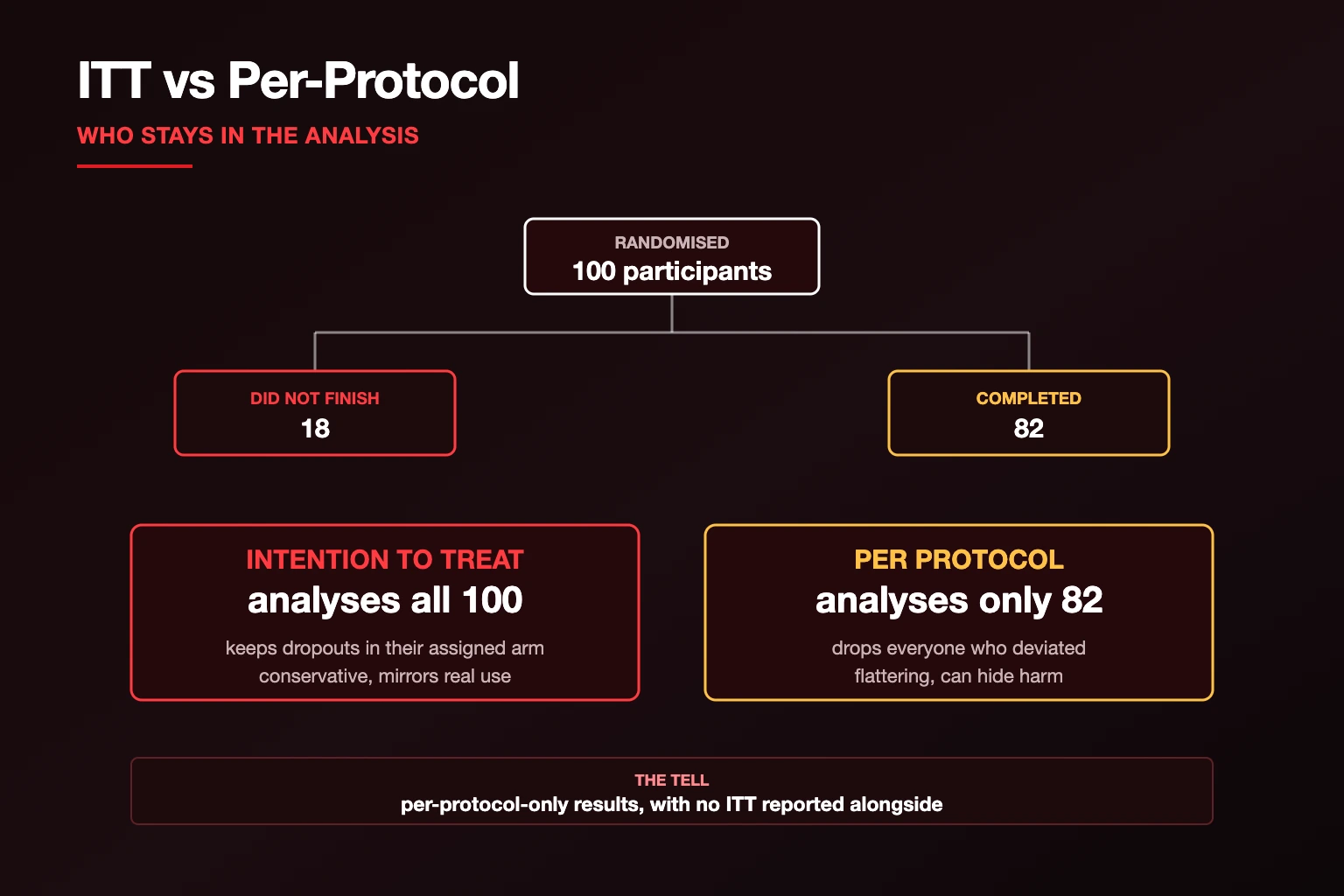
Randomization is meant to create comparable treatment groups. Yet after a photobiomodulation trial begins, some participants miss sessions, use the device incorrectly, stop treatment, cross over to another intervention, or fail to complete follow-up. The way researchers handle those people can materially change the study’s conclusion.
Photobiomodulation intention-to-treat analysis keeps participants in the groups to which they were randomly assigned, regardless of adherence or the treatment they ultimately received. Per-protocol analysis restricts the comparison to participants who followed defined parts of the protocol. Both can answer useful questions, but they do not estimate the same thing—and a naïve per-protocol comparison can erase the protection that randomization provides.
This guide explains intention-to-treat, per-protocol, as-treated, and modified ITT approaches; why missing outcomes remain a problem; and what readers should check in red and near-infrared light trials.
Research note: This article discusses trial analysis and evidence interpretation. It does not establish whether a particular photobiomodulation treatment is appropriate for any individual.
What photobiomodulation intention-to-treat means
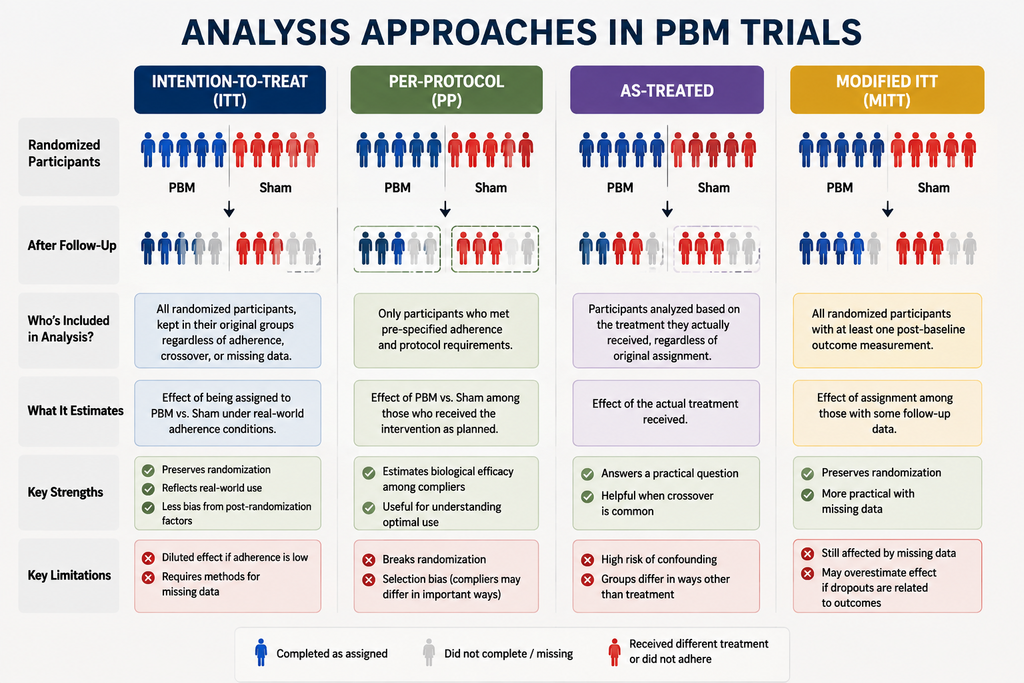
Under the intention-to-treat, or ITT, principle, every randomized participant is analyzed according to the original allocation. Someone assigned to active PBM remains in the active group even if they attended only half the sessions. Someone assigned to sham remains in the sham group even if they obtained red-light treatment elsewhere.
That may sound counterintuitive, but it preserves the comparison created by random assignment. Before treatment starts, randomization tends to balance known and unknown prognostic factors between groups. Moving or removing participants after their behavior and outcomes become visible can break that balance.
ITT primarily estimates the effect of being assigned to a treatment strategy under the adherence conditions observed in the trial. It is often particularly relevant to practical decisions: what happened when eligible people were offered this PBM program, including the real-world difficulty of completing it?
What per-protocol analysis means
A per-protocol, or PP, analysis includes participants who met prespecified adherence and eligibility requirements. A PBM trial might define adherence as completing at least 80% of sessions, staying within a treatment window, avoiding prohibited therapies, and providing the primary outcome measurement.
The goal is often to estimate what happened among people who received the intervention substantially as planned. That is a different question from the effect of assignment.
The danger is that adherence is not randomly assigned. People who complete every session may be healthier, more motivated, less busy, more optimistic, less sensitive to side effects, or more likely to perceive improvement. Those characteristics can also influence outcomes. A simple comparison of adherent active participants with adherent controls may therefore mix the treatment effect with selection differences.
Why excluding nonadherent participants breaks randomization
Imagine 100 people randomized evenly between an active PBM device and an identical sham. In the active group, several participants stop because the schedule is burdensome. In the sham group, several stop because they believe the device is inactive. If the analysis retains only completers, the remaining groups may differ in expectations, available time, symptom trajectory, and tolerance.
Those post-randomization differences did not exist by design; the study created them through exclusion. Baseline tables cannot guarantee that all relevant factors remain balanced, especially in a small sample.
Per-protocol results are not automatically wrong. They require stronger assumptions and often more advanced methods to adjust for predictors of adherence and dropout. A paper should not present the completer subset as though it were still a fully randomized comparison.
ITT does not mean pretending everyone received treatment
ITT preserves assigned groups; it does not claim perfect adherence. A transparent trial still reports how many sessions each participant completed, device use, protocol deviations, crossover, additional therapies, and reasons for discontinuation.
Those data help readers interpret the ITT effect. If adherence was high, the assignment and received-treatment effects may be similar. If many active participants barely used the device, a small ITT effect may reflect both treatment biology and poor implementation.
This is why adherence should be measured carefully rather than treated as an inconvenient detail. Device logs, session records, positioning checks, and dose documentation can be more informative than self-report alone.
Missing outcomes are a separate problem
True ITT would include an outcome for every randomized participant. In practice, some outcome values are missing. A participant may withdraw consent, skip a visit, become unreachable, or provide an unusable measurement. Keeping their name in the assigned group does not magically create the absent value.
Analyzing only participants with observed outcomes is a complete-case analysis, even if the authors call it ITT. It can be biased when the chance of missingness is related to treatment, prognosis, or the unobserved outcome.
For example, people who experience no improvement may be more likely to miss follow-up. If that pattern differs between active and sham groups, the observed sample can make either treatment look better than it really is.
How trials handle missing data
There is no universally correct repair. Methods depend on why data are missing and what information is available.
- Complete-case analysis uses only observed outcomes. It is simple but may be biased and inefficient.
- Multiple imputation creates several plausible values using observed variables, analyzes each completed dataset, and combines the estimates. Its validity depends on assumptions and model specification.
- Mixed models can use repeated observations without requiring every participant to have every visit, under stated missing-data assumptions.
- Sensitivity analyses test how conclusions change under alternative, including less favorable, assumptions.
CONSORT 2025 guidance emphasizes reporting the amount and reasons for missing data by trial arm, the assumed missingness mechanism, the variables and methods used for imputation, and sensitivity analyses. “Missing data were imputed” is not enough detail.
Modified intention-to-treat can mean almost anything
Modified ITT, often abbreviated mITT, usually excludes some randomized participants. One study may exclude anyone who never started treatment; another may require one post-baseline measurement; another may remove participants found ineligible after randomization.
Because the term lacks one universal definition, readers must find the actual inclusion rule. Were exclusions prespecified? How many people were removed from each group? Were reasons related to treatment or outcome? Did the rule apply symmetrically?
A small and defensible exclusion may have little effect, but the label “modified ITT” should never substitute for a participant-level accounting.
As-treated analysis asks another question
As-treated analysis groups participants according to the treatment they actually received. Someone randomized to sham who later used an active PBM device may be analyzed with the active group.
This discards the original randomized assignment. The decision to cross over may be related to symptoms, beliefs, access, or early response, so the resulting comparison resembles an observational study and is vulnerable to confounding.
As-treated results can help explore safety or exposure questions, but they need cautious interpretation and appropriate adjustment. They should not quietly replace the randomized primary analysis.
Effectiveness versus efficacy
ITT is often described as estimating effectiveness—how an intervention performs when offered in realistic conditions. PP is often described as estimating efficacy—how it performs when followed correctly. That shorthand is useful but incomplete.
A simple PP subset does not automatically estimate the causal effect everyone would experience under full adherence. To answer that question rigorously, analysts may need longitudinal data on adherence and factors that influence both adherence and outcomes. Methods such as inverse-probability weighting or g-estimation can attempt adjustment, but they introduce additional assumptions.
The key is to define the target quantity, sometimes called the estimand: effect of assignment, effect under adherence, effect while on treatment, or another precisely stated contrast.
Why PBM adherence can be complicated
Photobiomodulation protocols can require frequent clinic visits or repeated home sessions. Adherence is more than pressing the power button. It can include correct distance, body position, treatment duration, device orientation, contact, eye protection, pulse setting, and session timing.
A participant may complete every scheduled session but receive a different dose because placement varies or the device output changes. Conversely, someone may miss one session yet otherwise follow the optical protocol accurately.
Therefore, a per-protocol definition should be clinically and technically justified, not chosen after researchers see which cutoff creates the best result. The protocol should specify the threshold before analysis and report adherence as a distribution, not only pass versus fail.

A PBM example of ITT and PP reporting
A randomized trial of photobiomodulation combined with exercise for knee osteoarthritis reported both ITT and per-protocol analyses. The paper explicitly distinguished the estimate based on treatment assignment from the estimate under protocol adherence. Another randomized, triple-blind ICU trial stated that ITT analysis was applied.
A recent randomized PBM trial for post-stroke cognitive impairment analyzed its primary endpoint under ITT with multiple imputation and examined secondary and exploratory outcomes in a PP population. That example shows why readers must inspect each outcome separately; a paper may not use one analysis set for everything.
The presence of “ITT” in the methods does not settle the issue. Readers still need the flow diagram, analysis denominators, missing-data methods, and reasons for exclusion.
When ITT can dilute the observed difference
If many participants assigned to active PBM do not receive meaningful exposure, ITT may estimate a smaller difference than the biological effect among fully adherent users. Crossover between groups can also make treatments look more similar.
That dilution is not necessarily a flaw. It may accurately represent what happens when the intervention is offered with its actual burden, usability, and adherence challenges. A treatment that works only under unusually perfect conditions may have less practical value.
Showing both a primary ITT estimate and a carefully planned adherence analysis can help separate implementation from biological potential. Large disagreements between them should trigger questions about selection, crossover, and missing data.
Special caution in noninferiority trials
In a superiority trial, investigators ask whether one treatment is better than another. ITT is commonly favored because it protects randomization, though nonadherence can bias effects toward no difference.
In noninferiority or equivalence trials, showing little difference is the goal. Nonadherence that makes groups look similar can falsely support noninferiority. For that reason, both ITT and per-protocol results are often important, and agreement between them strengthens interpretation.
The direction of “conservative” bias is therefore not universal. Readers must understand the study objective and prespecified margin.
Red flags in a trial report
- The paper says “ITT” but excludes everyone without a follow-up outcome and gives no sensitivity analysis.
- Participants are removed because they did not improve or tolerate treatment.
- The adherence cutoff is not defined or appears only after results are reported.
- Exclusions differ substantially between active and sham groups.
- An as-treated analysis is presented as though randomization still applies.
- Missing values are replaced with a simplistic method without justification.
- The flow diagram and analysis denominators do not match.
- The abstract highlights PP results while the prespecified ITT primary analysis is unfavorable.
- Device adherence is measured only by participant recall despite available usage logs.
A practical checklist for readers
- How many participants were randomized to each group?
- How many were included in every primary and secondary analysis?
- Were participants analyzed according to original assignment?
- What exactly did ITT, mITT, PP, and as-treated mean in this paper?
- How was PBM adherence defined and measured?
- Were the adherence rules prespecified?
- Why did participants miss sessions, cross over, or withdraw?
- How many outcome values were missing in each group?
- What missing-data assumptions and methods were used?
- Did sensitivity analyses reach similar conclusions?
- Do ITT and PP estimates differ materially?
- Does the conclusion match the study’s actual estimand?
The bottom line
Photobiomodulation intention-to-treat analysis preserves randomized assignment and usually provides the most defensible primary comparison for superiority trials. Per-protocol analysis can explore outcomes under adherence, but a simple completer comparison is vulnerable to selection bias because adherence is not random.
Neither label resolves missing data. Strong reports show exactly who was randomized, treated, followed, and analyzed; define protocol adherence in advance; explain missing-outcome methods; and compare sensitivity analyses. When ITT and PP results agree, confidence increases. When they diverge, the discrepancy is a finding to understand—not a reason to select whichever analysis tells the more appealing story.
Last reviewed: August 23, 2026.