Red light therapy distance is one of the most common and consequential questions in the practice — and one of the least glamorous. It sounds trivial, but distance has a large effect on how much light actually reaches you, and getting it wrong is one of the easiest ways to undermine an otherwise sensible routine. This guide explains why red light therapy distance changes your dose, how light intensity falls off as you move away, and how to set it correctly without guesswork.
The short answer is that distance and time together determine your dose, and the manufacturer’s recommended distance is the most reliable starting point. The longer answer explains why, so you can make informed adjustments rather than blind ones.
Why Distance Changes the Dose
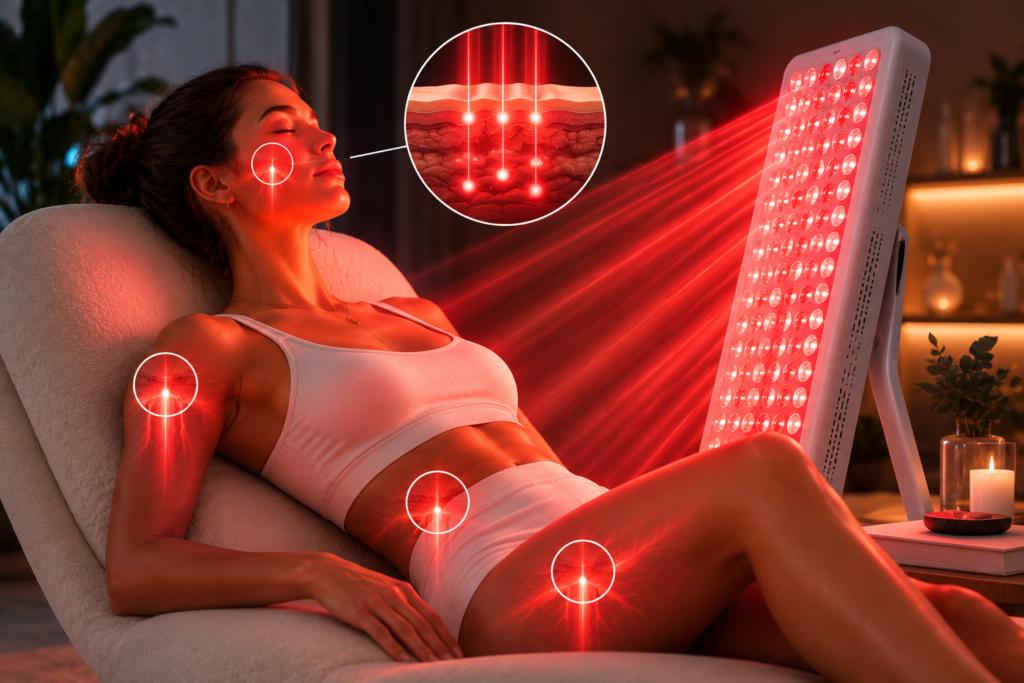
Your dose is not set by the panel’s power alone. It is set by how much light energy actually reaches your skin — the irradiance — multiplied by how long you are exposed. Distance is one of the biggest factors controlling irradiance. Sit closer, and more light reaches a given patch of skin per second; sit farther, and less does.
This matters because the dosing research shows that the relationship between dose and benefit is not a simple “more is better” line. Studies describe a biphasic dose response, meaning a moderate dose tends to help while too little does nothing and too much can reduce or even reverse the benefit. Red light therapy distance is one of your main levers for landing in that useful middle dose range, which is why it deserves attention.
Irradiance Falloff: The Physics in Plain Terms
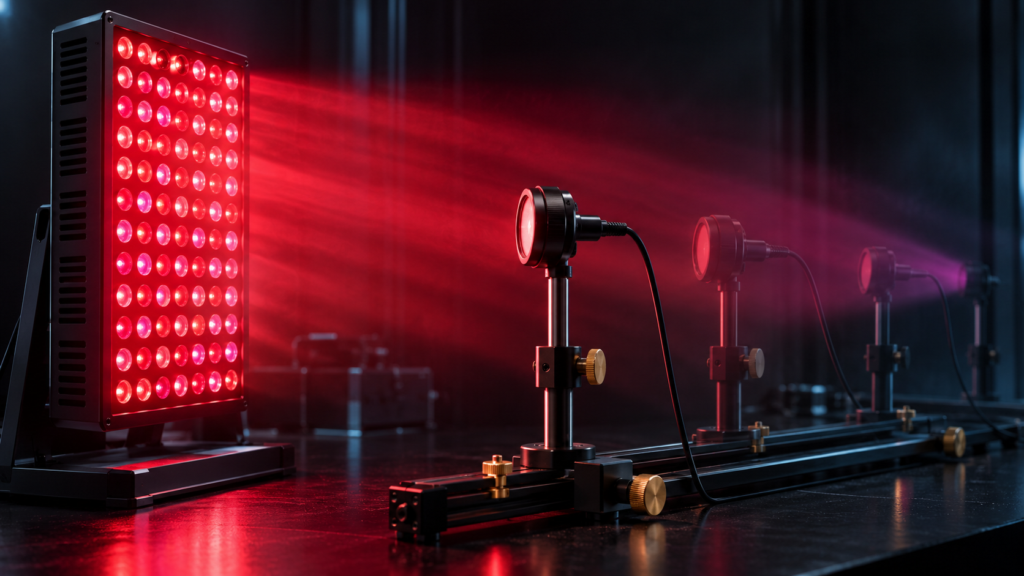
As red light therapy distance increases, light intensity at your skin drops — and it drops faster than many people expect. A modest increase in distance can mean a meaningful reduction in irradiance. The practical implication is that small changes in where you sit can noticeably change your dose, even if the session time stays the same.
How light behaves as it travels is also shaped by wavelength and the geometry of the source. Research on light–tissue interaction shows that wavelength affects penetration — longer near-infrared wavelengths generally reach deeper than red wavelengths — and that factors like beam characteristics influence how light spreads and is absorbed. For everyday use, the key takeaway is simpler: distance strongly influences how much light arrives, so it is not a detail to improvise.
Follow the Manufacturer’s Specifications
Because irradiance depends on the specific device, the single most reliable guide to red light therapy distance is the manufacturer’s specification. Reputable devices state an irradiance value measured at a specific distance, often in inches, along with a recommended session time. That pairing — distance plus time — is what defines an appropriate dose for that particular panel.
This is why a generic “distance chart” copied from one device cannot be trusted for another. Two panels with identical wavelengths can deliver very different irradiance, so the right distance for one may be wrong for the next. When you read a spec sheet, look for irradiance stated at a clear distance; a company that provides this is giving you the information you need to use the device well. Vague claims without numbers are a reason for caution.
Distance Versus Time: The Trade-Off
Red light therapy distance and time are linked because both feed into total dose. Sitting farther away lowers irradiance, which generally means a longer session is needed to reach the same dose; sitting closer raises irradiance, which means a shorter session delivers the same dose. In principle you can trade one for the other.
In practice, the safest approach is to follow the manufacturer’s recommended distance and time as a matched pair rather than improvising your own combination. If you do adjust, change one variable at a time and stay within the device’s guidance. The biphasic dosing principle is the reason to follow the manufacturer’s matched red light therapy distance and time rather than improvising your own combination.
Why “Closer and Longer” Is Not a Shortcut
It is tempting to assume that minimizing red light therapy distance and maximizing session time will accelerate results. The dosing research argues otherwise: beyond a certain point, more light can reduce the benefit. Treating distance and time as tools to hit a sensible dose — not to maximize exposure — is the more grounded approach.
Common Distance Mistakes
A handful of distance-related errors come up repeatedly. The first is sitting too close in the belief that maximum intensity equals maximum benefit, which ignores the biphasic dose curve. The second is sitting too far away, often to cover more of the body at once, which can drop irradiance so low that the session delivers little. The third is borrowing a distance recommendation from a different device, since irradiance varies by panel. The fourth is changing distance and time together without tracking, making it impossible to tell what affected your dose. And the fifth is leaving skin covered, since clothing blocks much of the light regardless of distance.
A Practical Way to Set Your Distance
Keep it methodical. Start by reading your device’s stated irradiance and the distance at which it was measured, then use that distance as your baseline along with the recommended session time. Measure the distance rather than estimating it, expose bare skin, and stay consistent from session to session so your dose is repeatable. If you later want to adjust, change only distance or only time, keep notes, and remain within the manufacturer’s guidance. This turns distance from a guessing game into a controlled, repeatable setting.
Safety Considerations
Distance also has a safety dimension. Sitting extremely close to a panel concentrates light and, depending on the device, can increase warmth, so respecting the recommended distance is sensible for comfort as well as dose. Eye protection remains worthwhile at any distance, particularly with near-infrared-heavy devices, because near-infrared light is invisible and does not trigger the eye’s natural aversion to brightness. As with all red light therapy, the practice is generally low-risk for healthy adults at appropriate doses but is not automatically safe for everyone; anyone who is pregnant, takes photosensitizing medication, or has a relevant skin or eye condition should consult a healthcare professional first.
Setting Realistic Expectations
Even with distance dialed in perfectly, red light therapy is not a guaranteed solution. Correct distance simply helps ensure you are delivering a reasonable dose rather than too little or too much; it does not override the broader reality that evidence is stronger for some uses than others and that individual responses vary. Reviewers consistently call for larger, standardized research. Getting distance right is a way to use the practice sensibly and consistently, not a guarantee of a particular outcome.
The Bottom Line
Distance is one of the most important and overlooked settings in red light therapy, because it strongly influences how much light reaches your skin and therefore your dose. Light intensity falls off as you move away, so the manufacturer’s irradiance-at-a-stated-distance specification is your most reliable guide. Follow the recommended distance and time as a matched pair, avoid the “closer and longer is better” trap that the biphasic dosing research warns against, expose bare skin, protect your eyes, and keep expectations realistic. Set distance deliberately, and the rest of your routine has a sound foundation.
Ready to get your red light therapy device? See our brand and product reviews, and try out our product comparison tool to inform your decision.
Frequently Asked Questions
How far should I sit from a red light panel?
Follow your device’s specification, which states irradiance at a specific distance along with a recommended time. That matched pair is the most reliable guide, since the right distance varies from one panel to another.
Does sitting closer make red light therapy more effective?
Not necessarily. Sitting closer raises intensity, but research describes a biphasic response in which too much light can reduce the benefit, so closer is not automatically better.
Can I use a distance chart from another device?
It is unreliable. Two panels with the same wavelengths can have very different irradiance, so a distance that suits one device may deliver too much or too little with another.
Should I sit farther away to treat more of my body?
You can cover more area at a greater distance, but irradiance falls off as you move away, so the dose may become too low. Following the manufacturer’s distance and time is safer.
Is sitting very close to a panel unsafe?
Sitting extremely close concentrates light and may increase warmth depending on the device. Respecting the recommended distance is sensible for comfort and dose, and eye protection is worthwhile at any distance.
This article is for general educational purposes only and is not medical advice. Red light therapy is not a substitute for professional care. Talk with a qualified healthcare professional about your individual situation.