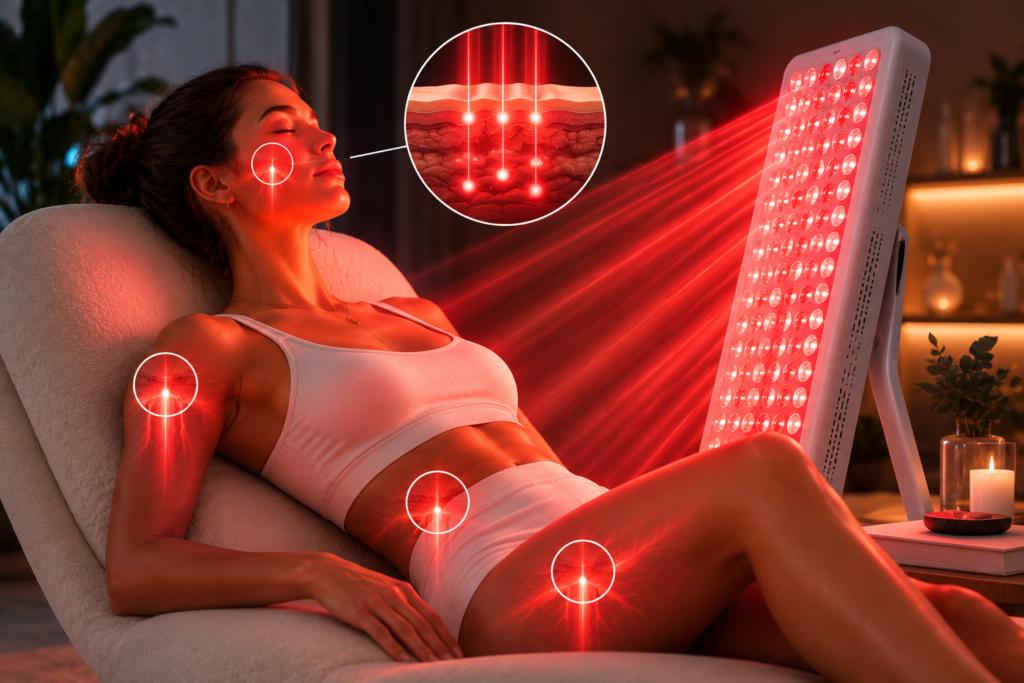

Red light therapy fat loss claims are among the most common and most misleading messages attached to light devices. Fat-loss claims are among the most common and most misleading messages attached to light devices. This article is a consumer-protection guide: it shows how to evaluate these claims, why regulatory clearance is not proof of weight loss, and what the evidence actually supports.
The bottom line on red light therapy fat loss claims up front: promises that a device melts fat or causes effortless, guaranteed results should be treated with deep skepticism. The science does not support them, and consumer-protection authorities specifically flag this style of promise as a warning sign of deception.
Why ‘Melts Fat’ Claims Fail a Basic Gut Check
Red light therapy fat loss claims fail almost immediately when held up against the Federal Trade Commission, the United States consumer-protection agency, guidance on false weight-loss promises. Its core principle is simple: meaningful weight loss requires taking in fewer calories than you use, and any product promising weight loss without effort is, in the FTC’s words, bogus. The agency lists several claims that experts say simply cannot be true.
Two are especially relevant to light devices. The FTC states that no product causes substantial weight loss for every user, because people’s bodies and lifestyles differ. And crucially, it states that weight loss is an internal metabolic process, so nothing you wear on the body or rub or shine onto the skin can cause substantial weight loss. The FTC even calls out marketing language like melt fat at the cellular level and burn fat faster as the kind of phrasing that should fail a gut check. When an ad for a light device leans on those words, that is a signal to be skeptical, not impressed.
Spotting the Red-Flag Phrases
Learning the vocabulary of red light therapy fat loss claims makes deception easier to catch. Be wary of phrases such as effortless fat loss, melt or burn fat, target stubborn fat in one area, guaranteed results, and works for everyone. The FTC notes that some marketers soften these into helps you lose fat or up to a certain amount, hoping the qualifier slips past you. The NIDDK similarly warns against programs promising weight loss without diet or exercise or loss in a specific part of the body. Different agencies, same message: these claims are red flags.
Why FDA Clearance Is Not Proof of Weight Loss
One of the most common sources of confusion is the phrase FDA cleared. It sounds like a guarantee of effectiveness, but it does not mean what shoppers often assume. Under the FDA’s 510(k) process, a manufacturer notifies the agency before marketing a device, and the FDA determines whether it is substantially equivalent to a device already on the market for a stated use. It is a clearance pathway centered on equivalence and a specific intended use — not a verdict that a product reliably causes weight loss.
Several important cautions follow. Clearance is not the same as approval, and neither is a promise that a device will help you lose weight. A clearance may also be tied to a narrow, specific purpose that has little to do with broad fat-loss marketing. So a claim like FDA cleared for fat loss, used to imply guaranteed results, stretches the meaning of clearance far beyond what it supports. Treat regulatory language as a starting question when evaluating red light therapy fat loss claims, not a conclusion.

What the Evidence Actually Shows
Behind the bold red light therapy fat loss claims, the research is modest and unsettled. A review of the efficacy of low-level laser therapy for body contouring and spot fat reduction states directly that scientific studies of its effectiveness, and of the mechanism by which it might cause loss of fat from fat cells, are lacking. The contouring studies that do exist mostly measured small, sometimes temporary changes in the circumference of treated areas over a few weeks — not fat loss, weight loss, or whole-body change.
In short, the science offers no basis for melts fat or effortless fat loss claims. The proposed mechanisms are uncertain, the trials are often small and short, and the measured effects are about the appearance of a treated area at most. Anyone presenting red light as a reliable fat-loss method is going beyond the evidence — red light therapy fat loss claims simply are not supported.

Why Testimonials and Photos Are Weak Evidence
Marketing leans heavily on personal stories and before-and-after images precisely because they are persuasive, not because they are reliable. The FTC points out that advertisers often cherry-pick their most flattering cases, or present results that are not typical of what most people experience, and that under the law such endorsements are supposed to disclose typical results. A glowing testimonial tells you what happened, or was claimed to happen, for one selected person under unknown conditions — it does not establish that a product works.
Before-and-after photos are similarly easy to stage with lighting, posture, timing, and selection. None of this rises to the level of evidence that a careful reader should trust. The FTC notes that even qualifiers like results not typical do not rescue a misleading impression. When a red light therapy fat loss claim rests mainly on stories and images rather than transparent, controlled research, that absence is itself informative.
What Honest Language Looks Like
“It is just as useful to recognize responsible communication about red light therapy fat loss claims as it is to spot deception. Honest descriptions of red light therapy use measured words: may support, some research suggests, modest, mixed, results vary, and more research is needed. They distinguish circumference from fat and weight, they acknowledge that trials are often small and short, and they avoid promising outcomes for everyone. When a source is willing to state the limits of the evidence plainly, that candor is a good sign — far more trustworthy than confident guarantees.

A Simple Framework for Evaluating Any Claim
When you meet red light therapy fat loss claims — or any product — a few questions cut through the hype. Does it promise results without diet or exercise, or for everyone? If so, the FTC says it cannot be true. Does it use words like melt, burn, or guaranteed? Those are red flags. Does it lean on FDA cleared to imply proven weight loss? Clearance does not establish that. Is there transparent, high-quality evidence in humans, or just testimonials and before-and-after photos? The FTC notes that cherry-picked endorsements are a staple of deceptive ads. Running a claim through these questions usually reveals how much is marketing and how little is substance.
A Prominent Caution
To state it plainly: red light therapy fat loss claims that promise melted fat, burned fat cells, or guaranteed weight loss are not supported by science. It is not a replacement for medical care or for the fundamentals of weight management. If you encounter a product making impossible-sounding promises, you can report deceptive weight-loss claims to the FTC, and you can bring questions about any product or your weight to a qualified healthcare professional, who can help you separate evidence from advertising.
The Bottom Line
Red light therapy fat loss claims deserve careful scrutiny — the science, the FTC, and major reviews all point in the same direction. The FTC explains that weight loss is an internal process and that nothing applied to the skin causes substantial weight loss, and it flags effortless, universal, and melt-fat language as warning signs. FDA clearance reflects a regulatory equivalence process, not proof that a device causes weight loss. The underlying evidence is modest, the mechanism is unclear, and the measured effects concern the appearance of a treated area at most. Evaluate claims skeptically, lean on the fundamentals, and consult a professional rather than trusting the hype.
Ready to get your red light therapy device? See our brand and product reviews, and try out our product comparison tool to inform your decision.
Frequently Asked Questions
Does red light therapy melt or burn fat?
No. There is no sound evidence that red light melts or burns fat. Red light therapy fat loss claims built on melting or burning fat have no sound evidence behind them.
Why are ‘effortless fat loss’ claims a red flag?
Red light therapy fat loss claims promising effortless results are a red flag because the FTC states meaningful weight loss requires using more calories than you take in. Such promises are warning signs of deception.
Does ‘FDA cleared’ mean a device causes weight loss?
No. FDA 510(k) clearance generally means a device was found substantially equivalent to an existing one for a stated use. It is not approval and not proof that the device causes weight loss.
What did the research actually measure?
Mostly small, sometimes temporary changes in the circumference of treated areas over a few weeks, not fat loss or weight loss. Reviews say evidence of effectiveness and the fat-cell mechanism are lacking.
How can I evaluate a fat-loss claim or report a bad one?
Watch for promises of effortless, guaranteed, universal, or spot fat loss and for melt or burn language. You can report deceptive weight-loss claims to the FTC and ask a healthcare professional about any product.
Sources
This article is for general educational purposes only and is not medical advice. Red light therapy is not a substitute for professional care. Talk with a qualified healthcare professional about your individual situation.