Two red light therapy devices can be measured at the same distance and still produce very different irradiance readings. Even the same panel can appear to “gain” or “lose” output when the meter, angle, measurement point, or warm-up time changes. That does not automatically mean the device is defective or that one tester is dishonest. It means optical measurement is sensitive to method.
This guide explains why red light therapy irradiance measurements often disagree, what a consumer-grade meter can and cannot tell you, and which details make a published number useful. It complements our guide to irradiance and dosage, which explains how power density and time combine to estimate surface dose.
What Irradiance Measures
Irradiance is radiant power arriving at a surface divided by that surface area. It is commonly reported in watts per square meter (W/m²) or milliwatts per square centimeter (mW/cm²). The units describe a rate, not a completed treatment dose. Irradiance multiplied by exposure time gives radiant exposure, often called fluence in photobiomodulation discussions and reported in joules per square centimeter (J/cm²).
That definition sounds simple, but a panel is not a perfectly uniform sheet of light. It is an array of individual LEDs with lenses, spacing, multiple wavelengths, and overlapping beams. The value at one point is not necessarily the average across the area being treated.
Why Two Meters Can Produce Different Results
Spectral response is not perfectly flat
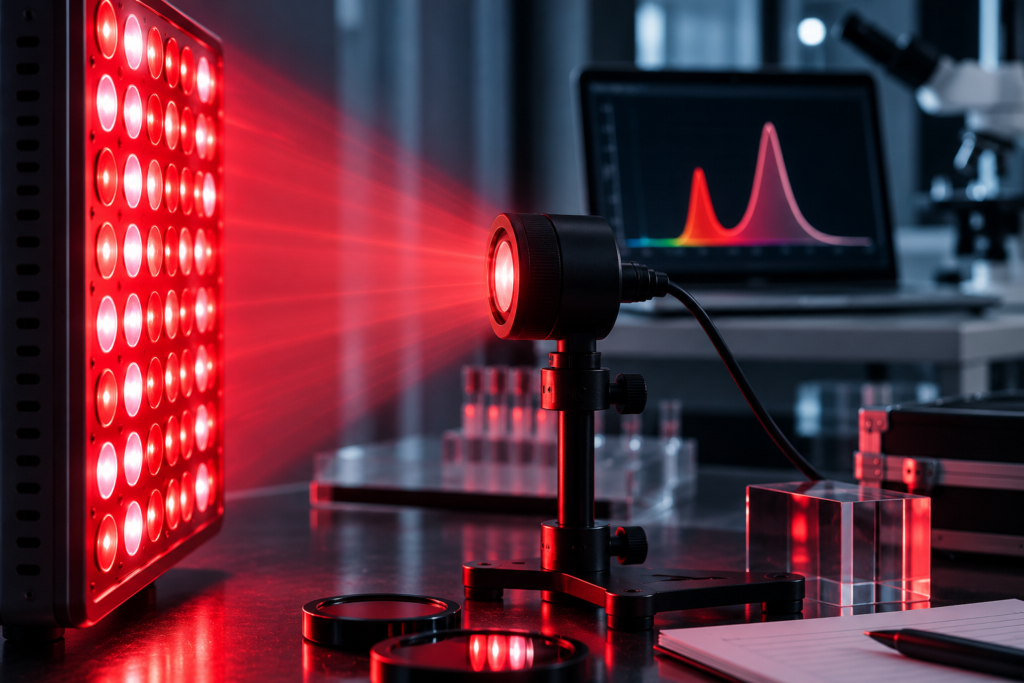
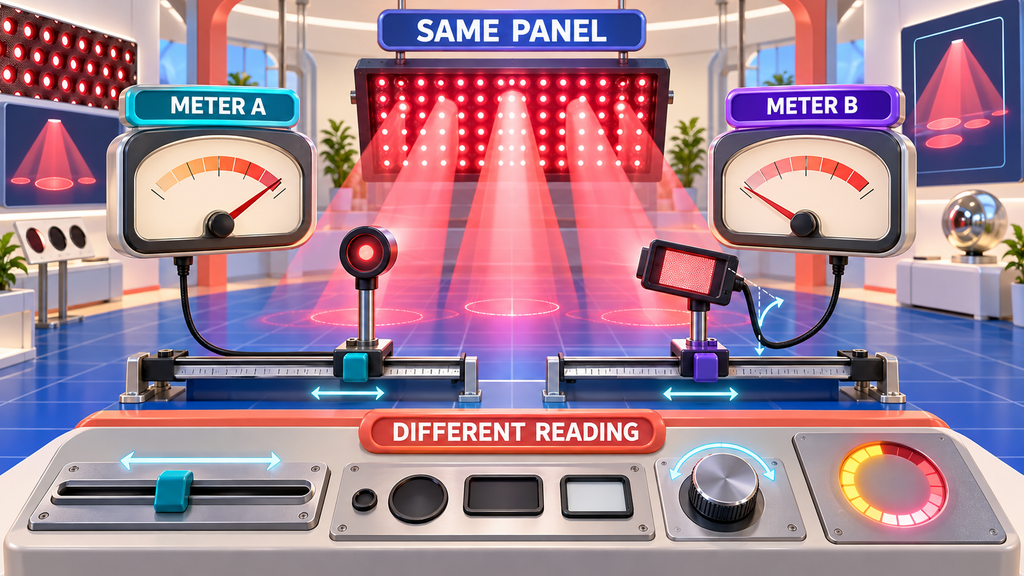
Most optical detectors do not respond equally to every wavelength. A silicon photodiode, for example, produces a different electrical response at 660 nm than at 850 nm unless the instrument corrects for wavelength. NIST notes that detector behavior and the associated electronics determine the quality and limits of an optical measurement. A meter calibrated for a broad solar spectrum may therefore respond differently to a narrow-band red or near-infrared LED source.
This matters especially for multi-wavelength panels. A reading from a device emitting 630, 660, 810, 830, and 850 nm depends on how the meter weights each band. A single displayed number can hide that spectral mismatch.
Sensor size changes what is being averaged
A small sensor placed in front of one LED may capture a local peak. A larger sensor may average light from a broader region, including dimmer spaces between LEDs. Neither number describes the entire treatment field unless the sampling method is designed to do so.
NIST calibration guidance warns that beam size and non-uniformity can affect results. For a panel, that means the relationship between the illuminated area and the detector aperture is part of the measurement—not a minor detail.
Angle and field of view matter
A detector facing the panel squarely may read more than the same detector tilted a few degrees. Some instruments also accept light over a wider angle than others. LED lenses create directional beams, so the detector’s orientation and field of view influence how much light reaches it.
For repeatable comparisons, the sensor should be parallel to the panel, centered consistently, and held in a stable fixture rather than by hand.
Distance Changes Both Intensity and Uniformity
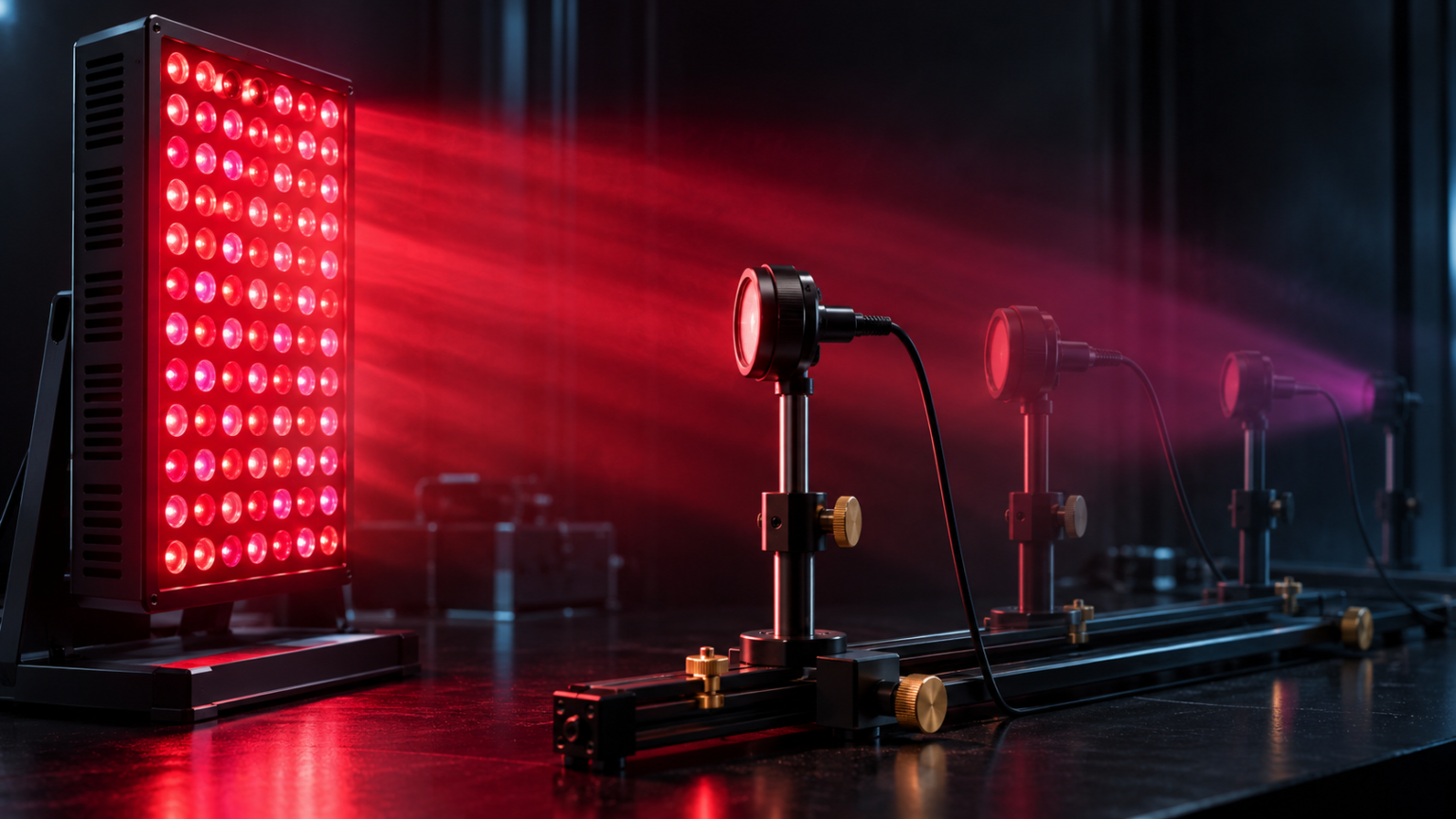
Moving away from a panel generally reduces irradiance, but the pattern is more complicated than applying the inverse-square law to a single point source. A panel contains many emitters spread over a large surface. Close to the panel, individual bright spots and gaps are more pronounced. Farther away, the beams overlap more evenly, even as overall intensity falls.
This creates a practical trade-off: a close measurement may produce a high central peak while representing a small, uneven area. A measurement farther away may be lower but more uniform across the body. A useful specification therefore needs both distance and location.
When comparing devices, use the same face-to-sensor distance, not the distance from the wall or stand. Follow the manufacturer’s recommended treatment distance when estimating a real-world dose.
Peak Irradiance Is Not Average Irradiance
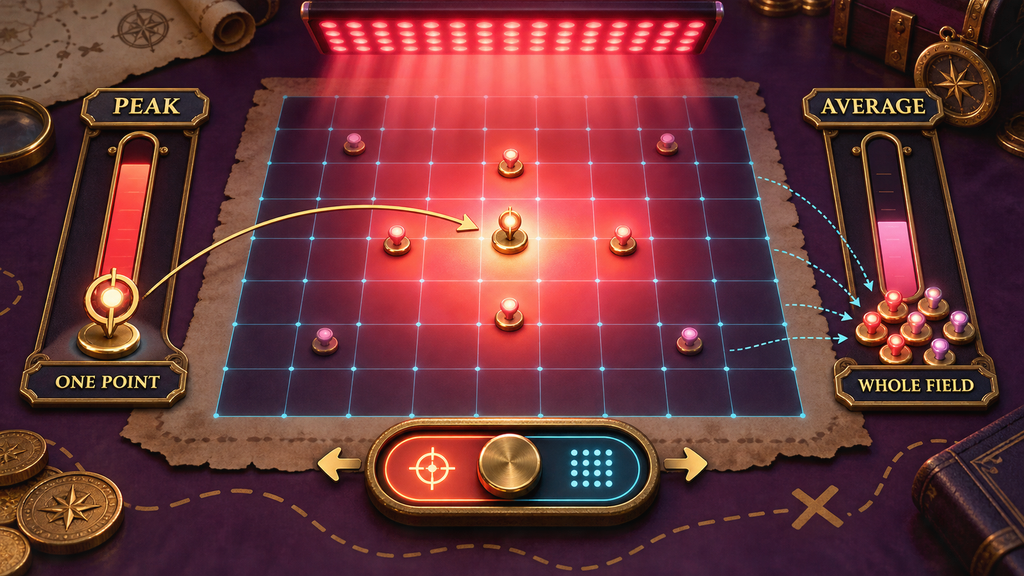
A single center reading is often presented as though it describes the whole panel. It does not. “Peak irradiance” is the highest value found at a point. “Average irradiance” requires multiple samples across a defined treatment area or an instrument that can integrate the field appropriately.
This distinction can explain why a compact panel with focused lenses posts a striking center number but covers less area at that intensity. Coverage and uniformity may be more useful than the peak alone when the goal is to expose a large body region.
A transparent measurement report should identify whether the result is a peak, a spatial average, or a grid of point measurements. If it says only “irradiance: 200 mW/cm²,” important context is missing.
Warm-Up Time and Output Stability
LED output and driver behavior can change as a device warms. The 2011 photomedicine reporting checklist by Jenkins and Carroll notes that beam power can decrease as equipment warms and ages, and recommends checking power routinely during research. A reading taken seconds after switch-on may not match one taken after ten minutes.
For a fair test, record the warm-up period and measure at the same point in each operating cycle. Repeat the measurement rather than relying on one snapshot. Large changes may indicate thermal regulation, power-supply behavior, or a measurement problem worth investigating.
Pulsed Modes Complicate the Displayed Number
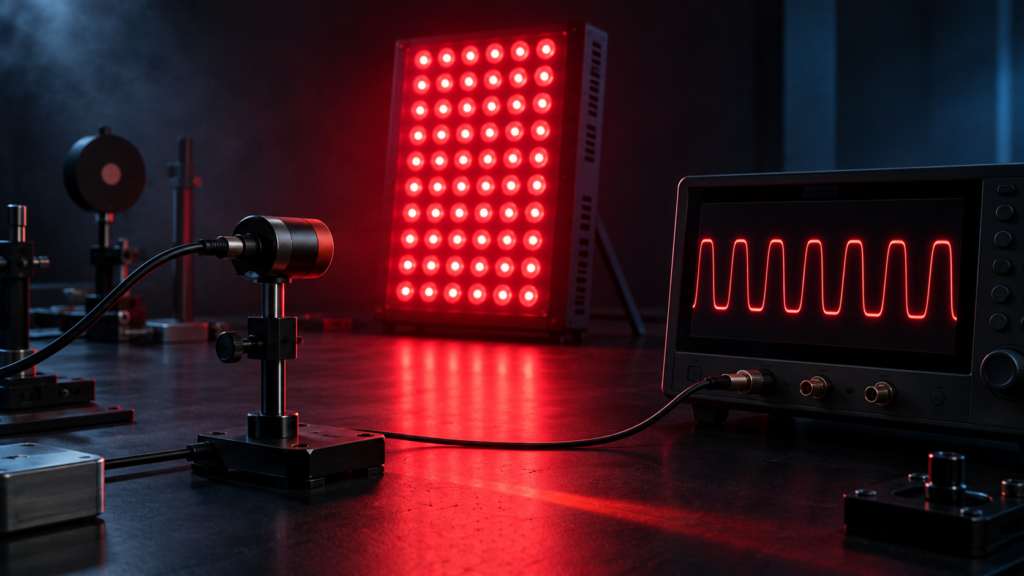
In pulsed operation, the LEDs alternate between on and off states. A meter may display peak power, time-averaged power, or an unstable approximation depending on its sampling rate and internal processing. Duty cycle—the percentage of time the light is on—must be known to interpret the result.
For example, a source that emits 100 mW/cm² during each pulse at a 50% duty cycle has an ideal time-averaged irradiance of 50 mW/cm², assuming the pulse amplitude is stable. Frequency alone does not provide that answer. Pulse width or duty cycle is also required.
Research reporting guidance identifies pulse parameters as one of the essential details needed to reproduce a photobiomodulation protocol.
Why Lux Meters Are the Wrong Tool
Lux measures light weighted to human visual sensitivity. That is useful for room lighting, not for measuring total radiant power from a red and near-infrared therapy panel. Near-infrared light is invisible and contributes essentially nothing to a conventional lux value even though it may represent a substantial portion of the panel’s optical output.
A lux meter cannot be converted reliably to mW/cm² for an unknown multi-wavelength source. Use an appropriately calibrated radiometric instrument with a stated wavelength range instead.
Solar Power Meters: Useful, but Limited
Affordable solar power meters can be useful for relative checks: comparing the same panel at several distances, mapping bright and dim regions, or watching whether output changes over time. Their absolute readings should be treated cautiously when the source spectrum differs from the spectrum used for calibration.
They are most informative when the method stays constant. Use the same meter, orientation, distance, warm-up time, ambient conditions, and measurement points. That can reveal trends even when the absolute value has meaningful uncertainty.
A Better Consumer Measurement Protocol
- Identify the spectrum. Record every enabled wavelength and whether red and near-infrared channels are measured together or separately.
- State the instrument. Record the meter model, sensor type, wavelength range, calibration information, and measurement units.
- Control distance. Measure from the light-emitting face to the sensor surface.
- Control alignment. Keep the detector parallel to the panel and use a fixture when possible.
- Allow a fixed warm-up. Use the same interval before every reading.
- Map a grid. Sample the center, edges, and intermediate points across a clearly defined area.
- Separate peak from average. Label the highest point and calculate the arithmetic mean of the documented grid if appropriate.
- Repeat measurements. Take several readings at each point and report variability rather than selecting the largest number.
- Document pulse settings. Record continuous or pulsed mode, frequency, pulse width, and duty cycle when available.
- Avoid false precision. A consumer meter reading of 73.842 mW/cm² is not necessarily accurate to three decimal places.
How to Read a Manufacturer Irradiance Claim
A useful claim answers five questions: which wavelengths were active, what instrument was used, where the sensor was placed, whether the value is peak or average, and whether the device had reached stable operating temperature. Independent lab documentation is stronger when it explains calibration and uncertainty.
Do not evaluate a device on irradiance alone. Wavelengths, treatment area, beam uniformity, recommended distance, session practicality, construction, safety documentation, and warranty all matter. Our device buyer’s guide explains how those specifications fit together.
What Irradiance Does Not Tell You
An irradiance number describes incident optical power at a surface under stated conditions. It does not prove how much energy reaches a biological target below the skin. Tissue absorption, scattering, wavelength, pigmentation, anatomy, contact, pressure, and geometry all affect light distribution.
It also does not establish that a particular dose is clinically effective. Photobiomodulation studies use different devices, wavelengths, schedules, populations, and outcomes. Matching one reported number while changing the rest of the protocol does not reproduce the study.
Measurement Uncertainty: The Missing Number
Every measurement has uncertainty. That does not make a reading useless; it means the result should be expressed with realistic limits. Uncertainty can come from detector calibration, spectral mismatch, sensor positioning, temperature, electrical noise, display resolution, and variation between repeated readings.
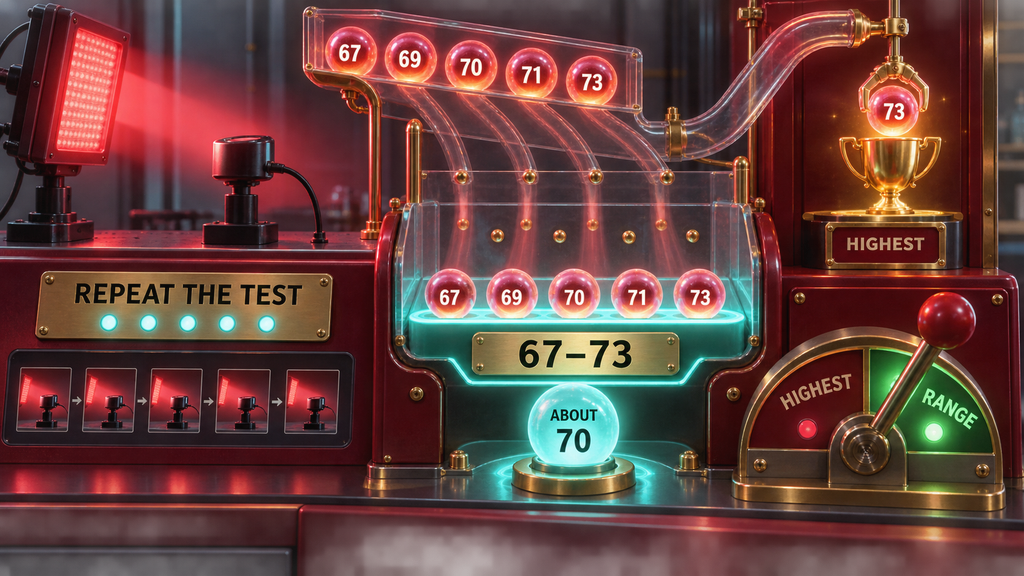
Suppose a meter repeatedly shows values between 67 and 73 mW/cm² at the same marked position. Reporting “about 70 mW/cm² under the stated setup” is more informative than presenting the highest observation as a definitive specification. A laboratory may calculate a formal uncertainty budget. A consumer test can still improve credibility by reporting the range, number of repetitions, and exact procedure.
Uncertainty matters when two devices differ by only a few percent. A displayed difference of 72 versus 75 mW/cm² may be smaller than the combined uncertainty of the meters and setups. It should not automatically be treated as a meaningful performance advantage.
Electrical Wattage Cannot Substitute for Optical Measurement
The number printed on a power supply or measured at a wall outlet describes electrical input, not the optical power reaching the skin. Electricity is also used by LED drivers, displays, control electronics, and cooling fans, while some energy becomes heat. Two panels drawing the same electrical wattage can therefore deliver different optical output.
Adding nominal LED wattage ratings is not a valid irradiance calculation. A “5-watt LED” label often describes a component class or maximum electrical rating rather than normal optical output inside the finished device. Lens design, drive current, thermal management, wavelength, and spacing all influence the treatment field.
Wall-power measurements can help estimate operating cost, but they cannot replace radiometric measurement.
Questions to Ask Before Trusting a Test
- Were all wavelengths and channels enabled and listed?
- Was the instrument calibrated for those wavelengths?
- Was distance measured from the emitting surface to the detector?
- Was the sensor centered, level, and held stationary?
- Was the device allowed to warm for a documented period?
- Is the value a peak, an average, or one selected point?
- Were measurements repeated across a defined grid?
- For pulsed light, is the result peak or time-averaged irradiance?
- Are variability and instrument limitations disclosed?
A test that answers these questions can be compared with another test using the same method. A bare number in a product table cannot.
Conclusion
Red light therapy irradiance measurements disagree because the detector, wavelength response, sampling area, angle, distance, beam pattern, warm-up time, and pulse mode all influence the result. A number without a method is difficult to interpret.
For consumers, a consistent measurement setup is valuable for comparing positions and tracking a device over time. For absolute claims, calibrated equipment and a fully documented procedure are far more trustworthy than a single peak reading. Treat irradiance as one measured property of a device—not a score for its overall quality or a promise of a biological outcome.