Electrical watts and optical watts use the same SI unit, but they describe different parts of a red light therapy device. Electrical power is what the panel draws from the outlet or power supply. Optical power is radiant energy emitted as light per unit time. One cannot be substituted for the other.
This distinction explains why adding the advertised wattage of LED chips does not reveal irradiance, why a “1,500-watt panel” may draw far less from the wall, and why two devices with similar electrical consumption can deliver different light fields.
Power Is a Rate of Energy Transfer
A watt is one joule per second. The unit can describe electrical power entering a device, radiant power leaving as light, heat flow, or mechanical power. The quantity and measurement location determine what the number means.
In radiometry, optical power is called radiant flux. NIST lists radiant flux in watts, irradiance in watts per square meter, and radiant energy in joules. These quantities are related but not interchangeable.
- Electrical input power: electricity consumed per unit time, in watts.
- Radiant flux: total optical power emitted, in watts.
- Irradiance: optical power arriving per unit area, commonly mW/cm².
- Radiant exposure: optical energy delivered per unit area over time, commonly J/cm².
Where Electrical Power Goes
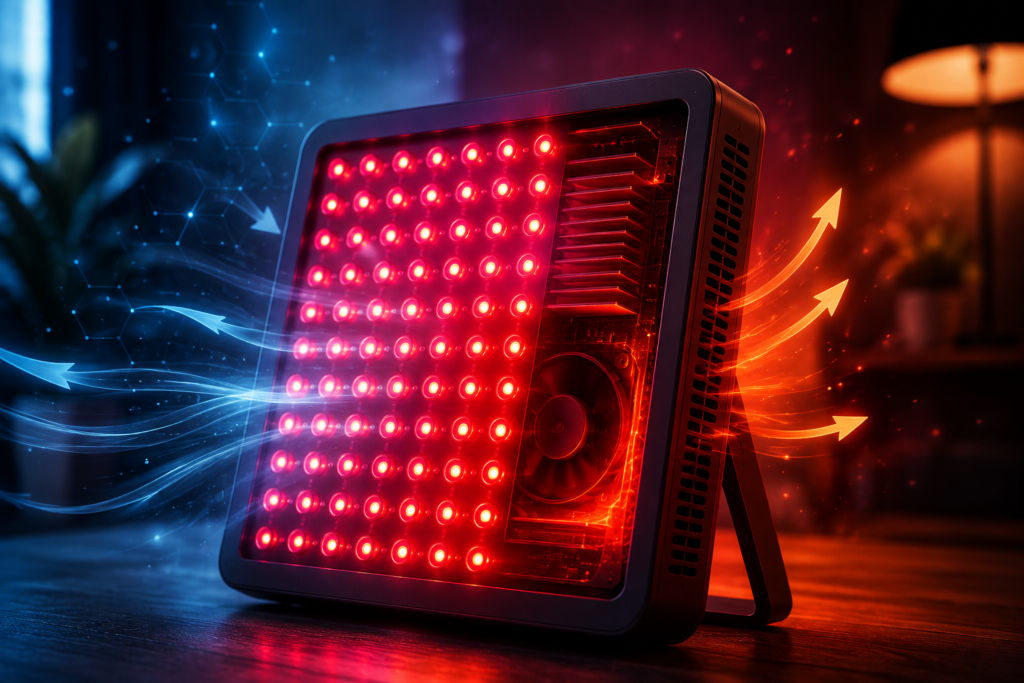
A panel converts electrical energy into several outputs. Some becomes red or near-infrared radiation. Some becomes heat in the LED junctions, drivers, wiring, and power supply. Fans, displays, wireless controls, and microprocessors also consume electricity.
Energy is conserved, but not all input becomes useful forward optical output. Light can also be absorbed inside the enclosure, reflected in unwanted directions, or blocked by lenses and covers. System efficiency therefore depends on more than the LED semiconductor.
The Department of Energy distinguishes source performance from complete-luminaire performance because power supplies, thermal design, optics, and fixture features change overall efficiency. The same principle applies when evaluating a therapy panel, although visible-light lumen metrics are not appropriate for invisible near-infrared output.
What Wall-Plug Efficiency Means
Wall-plug efficiency is the ratio of emitted optical power to electrical input power under stated conditions:
Wall-plug efficiency = optical output power ÷ electrical input power × 100%
If a complete device consumes 300 electrical watts and emits 90 watts of total radiant flux, its system wall-plug efficiency is 30% under that test. That does not mean 90 watts reaches the body. Radiant flux leaves in different directions, and irradiance at the treatment plane depends on geometry, distance, optics, and coverage.
Efficiency also varies with drive current, wavelength, temperature, and component design. A ratio from one LED package cannot be applied automatically to a finished multi-wavelength panel.
Why “5-Watt LEDs” Do Not Add Up to Panel Output
Product listings often multiply the number of LED packages by a component wattage: 300 LEDs × 5 watts becomes a “1,500-watt” panel. That figure commonly reflects a nominal LED class or maximum electrical rating, not measured optical output or actual wall draw.
The finished device may operate each package below its maximum to control temperature, efficiency, and lifetime. Multi-chip packages may divide current among several emitters. Drivers can limit channels differently. Adding catalog ratings produces an installed nominal capacity, not a measurement.
A responsible specification separates LED count and package type from actual input power, total radiant flux, and irradiance at stated distances.
Electrical Input Power: Nameplate Versus Measured Draw
A power-supply label often lists a maximum output rating. The panel may consume less during normal operation. Likewise, a plug-in energy meter reports real electrical draw, which may change with brightness, wavelength channel, pulse mode, fan speed, and warm-up.
For AC devices, a complete electrical test can include real power, apparent power, voltage, current, frequency, and power factor. Multiplying nominal voltage by current can overstate real power when power factor is below one. A consumer energy monitor may provide a useful estimate, but instrument accuracy and load characteristics matter.
Electrical draw is valuable for operating-cost calculations and circuit planning. It is not an optical dose measurement.
Optical Power Is Not the Same as Irradiance
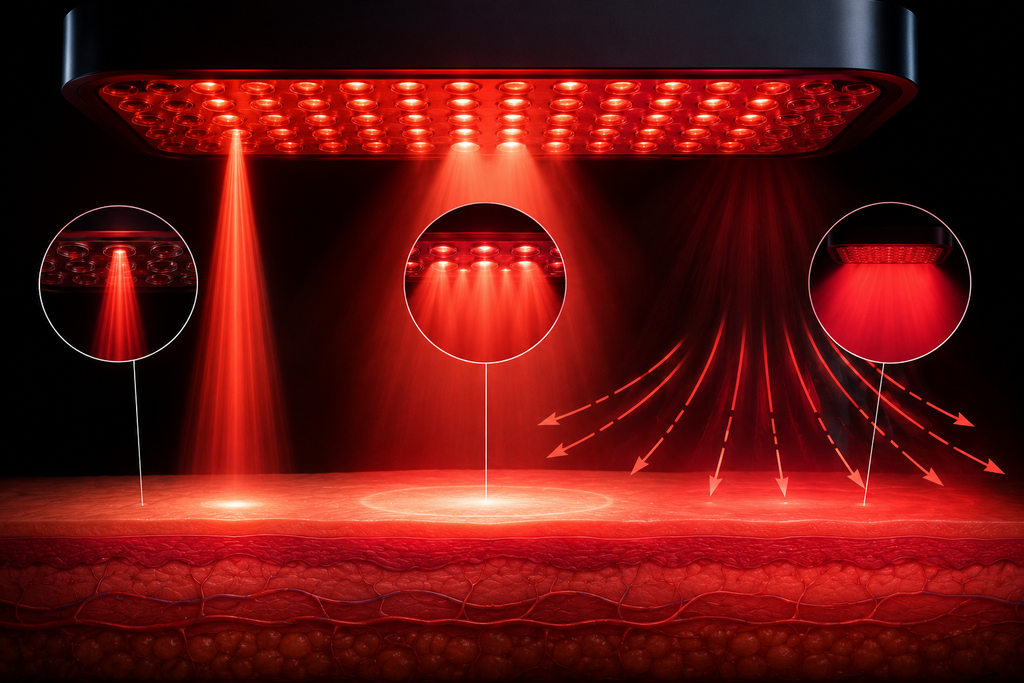
Total radiant flux describes all emitted optical power captured under a defined method. Irradiance describes the portion reaching each unit area at a plane. A 100-watt optical source can produce very different irradiance patterns depending on panel size and lens design.
A small focused device can create a high peak across a tiny area while emitting less total power than a large panel. A broad panel can emit more total power yet show a lower center peak because output is spread over more area.
Our beam-angle guide explains how lens angle, spacing, and distance change the field, while the irradiance measurement guide explains why meter readings vary.
How Total Optical Power Is Measured
An integrating sphere can collect light emitted over a broad range of directions and direct it to a calibrated detector or spectroradiometer. The method can estimate total radiant flux and spectral distribution when the sphere, detector, geometry, and corrections are appropriate.
A flat radiometer placed in front of a panel does not capture total output. It samples irradiance over its detector area and field of view. Multiplying one point reading by an assumed panel area is generally invalid when the field is nonuniform.
CIE 127 describes defined conditions for LED intensity, total and partial flux, and spectral power distribution. Finished panels are more complex than a single LED, but the core lesson remains: optical quantities require specific measurement geometry.
Why Lux and Lumens Are Poor Therapy Metrics
Photometric quantities weight light according to human visual sensitivity. Lumens describe visible luminous flux, and lux describes visible illuminance per area. Near-infrared radiation contributes essentially nothing because the eye does not see it.
A dual red and near-infrared panel can change optical power substantially when the near-infrared channel is switched on while a lux meter changes little or not at all. Radiometric watts and W/m² are the appropriate physical units for combined visible and invisible optical output.
Photometric data can still describe visual brightness or room-light effects. It should not replace radiometry for a therapy device.
Electrical Efficiency Does Not Equal Therapeutic Effectiveness
A panel that converts more electricity into light may use less power for a given optical output and produce less waste heat. That can benefit operating cost and thermal design. It does not prove better biological outcomes.
Effectiveness depends on the actual wavelengths, dose at the target, treatment geometry, schedule, population, outcome, and evidence. A more efficient device could be used at an inappropriate dose; a less efficient one could still deliver a studied protocol. Efficiency is an engineering property.
Why Temperature Changes Performance
LED output and efficiency can change as junction temperature rises. The driver may reduce current to protect the device, producing thermal droop during a session. Spectral peaks can also shift with temperature.
A credible report states warm-up time and measures stability, not only the first seconds after switch-on. The article on LED spectral width explains how temperature and manufacturing tolerance influence the spectrum.
Good heat sinks and airflow can improve consistency, but fan electricity reduces system wall-plug efficiency slightly. That is a reasonable trade-off when it maintains stable output and component life.
Comparing Two Panels Fairly
To compare electrical and optical performance, use the same operating conditions:
- Record input voltage and real electrical power after a fixed warm-up.
- List active wavelengths, brightness levels, and pulse settings.
- Measure total radiant flux with an appropriate calibrated system when available.
- Map irradiance across the same treatment plane and distances.
- Distinguish peak, minimum, and spatial average values.
- Report uncertainty and repeatability.
- Calculate system efficiency only from compatible optical and electrical measurements.
- Repeat across multiple units if making model-wide claims.
A device drawing fewer watts is not necessarily weaker. A device drawing more watts is not necessarily delivering more useful light to the intended area.
Calculating Electricity Cost
Operating cost uses electrical energy, not optical output. Multiply real input power in kilowatts by hours of use and the electricity price per kilowatt-hour.
For example, a panel drawing 300 watts equals 0.3 kilowatts. Used for 20 minutes, or one third of an hour, it consumes about 0.1 kWh. At $0.20 per kWh, that session costs about $0.02 in electricity. Actual rates and measured draw vary.
This calculation says nothing about dose. It is simply a household energy estimate.
Understanding Power-Supply Ratings
A power supply marked 24 V, 10 A can provide up to 240 watts of DC output under its rating. The panel does not necessarily draw the full amount. Conversion losses mean AC input may differ from DC output, and measured real power depends on load.
Do not open a panel or probe live circuits unless qualified to work safely with electrical equipment. Plug-in measurement is safer for consumer energy estimates, while detailed engineering tests belong in a competent laboratory.
Pulse Modes and Average Power
A pulsed panel can report peak optical power during the on-state or time-averaged power across the complete cycle. Duty cycle determines the relationship for an ideal rectangular waveform.
At a 50% duty cycle, a peak irradiance of 100 mW/cm² corresponds to an ideal time-averaged irradiance of 50 mW/cm². Multiplying the peak by the full session time would overstate radiant exposure. The flicker and temporal modulation guide explains frequency, duty cycle, and waveform measurement.
Red Flags in Power Claims
- LED package ratings are labeled as actual panel output.
- Electrical watts are described as irradiance.
- A wall-power meter is used to calculate optical dose.
- One center irradiance value is multiplied by the panel face area.
- Lux readings are used to include near-infrared output.
- Peak pulsed output is reported without average power or duty cycle.
- No active channels, distance, warm-up, or meter are disclosed.
- Efficiency is used as proof of a health benefit.
What a Transparent Specification Sheet Includes
A strong device sheet separates nominal LED package ratings, measured AC input power, DC power-supply rating, total radiant flux, spectral distribution, and irradiance maps. It identifies test conditions and uncertainty.
For consumers, the most actionable optical data are wavelengths, irradiance and uniformity at realistic distances, stability over a session, and clearly described pulse behavior. Electrical draw helps estimate operating cost and circuit load. Neither should be hidden behind one oversized “wattage” number.
How Power Fits Into Device Selection
Power is only one part of a device. Compare treatment area, wavelength evidence, instructions, controls, mounting, cooling, noise, warranty, safety documentation, and company transparency. Our device buyer’s guide provides a broader checklist.
Choose the device that can deliver a documented, practical exposure across the intended area—not the model with the largest wattage in its name.
Total Radiant Flux Versus Forward Output
Total radiant flux can include light emitted in directions that never reach the treatment plane. A panel’s enclosure, reflectors, lenses, protective window, and LED orientation determine how much optical power travels forward. For user-facing comparisons, both total flux and a spatial irradiance map are valuable: total flux describes conversion and source output, while the map shows where that power arrives. “Usable optical power” should not be reported without defining the angular region, plane, distance, and threshold that count as usable. Otherwise, it becomes another marketing phrase rather than a reproducible radiometric quantity.
Conclusion
Electrical power is what a red light therapy panel consumes. Optical power is radiant flux emitted as light. Irradiance is optical power arriving per unit area, and radiant exposure adds time. Although each can involve watts, they answer different questions.
Do not add nominal LED wattages to estimate panel output, use wall draw as dose, or treat a center reading as total optical power. Look for separately measured electrical input, total radiant flux, spectral output, and irradiance maps with documented settings and uncertainty. That information supports meaningful engineering comparisons without turning a power specification into a medical claim.