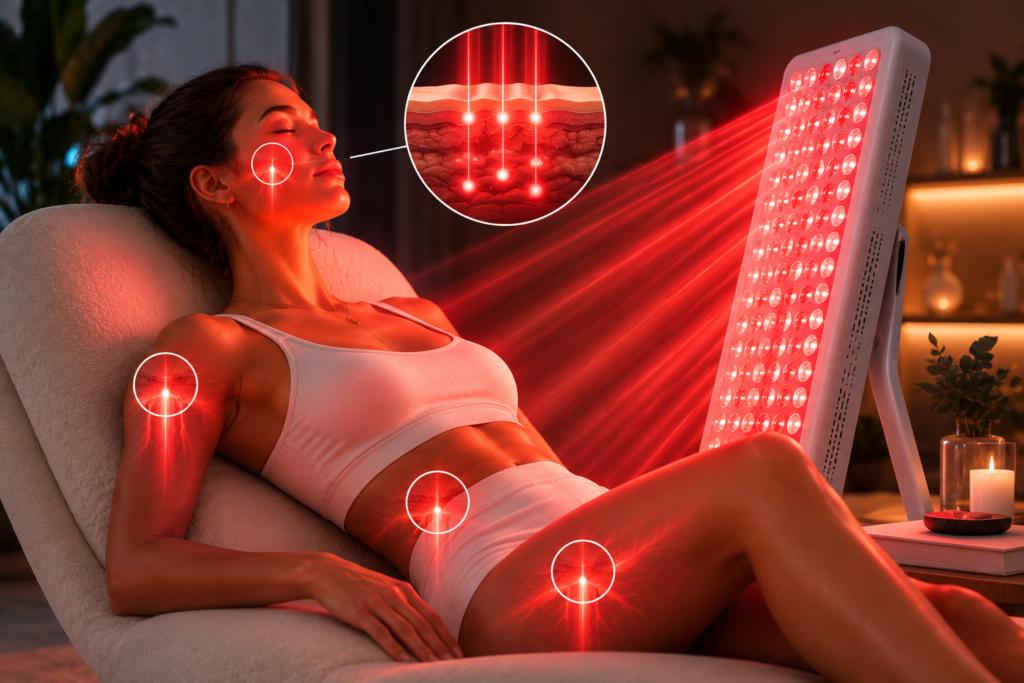

660nm vs 850nm Red Light Therapy: Key Takeaway
The main difference between 660nm and 850nm red light therapy is how each wavelength interacts with tissue. The visible 660nm wavelength is commonly used in skin-focused photobiomodulation research, including studies involving wrinkles, fibroblast activity and surface-level tissue repair. The invisible 850nm wavelength is frequently included in research involving muscles, joints, exercise recovery and other targets located farther beneath the skin.
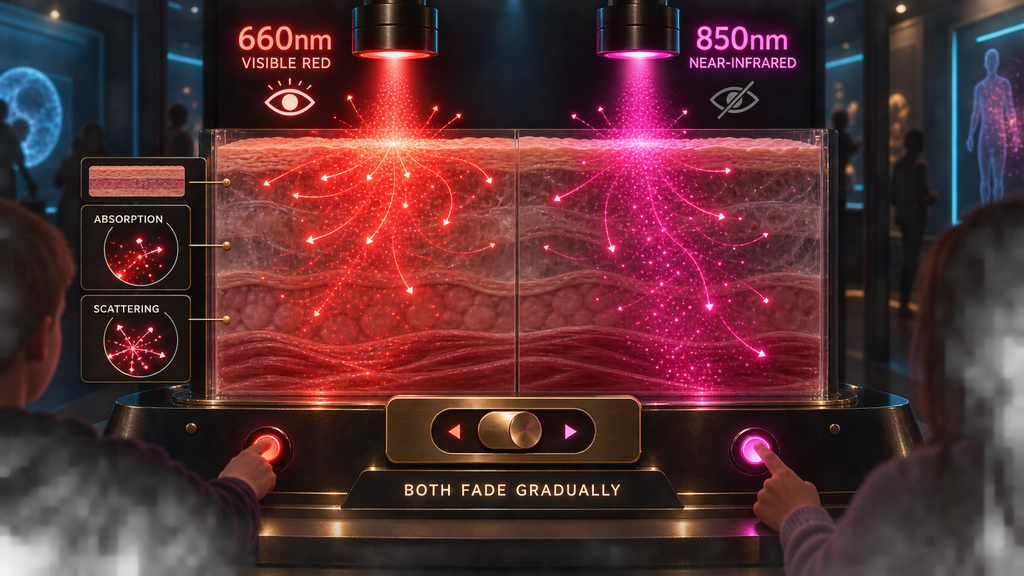
This does not mean 660nm only affects the skin or that 850nm reaches one guaranteed depth. Both wavelengths enter at the surface and gradually weaken through absorption and scattering. The amount of light reaching a target depends on skin and tissue composition, anatomy, pigmentation, treatment distance, irradiance, beam angle and the device’s design.
- For facial skin and other surface-oriented goals: 660nm is a relevant starting point because visible red wavelengths appear frequently in skin research.
- For muscles, joints and deeper anatomical targets: 850nm may provide a more favorable tissue distribution, but wavelength alone does not prove that an effective dose reaches the target.
- For a general-purpose device: using 660nm and 850nm together can be practical when the product provides clear output measurements and instructions for the combined mode.
Neither wavelength is automatically stronger or universally better. A useful comparison must also consider irradiance, radiant exposure, treatment area, uniformity, distance and the research behind the intended application. Consumers should look for wavelength-specific output data rather than choosing a device solely because it lists 660nm, 850nm or a larger number of wavelengths.
A red light therapy device lists 660nm. Another lists 850nm. A third includes both and promises the best of everything. At that point, choosing a device can start to feel like comparing two nearly identical paint colors without being allowed to see either swatch.
The numbers represent a meaningful difference, but the usual explanation is oversimplified. Red light is often described as “surface level,” while near-infrared light supposedly travels straight to the muscles and joints. Human tissue is more complicated than that.
Understanding 660nm vs 850nm red light therapy requires looking at visibility, absorption, scattering, tissue depth and the actual optical output of the device. Wavelength matters, but it is only one part of a complete treatment protocol.
What Do 660nm and 850nm Mean?
The abbreviation “nm” stands for nanometers, a unit used to describe wavelength.
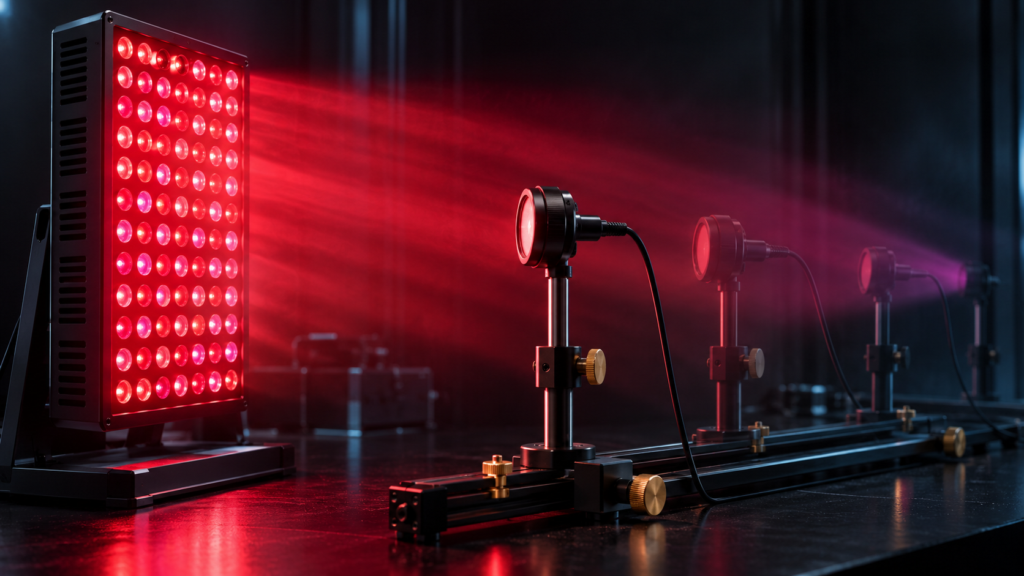
A wavelength of 660nm falls within the visible red portion of the electromagnetic spectrum. It produces the bright red glow commonly associated with red light therapy panels and masks.
A wavelength of 850nm falls within the near-infrared region. Human eyes normally cannot see it, although some 850nm LEDs may produce a faint visible glow because of nearby emissions or the way the LED is constructed.
Both are forms of non-ionizing optical radiation. Neither is ultraviolet light.
The wavelength number does not tell anyone how powerful a device is. It also does not reveal the dose, beam angle, treatment area or number of LEDs. A 660nm device can produce more or less irradiance than an 850nm device depending on how each product is designed.
The number is also normally a nominal or peak wavelength. An LED labeled 660nm emits a narrow band of nearby wavelengths rather than one mathematically exact wavelength.
Difference 1: 660nm Is Visible and 850nm Is Not
The most obvious difference is visibility.
Human eyes are sensitive to 660nm red light, so those LEDs appear bright. An 850nm LED can be operating normally without looking illuminated because its output sits beyond normal visible sensitivity.
This creates an easy consumer mistake. The visible red channel may look much stronger even when a meter shows substantial near-infrared output. Visual brightness cannot be used to compare the radiometric power of the two channels.
Some phone cameras can detect near-infrared light because their sensors respond beyond the visible spectrum. Pointing a camera at the panel may reveal a pale or purple glow from an 850nm LED. That can suggest that the LED is active, but it cannot confirm that the wavelength is exactly 850nm or measure its therapeutic output.
A spectrometer is required to characterize wavelength accurately. A suitable radiometric instrument is needed to measure optical power or irradiance.
Difference 2: The Wavelengths Interact With Tissue Differently
Light entering the body can be reflected, absorbed or scattered. The proportions depend on the wavelength and the tissue involved.
Skin is not one uniform material. It contains water, blood, melanin, collagen, fat and other components that interact with light differently. Research on the optical properties of skin shows that absorption and scattering change across visible and near-infrared wavelengths.
Near-infrared wavelengths can experience a different balance of absorption and scattering than visible red light. This can allow 850nm light to produce a different distribution through tissue, but it does not mean every emitted photon reaches a muscle or joint.
When comparing 660nm vs 850nm red light therapy, it is more accurate to say the wavelengths create different tissue distributions than to place each one inside a rigid treatment category.
Red light is not restricted to the skin. Near-infrared light does not bypass the skin. Both begin at the surface and progressively weaken as they travel through tissue.
Difference 3: 850nm Does Not Have One Guaranteed Penetration Depth
Some product descriptions assign exact depths to individual wavelengths. These measurements are often presented without explaining the tissue, device, testing method or threshold used to decide when light no longer “counts.”
Light does not travel to one precise depth and stop. Its intensity decreases gradually through absorption and scattering.
The resulting distribution can be affected by:
- Skin pigmentation
- Blood content
- Tissue thickness
- Fat and muscle depth
- Anatomical location
- Irradiance at the surface
- Beam angle
- Treatment distance
- Contact and pressure
- The threshold used to define penetration
A small amount of light may be detectable deeper in tissue without delivering the same energy available near the surface. Detectable light and a biologically useful dose are not automatically the same thing.
This is why the penetration question in 660nm vs 850nm red light therapy cannot be answered with one universal measurement in millimeters or centimeters. A wavelength can have a tendency toward a different tissue distribution without guaranteeing a specific dose at a specific target.
Difference 4: 660nm Is Common in Skin-Focused Research
Visible red wavelengths appear frequently in photobiomodulation research involving skin.
Researchers have evaluated red light for wrinkles, wound repair, fibroblast activity and processes associated with collagen and extracellular-matrix remodeling. A controlled clinical study, for example, evaluated a 660nm LED device for wrinkles.
This does not mean every 660nm product produces the same outcome. The study’s irradiance, radiant exposure, treatment schedule, distance and device geometry are part of the protocol. A face mask and a large panel can both contain 660nm LEDs while delivering light in very different ways.
Laboratory research also indicates that cellular responses can vary across defined wavelengths. Researchers studying skin fibroblasts observed wavelength-dependent changes in mitochondrial membrane potential and redox balance.
For someone comparing 660nm vs 850nm red light therapy for a primarily cosmetic skin goal, 660nm provides a logical starting point because visible red wavelengths appear in relevant research. It should still be evaluated as part of a complete device rather than treated as a guaranteed anti-aging setting.
Difference 5: 850nm Is Frequently Used for Deeper Targets
Near-infrared wavelengths appear frequently in studies involving skeletal muscle, physical performance, exercise recovery, joints and neurological applications.
A review of randomized trials examined whether pre-exercise photobiomodulation could affect muscle endurance and recovery. Studies in this area often use near-infrared light or combinations of red and near-infrared wavelengths.
That evidence does not prove that every consumer 850nm panel will improve muscle recovery. Research devices may use different irradiance levels, treatment areas, application techniques and session timing. Some studies also combine LEDs with lasers or use several wavelengths together.
The phrase “850nm reaches deeper” is therefore a starting explanation, not a complete effectiveness claim.
For 660nm vs 850nm red light therapy involving muscles or joints, the relevant questions include how much light reaches the surface, how large the treatment area is, how far the target sits beneath the skin and whether the device resembles the studied protocol.
Difference 6: Equal Settings Do Not Mean Equal Output
A panel may allow the red and near-infrared channels to be controlled separately. Setting both channels to 50 percent does not necessarily mean the skin receives equal optical output from each wavelength.
The displayed percentage may describe an electrical control level rather than measured irradiance. Output can differ because of:
- The number of LEDs assigned to each wavelength
- LED efficiency
- Electrical drive current
- Lens design
- LED placement
- Beam overlap
- Treatment distance
- The meter’s spectral response
The human eye makes this comparison even harder because 660nm looks bright while 850nm is invisible.
A manufacturer may publish one combined irradiance number with both channels active. That number does not reveal how much output came from each wavelength. Separate measurements provide more useful information when a device allows the channels to operate independently.
A credible 660nm vs 850nm red light therapy comparison therefore needs more than two wavelength labels and two app sliders.

Difference 7: The Same Session Time Does Not Guarantee the Same Dose
Radiant exposure is commonly estimated by multiplying irradiance by exposure time:
Radiant exposure = irradiance × time
If the irradiance reaching the skin is 20 mW/cm², a ten-minute exposure produces a different estimated surface dose than ten minutes at 80 mW/cm².
That means “use 660nm for ten minutes” and “use 850nm for ten minutes” do not necessarily describe equal doses. The output of each channel must be known.
Treatment distance also matters. Moving closer to a panel can increase irradiance while reducing uniformity. Moving farther away can lower irradiance while allowing neighboring LED beams to overlap more evenly.
Wavelength cannot replace these measurements. A near-infrared setting is not automatically more intense because it may reach a different tissue distribution.
660nm vs 850nm Red Light Therapy by Goal
The following table is a starting framework, not a universal treatment prescription.
| Consumer goal | More relevant starting point | What still needs to be checked |
|---|---|---|
| Facial skin appearance | 660nm or another studied red wavelength | Dose, fit, coverage and protocol |
| Superficial skin applications | 660nm | Irradiance and treatment schedule |
| Muscle recovery | 850nm or a studied red/NIR combination | Target depth and delivered dose |
| Joint-focused use | 850nm or a studied combination | Anatomy, positioning and protocol |
| General-purpose panel | A combination may be practical | Separate channel output and controls |
| Hair and scalp | Follow the studied device protocol | Hair interference, geometry and dose |
| Whole-body wellness | No universal winner | Evidence for the specific claimed outcome |
The table does not mean 660nm works exclusively on skin or 850nm works exclusively below it. It reflects how these wavelength ranges are commonly used and studied.
The best starting choice depends on the intended target. The final decision should also consider the device’s treatment area, optical output, controls and instructions.
Should 660nm and 850nm Be Used Together?
Many consumer panels operate both wavelengths simultaneously. That can be practical when someone wants visible red and near-infrared exposure during the same session.
Combined-wavelength protocols also appear in clinical research. One randomized, double-blind trial studied simultaneous red and infrared LEDs for temporomandibular pain.
However, that does not prove that combining wavelengths always improves results. It shows that combined delivery is a legitimate protocol that can be studied.
When considering both wavelengths, check:
- Whether the channels can be activated separately
- Whether the manufacturer reports output for each channel
- Whether the session instructions change when both are active
- How the LEDs are distributed across the treatment area
- Whether the cited research used the same wavelengths together
- Whether the cited dose resembles the device’s output
The practical answer to 660nm vs 850nm red light therapy is often not “choose one forever.” A well-documented device may allow both to be used together or selected according to the intended application.
Is a Device With More Wavelengths Automatically Better?
No. Wavelength count is not a quality score.
A device with five or nine wavelengths may offer greater flexibility, but only if the output is useful, measurable and supported by clear instructions. Adding more wavelengths does not compensate for poor coverage, weak documentation or misleading irradiance claims.
A simpler device with well-characterized output may be easier to evaluate than a complicated panel that combines every wavelength into one unexplained number.
Compare:
- Relevant wavelengths
- Irradiance at the recommended distance
- Treatment-area uniformity
- Separate channel controls
- Session instructions
- Measurement method
- Safety documentation
- Warranty and support
The important question is not how many wavelength numbers appear on the product page. It is whether those wavelengths are delivered under conditions that make sense for the intended use.
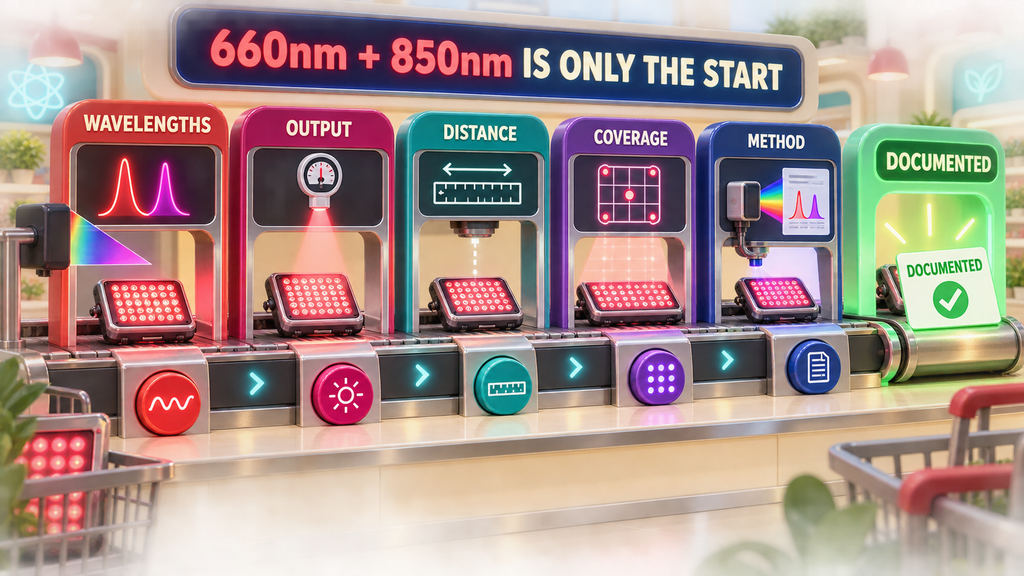
How to Compare 660nm and 850nm Product Claims
Before buying a device based on 660nm vs 850nm red light therapy, ask:
- How many LEDs produce each wavelength?
- Can the red and near-infrared channels be controlled separately?
- Is irradiance reported separately or only with both channels active?
- At what distance was the output measured?
- Is the published number a peak or a spatial average?
- What treatment area receives the stated irradiance?
- Were the wavelengths measured with a spectrometer?
- Does the cited research use the same wavelength and a comparable dose?
- Do the instructions explain which mode to use for each application?
- Does activating both channels change the recommended session?
A product page that only lists “660nm + 850nm” has identified two components. It has not described the complete optical performance of the device.
Common Comparison Mistakes
Assuming 850nm is automatically more powerful
Wavelength and power are separate specifications. An 850nm device can deliver more, less or similar irradiance compared with a 660nm device.
Using brightness to judge output
The eye is highly sensitive to visible red light and effectively blind to 850nm. Visual brightness cannot compare the two channels.
Assigning each wavelength an exact depth
Penetration depends on tissue, anatomy, device output and how the measurement threshold is defined.
Copying another device’s protocol
Two products with the same wavelengths may deliver different irradiance, coverage and radiant exposure.
Assuming more wavelengths mean better results
Additional wavelengths may provide flexibility, but only when their output and intended use are documented.
Treating wavelength as the entire protocol
A successful study includes a device, wavelength, irradiance, dose, schedule, treatment location and participant population. Matching only the wavelength does not reproduce the study.
Frequently Asked Questions
Is 850nm stronger than 660nm?
Not inherently. “Stronger” requires a defined measurement such as radiant power or irradiance. Wavelength describes the light’s spectral position, not how much optical energy the device produces.
Which is better in 660nm vs 850nm red light therapy?
Neither is universally better. A 660nm wavelength is common in skin-focused research, while 850nm is commonly used when deeper anatomical targets are involved. The correct choice depends on the application and the complete device protocol.
Is 660nm better for collagen?
Red wavelengths, including 660nm, appear in research involving fibroblasts, skin remodeling and wrinkles. Results from a particular protocol should not be applied automatically to every 660nm device.
Is 850nm better for muscles and joints?
Near-infrared light can produce a different tissue distribution and appears frequently in muscle and joint research. Effectiveness still depends on dose, anatomy, treatment area and application method.
Can 660nm and 850nm be used simultaneously?
Yes, if the device is designed for simultaneous operation and its instructions support that mode. Combined use does not automatically mean twice the benefit.
Why can’t I see the 850nm LEDs?
The output sits outside normal human visible sensitivity. An LED can be operating correctly without appearing bright.
Can a phone camera verify 850nm?
No. A camera may detect some near-infrared light, but it cannot confirm the exact wavelength, irradiance or dose.
Is 810nm or 830nm better than 850nm?
There is no universal ranking. Each wavelength has its own research history and optical characteristics. The studied dose and application matter more than a small numerical difference by itself.
The Practical Takeaway
The most useful way to understand 660nm vs 850nm red light therapy is to stop looking for one universal winner.
Visible 660nm red light is common in skin-focused research. Invisible 850nm near-infrared light can create a different distribution through tissue and is frequently included in protocols involving muscles, joints and other deeper targets. Those patterns are useful, but they are not rigid rules.
Wavelength alone cannot establish power, penetration depth or effectiveness. Irradiance, treatment distance, coverage, radiant exposure, anatomy and the research protocol all matter.
For a general-purpose device, access to both wavelengths can be practical. The stronger buying decision comes from choosing a product that explains how much of each wavelength it delivers, where it delivers it and how the settings should be used.