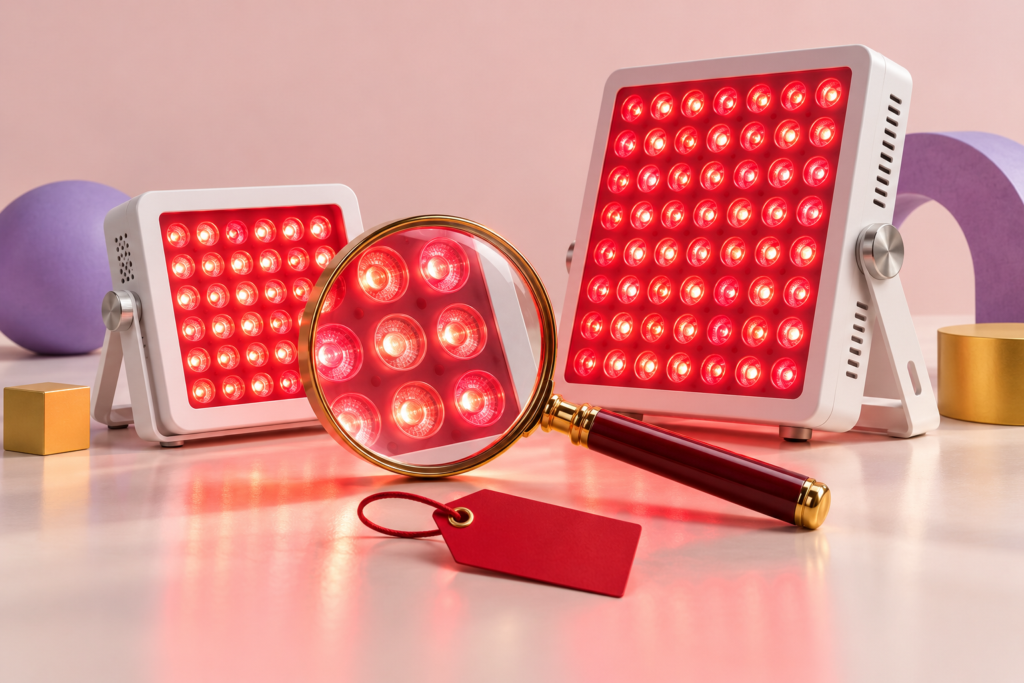

You are scrolling late at night with one hand on your belly and the other on your phone. A friend swears by her red light panel. A clinic lists it for skin. Your prenatal app says nothing useful. So you type the question everyone eventually asks.
Can you use red light therapy while pregnant?
The honest answer is that we do not have enough research to say. Pregnant people are almost always excluded from red light therapy trials, so there is very little direct data on safety during pregnancy. This article explains what the existing literature does say, why the gap exists, what is being studied after birth, and why your OB or midwife should be part of the decision.

The short answer on red light therapy while pregnant
There is no good evidence that red light therapy while pregnant is safe, and there is also no good evidence that it is harmful. That is not the same as “safe.” It simply means the question has not been studied well.
Because of that uncertainty, the cautious approach is to avoid using red light therapy during pregnancy unless your OB or midwife has reviewed your situation and agrees it is appropriate. If you already use a device, it is worth asking about it at your next prenatal visit.
What contraindication reviews say about pregnancy
A contraindication is a situation where a treatment should not be used, or should be used only with extra care. A 2002 review in the Journal of Clinical Laser Medicine and Surgery (Navratil and Kymplova) sorted the contraindications commonly listed for noninvasive laser therapy into three groups: those the authors considered correct, those doubtful under certain conditions, and those they considered incorrect.
Exposure of the abdomen during pregnancy was placed in the “correct” group, alongside a history of a histologically demonstrated malignant carcinoma, irradiation of the neck region in hyperthyroidism, epilepsy, and exposure of the retina. Treating near the gonads was listed among the contraindications that are doubtful under certain conditions, along with fever and infectious diseases, certain blood diseases, heavy blood losses, and neuropathies.
A few points are worth keeping in mind about this review:
- It is an expert opinion review, not a clinical trial in pregnant people.
- It focused on low-level laser therapy, not modern LED panels, although both deliver red and near-infrared light.
- It is more than 20 years old, and it remains one of the references most often cited on this question, which shows how little newer research exists.
Even so, it is a useful signal. The abdomen during pregnancy has long been treated as an area to avoid when people ask about red light therapy while pregnant.
Why trials exclude pregnant people
Excluding pregnant participants is standard practice for many devices and treatments, not just red light therapy. Researchers and ethics boards are careful about anything that could possibly affect a developing baby, especially when the treatment is not medically necessary.
The result is a data gap. When you read that red light therapy has a “favorable safety profile,” that finding comes from studies that did not include pregnant people, so it cannot simply be extended to pregnancy. If you want to understand how study populations shape conclusions, see our guide on how to read red light therapy studies and our overview of photobiomodulation research.
That gap is the main reason articles like this stay cautious about red light therapy while pregnant.
Which areas should you avoid?
Based on the contraindication literature, the abdomen and pelvic area are the main areas flagged for avoidance during pregnancy. Some people ask whether treating distant areas, such as the face or a knee, is different.
There is no research that answers that question in pregnancy. Areas far from the abdomen may seem lower concern, but “seems lower concern” is not evidence of safety. This is exactly the kind of decision to bring to your OB or midwife, who knows your health history and pregnancy.
Other general precautions still apply, including eye protection and following your device’s guidance on irradiance and dosage. Our broader guides on who should avoid red light therapy and when to consult a doctor cover those basics.
What postpartum research looks like
Interest is growing in light therapy after birth, especially for healing and comfort. One example is a 2026 published protocol in Lasers in Medical Science (Rodrigues et al.) for a randomized, double-blind, sham-controlled trial. It plans to test a single session of 808 nm infrared laser light in women within 12 hours after vaginal delivery who have first- or second-degree perineal trauma or vulvar swelling with pain. The researchers will measure pain, swelling, maternal functioning, satisfaction, urinary incontinence, and sexual function at several points up to three months postpartum.
It is important to read this correctly. A protocol describes a study that is planned or underway. It does not report results yet. The authors expect benefits, but expectations are not findings. The trial also uses a clinical laser applied by researchers, which is different from using a home panel on your own.
If you are interested in light therapy after your baby arrives, ask your OB or midwife when and whether it makes sense, especially if you had stitches, a cesarean birth, or are breastfeeding and plan to treat the chest area. Postpartum interest is real. It still is not a green light for red light therapy while pregnant.
Why you should ask your OB or midwife
Your care team can weigh things a general article cannot: your medical history, any pregnancy complications, medications that may increase light sensitivity, and skin changes common in pregnancy such as melasma. They can also help you decide whether a device is worth using at all right now, or whether it is better to wait until after delivery.
For a broader list of situations where medical advice matters, see when to consult a doctor about red light therapy. When you ask about red light therapy while pregnant, it helps to bring the device’s name, its wavelengths, the area you want to treat, and how long each session lasts.

Frequently asked questions
Is red light therapy safe during pregnancy?
No one can say it is safe, because pregnant people have been excluded from trials. Contraindication reviews advise against treating the abdomen during pregnancy. Talk to your OB or midwife before using any device. That is the clearest answer we can give on red light therapy while pregnant.
Can I use a red light face mask while pregnant?
There is no research on face masks in pregnancy. The face is far from the abdomen, but that does not prove safety. Ask your OB or midwife, and remember that pregnancy-related skin changes like melasma can react to light and heat. Distance from the belly does not settle the question of red light therapy while pregnant.
Is infrared light different from red light in pregnancy?
Near-infrared light reaches deeper into tissue than visible red light. Neither has been studied for safety in pregnancy, so the same caution applies to both when you are considering red light therapy while pregnant.
Can I use red light therapy postpartum?
Postpartum use is being studied, including a planned trial for perineal pain after vaginal delivery. Results are not yet available. Check with your care team before starting, especially while you are healing. Postpartum is a different chapter from red light therapy while pregnant.
I used red light therapy before I knew I was pregnant. What should I do?
Try not to panic, and mention it to your OB or midwife at your next visit, so they have the full picture. One past session does not rewrite the evidence gap around red light therapy while pregnant, but your care team should know.
The bottom line
Can you use red light therapy while pregnant? The evidence is too thin to give a confident yes. Expert reviews flag the abdomen during pregnancy as an area to avoid, and pregnancy safety has not been tested in trials.
The safest path is to pause or skip red light therapy during pregnancy unless your OB or midwife says otherwise, and to revisit it after delivery with their guidance. If you are planning ahead for later, our guide on how to choose a red light therapy device can help when the time is right.
This article is for general information only and is not medical advice. Always talk with your OB, midwife, or doctor about any treatment during pregnancy or after birth.